The Panchatantra (पञ्चतन्त्र, “Five Treatises”) is the most translated literary work to emerge from India and one of the most influential collections of stories in all of world literature. Attributed to the legendary sage Viṣṇu Śarmā, this Sanskrit masterpiece weaves together animal fables, verse aphorisms, and nested narratives into an intricate tapestry of practical wisdom — teaching statecraft, diplomacy, friendship, betrayal, and the art of intelligent living. From its origins in ancient India, the Panchatantra has travelled across every continent, been translated into more than fifty languages, and given rise to over two hundred distinct versions, making it, in the words of the German Indologist Johannes Hertel, “the most widely diffused work of Indian literature.”
Origins and Dating
The question of when the Panchatantra was composed remains a matter of scholarly debate. The text itself names Viṣṇu Śarmā as its author — a Brahmin scholar who, according to the frame story, composed the work to educate three ignorant princes in the principles of nīti (wise conduct and statecraft). Many scholars regard Viṣṇu Śarmā as a literary persona rather than a historical figure; some recensions attribute the work to Vāsubhāga instead.
The original Sanskrit text is generally dated to between 300 BCE and 300 CE, though the individual fables it contains are almost certainly older, drawing on a rich oral tradition of storytelling that may stretch back to the Vedic period. The earliest firm external evidence comes from a Middle Persian translation (Kalīlag ud Dimnag) commissioned around 570 CE by the Sassanid physician Borzūya, who reportedly travelled to India specifically to obtain the text. This translation confirms that the Panchatantra existed in a well-formed state by the sixth century at the latest.
The two most important surviving Sanskrit recensions are the Tantrākhyāyikā (likely closer to the original) and the later, more polished Pūrṇabhadra recension (c. 1199 CE), which expanded and embellished the text significantly. The celebrated Sanskrit scholar Arthur W. Ryder produced an influential English translation in 1925 that introduced the work to a broad Western readership, and more recently Patrick Olivelle provided a scholarly translation for the Clay Sanskrit Library.
The Frame Story: Teaching Princes Through Tales
The Panchatantra’s overarching narrative provides an elegant pedagogical frame. King Amaraśakti of Mahilāropya in southern India is dismayed that his three sons — Bahuśakti, Ugraśakti, and Matiśakti — are thoroughly ignorant of the principles needed to govern wisely. Having failed with conventional teachers, the king turns to the aged Brahmin scholar Viṣṇu Śarmā, who makes a remarkable promise: he will teach the princes the complete science of nīti within six months using nothing but entertaining stories.
This frame establishes a principle central to Indian pedagogy: kathā (narrative) is the most powerful vehicle for transmitting complex wisdom. Viṣṇu Śarmā does not lecture; he enchants. Each story contains within it further stories, creating an architecture of nested narratives — stories within stories within stories — that mirrors the layered complexity of real-world decision-making. The reader, like the princes, learns not through abstract axioms but through concrete dramatic situations that demand reflection and judgment.
The Five Books (Pañca Tantrāṇi)
Book I: Mitra Bheda (मित्रभेद) — The Separation of Friends
The longest and most elaborate book tells the story of a bull named Saṃjīvaka who becomes the trusted friend and advisor of the lion king Piṅgalaka. Two jackals, Karataka and Damanaka — the Indian equivalents of the Arabic Kalīla and Dimna — scheme to break this friendship apart. Damanaka, ambitious and Machiavellian, manipulates both the lion and the bull through carefully crafted lies and half-truths until they turn against each other with fatal consequences.
This book is a masterclass in political intrigue. Through approximately thirty embedded sub-stories, it examines how trust can be destroyed by cunning intermediaries, how fear and suspicion poison even the strongest bonds, and how the ambitious courtier exploits the insecurities of the powerful. Famous sub-tales include The Monkey and the Wedge, The Jackal and the War Drum, and The Weaver’s Unfaithful Wife.
Key verse (I.63): अनागतविधानं च कर्तव्यं शुभमिच्छता — “One who desires well-being must plan for the future before calamity arrives.”
Book II: Mitra Lābha (मित्रलाभ) — The Winning of Friends
In deliberate contrast to the first book, Mitra Lābha celebrates the power of friendship and cooperation. Four unlikely companions — a crow (Laghupatanaka), a mouse (Hiraṇyaka), a turtle (Mantharaka), and a deer (Citrāṅga) — form an alliance of mutual protection. When the deer is caught in a hunter’s net, the others combine their unique abilities to free him. When the turtle is subsequently captured, they devise yet another rescue.
The moral is clear: true friendship transcends differences of birth, nature, and station. Where Book I shows how friendship is destroyed by treachery, Book II shows how it is built through trust, loyalty, and selfless action. The embedded tales reinforce themes of solidarity and the wisdom of choosing one’s companions carefully.
Book III: Kākolūkīyam (काकोलूकीयम्) — On Crows and Owls
This book is the Panchatantra’s treatise on war and strategic deception. An ancient enmity exists between the crows and the owls. The owl king launches devastating night raids on the crow colony. In desperation, the crow minister Sthirabuddhi (“Steady-Mind”) devises an audacious plan: he will allow himself to be publicly humiliated and cast out by the crow king, then present himself to the owls as a defector. Taken in by the owls, he gradually learns the location of their fortress and ultimately guides the crows to a decisive victory.
The stories in this book draw heavily on the Arthaśāstra tradition, echoing Kauṭilya’s treatise on statecraft. Themes include espionage, the six methods of foreign policy (ṣāḍguṇya), the danger of trusting enemies, and the importance of strategic intelligence. It is arguably the most politically sophisticated of the five books.
Key verse (III.17): शत्रोरपि गुणा वाच्याः दोषा वाच्या गुरोरपि — “Even an enemy’s virtues should be acknowledged; even a teacher’s faults should be noted.”
Book IV: Labdhapraṇāśam (लब्धप्रणाशम्) — Loss of What Was Gained
The shortest of the five books focuses on how carelessness, greed, and foolishness cause the loss of hard-won advantages. The frame story follows a monkey and a crocodile — one of the Panchatantra’s most beloved tales. The monkey befriends a crocodile who lives in the river below his tree. But the crocodile’s wife, craving the monkey’s heart (believing it must be sweet since the monkey eats sweet fruits), persuades her husband to lure the monkey onto his back under the pretext of a visit. Midway across the river, the crocodile reveals his intention. The monkey, thinking quickly, claims he left his heart hanging in the tree and must go back to fetch it — and thus escapes.
This tale, known across Asia and beyond, illustrates that presence of mind (yukti) can overcome even mortal danger, and that greed invariably destroys the very thing it seeks to possess.
Book V: Aparīkṣitakārakam (अपरीक्षितकारकम्) — Hasty Action
The final book warns against acting without proper investigation. Its central tale is the story of a Brahmin who leaves his loyal pet mongoose to guard his infant son. When a cobra enters the room, the mongoose kills the snake to protect the child. But when the Brahmin returns and sees blood on the mongoose’s mouth, he assumes the worst and kills the faithful animal — only to discover the dead cobra and realize his catastrophic error.
This devastating tale — which exists in variants across cultures (as “Llewellyn and Gelert” in Welsh legend, for instance) — drives home the book’s central lesson: rash judgment born of incomplete information leads to irreversible tragedy. The embedded stories further explore themes of gullibility, the danger of trusting appearances, and the necessity of deliberation before action.
Literary Technique: The Architecture of Nested Narratives
The Panchatantra’s most distinctive literary innovation is its emboxed narrative structure — stories nested within stories, sometimes three or four levels deep. A character in one tale will begin telling another tale to illustrate a point, and a character within that second tale may tell yet a third. This technique, known in Sanskrit poetics as kathā-pīṭhikā (story-seat), serves multiple purposes.
First, it creates dramatic irony: the reader sees connections between nested tales that the characters within the frame cannot perceive. Second, it mirrors the complexity of real moral reasoning — life rarely presents simple, isolated dilemmas but rather interlocking situations where wisdom from one context must be applied to another. Third, it provides a mnemonic architecture: the nested structure helps listeners remember a vast corpus of wisdom by anchoring abstract principles to vivid, emotionally engaging stories.
The text also alternates freely between prose narrative and verse aphorisms (subhāṣita). The verses — sharp, memorable, often cynical — function as distillations of the tales’ wisdom. Many of these verses became independent proverbs that circulated throughout Indian literature and beyond.
Nīti Śāstra: The Science of Wise Conduct
The Panchatantra belongs to the genre of Nīti Śāstra — literature concerned with practical wisdom, worldly prudence, and the art of successful living. Unlike the dharmaśāstras, which focus on religious duty, or the mokṣaśāstras, which aim at spiritual liberation, nīti literature is frankly pragmatic. It teaches how the world actually works, not how it ideally should.
The Panchatantra’s worldview is thus simultaneously realistic and ethical. It acknowledges that the world contains cunning, betrayal, and ruthless ambition. But rather than counselling cynicism, it argues that the wise person — armed with intelligence (buddhi), presence of mind (yukti), good counsel (mantra), and tested friendships (mitra) — can navigate even the most treacherous circumstances. Intelligence, the text repeatedly insists, is the supreme human faculty:
उत्साहो बलवान् आर्य नास्त्युत्साहात् परं बलम् — “Enthusiasm is mighty, O noble one; there is no force greater than determination.” (I.252)
The Panchatantra and the Hitopadeśa
The Hitopadeśa (“Beneficial Instruction”), composed by Nārāyaṇa around the 12th century CE, is often confused with the Panchatantra. The Hitopadeśa explicitly acknowledges its debt, stating in its prologue that it draws primarily from the Panchatantra and secondarily from another unidentified work. However, the two texts differ significantly.
The Hitopadeśa reorganizes the material into four books instead of five (Mitra Lābha, Suhṛd Bheda, Vigraha, Sandhi) and adds substantial new material, including stories drawn from the Kāmandakīya Nītisāra and other sources. Its language is simpler and more accessible than the Panchatantra’s, which contributed to its enormous popularity — particularly in Bengal, where it became a standard educational text. The Hitopadeśa also gives greater emphasis to dharmic values and religious morality, whereas the Panchatantra maintains a more secular, pragmatic tone rooted in Arthaśāstra-style political realism.
The Global Journey: From India to the World
No other work of Indian literature has had a more extraordinary global career. The Panchatantra’s journey across languages and civilizations is itself a tale worthy of inclusion in the collection.
The Persian and Arabic Transmissions
Around 570 CE, the Sassanid physician Borzūya translated the Panchatantra from Sanskrit into Middle Persian as Kalīlag ud Dimnag (named after the two jackals, Karataka and Damanaka). This Persian version was subsequently translated into Syriac and then into Arabic by Ibn al-Muqaffaʿ around 750 CE as Kalīla wa-Dimna. Ibn al-Muqaffaʿ’s Arabic version is considered a masterpiece of Arabic prose in its own right and became the basis for virtually all subsequent translations — both eastward and westward.
Into Europe
From Arabic, the tales were translated into Greek (as Stephanites kai Ichnelates, 11th century), Hebrew (by Rabbi Joel, 12th century), Old Spanish (Calila e Dimna, 1251), and Latin (Directorium Vitae Humanae by John of Capua, c. 1270). The Latin version opened the floodgates to all of Western Europe. La Fontaine drew directly on Panchatantra-derived material for several of his celebrated Fables (1668-1694), and scholars have traced Panchatantra influences in Boccaccio’s Decameron, Chaucer’s Canterbury Tales, and even the Brothers Grimm.
Eastward and Southward
The Panchatantra also spread eastward in its Sanskrit and Pali forms. Versions exist in Tibetan, Chinese, Mongolian, Thai, Malay, Javanese, and Lao. In Southeast Asia, Panchatantra tales merged with local Jātaka traditions and became part of the living storytelling heritage. In Tamil, the Nīti Veṇpā reflects Panchatantra influence, and regional retellings exist in virtually every major Indian language including Kannada, Telugu, Marathi, and Bengali.
The German scholar Theodor Benfey argued in his landmark 1859 study that the Panchatantra was the single most important source for European fable and novella traditions — a claim that, while overstated, reflects the genuine magnitude of its influence.
Famous Tales and Their Enduring Lessons
Several Panchatantra stories have achieved near-universal recognition:
- The Monkey and the Crocodile: Quick thinking defeats brute force and treachery.
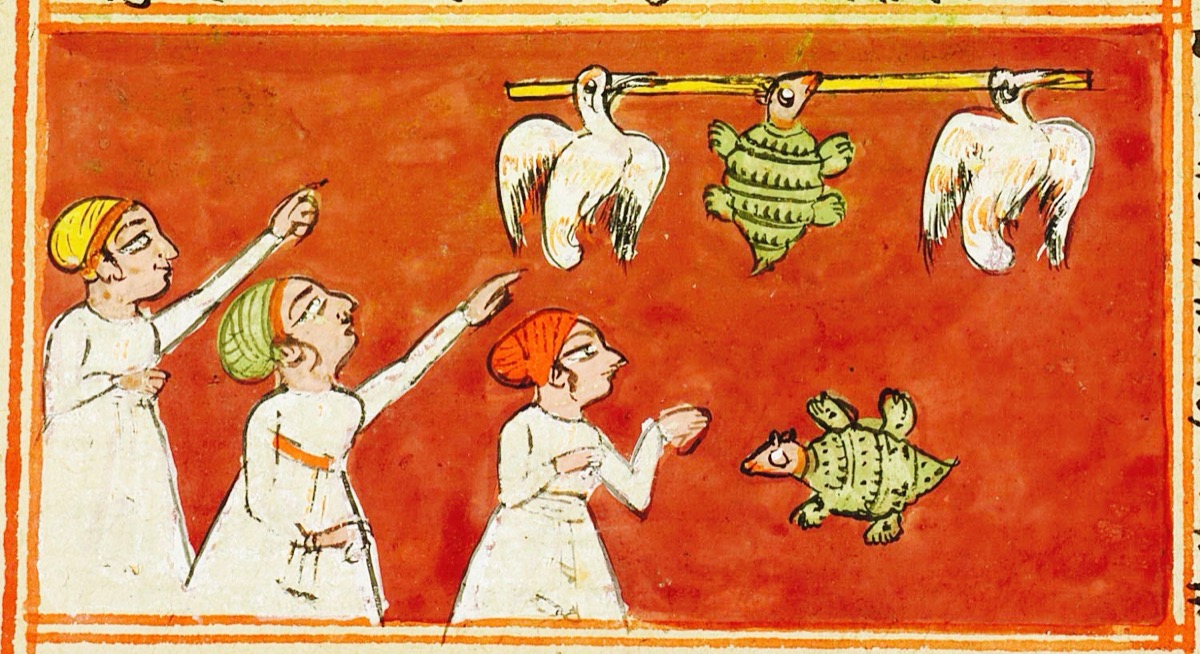
- The Talkative Turtle: The turtle, carried through the air by two geese holding a stick, cannot resist speaking and falls to her death — a warning against uncontrolled speech.
- The Blue Jackal: A jackal falls into a vat of dye and passes himself off as a divine creature, but his deception is exposed when he cannot suppress his natural howl — a parable about the impossibility of sustaining false identity.
- The Brahmin’s Dream: A man fantasizes about the wealth he will gain from a pot of grain, kicks the pot in his excitement, and loses everything — the origin of “counting one’s chickens before they hatch.”
- The Loyal Mongoose: Hasty judgment destroys an innocent protector — perhaps the most emotionally powerful tale in the collection.
Legacy in Hindu Tradition and Beyond
The Panchatantra occupies a unique position in Hindu intellectual culture. It bridges the worlds of sacred and secular learning — while not a religious scripture, it draws on the same philosophical traditions as the Upaniṣads and the Arthaśāstra. Its verse aphorisms are quoted in countless later Sanskrit works, and its stories have been depicted in temple sculpture (notably at Pattadakal and other sites), miniature paintings (especially in the Rajasthani and Mughal traditions), and oral storytelling traditions across the subcontinent.
In the modern era, the Panchatantra continues to serve its original purpose: teaching children and adults alike the principles of wise living through the irresistible medium of storytelling. As Viṣṇu Śarmā promised King Amaraśakti, these tales make the listener wise — not through instruction, but through delight:
यदिहास्ति तदन्यत्र यन्नेहास्ति न तत् क्वचित् — “What is found here may be found elsewhere; what is not found here is found nowhere.”