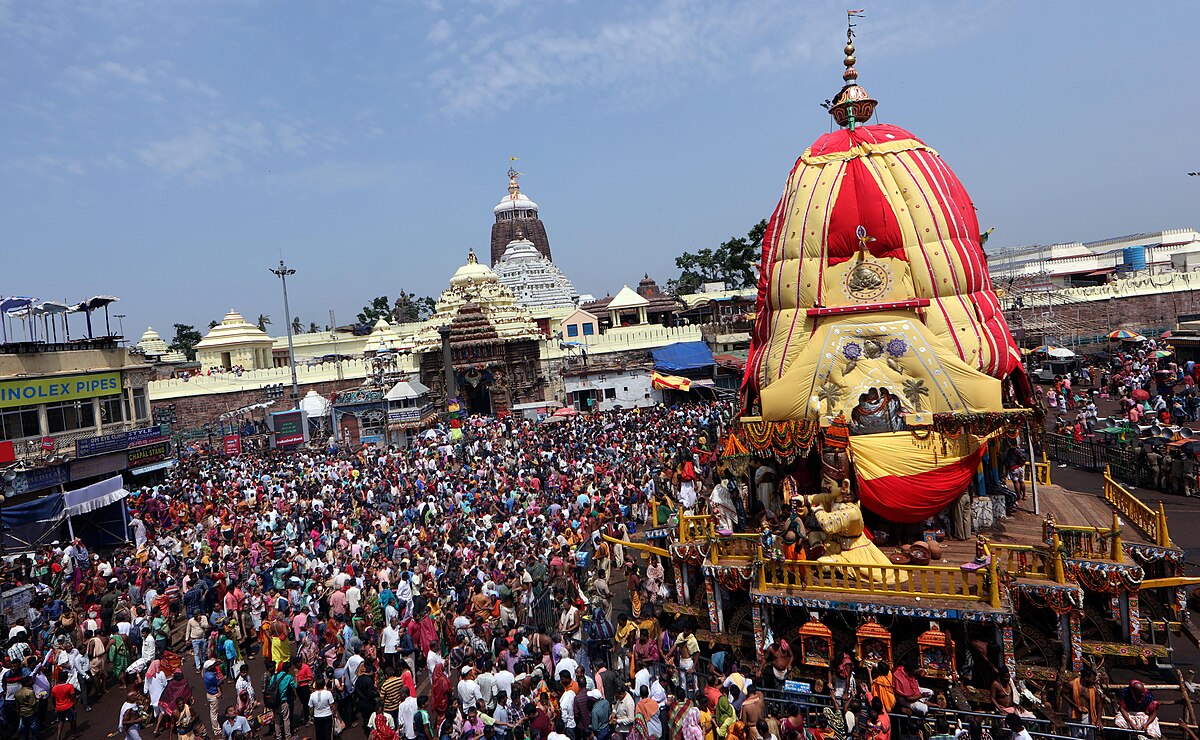
Rathayātrā (रथयात्रा, “the chariot journey”), popularly known as the Chariot Festival of Lord Jagannātha, is the oldest and grandest chariot festival in the Hindu tradition — a spectacular annual procession in which the three presiding deities of the Jagannātha Temple in Purī, Odisha — Lord Jagannātha, His elder brother Balabhadra (Balarāma), and Their sister Subhadrā — are ceremonially transported on three colossal, newly constructed wooden chariots from their abode in the Śrī Mandira to the Guṇḍichā Temple, approximately three kilometres away on the Baḍa Ḍāṇḍā (Grand Avenue). The festival falls on the second day of the bright fortnight (śukla pakṣa) of the month of Āṣāḍha (June–July) and lasts approximately ten to twelve days, culminating in the return journey known as the Bahudā Yātrā.
Rathayātrā is not merely an Odia or regional festival — it is a pan-Indian and now global celebration that draws over a million devotees to Purī each year and is replicated in cities across every inhabited continent. The Skanda Purāṇa declares that merely witnessing the deities atop their chariots liberates one from the cycle of rebirth: “rathastham yo naraḥ paśyed, punarjanma na vidyate” — “one who beholds the Lord upon His chariot shall not be born again” (Skanda Purāṇa, Vaiṣṇava Khaṇḍa).
Origin and Mythology
The origins of Rathayātrā are embedded in multiple layers of Purāṇic narrative. According to the Skanda Purāṇa, Padma Purāṇa, and Brahma Purāṇa, the festival is connected to the legendary King Indradyumna of Avantī, whose fervent devotion led to the manifestation of Lord Jagannātha’s wooden mūrti, carved by the divine craftsman Viśvakarmā (appearing in the form of a mysterious old artisan). The Purāṇas narrate that Queen Guṇḍichā, wife of Indradyumna, built a separate temple — the Guṇḍichā Mandira — and the annual chariot journey commemorates Jagannātha’s visit to His aunt’s (or, in some versions, His birthplace’s) abode.
Another popular narrative in Odia tradition holds that the Rathayātrā re-enacts Kṛṣṇa’s return to Vṛndāvana from Dvārakā, reuniting with Rādhā and the gopīs. In this reading, the Guṇḍichā Temple symbolises Vṛndāvana, the land of Kṛṣṇa’s childhood love, while the main Jagannātha Temple represents the royal court of Dvārakā. This interpretation was central to the devotional theology of Śrī Chaitanya Mahāprabhu, who saw the deities’ journey as the supreme expression of viraha-bhakti (love-in-separation) — Rādhā’s longing for Kṛṣṇa made manifest before the entire world.
The Brahma Purāṇa and the Kapila Saṃhitā further state that the festival has been observed since the Satya Yuga, making it — in theological terms — as old as creation itself. Historical inscriptions in the Jagannātha Temple complex date the festival’s continuous observance to at least the twelfth century CE, during the reign of the Gaṅga dynasty king Anaṅgabhīma Deva III (r. 1211–1238 CE), who dedicated his kingdom to Lord Jagannātha and formalised many of the temple’s ritual protocols.
The Three Chariots: Cosmic Vehicles of the Divine
The three chariots of Rathayātrā are not mere conveyances — they are mobile temples, each constructed afresh every year with rigorous adherence to ancient Odia craft traditions. No nails or metal fasteners are used; the chariots are assembled entirely from specially selected sacred wood, bound with ropes and pegs.
Nandighosa — The Chariot of Jagannātha
The largest and most magnificent of the three, Nandighosa (Nandighoṣa, “the cry of joy”) bears Lord Jagannātha. Standing 45 feet (approximately 14 metres) tall, it has 16 wheels, each seven feet in diameter. The chariot is draped in red and yellow cloth, symbolising Kṛṣṇa’s association with golden robes (Pītāmbara). Its charioteer (sārathī) is Mātali, the divine charioteer of Indra, and its four horses are dark-coloured (śyāma), reflecting Kṛṣṇa’s complexion. Nandighosa requires 832 specially selected wooden pieces for its construction and is guarded by nine pārśva devatās (protective deities) on each side. The flag atop the chariot is called Trailokyamohini (“Enchantress of the Three Worlds”). The pulling rope is named Śaṅkhachūḍa.
Tāladhvaja — The Chariot of Balabhadra
Tāladhvaja (Tāladhvaja, “the one whose flag bears a palm tree”) carries Lord Balabhadra. It stands 44 feet tall with 14 wheels, each seven feet in diameter. Draped in red and blue cloth, it is driven by the charioteer Dāruka. Its horses are white, reflecting Balarāma’s fair complexion. Tāladhvaja requires 763 wooden pieces and is similarly flanked by nine pārśva devatās on each side. The flag is called Unnānī and the pulling rope is Basuki.
Darpadālana — The Chariot of Subhadrā
Darpadālana (Darpadālana, “Crusher of Pride”) — sometimes also called Devadālana (“Crusher of Gods”) — bears Goddess Subhadrā. At 43 feet tall with 12 wheels, it is the smallest of the three yet still a towering structure. Draped in red and black cloth (black symbolising Śakti and the Mother Goddess), its charioteer is Arjuna, Subhadrā’s husband in the Mahābhārata. Its horses are red. The chariot requires 593 wooden pieces. Subhadrā’s chariot also carries the small deity Sudarśana (the sacred discus of Viṣṇu). The flag is called Nadāmbikā and the pulling rope is Svarnachūḍa.
Construction Rituals: From Forest to Grand Avenue
The construction of the three chariots is itself a months-long sacred process governed by hereditary artisan families — the Mahārāṇā (carpenters) and Bhoi servitors — whose lineages have served the Jagannātha Temple for centuries.
The process begins on Vasanta Pañcamī (January–February), when logs of specified sacred wood varieties — Phāsi (Anogeissus accuminata), Dhaura (Anogeissus latifolia), Āsana (Terminalia tomentosa), and Śimili (Bombax ceiba) — are floated down the Mahānadī River as rafts from the forests of Daśapallā and delivered to the temple precincts. On Rāma Navamī (March–April), the logs are ceremonially cut into specific sizes and shapes.
Formal construction begins on Akṣaya Tṛtīyā (April–May) with a ritual fire ceremony (homa). For approximately two months, the Mahārāṇā families work in a designated construction yard adjacent to the temple, shaping over 4,000 individual pieces of wood into the three chariots — all measured with traditional sticks rather than modern instruments. The completed chariots, each weighing over 200 tonnes, are decorated with painted cloth, metal fittings, and wooden carvings just days before the festival.
The wheels are among the most sacred components. Each seven-foot wheel is carved from a single piece of wood and painted with intricate designs. On the eve of the festival, the Pahāṇḍi Bijā ceremony sees the deities carried from the inner sanctum of the temple to their respective chariots in a swaying, dance-like procession by temple servitors — a moment of immense emotional intensity for the assembled devotees.
The Festival Day: Procession on the Grand Avenue
On the day of Rathayātrā, the Baḍa Ḍāṇḍā (Grand Avenue) of Purī transforms into one of the most extraordinary spectacles in the religious world. Over a million devotees — pilgrims, mendicants, priests, and tourists — pack the broad avenue that stretches from the Lion Gate (Siṃha Dvāra) of the Jagannātha Temple to the Guṇḍichā Temple.
Cherā Pahānrā: The King as Sweeper
Before the chariots begin to move, one of the most theologically significant rituals of the entire festival takes place — the Cherā Pahānrā (sweeping ceremony). The Gajapati Mahārāja of Purī — the titular king of the Jagannātha domain and the foremost servitor of the Lord — arrives in a palanquin, dressed not in royal regalia but as a humble sweeper. Armed with a gold-handled broom, the king sweeps the platform of each chariot, sprinkles sandalwood water and powder, and cleans the path before the deities.
This astonishing act of royal humility encodes a profound theological message: before Lord Jagannātha, even a king is a servant. The Gajapati’s sweeping establishes that Jagannātha is the true sovereign of the land — a concept formalised in the thirteenth century when King Anaṅgabhīma Deva III declared himself merely the rāūta (deputy) of Lord Jagannātha and dedicated his entire kingdom to the deity. The Cherā Pahānrā takes place both at the start of the Rathayātrā and during the return Bahudā Yātrā.
The Pulling of the Chariots
After the Cherā Pahānrā, thousands of devotees grasp the thick ropes — Śaṅkhachūḍa, Basuki, and Svarnachūḍa — and begin pulling the three massive chariots down the Grand Avenue. The procession moves slowly, accompanied by the thunderous chanting of “Jai Jagannātha!”, the beating of drums, clashing of cymbals, and blowing of conch shells. The chariots do not move smoothly — their massive wooden wheels grind and lurch, sometimes requiring hours to cover the three-kilometre distance. Tradition holds that the chariots may halt at certain points, which is interpreted as the Lord’s wish to pause and bless specific devotees or locations.
The order of procession is fixed by tradition: Tāladhvaja (Balabhadra’s chariot) leads, followed by Darpadālana (Subhadrā’s), with Nandighosa (Jagannātha’s) bringing up the rear. When the three chariots reach the Guṇḍichā Temple, the deities are ceremonially installed within for a nine-day stay, during which the temple serves as their temporary abode.
Guṇḍichā Temple: The Garden House
The Guṇḍichā Temple — affectionately called Guṇḍichā Ghara or the “Garden House” of Jagannātha — is a quiet, garden-surrounded temple in stark contrast to the bustling Śrī Mandira. During the deities’ nine-day sojourn, the Guṇḍichā Temple becomes the principal site of worship. The rituals performed here mirror those at the main temple, but the atmosphere carries a special intimacy — as if the Lord has stepped out of His royal court to visit His maternal family.
Chaitanya Mahāprabhu is recorded in the Caitanya-caritāmṛta of Kṛṣṇadāsa Kavirāja as personally sweeping the Guṇḍichā Temple with his own hands before the deities’ arrival, teaching his followers that cleansing the temple is analogous to cleansing the heart of material attachments — a passage that ISKCON devotees cite as the inspiration for their annual Guṇḍichā-mārjana (temple-cleaning) ceremonies worldwide.
Bahudā Yātrā: The Return Journey
On the ninth day after Rathayātrā, the deities are placed back on their chariots for the Bahudā Yātrā (Return Journey) to the Jagannātha Temple. The return procession follows the same Grand Avenue in reverse and generates its own unique fervour. During the return, the chariots halt briefly at the Māuṣī Māā Temple (the Temple of the Aunt), where the deities are offered podā piṭhā — a special Odia cake that is said to be Jagannātha’s favourite, symbolising the love of a maternal aunt feeding her nephews and niece.
Sunā Beshā: The Golden Adornment
On the day after the Bahudā Yātrā, while the deities still sit on their chariots in front of the Siṃha Dvāra, the magnificent ceremony of Sunā Beshā (Suṇā Beṣā, “Golden Attire”) takes place. The three deities are adorned with over 200 kilograms of gold ornaments — crowns, necklaces, earrings, armlets, and hand decorations — drawn from the temple treasury. This dazzling spectacle, which attracts hundreds of thousands of viewers, is considered one of the most auspicious darśanas (sacred viewings) of the entire year. The deities are worshipped on the chariots themselves in this resplendent form before being ceremonially carried back into the inner sanctum of the Jagannātha Temple in a final Pahāṇḍi procession.
Chaitanya Mahāprabhu and Rathayātrā
No account of Rathayātrā is complete without acknowledging the towering figure of Śrī Chaitanya Mahāprabhu (1486–1534 CE), the Bengali Vaiṣṇava saint regarded by his followers as the combined incarnation of Rādhā and Kṛṣṇa. Chaitanya spent the last eighteen years of his earthly life in Purī, and the Rathayātrā was the supreme annual event of his devotional practice.
The Caitanya-caritāmṛta (Madhya-līlā, chapters 13–14) provides vivid descriptions of Chaitanya dancing ecstatically before Lord Jagannātha’s chariot, sometimes leaping into the air, sometimes falling to the ground in states of divine love (prema). He organised his followers into seven saṅkīrtana (devotional singing) groups that would sing and dance before the chariots in rotation. Chaitanya’s profound theological interpretation — that Rathayātrā represents Kṛṣṇa’s return to Vṛndāvana and Rādhā’s ecstatic reunion with her beloved — became the dominant devotional lens through which millions of Gauḍīya Vaiṣṇavas experience the festival to this day.
It was Chaitanya’s overwhelming love for Jagannātha at Rathayātrā that later inspired A. C. Bhaktivedānta Swāmī Prabhupāda to establish Rathayātrā processions through ISKCON as a central feature of the global Hare Kṛṣṇa movement.
The Word “Juggernaut”: Etymology and Colonial Distortion
The English word juggernaut — meaning an unstoppable, crushing force — derives directly from the Rathayātrā of Purī. The word entered European languages through the accounts of medieval travellers, most notably the Franciscan friar Odoric of Pordenone (c. 1286–1331), who visited India around 1316–1318 and described the chariot procession in terms that mixed genuine observation with sensationalist exaggeration. Odoric’s account, which was later incorporated into the fictitious travelogue attributed to “Sir John Mandeville” (c. 1357), described Hindu devotees casting themselves beneath the chariot wheels as an act of religious sacrifice.
During the British colonial period (eighteenth–nineteenth centuries), these accounts were amplified by missionaries and colonial administrators who characterised Hindu religious practice as barbaric. The image of the “Juggernaut” became a staple of anti-Hindu propaganda, depicting the festival as a scene of mass self-immolation. Modern historians have thoroughly debunked these characterisations, noting that any deaths beneath the wheels were rare accidents in an enormous crowd, not deliberate acts of suicide. Nevertheless, the word juggernaut entered the English lexicon permanently — an ironic linguistic legacy of one of the world’s most joyous and life-affirming religious celebrations.
ISKCON and Rathayātrā Worldwide
A. C. Bhaktivedānta Swāmī Prabhupāda, the founder-ācārya of the International Society for Krishna Consciousness (ISKCON), inaugurated the first Western Rathayātrā in San Francisco in 1967, just one year after founding ISKCON. Prabhupāda, a devoted follower of Chaitanya Mahāprabhu’s Gauḍīya Vaiṣṇava tradition, selected Jagannātha as one of the primary forms of Kṛṣṇa installed in ISKCON temples worldwide.
By the time of Prabhupāda’s passing in 1977, Rathayātrā processions were being held in London, Paris, Sydney, Tokyo, Los Angeles, and on New York’s Fifth Avenue. Today, ISKCON organises Rathayātrā festivals in over 100 cities across every inhabited continent — from Moscow to Melbourne, from Durban to Dublin. These processions typically feature handcrafted wooden chariots (smaller than the Purī originals but faithful in design), devotional singing (kīrtana), free vegetarian feasts (prasādam distribution), and cultural performances. ISKCON’s Rathayātrā in Kolkata, started in 1972, has grown to become the second largest Rathayātrā in the world by attendance, drawing millions of devotees through the streets of the city.
The Bengali Connection: Ulṭo Ratha and the Mahesh Tradition
Bengal’s relationship with Rathayātrā extends far beyond the ISKCON processions. The Rathayātrā of Mahesh — held in Mahesh, a historic locality within Serāmpore in Hooghly district — is the oldest chariot festival in Bengal, with continuous observance claimed since 1396 CE, making it the second oldest Rathayātrā after Purī’s own. The Mahesh festival features a massive wooden chariot and draws two to three lakh (200,000–300,000) visitors during its month-long associated fair.
In Bengali culture, the Ulṭo Ratha (“Return Chariot”) — corresponding to the Bahudā Yātrā — holds special significance. While Rathayātrā marks the deities’ departure, Ulṭo Ratha marks their homecoming and is celebrated with particular fervour in Kolkata and throughout rural Bengal. Bengali proverbs and folk songs reference the Ulṭo Ratha as a metaphor for completion and return: just as Jagannātha always returns home, so too does every journey find its end.
The Jagannātha cult in Bengal predates Chaitanya and is linked to the broader Vaiṣṇava-Sahajiyā and Bāul traditions of the region. Many historic Jagannātha temples across Bengal — in Balasore, Midnapore, and Bankura — hold their own local Rathayātrā celebrations, weaving the festival into the fabric of Bengali village life.
Historical Accounts by Foreign Travellers
Beyond Odoric of Pordenone, several other foreign travellers left accounts of the Rathayātrā:
- Ibn Battuta (c. 1345): The Moroccan traveller described a chariot procession in eastern India that scholars have identified as a Rathayātrā, noting the immense size of the chariots and the devotion of the crowd.
- Ralph Fitch (1583–1591): One of the first Englishmen to visit India, Fitch described the Jagannātha Temple and the chariot festival in Purī, calling the idol “Iogannat” and noting the temple’s immense wealth.
- François Bernier (1656–1668): The French physician described the festival in his accounts of Mughal India, noting the vast numbers of pilgrims.
- William Bruton (1632): An English sailor whose account of the Jagannātha festival became widely read in Europe, contributing to the “Juggernaut” mythology.
These accounts, while often coloured by the biases of their era, collectively attest to the unbroken historical continuity and spectacular scale of the Rathayātrā — a festival that has astonished visitors from every culture for at least eight centuries.
Spiritual Significance: Equality Before the Lord
One of the most theologically radical aspects of the Jagannātha tradition — and by extension the Rathayātrā — is its emphasis on universal access to the divine. Unlike many Hindu temples of the medieval period that restricted entry based on caste, the Rathayātrā brings Lord Jagannātha out of the temple and into the streets, where every person — regardless of caste, creed, gender, or social status — can behold the Lord and pull His chariot. The Skanda Purāṇa explicitly states that during the Rathayātrā, the merit of seeing Jagannātha is available to all beings equally.
This egalitarian dimension was central to Chaitanya Mahāprabhu’s theology, which held that love of God (prema) transcends all social boundaries. It continues to resonate in the modern era, as millions of devotees from every walk of life gather on the Grand Avenue of Purī, united in the simple, powerful act of pulling God’s chariot toward His garden house — an annual journey that has been repeated, without interruption, for nearly a millennium.