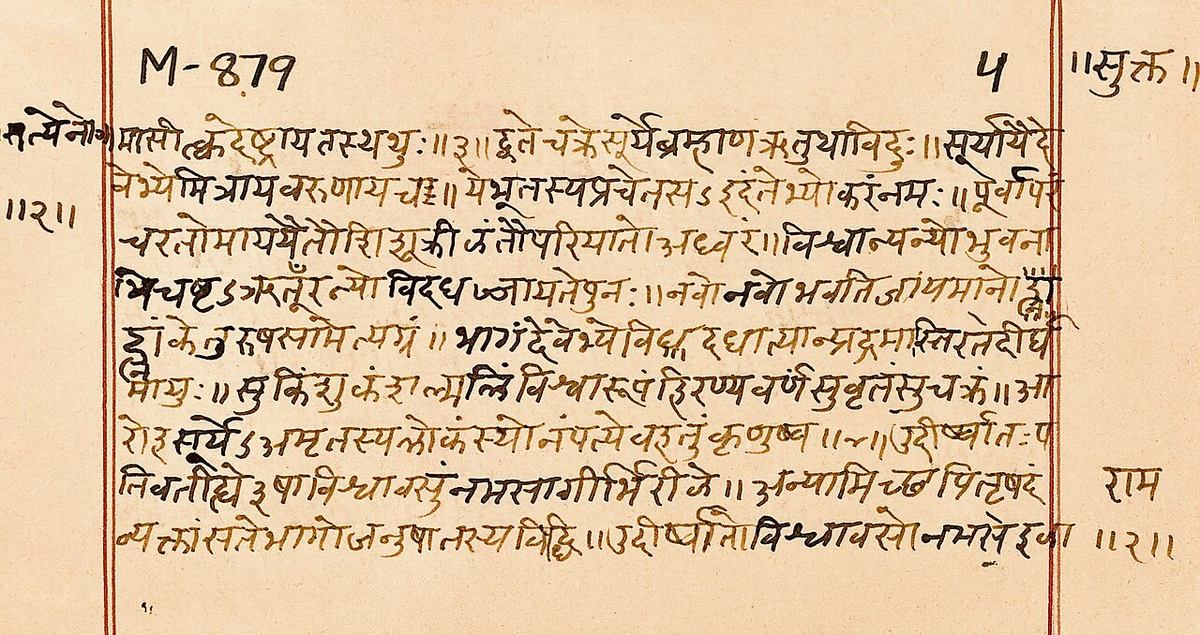
The Vedas (वेद, from the Sanskrit root vid, “to know”) are the oldest and most sacred scriptures of Hinduism — a vast corpus of sacred literature that forms the very foundation of Hindu religious thought. They are classified as śruti (श्रुति, “that which is heard”), meaning they are not considered human compositions but eternal truths directly perceived by ancient sages (ṛṣis) in states of deep contemplation. In matters of dharma, ritual, and metaphysical truth, the Vedas are regarded as the supreme and infallible authority (pramāṇa), and virtually every school of Hindu philosophy — from Advaita Vedānta to Viśiṣṭādvaita — anchors its claims in Vedic revelation.
Origins and Chronology
The Vedas are regarded within Hindu tradition as apauruṣeya (अपौरुषेय, “not of human origin”) — eternal, beginningless, and revealed anew at the start of each cosmic cycle. Modern Indological scholarship, drawing on linguistic analysis and archaeological evidence, dates the composition of the earliest Vedic hymns — those of the Ṛg Veda — to approximately 1500-1200 BCE, with later portions of the corpus extending to around 500 BCE. This makes the Vedas among the oldest religious literature in the world, roughly contemporaneous with the earliest Egyptian religious texts.
The Vedas were not composed by any single author. Instead, each hymn is attributed to a specific ṛṣi or family of ṛṣis — the Vasiṣṭhas, Viśvāmitras, Bharadvājas, Atris, and others — who are understood not as authors but as draṣṭāras (“seers”) who perceived the eternal mantras. The compiler of the Vedas into their present fourfold form is traditionally said to be Vyāsa (Veda Vyāsa, “the divider of the Vedas”), who organized the originally unified body of knowledge into the Ṛg, Yajur, Sāma, and Atharva Vedas so that they could be transmitted through distinct priestly lineages.
The Four Vedas
Hindu tradition recognizes four Vedas, each serving a distinct liturgical and philosophical purpose in the Vedic sacrificial system (yajña).
1. Ṛg Veda (ऋग्वेद) — The Veda of Praise
The Ṛg Veda is the oldest and most foundational of the four Vedas. It comprises 1,028 hymns (sūktas) organized into ten maṇḍalas (books), containing approximately 10,600 verses in total. These hymns are primarily addressed to various deities — Agni (fire), Indra (the warrior god of storms), Sūrya (the sun), Varuṇa (cosmic order), the Aśvins (divine physicians), and Uṣas (dawn) — and were recited by the Hotṛ priest during Vedic rituals.
The Ṛg Veda is far more than a collection of ritual invocations. It contains some of the earliest philosophical speculations in human history. The celebrated Nāsadīya Sūkta (Ṛg Veda 10.129), the “Hymn of Creation,” poses profound questions about the origin of the universe in a remarkably open-ended, almost agnostic tone:
nā́sad āsīn nó sád āsīt tadā́nīṃ — “There was neither existence nor non-existence then” (Ṛg Veda 10.129.1)
The hymn concludes by suggesting that even the gods may not know the answer to how creation began, since they themselves came after it — a startlingly modern posture of philosophical humility. The Puruṣa Sūkta (10.90) presents a different cosmogonic vision, describing the self-sacrifice of the cosmic being (Puruṣa) from whose body the universe, the social orders, and the gods themselves emerge.
2. Yajur Veda (यजुर्वेद) — The Veda of Sacrifice
The Yajur Veda contains prose formulas (yajus) used by the Adhvaryu priest — the officiant who performs the physical actions of the Vedic ritual. It provides detailed instructions for the performance of sacrifices and ceremonies, making it the most directly liturgical of the four Vedas.
The Yajur Veda exists in two major recensions:
- Śukla Yajur Veda (White Yajur Veda) — contains only the mantras (Saṃhitā), with the ritual commentary (Brāhmaṇa) kept separate in the Śatapatha Brāhmaṇa, one of the most important texts in all of Vedic literature
- Kṛṣṇa Yajur Veda (Black Yajur Veda) — interleaves mantras with prose explanations, representing an older arrangement where ritual instruction was not yet separated from the hymns themselves
The Śatapatha Brāhmaṇa, attached to the Śukla Yajur Veda, is a massive work containing elaborate explanations of Vedic rituals, cosmological narratives (including the famous flood story of Manu), and early philosophical reflections that would later flower into the Upaniṣads.
3. Sāma Veda (सामवेद) — The Veda of Melodies
The Sāma Veda consists primarily of verses drawn from the Ṛg Veda, rearranged and set to specific melodic patterns (sāman) for chanting during the soma sacrifice and other rituals. It was the domain of the Udgātṛ priest, the chanter whose musical recitation was believed to have direct spiritual power. The Sāma Veda contains approximately 1,549 verses, of which all but 75 are derived from the Ṛg Veda.
The significance of the Sāma Veda lies not in its textual content (which largely duplicates the Ṛg Veda) but in its musical dimension. Śrī Kṛṣṇa declares in the Bhagavad Gītā (10.22): vedānāṃ sāmavedo’smi — “Among the Vedas, I am the Sāma Veda,” highlighting the supreme status of sacred music as a path to the divine. The Sāma Veda is thus regarded as the origin of Indian classical music, and its melodic notation system (svara) laid the foundation for the elaborate rāga traditions that would develop over subsequent millennia.
4. Atharva Veda (अथर्ववेद) — The Veda of the Atharvans
The Atharva Veda, named after the sage Atharvan, differs significantly in character from the other three Vedas. While the Ṛg, Yajur, and Sāma Vedas (trayī vidyā, the “triple knowledge”) are primarily concerned with the public ritual of the soma sacrifice, the Atharva Veda addresses the concerns of everyday life:
- Healing charms and medicinal hymns — incantations for curing diseases, snake bites, and fevers, representing the earliest stratum of Indian medical knowledge
- Protective spells — formulas against malevolent spirits, sorcery, and natural calamities
- Domestic rituals — ceremonies for birth, marriage, agriculture, and prosperity
- Philosophical hymns — including the Pṛthivī Sūkta (12.1), a remarkable hymn to the Earth personified as a goddess, and the Skambha Sūkta (10.7-8), which explores the cosmic pillar supporting the universe
- Political treatises — hymns related to royal power, governance, and military success
The Atharva Veda was not always accorded equal status with the other three; some orthodox traditions initially considered only the trayī as fully canonical. Over time, however, the Atharva Veda was recognized as the fourth Veda, and the Brahmā priest — the silent supervisor of the entire sacrifice — was assigned its mastery.
The Fourfold Structure of Each Veda
Each Veda is internally divided into four layers of text, representing a progression from ritual action to philosophical contemplation:
1. Saṃhitā (संहिता) — “Collection”
The Saṃhitās are the oldest and most core layer — collections of mantras, hymns, prayers, and ritual formulas. When one speaks of “the Ṛg Veda” without qualification, it is typically the Ṛg Veda Saṃhitā that is meant. The Saṃhitās form the textual bedrock upon which all subsequent layers of Vedic literature are built.
2. Brāhmaṇa (ब्राह्मण) — “Ritual Commentary”
The Brāhmaṇas are elaborate prose texts that explain the procedures, meaning, and symbolism of Vedic rituals. They contain detailed instructions for priests, mythological narratives that provide the raison d’être of specific rites, and early theological speculation. Major Brāhmaṇas include the Śatapatha Brāhmaṇa (Śukla Yajur Veda), the Aitareya Brāhmaṇa (Ṛg Veda), and the Tāṇḍya Mahābrāhmaṇa (Sāma Veda). The Brāhmaṇas are invaluable sources for understanding the social, religious, and intellectual life of Vedic India.
3. Āraṇyaka (आरण्यक) — “Forest Texts”
The Āraṇyakas (“forest books”) represent a transitional literature between the ritualism of the Brāhmaṇas and the pure philosophy of the Upaniṣads. Intended for study by forest-dwelling hermits (vānaprasthas) who had withdrawn from active ritual life, they begin to internalize the external sacrifice — reinterpreting fire rituals as metaphors for inner spiritual processes. The Aitareya Āraṇyaka and Taittirīya Āraṇyaka are among the most important texts in this category.
4. Upaniṣad (उपनिषद) — “Sitting Near” (Esoteric Teaching)
The Upaniṣads are the philosophical crown of the Vedas, collectively known as Vedānta (“the end of the Vedas”). They explore the most fundamental questions of existence: the nature of ultimate reality (Brahman), the individual self (Ātman), the relationship between the two, and the means of liberation (mokṣa). The central insight of the Upaniṣads — expressed in the mahāvākyas (great sayings) such as tat tvam asi (“Thou art That,” Chāndogya Upaniṣad 6.8.7) and aham brahmāsmi (“I am Brahman,” Bṛhadāraṇyaka Upaniṣad 1.4.10) — is the identity of the individual self with the universal absolute.
The principal Upaniṣads (mukhya upaniṣads), as recognized by Ādi Śaṅkarācārya, include: Īśa, Kena, Kaṭha, Praśna, Muṇḍaka, Māṇḍūkya, Taittirīya, Aitareya, Chāndogya, Bṛhadāraṇyaka, Śvetāśvatara, and Kauṣītakī. While tradition counts 108 Upaniṣads, these twelve or thirteen form the philosophical core that gave rise to the great Vedāntic traditions.
Key Philosophical Concepts
Ṛta and Dharma
The concept of Ṛta (ऋत, “cosmic order”) is central to the Ṛg Veda. It represents the principle of natural and moral order that governs the universe — the regularity of seasons, the movement of celestial bodies, and the ethical conduct expected of humans and gods alike. Varuṇa is the primary guardian of Ṛta. In later Vedic and post-Vedic literature, the concept of Ṛta evolved into Dharma, which came to encompass cosmic law, religious duty, and moral righteousness.
Brahman and Ātman
Brahman (ब्रह्मन्) — the ultimate, impersonal, all-pervading reality — is the supreme concept of the Upaniṣads. It is the source, sustainer, and dissolution point of all existence, beyond all attributes and conceptualization. Ātman (आत्मन्), the individual self or soul, is ultimately identical with Brahman — a realization that constitutes liberation (mokṣa). The Māṇḍūkya Upaniṣad identifies Brahman with the sacred syllable Oṃ (ॐ), analyzing it through its constituent sounds (a-u-m) as corresponding to the waking, dreaming, and deep sleep states, with the silence that follows representing the transcendent fourth state (turīya).
Karma
The concept of karma (कर्म, “action”) — the principle that every action generates consequences that shape one’s future experience — emerges in its fully developed form in the later Vedic texts, particularly the Bṛhadāraṇyaka Upaniṣad (4.4.5-6), which states that a person becomes good by good action and evil by evil action.
The Extraordinary Oral Tradition
Perhaps the most remarkable aspect of the Vedas is their mode of preservation. For well over two millennia before they were first committed to writing, the Vedas were transmitted entirely through an oral tradition of extraordinary precision and sophistication. UNESCO proclaimed the tradition of Vedic chanting a Masterpiece of the Oral and Intangible Heritage of Humanity in 2003, recognizing it as one of the oldest unbroken oral traditions in the world.
To ensure absolute fidelity across generations, Vedic scholars developed eleven methods of recitation (pāṭhas), each serving as an independent cross-check against textual corruption:
- Saṃhitā Pāṭha — continuous recitation of the text as it naturally flows
- Pada Pāṭha — word-by-word recitation, separating sandhi (euphonic combinations)
- Krama Pāṭha — sequential pairing: word 1 + word 2, then word 2 + word 3, and so on
- Jaṭā Pāṭha — “braided” recitation: words are chanted forward, backward, then forward again (1-2, 2-1, 1-2; 2-3, 3-2, 2-3…)
- Ghana Pāṭha — the most complex form (“dense recitation”): word1-word2, word2-word1, word1-word2-word3, word3-word2-word1, word1-word2-word3; then the pattern advances
Through these interlocking methods, every single syllable, accent (svara), and pause of the 10,600 verses of the Ṛg Veda was preserved with astonishing accuracy over three thousand years — long before the invention of writing in India. The effectiveness of this system is confirmed by the near-identical readings found across manuscripts from geographically distant regions of the subcontinent.
The Six Vedāṅgas: Auxiliary Sciences
To support the correct understanding, recitation, and application of the Vedas, six auxiliary disciplines known as the Vedāṅgas (वेदाङ्ग, “limbs of the Vedas”) developed in the late Vedic and post-Vedic periods:
- Śikṣā (शिक्षा, Phonetics) — the science of correct pronunciation, accent, and articulation of Vedic syllables
- Chandas (छन्दस्, Metrics) — the study of poetic metres used in Vedic hymns (gāyatrī, triṣṭubh, anuṣṭubh, jagatī, etc.)
- Vyākaraṇa (व्याकरण, Grammar) — grammatical analysis of Sanskrit, culminating in Pāṇini’s Aṣṭādhyāyī, one of the greatest intellectual achievements of the ancient world
- Nirukta (निरुक्त, Etymology) — the interpretation of difficult and archaic Vedic words, exemplified by Yāska’s Nirukta
- Jyotiṣa (ज्योतिष, Astronomy) — the science of celestial movements, essential for determining the correct times for Vedic rituals
- Kalpa (कल्प, Ritual) — systematic codification of ritual procedures, including the Śrauta Sūtras (solemn sacrifices), Gṛhya Sūtras (domestic rites), and Dharma Sūtras (social and moral law)
Together, the Vedas and Vedāṅgas constituted the core curriculum of traditional Vedic education (brahmacarya), studied intensively in the gurukula system over a period of twelve or more years.
The Gāyatrī Mantra
Perhaps the most celebrated Vedic mantra is the Gāyatrī Mantra from the Ṛg Veda (3.62.10), attributed to the ṛṣi Viśvāmitra:
oṃ bhūr bhuvaḥ svaḥ tat savitur vareṇyaṃ bhargo devasya dhīmahi dhiyo yo naḥ pracodayāt
“We meditate upon the glorious splendour of the divine Sun (Savitṛ); may He illuminate our intellects.”
This mantra, chanted daily by millions of Hindus at dawn, noon, and dusk as part of the sandhyāvandana practice, embodies the Vedic aspiration toward divine illumination and the awakening of higher consciousness. It is composed in the gāyatrī metre (three lines of eight syllables each), from which it takes its name.
The Vedas in Contemporary Life
Though composed over three millennia ago, the Vedas remain a living tradition:
- Temple worship: Vedic mantras are recited daily in Hindu temples across the world. The agnicayana tradition — an elaborate twelve-day fire altar construction ritual from the Vedas — survives among Nambūdiri Brahmins in Kerala, recognized as one of the oldest continuously practised ritual traditions on earth.
- Saṃskāras: The sixteen sacraments of Hindu life — from the prenatal garbhādhāna to the funeral antyeṣṭi — all incorporate Vedic mantras and fire ceremonies.
- Academic study: The Vedas continue to be objects of intensive scholarly research in universities worldwide, generating insights into linguistics, comparative religion, Indo-European studies, and the history of ideas.
- Philosophical influence: Every major school of Hindu philosophy — Advaita, Viśiṣṭādvaita, Dvaita, Sāṃkhya, Yoga, Nyāya, Vaiśeṣika, Mīmāṃsā — claims fidelity to Vedic authority. The Vedas are thus the common root from which the extraordinary diversity of Hindu thought has flowered.
The Living Word
The Vedas represent not merely ancient literature but an unbroken chain of sacred transmission stretching from the earliest Indo-Aryan communities to the present day. Their hymns explore the full range of human experience — from the practical concerns of agriculture, health, and prosperity to the most exalted metaphysical questions about the nature of reality, consciousness, and the absolute. The Nāsadīya Sūkta’s unforgettable closing verse captures this spirit of cosmic wonder:
kó addhā́ veda ká ihá prá vocat / kúta ā́jātā kúta iyáṃ vísṛṣṭiḥ — “Who truly knows? Who shall declare it here — whence this creation arose, whence this manifold world?” (Ṛg Veda 10.129.6)
In temples and homes, in universities and ashrams, in the measured chanting of Ghana Pāṭha and the whispered Gāyatrī at dawn, the Vedas continue what they have always been: humanity’s oldest and most meticulously preserved conversation with the mystery of existence.