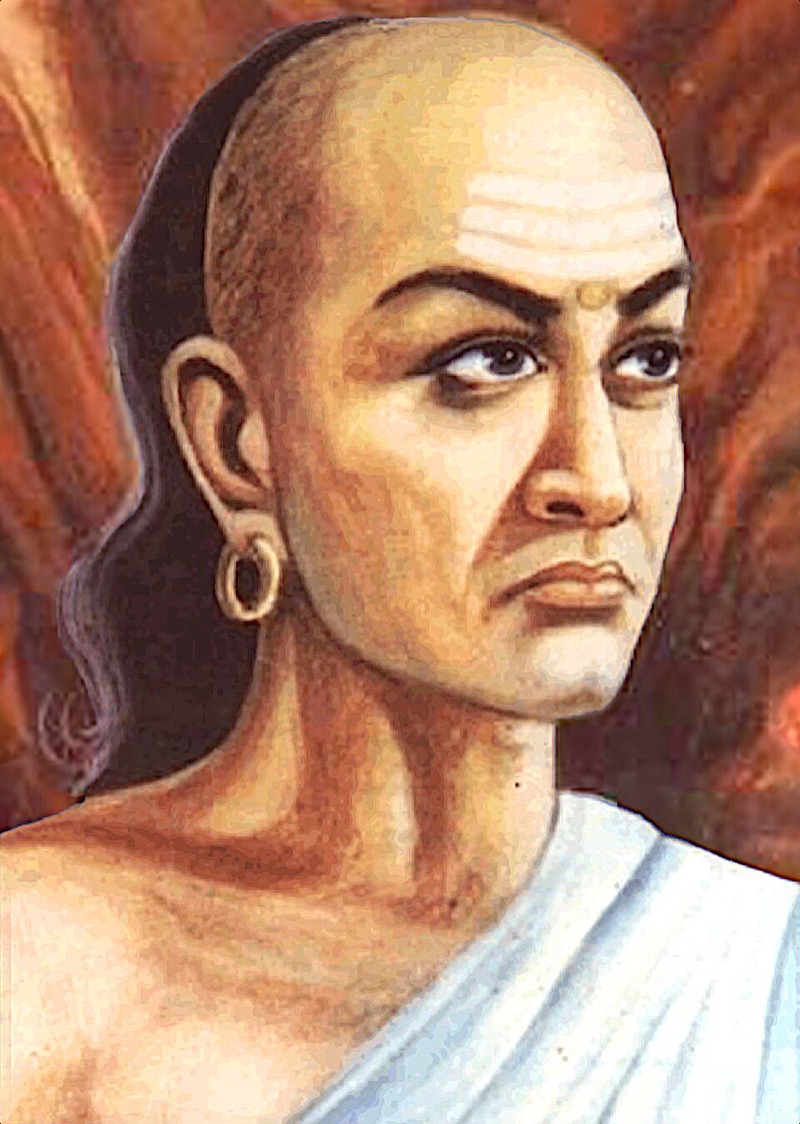
Cāṇakya (चाणक्य), also known as Kauṭilya and Viṣṇugupta, stands as one of the most formidable intellects in the history of ancient India. A Brahmin scholar at the legendary university of Takṣaśilā (Taxila), a master of political strategy, a kingmaker who toppled the Nanda dynasty and installed Candragupta Maurya on the throne, and the author of the Arthaśāstra — arguably the most comprehensive treatise on statecraft, economics, and governance ever composed in the ancient world — Cāṇakya’s influence reverberates across millennia of Indian political thought and continues to command study in modern universities worldwide.
Unlike the divine figures and saints who populate much of Hindu sacred biography, Cāṇakya is a distinctly human figure — sharp, ruthless, pragmatic, yet deeply rooted in the dharmic framework that insists governance must serve the welfare of the people. His life story, preserved in texts such as the Mudrārākṣasa (a 4th-century CE Sanskrit drama by Viśākhadatta), the Buddhist Mahāvaṁsa, and various Jain traditions, reads like an epic of revenge, strategy, and the triumph of intellect over brute power.
The Three Names: Cāṇakya, Kauṭilya, Viṣṇugupta
The question of Cāṇakya’s identity has intrigued scholars for centuries. The three names that tradition assigns to him each carry distinct connotations:
- Cāṇakya — derived from his father’s name Caṇaka or his native village Caṇaka, this is his patronymic and the name by which he is most popularly known
- Kauṭilya — literally “the crooked one” (from kuṭila, meaning curved or devious), this name reflects his reputation for cunning statecraft. It is the name used in the Arthaśāstra itself. Some scholars derive it from the gotra name Kuṭila
- Viṣṇugupta — “protected by Viṣṇu,” this is the name that appears at the end of the Arthaśāstra’s colophon: “This śāstra has been made by him who, with resentment, quickly rescued the scriptures and the science of weapons and the earth which had gone to the Nanda king” (Arthaśāstra 15.1.73)
The Arthaśāstra (15.1.73) itself confirms all three as the same person: “This treatise was composed by Viṣṇugupta, also known as Kauṭilya.” Whether the three names represent one historical individual or a composite of scholarly traditions remains debated, but Hindu, Buddhist, and Jain sources consistently treat them as a single figure.
Takṣaśilā: The Crucible of Knowledge
Cāṇakya’s intellectual formation took place at Takṣaśilā (modern Taxila in Pakistan), one of the greatest centres of learning in the ancient world. Established centuries before Plato’s Academy or Aristotle’s Lyceum, Takṣaśilā attracted students from across the Indian subcontinent and beyond. The curriculum encompassed the Vedas, grammar (vyākaraṇa), logic (nyāya), philosophy (darśana), medicine (āyurveda), warfare (dhanurvidyā), law (dharmaśāstra), and — critically for Cāṇakya — political science (arthaśāstra and daṇḍanīti).
Cāṇakya is said to have mastered all these disciplines and eventually became an ācārya (professor) at Takṣaśilā. The Mudrārākṣasa describes him as “ugly in appearance but matchless in intellect,” a characterization that tradition has preserved: physical plainness combined with devastating mental acuity. Buddhist texts in the Mahāvaṁsa tradition describe him as having been born with a full set of teeth — an omen of future kingship or kingmaking.
The Humiliation and the Oath
The pivotal event that launched Cāṇakya’s political career was a public humiliation at the court of the Nanda dynasty. According to the Mudrārākṣasa and later traditions, Cāṇakya attended the court of Dhana Nanda (the last Nanda king) either as a participant in a royal assembly or as an invitee to distribute charity. The Nanda king, known for his arrogance and low birth (he was reputedly the son of a barber or a śūdra woman), insulted Cāṇakya publicly — either mocking his appearance, his Brahmin pretensions, or dismissing him from the court.
Cāṇakya, according to the Pariśiṣṭaparvan (a Jain text by Hemacandra), untied his śikhā (topknot) — a profoundly symbolic act for a Brahmin — and swore a terrible oath: “I will not tie this knot again until I have uprooted the entire Nanda dynasty.” This oath of destruction, born of personal humiliation but ultimately serving a larger dharmic purpose, set in motion one of the most consequential political revolutions in Indian history.
The Making of Candragupta Maurya
Cāṇakya’s genius lay not merely in strategic thinking but in recognizing potential. He identified a young man named Candragupta (later Candragupta Maurya) — a youth of the Moriya clan, possibly of Kṣatriya or mixed lineage — as the instrument through whom the Nanda dynasty would be overthrown.
The Buddhist Mahāvaṁsa and the Greek historian Justin (Epitome of Trogus, Book 15) both record that Candragupta was a man of humble origins who was taken under Cāṇakya’s tutelage at Takṣaśilā. There, Cāṇakya trained him in:
- Military strategy (yuddhakauśala) — the art of warfare, siege craft, and army organization
- Statecraft (rājanīti) — the science of governance, diplomacy, and espionage
- Self-discipline (ātmavinigraha) — the personal virtues a king must cultivate
- Knowledge of the śāstras — the theoretical framework of dharmic governance
According to tradition, Cāṇakya and Candragupta first attempted to overthrow the Nandas by attacking their capital directly — and failed. Cāṇakya, observing a mother scolding her child for eating from the centre of a hot plate rather than the cooler edges, realized the strategic lesson: conquer the periphery first, then close in on the centre. This famous anecdote illustrates Cāṇakya’s core strategic principle — patience and methodical approach over reckless ambition.
Cāṇakya then systematically built alliances with border kingdoms, recruited disaffected Nanda generals, established a network of spies, and gradually weakened the Nanda state from within. Around 322 BCE, Candragupta, with Cāṇakya as his chief minister (mahāmātya), successfully overthrew Dhana Nanda and established the Maurya Empire — the first pan-Indian empire, stretching from Bengal to Afghanistan.
The Arthaśāstra: A Treatise on Statecraft
The Arthaśāstra (अर्थशास्त्र — “The Science of Wealth/Statecraft”) is Cāṇakya’s magnum opus and one of the most significant texts in world political literature. Lost for centuries, it was rediscovered in 1905 by R. Shamasastry in a palm-leaf manuscript at the Mysore Oriental Research Institute and published in 1909, stunning the scholarly world with its sophistication.
The text comprises 15 books (adhikaraṇas) and 150 chapters, covering an astonishing range of topics:
- Training of the King (Vinayādhikaraṇa) — education, self-discipline, and the daily routine of a ruler
- Administration (Adhyakṣapracāra) — revenue, agriculture, mining, trade, and urban management
- Law and Justice (Dharmasthīya) — civil and criminal law, judicial procedure, contracts
- Removal of Thorns (Kaṇṭakaśodhana) — suppression of crime, anti-corruption measures
- Diplomacy (Yogavṛtta) — the famous Ṣāḍguṇya (six-fold policy) of peace, war, neutrality, march, alliance, and double policy
- Espionage — elaborate systems of spies, secret agents, and intelligence gathering
- Warfare — military strategy, siege operations, use of poison, fire, and biological weapons
- Treasury and Economics — taxation, currency, wages, prices, and state monopolies
The four methods of statecraft (upāya) that Cāṇakya prescribes — Sāma (conciliation/negotiation), Dāma (enticement/bribery), Daṇḍa (force/punishment), and Bheda (division/dissension) — have become a foundational framework in Indian political discourse. The phrase “Sām, Dām, Daṇḍ, Bhed” remains a common expression in Hindi to this day.
Cāṇakya Nīti: Practical Wisdom
Distinct from the Arthaśāstra, the Cāṇakya Nīti (also called Cāṇakya Nītiśāstra or Cāṇakya Sūtra) is a collection of aphorisms attributed to Cāṇakya that offers practical wisdom for everyday life. While its direct authorship is debated, it reflects the pragmatic, dharma-grounded worldview that characterizes Cāṇakya’s thought. Some celebrated maxims include:
“A person should not be too honest. Straight trees are cut first, and honest people are screwed first.” (Cāṇakya Nīti 1.13)
“The fragrance of flowers spreads only in the direction of the wind. But the goodness of a person spreads in all directions.” (Cāṇakya Nīti 2.3)
“Education is the best friend. An educated person is respected everywhere. Education beats beauty and youth.” (Cāṇakya Nīti 4.18)
“Before beginning any work, always ask yourself three questions — Why am I doing it? What might the results be? And will I succeed? Only when you think deeply and find satisfactory answers to these questions, go ahead.” (Cāṇakya Nīti 12.15)
The Cāṇakya Nīti’s enduring popularity across North India reflects how deeply Cāṇakya’s practical philosophy has permeated Indian culture. The text is regularly quoted in political speeches, business discussions, and educational settings.
Dharmic Governance: The King’s Sacred Duty
Central to Cāṇakya’s philosophy is the concept that governance is a dharmic obligation, not merely a pragmatic enterprise. The Arthaśāstra (1.19.34) contains what may be its most famous single verse:
“In the happiness of the subjects lies the king’s happiness; in their welfare, his welfare. He shall not consider as good only that which pleases him but treat as beneficial that which pleases his subjects.”
This statement places Cāṇakya firmly within the dharmic tradition of Hindu political thought, connecting him to the ideals expressed in texts like the Rāmāyaṇa (where Rāma is the model of the dharmic king) and the Mahābhārata (particularly the Śānti Parva, which contains extensive political philosophy). For Cāṇakya, the king’s personal desires are subordinate to the welfare (yoga-kṣema) of the people. A king who neglects his subjects violates dharma and forfeits the right to rule.
The Arthaśāstra prescribes a rigorous daily schedule for the king: rising before dawn, reviewing intelligence reports, holding court, inspecting troops, meeting with ministers, studying the śāstras, and retiring only after a final review of the kingdom’s affairs. The king is expected to be the hardest worker in the realm — a concept that parallels the Bhagavad Gītā’s teaching of niṣkāma karma (selfless action).
The Relationship with Candragupta
The bond between Cāṇakya and Candragupta represents one of the most celebrated guru-śiṣya (teacher-disciple) relationships in Indian history. Cāṇakya served as Candragupta’s prime minister throughout his reign, guiding policy, managing diplomacy (including with the Seleucid Empire of Alexander’s successors), and maintaining the vast intelligence network that held the empire together.
According to the Mudrārākṣasa, even after the empire was established, Cāṇakya continued to live the austere life of a Brahmin — in a modest hut outside the palace, wearing simple garments, eating plain food. He refused wealth and luxury, embodying his own teaching that power should be exercised with detachment. His asceticism stood in deliberate contrast to the magnificence of the Maurya court, serving as a constant reminder that true authority derives from knowledge and virtue, not from material display.
Greek ambassador Megasthenes, who visited the Maurya court during Candragupta’s reign, left accounts (preserved in fragments by later writers) describing the extraordinary efficiency of the Maurya administration — a system widely attributed to Cāṇakya’s design.
Later Life and Legacy
The traditions differ on Cāṇakya’s final years. Some accounts say he retired to a life of asceticism after Candragupta’s abdication and Jain renunciation. The Mudrārākṣasa suggests he remained in service through the early part of Bindusāra’s reign (Candragupta’s son). Jain traditions in Hemacandra’s Pariśiṣṭaparvan describe a dramatic end involving a court intrigue with Bindusāra’s minister Subandhu, culminating in Cāṇakya’s voluntary death by fasting (prāyopaveśa).
Regardless of the manner of his departure, Cāṇakya’s intellectual legacy proved indestructible:
- In Indian governance: The administrative framework of the Maurya Empire — arguably the most efficient state in the ancient world — was Cāṇakya’s creation. Its echoes can be traced through the Gupta period, the medieval sultanates, and into modern Indian administrative structures
- In global political philosophy: The Arthaśāstra is regularly compared to Niccolò Machiavelli’s The Prince (1513), though Cāṇakya preceded Machiavelli by nearly 1,800 years and was far more comprehensive in scope
- In popular culture: Cāṇakya has been the subject of the acclaimed Indian television series Chanakya (1991), numerous films, novels, and a perennial favourite for competitive examination study in India
- In modern strategic studies: The Arthaśāstra is studied at military academies and diplomatic institutions worldwide as a foundational text of realpolitik
Cāṇakya in the Dharmic Framework
While Cāṇakya is often characterized as a purely secular thinker, this view overlooks his deep embedding in the dharmic tradition. The Arthaśāstra begins with an invocation to Śukra and Bṛhaspati (the divine preceptors of the Asuras and Devas respectively), and repeatedly grounds its prescriptions in dharma. Cāṇakya’s statecraft is not amoral — it is dharma applied to the complex realities of governance, where the protection of the people sometimes requires methods that transcend conventional morality.
His name Viṣṇugupta — “protected by Viṣṇu” — itself signals his self-understanding as an instrument of divine order. In the Hindu framework, Cāṇakya is not merely a clever politician but a dharma-rakṣaka (protector of dharma) who used his extraordinary intellect to establish a righteous state capable of protecting the people, supporting scholarship, and enabling the pursuit of the four puruṣārthas (aims of life): dharma, artha, kāma, and mokṣa.
In this sense, Cāṇakya stands alongside figures like Bhīṣma and Vidura in the Mahābhārata as a model of the dharmic advisor — one who deploys worldly wisdom in the service of cosmic order.