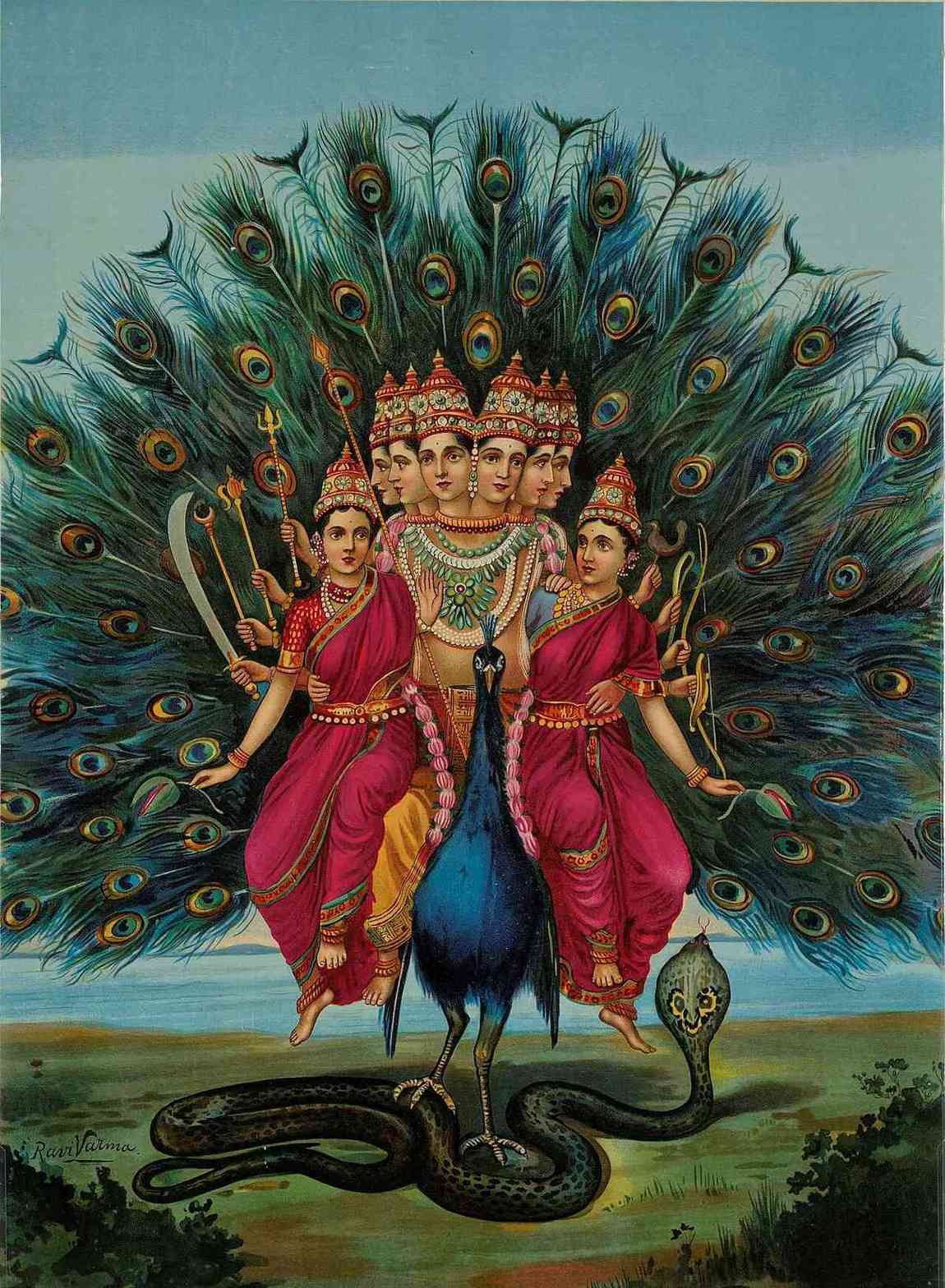
Lord Kārttikeya, known variously as Skanda, Murugan, Subrahmaṇya, Ṣaṇmukha, and Kumāra, is one of the most widely venerated deities in the Hindu pantheon. As the elder son of Lord Śiva and Goddess Pārvatī, he holds the supreme title of Devasenāpati — Commander-in-Chief of the celestial armies. His mythology, spanning the Skanda Purāṇa, Śiva Purāṇa, Mahābhārata, and the classical Sanskrit poem Kumārasambhava by Kālidāsa, presents a deity who embodies youthful valour, spiritual wisdom, and the triumph of dharma over cosmic evil.
Origins and Birth
The birth of Kārttikeya is one of the most elaborate divine narratives in Hindu scripture, with multiple accounts across different textual traditions.
According to the Śiva Purāṇa, the demon Tārakāsura performed severe tapas (austerities) to propitiate Brahmā, who granted him the boon that only a son born of Śiva could destroy him. Since Śiva was immersed in profound meditation following the death of his first consort Satī, the gods despaired, believing no such child would ever be born. The gods sent Kāmadeva (the god of desire) to awaken Śiva from his asceticism, but Śiva reduced Kāma to ashes with his third eye. It was only through the devoted tapas of Pārvatī that Śiva was finally moved to accept her as his consort (Kumārasambhava, Cantos I–VIII).
The Śiva Purāṇa and Skanda Purāṇa relate that six divine sparks of Śiva’s tejas (spiritual fire) were carried by Agni (the fire god) and deposited in the Śaravana (a forest of reeds) beside the river Gaṅgā. There, six infants were born and were nursed by the six Kṛttikā stars (the Pleiades constellation). When Pārvatī embraced them, the six children merged into one divine child with six heads and twelve arms — hence the names Ṣaṇmukha (“Six-Faced”) and Kārttikeya (“Son of the Kṛttikās”) (Śiva Purāṇa, Kumārakhaṇḍa).
An alternate account in the Vana Parva of the Mahābhārata (III.213–221) describes him as the son of Agni and Svāhā, where Svāhā deposited Agni’s seed in the reeds of the Gaṅgā, and the child emerged as the six-headed Skanda.
Names and Epithets
Kārttikeya is known by a remarkable array of names, each illuminating a different facet of his divine nature:
- Skanda — from the Sanskrit root skand-, meaning “to leap” or “to attack,” denoting his warrior prowess.
- Murugan (Tamil: முருகன்) — meaning “the beautiful or youthful one,” the name by which he is most beloved in Tamil-speaking regions.
- Subrahmaṇya — often interpreted as “dear to the Brāhmaṇas” or “one of auspicious wisdom,” linking his martial glory to spiritual knowledge.
- Ṣaṇmukha (Shanmukha) — “Six-Faced,” referring to his distinctive six heads.
- Kumāra — “the youthful prince,” emphasizing his eternal youth and beauty.
- Devasenāpati — “Commander of the divine army.”
- Śaravana-bhava — “born in the forest of reeds.”
- Daṇḍāyudhapāṇi — “he who holds the staff as weapon,” the ascetic form venerated at Palani.
Iconography and Symbols
Kārttikeya’s iconography is rich with symbolic meaning. The Skanda Purāṇa describes his Ṣaṇmukha form as having six faces and twelve arms, bearing an array of divine weapons including the spear, bow, sword, discus, and mace.
- Vel (Śakti) — His primary weapon is the Vel, a divine spear bestowed upon him by his mother Pārvatī. The Vel represents jñāna-śakti (the power of wisdom) that pierces through ignorance and illusion (Skanda Purāṇa; Tirumurugāṟṟuppaṭai).
- Peacock (Paravāṇi) — His vāhana (mount) is the peacock, which in Tamil Purāṇic tradition was originally the demon Sūrapadmā himself, transformed after being split by the Vel. The peacock symbolizes the conquest of ego and the transmutation of vice into beauty.
- Rooster banner (Seval Koḍi) — The rooster adorns his battle flag, signifying the announcement of dawn, the victory of light over darkness, and perpetual vigilance.
- Youthful appearance — He is invariably depicted as an eternally young warrior, radiant with golden lustre, embodying vigour, purity, and divine grace.
The Slaying of Tārakāsura and Sūrapadmā
The primary mythological purpose of Kārttikeya’s birth was the destruction of the demon Tārakāsura, who had rendered the gods helpless through his boon of near-invincibility. Shortly after his birth, the young Kārttikeya was appointed commander of the divine armies. He led the Devas into battle and slew Tārakāsura with his Vel, restoring cosmic order (Śiva Purāṇa, Kumārakhaṇḍa; Mahābhārata, Śalya Parva 44–46).
In the Tamil Purāṇic tradition, particularly the Kanda Purāṇam (the Tamil rendering of the Skanda Purāṇa), the narrative extends to the great war against Sūrapadmā and his brothers Siṁhamukha and Tārakāsura. The climactic six-day battle culminates on the day of Sūrasamhāra (“the annihilation of Sūra”). When the desperate Sūrapadmā transforms into a massive mango tree to escape destruction, Kārttikeya hurls his Vel and splits the tree in two. One half becomes the peacock (his mount) and the other becomes the rooster (his banner). This event is commemorated annually during the festival of Skanda Ṣaṣṭhī.
Family and Relationships
Kārttikeya occupies a central place within the divine family of Śiva:
- Śiva and Pārvatī — As their son, he embodies the union of the supreme ascetic (Śiva) and primordial Śakti (Pārvatī). His mother’s gift of the Vel underscores that divine power (śakti) is essential for even the gods to overcome evil.
- Gaṇeśa — The relationship between Kārttikeya and his brother Gaṇeśa is celebrated in the well-known tale of the race around the universe. While Kārttikeya physically circumnavigated the cosmos on his peacock, Gaṇeśa simply circled his parents, declaring them to be his entire world. In different regional traditions, either Kārttikeya or Gaṇeśa is considered the elder.
- Devayānī (Devasenā) and Vallī — Kārttikeya’s two consorts represent complementary aspects of devotion: Devasenā, daughter of Indra, symbolizes the formal, Vedic path, while Vallī, the tribal huntress, embodies passionate personal bhakti. Their union with Murugan signifies the integration of all social and spiritual paths.
- Swāmināthan — At the temple of Swāmimalai in Tamil Nadu, Kārttikeya is worshipped as Swāmināthan, “the lord who became the guru,” for here he revealed the meaning of the sacred syllable Oṁ (Praṇava) to his own father Śiva — a profound reversal that establishes Kārttikeya as a supreme teacher.
South Indian Worship: Murugan and the Āṟupaṭai Vīṭu
While Kārttikeya is venerated throughout India, his worship reaches extraordinary intensity in Tamil Nadu, where as Murugan he is regarded as the Tamil Kaṭavuḷ (God of the Tamils). The ancient Sangam literature, including the Tirumurugāṟṟuppaṭai by Nakkīrar, is one of the earliest devotional hymns to Murugan.
The Āṟupaṭai Vīṭu (“Six Battle Camps”) are six sacred temples in Tamil Nadu, each associated with a specific episode in Murugan’s mythology:
- Tirupparaṅkunṟam — where Murugan married Devasenā after defeating Sūrapadmā.
- Tiruccentūr — the only seaside temple, marking the battlefield where Sūrapadmā was vanquished.
- Paḻani — where Murugan appears as the ascetic Daṇḍāyudhapāṇi, having renounced all ornaments.
- Swāmimalai — where Murugan taught the Praṇava mantra to Śiva.
- Tiruttaṇi — symbolizing peace and serenity after victory, where he married Vallī.
- Paḻamutircōlai — a lush forest shrine where Murugan resides with both consorts.
The festival of Thaipūsam, celebrated in the Tamil month of Thai (January–February), is marked by intense acts of devotion, including the carrying of kāvaḍi — ornate burdens borne on the shoulders, often involving ceremonial piercing — as offerings of penance and gratitude to Murugan. This festival draws millions of devotees, not only in Tamil Nadu but also among Tamil diaspora communities in Malaysia, Singapore, Sri Lanka, and beyond.
Kartik Pūjā in Bengal
In Bengal, Kārttikeya is worshipped as Kārtik Ṭhākur, though the character of his veneration differs markedly from the South. Observed on Kārtik Saṅkrānti (the final day of the Bengali month of Kārtik), the festival carries a distinctly agrarian dimension. Here Kārttikeya is revered not primarily as a warrior but as a guardian of crops, fertility, and children’s welfare. Families worship small clay images of the deity with offerings of rice, pulses, and seasonal produce, reflecting Bengal’s deep connection between religious observance and the harvest cycle. The earliest known Kārttikeya images in North Bengal, discovered at Mahāsthāngarh, date to the 1st–2nd century CE, attesting to the deity’s ancient presence in the region (Murugan.org, Seethalakshmi).
Philosophical Significance
Beyond mythology, Kārttikeya embodies profound philosophical teachings:
- The six faces represent mastery over the five senses and the mind — a prerequisite for spiritual liberation. They also symbolize the overcoming of the six inner enemies: kāma (lust), krodha (anger), lobha (greed), moha (delusion), mada (pride), and mātsarya (jealousy).
- The Vel as jñāna-śakti signifies that true victory is achieved not through brute force but through the piercing clarity of discriminative wisdom (viveka).
- The peacock mount teaches that beauty can emerge from the transmutation of base tendencies — the proud, aggressive demon becomes a vehicle of grace.
- Kumāra (eternal youth) represents the ever-fresh nature of ātman (the Self), untouched by time and decay.
- Swāmināthan — the child teaching the father — embodies the Upaniṣadic insight that brahmavidyā (knowledge of Brahman) transcends all worldly hierarchies, including familial ones.
In the words of the Tirumurugāṟṟuppaṭai: Murugan is both the goal and the guide, the warrior who destroys outer demons and the guru who dispels inner darkness. His worship thus integrates karma (action), bhakti (devotion), and jñāna (knowledge) into a single, luminous path toward the Divine.