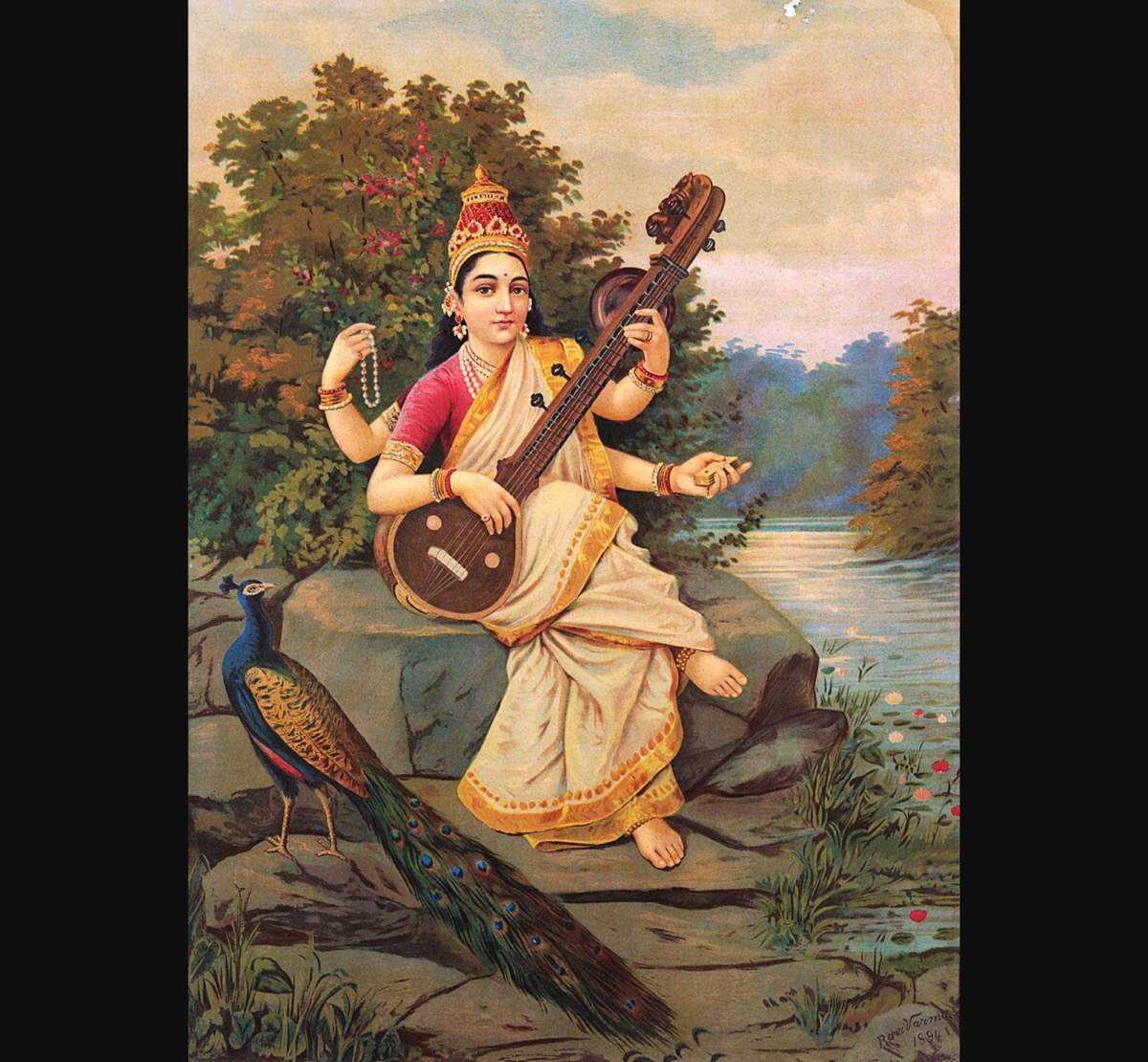
The Sarasvatī Vandanā is among the most universally recited prayers in all of Hindu worship. Beginning with the immortal words “Yā Kuṇḍendu Tuṣāra Hāra Dhavalā” (“She who is as white as the jasmine, the moon, and the snow-garland”), this single verse paints a luminous portrait of Goddess Sarasvatī — the divine embodiment of knowledge, wisdom, music, and all the arts. Recited daily in millions of homes and schools across India, chanted at the commencement of studies and at the beginning of musical performances, the Sarasvatī Vandanā occupies a uniquely central place in Hindu devotional life.
The Complete Prayer in Sanskrit
The most commonly recited Sarasvatī Vandanā consists of one celebrated verse, often accompanied by additional invocation verses:
The Principal Verse
या कुन्देन्दुतुषारहारधवला या शुभ्रवस्त्रावृता या वीणावरदण्डमण्डितकरा या श्वेतपद्मासना। या ब्रह्माच्युतशङ्करप्रभृतिभिर्देवैः सदा पूजिता सा मां पातु सरस्वती भगवती निःशेषजाड्यापहा॥
IAST: Yā Kuṇḍendutuṣārahāradhavalā Yā Śubhravastrāvṛtā Yā Vīṇāvaradaṇḍamaṇḍitakarā Yā Śvetapadmāsanā | Yā Brahmācyutaśaṅkaraprabhṛtibhir Devaiḥ Sadā Pūjitā Sā Māṃ Pātu Sarasvatī Bhagavatī Niḥśeṣajāḍyāpahā ||
Translation: “She who is as radiant as the jasmine flower, the moon, and the snow-garland, She who is draped in pure white garments, She whose hands are adorned with the excellent Vīṇā, She who is seated upon a white lotus, She who is always worshipped by Brahmā, Viṣṇu (Acyuta), Śaṅkara (Śiva), and all the gods — may that Goddess Sarasvatī, the Blessed One, the complete remover of all dullness and ignorance, protect me.”
The Supplementary Invocation
The Vandanā is often preceded or followed by this verse:
शुक्लां ब्रह्मविचारसारपरमामाद्यां जगद्व्यापिनीं वीणापुस्तकधारिणीमभयदां जाड्यान्धकारापहाम्। हस्ते स्फाटिकमालिकां विदधतीं पद्मासने संस्थितां वन्दे तां परमेश्वरीं भगवतीं बुद्धिप्रदां शारदाम्॥
IAST: Śuklāṃ Brahmavicārasāraparamām Ādyāṃ Jagadvyāpinīṃ Vīṇāpustakadhāriṇīm Abhayadāṃ Jāḍyāndhakārāpahām | Haste Sphaṭikamālikāṃ Vidadhatīṃ Padmāsane Saṃsthitāṃ Vande Tāṃ Parameśvarīṃ Bhagavatīṃ Buddhipradāṃ Śāradām ||
Translation: “I salute that Śāradā (Sarasvatī), the Supreme Goddess, the Blessed One who bestows wisdom — She who is white, who is the supreme essence of the inquiry into Brahman, who is primeval, who pervades the universe, who holds the Vīṇā and the book, who grants fearlessness, who dispels the darkness of ignorance, who holds a crystal rosary in Her hand, and who is seated on a lotus.”
Word-by-Word Analysis of the Principal Verse
The principal verse is a masterwork of descriptive theology, each compound word painting one element of Sarasvatī’s divine form:
First Line: The White Radiance
- Yā — She who
- Kuṇḍendu-tuṣāra-hāra-dhavalā — is as white/radiant (dhavalā) as the jasmine flower (kuṇḍa), the moon (indu), snow (tuṣāra), and a garland (hāra)
- Yā — She who
- Śubhra-vastra-āvṛtā — is clothed (āvṛtā) in bright/pure white (śubhra) garments (vastra)
The opening compound is a cascade of whiteness — four increasingly luminous images of purity: the jasmine blossom, the moon, fresh snow, and a radiant garland. White in Hindu iconography represents sattva — the quality of purity, truth, and luminosity. Unlike Lakṣmī (draped in red and gold, symbolising worldly prosperity) or Durgā (in red, symbolising power), Sarasvatī wears pure white, signifying that true knowledge is untouched by material desire.
Second Line: The Vīṇā and the Lotus
- Yā — She who
- Vīṇā-vara-daṇḍa-maṇḍita-karā — whose hands (karā) are adorned (maṇḍita) with the staff (daṇḍa) of the excellent (vara) Vīṇā
- Yā — She who
- Śveta-padma-āsanā — is seated (āsanā) upon a white (śveta) lotus (padma)
The Vīṇā is Sarasvatī’s most iconic attribute. This ancient stringed instrument represents the harmony of all knowledge — the arts, sciences, and philosophy unified in a single vibrating string. The white lotus (śveta padma) is remarkable: most Hindu deities sit on a red or pink lotus, but Sarasvatī’s is white, once again emphasising the purity and otherworldliness of true learning. The Padma Purāṇa (Uttara Khaṇḍa) states that the white lotus of Sarasvatī blooms in the lake of the aspirant’s mind when knowledge dawns.
Third Line: Worshipped by the Trimūrti
- Yā — She who
- Brahmā-Acyuta-Śaṅkara-prabhṛtibhiḥ — by Brahmā, Acyuta (Viṣṇu), Śaṅkara (Śiva), and others (prabhṛtibhiḥ — “beginning with”)
- Devaiḥ — by the gods
- Sadā — always
- Pūjitā — is worshipped
This line establishes Sarasvatī’s supremacy: even the Trimūrti — Brahmā the creator, Viṣṇu the preserver, and Śiva the destroyer — worship Her. This is theologically significant: knowledge (vidyā) is prior to and the foundation of all cosmic activity. Creation requires knowledge of what to create; preservation requires wisdom to sustain; and even dissolution requires the discernment of what must end. The Sarasvatī Rahasya Upaniṣad affirms: “Without Sarasvatī, even the gods are blind; with Her grace, even the ignorant become wise.”
Fourth Line: The Remover of Dullness
- Sā — She
- Māṃ — me
- Pātu — may She protect
- Sarasvatī — (the name itself: “she who flows” — saras = flowing, vatī = possessing)
- Bhagavatī — the Blessed One, the Glorious One
- Niḥśeṣa-jāḍya-apahā — the complete (niḥśeṣa) remover (apahā) of dullness/torpor (jāḍya)
The verse culminates in a prayer for protection from jāḍya — mental dullness, torpor, intellectual laziness. In Vedāntic terms, jāḍya is not merely stupidity but the fundamental tamas (darkness) that prevents the mind from perceiving truth. Sarasvatī’s grace is the light that dispels this darkness completely (niḥśeṣa — “without remainder”).
Sarasvatī in Vedic Literature
The worship of Sarasvatī is among the oldest in the Hindu tradition. In the Ṛgveda, Sarasvatī appears primarily as a mighty river goddess — the greatest of all rivers, whose waters purify and inspire. The Ṛgveda (1.3.10-12) invokes Her: “Sarasvatī, the inspirer of true thoughts, the awakener of noble aspirations.” The Ṛgveda (6.61.7) praises Her as “She who kills the Vṛtras” — a warrior goddess who vanquishes the forces of obstruction.
Over time, the river goddess Sarasvatī evolved into the goddess of speech (Vāk), wisdom, and all learning. The Ṛgveda (10.71) and the Vāk Sūkta (Ṛgveda 10.125) — in which the goddess of Speech declares herself the supreme power — provided the theological bridge. By the Purāṇic period, Sarasvatī was firmly established as the consort of Brahmā and the universal goddess of knowledge.
Iconographic Symbolism
The Vandanā’s description of Sarasvatī matches her traditional iconographic depiction with precision:
| Attribute | Symbol | Meaning |
|---|---|---|
| White colour | Sattva guṇa | Purity, luminosity, truth |
| White garments | Simplicity | Knowledge needs no ornamentation |
| Vīṇā | Musical harmony | Unified knowledge; mastery of nāda (sound) |
| Book (Pustaka) | Vedas/Śāstras | Written wisdom and scriptural authority |
| Crystal rosary (Sphaṭika mālā) | Meditation | Contemplative practice, counting of mantras |
| White lotus seat | Spiritual purity | Knowledge blooming from the mud of ignorance |
| Swan (Haṃsa) vehicle | Discrimination | Viveka — the ability to separate truth from falsehood |
| Flowing water | Saras (flow) | Knowledge as an ever-flowing river |
The Haṃsa (swan), though not mentioned in this particular verse, is Sarasvatī’s traditional vehicle. According to legend, the swan possesses the ability to separate milk from water — symbolising viveka, the supreme intellectual faculty of discriminating the real from the unreal.
Use in Educational Settings
The Sarasvatī Vandanā holds a uniquely practical role in Indian life. It is recited:
- At the start of the school day — Millions of students across India begin each morning with this prayer
- During Sarasvatī Pūjā — The annual worship of Sarasvatī, especially prominent during Vasanta Pañcamī (the fifth day of the bright half of Māgha, marking the onset of spring)
- At the start of music lessons — Both Carnatic and Hindustāni musicians invoke Sarasvatī before practice and performance
- During Vidyāraṃbha — The ceremony of initiating a child into letters, performed on Vijayādaśamī in Kerala and other South Indian states
- Before examinations — Students across India pray to Sarasvatī for clarity and wisdom
- At the beginning of any lecture, discourse, or scholarly activity
Vasanta Pañcamī / Sarasvatī Pūjā
Vasanta Pañcamī (also called Śrī Pañcamī) is the principal festival of Sarasvatī worship. Falling in January-February, it marks the beginning of spring. On this day:
- Books, musical instruments, and tools of learning are placed before Sarasvatī’s image and worshipped
- Students offer flowers, fruits, and prayers seeking Her blessing for academic success
- In Bengal, Sarasvatī Pūjā is one of the most beloved festivals, celebrated with elaborate pandals, cultural programmes, and community worship
- Yellow is the colour of the day — yellow flowers, yellow garments, and yellow food are offered, symbolising the radiance of knowledge and the coming spring
Theological Dimensions
Sarasvatī as Brahmavidyā
In the Vedāntic tradition, Sarasvatī represents Brahmavidyā — the supreme knowledge of Brahman (Ultimate Reality). The Sarasvatī Rahasya Upaniṣad identifies Her directly with the liberating wisdom that frees the soul from the cycle of birth and death. She is not merely a “goddess of books” but the very power (śakti) of consciousness that enables any knowing whatsoever.
Sarasvatī as Vāk (Sacred Speech)
The identification of Sarasvatī with Vāk (divine speech) connects Her to the most fundamental creative power in Vedic cosmology. The universe was created through speech — “In the beginning was the Word” (cf. Ṛgveda 10.71). Sarasvatī as Vāk is the power through which Brahman manifests as the cosmos. Every mantra, every sacred text, every philosophical insight arises from Her.
Sarasvatī in the Śākta Tradition
In the Śākta tradition, Sarasvatī is understood as one of the Mahāvidyās or as a manifestation of Mahādevī (the Great Goddess). She represents the sāttvic aspect of the Divine Feminine — the power that illumines, clarifies, and liberates. The Devī Māhātmya (Mārkaṇḍeya Purāṇa, chapters 81-93) presents Sarasvatī alongside Lakṣmī and Kālī as the three primary śaktis of the Supreme Goddess.
The Vandanā in Musical Tradition
The Sarasvatī Vandanā has been set to numerous rāgas in both the Carnatic and Hindustāni traditions. Among the most celebrated musical settings:
- “Sarasvatī Namastubhyam” — A widely sung invocation in rāga Sarasvatī (a rāga named after the goddess herself)
- The legendary Carnatic composer Muttusvāmi Dīkṣitar (1775–1835) composed the sublime “Śrī Sarasvatī Namastubhyam” in rāga Ārabhi
- Tyāgarāja (1767–1847) composed multiple kṛtis invoking Sarasvatī’s grace for musical inspiration
- In the Hindustāni tradition, the opening ālāp of a rāga performance is often considered an offering to Sarasvatī
The connection between music and Sarasvatī is not incidental — in Hindu philosophy, Nāda Brahman (the Absolute as Sound) is the primordial creative force, and Sarasvatī, who holds the Vīṇā, is the mistress of this cosmic sound.
Sarasvatī in Regional Traditions
Bengal
In Bengal, Sarasvatī Pūjā is one of the most joyous festivals of the year. Students worship their books and instruments, and the festival is imbued with the energy of youthful aspiration. The iconic image of Sarasvatī in Bengal depicts Her in a white sari with a Vīṇā, seated on a white lotus, with a swan and a peacock.
South India
In Kerala and Tamil Nadu, Sarasvatī is worshipped during Navarātri (the last three days are dedicated to Her). The practice of Vidyāraṃbha — initiating young children into writing by making them trace the syllable “Oṃ Hariḥ Śrī Gaṇapataye Namaḥ” in a plate of rice — is performed under Sarasvatī’s blessing on Vijayādaśamī.
North India
During Vasanta Pañcamī, particularly in Uttar Pradesh, Punjab, and Bihar, Sarasvatī Pūjā is celebrated with great devotion. In Punjab, this day also marks the beginning of the kite-flying season, and the yellow mustard fields are seen as nature’s offering to the golden-complexioned Sarasvatī.
The Enduring Power of the Vandanā
The Sarasvatī Vandanā endures because it speaks to a universal human need: the longing for clarity, wisdom, and the light of understanding. In a single verse, it captures the entire theology of learning — that knowledge is not merely the accumulation of facts but a radiant, divine grace that must be sought with humility, received with gratitude, and shared without reservation. When millions of students chant “Yā Kuṇḍendu Tuṣāra Hāra Dhavalā” each morning, they participate in a tradition that stretches back to the Vedic sages who first praised Sarasvatī on the banks of Her sacred river, invoking the light of wisdom to flow through their minds like the waters of the great river that bears Her name.