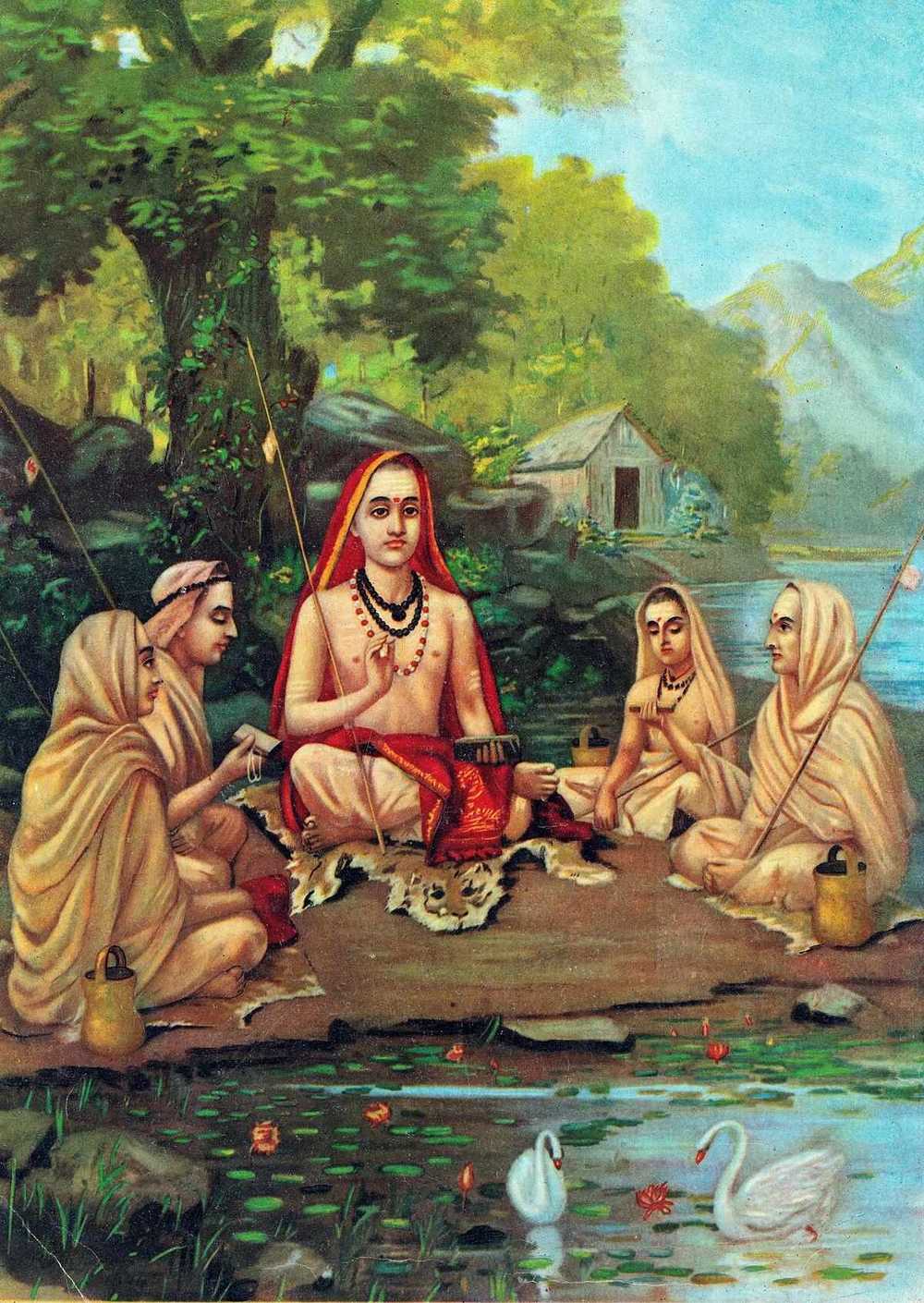
The Complete Mantra
The Oṁ Saha Nāvavatu is one of the most widely recited Śānti Mantras (peace invocations) in the Hindu tradition. It appears at the opening of the Brahmānandavallī, the second chapter of the Taittirīya Upaniṣad, which belongs to the Kṛṣṇa Yajurveda. Traditionally chanted in unison by the teacher (guru) and the student (śiṣya) before commencing the study of the Upaniṣad, this mantra establishes the sacred covenant of learning.
Devanāgarī Text
ॐ सह नाववतु। सह नौ भुनक्तु। सह वीर्यं करवावहै। तेजस्वि नावधीतमस्तु मा विद्विषावहै। ॐ शान्तिः शान्तिः शान्तिः॥
IAST Transliteration
Oṁ saha nāvavatu, saha nau bhunaktu, saha vīryaṁ karavāvahai. Tejasvi nāvadhītam astu, mā vidviṣāvahai. Oṁ śāntiḥ śāntiḥ śāntiḥ.
Complete Translation
“Oṁ! May He protect us both (teacher and student together). May He nourish us both. May we both work with great vigour. May our study be brilliant and effective. May we never quarrel with each other. Oṁ! Peace, peace, peace.”
Word-by-Word Analysis
A precise understanding of this mantra requires examining each Sanskrit word and its grammatical function:
-
Oṁ (ॐ) — The praṇava, the primordial sacred syllable representing Brahman, the Absolute Reality. Every Vedic recitation begins and ends with Oṁ.
-
Saha (सह) — “Together,” indicating the mutual, cooperative nature of the prayer. Both teacher and student are included simultaneously.
-
Nau (नौ) — “Us both” (dual number of the first-person pronoun asmad). The use of the dual number (dvivacana) rather than the plural is grammatically precise — it refers specifically to the pair of guru and śiṣya.
-
Avatu (अवतु) — “May He protect” (third person singular imperative of the root av, “to protect, to guard”). The unnamed subject is Brahman or Īśvara, the Lord who is the ultimate protector.
-
Bhunaktu (भुनक्तु) — “May He nourish” (third person singular imperative of the root bhuj, “to enjoy, to nourish, to feed”). This refers to spiritual and intellectual nourishment — the sustenance needed for the pursuit of knowledge.
-
Vīryam (वीर्यम्) — “Vigour, strength, energy” — not merely physical but the spiritual resolve and intellectual capacity needed for Vedāntic inquiry.
-
Karavāvahai (करवावहै) — “May we both do, may we both exert” (first person dual, ātmanepada of the root kṛ, “to do”). Again, the dual form emphasises the collaborative endeavour.
-
Tejasvi (तेजस्वि) — “Brilliant, luminous, full of splendour” — from tejas, meaning radiance, intellectual brilliance, or spiritual lustre.
-
Nau (नौ) — “Of us both” (genitive dual).
-
Adhītam (अधीतम्) — “Study, what has been studied” (past passive participle of adhi + ī, “to study, to learn”). This specifically refers to the Upaniṣadic knowledge being imparted.
-
Astu (अस्तु) — “May it be” (third person singular imperative of as, “to be”).
-
Mā (मा) — The prohibitive particle, “not, never.”
-
Vidviṣāvahai (विद्विषावहै) — “May we (two) hate each other” (first person dual, ātmanepada of vi + dviṣ, “to hate mutually”). Together with mā, this means “may we never develop mutual animosity.”
-
Śāntiḥ (शान्तिः) — “Peace” — chanted three times to ward off the three categories of obstacles (tāpatraya).
The Three-fold Śānti: Warding Off Obstacles
The triple utterance of śāntiḥ at the conclusion is not mere repetition — it is a deliberate invocation against the three categories of suffering (tāpatraya) recognised in Vedāntic philosophy:
-
Ādhidaivika (आधिदैविक) — Disturbances arising from divine or cosmic forces: natural calamities, earthquakes, storms, and celestial phenomena beyond human control. The first śāntiḥ is chanted aloud, directed upward toward these cosmic forces.
-
Ādhibhautika (आधिभौतिक) — Disturbances caused by other beings: wild animals, insects, hostile persons, or any external living agent. The second śāntiḥ is chanted at a moderate volume, directed at the surrounding environment.
-
Ādhyātmika (आध्यात्मिक) — Disturbances arising from within oneself: physical illness, mental agitation, emotional turbulence, laziness, or doubt. The third śāntiḥ is chanted softly, directed inward.
Ādi Śaṅkarācārya, in his commentary (bhāṣya) on the Taittirīya Upaniṣad, explains that these three repetitions serve as a prayer for the complete removal of all obstacles to the study of Brahmavidyā (the knowledge of Brahman).
The Taittirīya Upaniṣad: Context and Structure
The Taittirīya Upaniṣad is one of the oldest and most revered of the principal Upaniṣads. It forms part of the Taittirīya Āraṇyaka, which itself belongs to the Kṛṣṇa Yajurveda — one of the four Vedas. The Upaniṣad is divided into three sections called vallī (literally “creeper” or “branch”):
1. Śīkṣāvallī (The Chapter on Education)
This first section deals with phonetics (śīkṣā), the science of Vedic pronunciation, and the teacher’s instructions to the graduating student. It opens with its own Śānti Mantra (Oṁ śaṁ no Mitraḥ…) and culminates in the famous convocation address (samāvartana) where the teacher sends the student into the world with ethical exhortations: “Speak the truth. Follow dharma. Do not neglect your study.”
2. Brahmānandavallī (The Chapter on the Bliss of Brahman)
Our Śānti Mantra — Oṁ Saha Nāvavatu — opens this second chapter. The Brahmānandavallī contains the celebrated teaching of the five sheaths (pañcakośa): the physical body (annamaya), the vital breath (prāṇamaya), the mind (manomaya), the intellect (vijñānamaya), and bliss (ānandamaya). Through a progressive inward journey, the student is led from the gross to the subtle, ultimately arriving at Brahman as infinite bliss (ānanda).
3. Bhṛguvallī (The Chapter of Bhṛgu)
The third section narrates the story of Bhṛgu, son of Varuṇa, who through repeated contemplation and his father’s guidance — “Seek to know that from which all beings are born” — progressively discovers Brahman through each of the five sheaths, finally realising that ānanda (bliss) is Brahman.
The Guru-Śiṣya Tradition
The Oṁ Saha Nāvavatu mantra is perhaps the most eloquent expression of the guru-śiṣya (teacher-student) relationship in all of Vedic literature. Unlike modern educational paradigms where knowledge flows in one direction — from teacher to student — the Vedic model envisions learning as a mutual, sacred undertaking.
Mutual Protection and Nourishment
The mantra’s opening petition — “May He protect us both” — is remarkable. The teacher does not pray only for the student’s welfare, nor does the student pray only for the teacher’s blessing. Instead, both together pray for each other. Śaṅkarācārya comments that the teacher needs protection from the frustration of teaching an inattentive student, while the student needs protection from the confusion of improper instruction. Both are vulnerable; both need divine grace.
Collaborative Vigour
“May we both work with great vigour” (saha vīryaṁ karavāvahai) acknowledges that the transmission of Brahmavidyā requires sustained effort from both parties. The guru must exert himself to present the teaching clearly, using appropriate analogies and methods. The student must exert himself in listening (śravaṇa), reflection (manana), and deep meditation (nididhyāsana). Neither can succeed alone.
Freedom from Animosity
The final petition — “May we never quarrel with each other” — addresses a very human danger in the intimate teacher-student relationship. When the student challenges the teacher or the teacher disciplines the student, friction can arise. The mantra preemptively seeks divine protection against this. Śaṅkarācārya notes that intellectual disagreement (vidveṣa) between guru and śiṣya is the greatest obstacle to the transmission of knowledge. Where there is hostility, there can be no real learning.
Ādi Śaṅkarācārya’s Commentary
Ādi Śaṅkarācārya (circa 788–820 CE), the pre-eminent commentator of the Advaita Vedānta tradition, wrote an extensive bhāṣya (commentary) on the Taittirīya Upaniṣad. His analysis of this Śānti Mantra illuminates several key points:
-
The unnamed subject is Brahman: When the mantra says “May He protect us both,” the “He” refers to Parameśvara (the Supreme Lord), who is identical with Brahman. Śaṅkara explains that before undertaking the study of Brahman, one must invoke Brahman’s own grace — for only by Brahman’s favour can Brahman be known.
-
The purpose of the mantra is the removal of obstacles: Śaṅkara identifies the Śānti Mantra as an upāsanā (meditative invocation) whose specific function is to clear away all impediments to successful Upaniṣadic study. Without this preparatory purification, the subtle truths of the Brahmānandavallī cannot be grasped.
-
The dual number is intentional: Śaṅkara draws attention to the consistent use of the dual number throughout the mantra (nau, āvahai, etc.), confirming that this is specifically a prayer for the teacher-student pair, not for a congregation.
-
Brilliance of study means realisation: When the mantra prays that “our study be brilliant” (tejasvi nāvadhītam astu), Śaṅkara interprets tejas not merely as intellectual sharpness but as the transformative luminosity that arises when scriptural knowledge is truly assimilated — when parokṣa jñāna (indirect knowledge) becomes aparokṣa jñāna (direct realisation).
Significance in Daily Practice
The Oṁ Saha Nāvavatu mantra continues to hold a central place in Hindu religious and educational life:
-
Vedic pāṭhaśālās (traditional schools): The mantra is chanted daily before the commencement of scriptural study, maintaining the unbroken oral tradition that stretches back thousands of years.
-
Modern yoga studios: The mantra is frequently chanted at the beginning of yoga classes worldwide, inviting a spirit of cooperation and mutual respect between teacher and practitioner.
-
Hindu ceremonies: The mantra is recited at upanayana (sacred thread) ceremonies, guru pūrnimā celebrations, and at the inauguration of any new course of religious study.
-
Vedānta classes: In contemporary Advaita Vedānta teaching institutions such as those established by Swami Dayananda Saraswati and Swami Chinmayananda, this mantra is chanted at the beginning and end of every class session.
The mantra’s universal appeal lies in its simple yet profound vision: that learning is not extraction but communion, not competition but collaboration, and that the highest knowledge can only be transmitted in an atmosphere of mutual protection, nourishment, effort, brilliance, and peace.
Recitation and Metre
The Oṁ Saha Nāvavatu is composed in prose (gadya) rather than in a specific Vedic metre (chandas). This is characteristic of many Upaniṣadic passages, which often alternate between verse and prose. Being a Śānti Mantra, it is classified as a prārthanā (prayer) rather than a ṛk (verse hymn) or sāman (chant melody).
In Vedic recitation, the mantra follows the svarita (tonal accent) patterns of the Kṛṣṇa Yajurveda. The three śāntiḥ utterances are traditionally chanted with decreasing volume — the first loudly, the second at moderate volume, and the third softly — corresponding to the three sources of obstacles as described above.
The mantra is customarily chanted at both the beginning and the end of an Upaniṣadic study session: at the start, to invoke protection and blessings; at the close, to offer gratitude and seal the knowledge received.