Agama Shastra (आगम शास्त्र) is one of the most vital yet often overlooked pillars of living Hindu practice. While the Vedas and Upanishads enjoy wide recognition as the philosophical and spiritual bedrock of Sanātana Dharma, it is the Āgamas that govern the day-to-day reality of how millions of Hindus worship — from the architectural blueprint of a temple to the precise mantras chanted during a deity’s morning bath, from the sacred geometry of the sanctum to the elaborate rites of consecration that bring a stone image to life as a living divine presence. Without the Āgamas, the grand temples of India — Madurai Mīnākṣī, Tirupati Veṅkaṭeśvara, Chidambaram Naṭarāja, Puri Jagannātha — would have neither their architectural form nor their ritual soul.
The word āgama derives from the Sanskrit root ā-gam, meaning “that which has come down” or “that which has been received as tradition.” The Āgamas present themselves as divine revelations — dialogues between Śiva and Pārvatī, or between Viṣṇu and Lakṣmī — transmitted through an unbroken lineage of teachers. They are regarded not as human compositions (pauruṣeya) but as expressions of divine will, complementary to the Vedas and in many traditions considered equal in authority.
Āgama and Nigama: The Twin Streams of Dharma
Hindu scriptural tradition recognises two great currents: Nigama (the Vedic stream) and Āgama (the Tantric-ritual stream). While Nigama centres on the sacrificial institution (yajña-saṃsthā) and the formless Absolute (nirguṇa Brahman), the Āgama tradition focuses on the worship of a personal God (saguṇa Īśvara) through icons, temples, and elaborate ritual sequences. The Nigama is considered anādi (beginningless) and apauruṣeya (authorless); the Āgamas, while also regarded as divine, are attributed to specific divine speakers — Śiva, Viṣṇu, or Devī.
Over centuries, these two streams converged in practice. The great synthesis visible in South Indian temple worship, for example, employs Vedic mantras for invocation and sanctification while following Āgamic prescriptions for the details of ritual procedure, temple design, and iconography. As the scholar Sreenivasarao Vepachedu notes, the Āgamas “borrow the mantras from the Vedic traditions and the ritualistic details from Tantric traditions,” creating a living fusion that claims Vedic validity while carrying out popular methods of devotional worship.
Classification: The Three Great Āgamic Streams
The Āgama literature is traditionally classified into three principal divisions corresponding to the three major devotional traditions of Hinduism:
1. Śaiva Āgamas
The Śaiva Āgamas are the foundational scriptures of Śaivism, particularly the Śaiva Siddhānta school that flourishes in Tamil Nadu and other parts of South India. Tradition enumerates 28 principal Śaiva Āgamas, revealed by the five faces of Śiva (Sadāśiva):
The ten Śivabheda Āgamas: Kāmika, Yogaja, Cintya, Kāraṇa, Ajita, Dīpta, Sūkṣma, Sahasraka, Aṃśumat, and Suprabheda.
The eighteen Rudrabheda Āgamas: Vijaya, Niḥśvāsa, Svāyambhuva, Anala, Vīra (Bhadra), Raurava, Makuṭa, Vimala, Candrajñāna, Mukhabimba, Prodgīta, Lalita, Siddha, Santāna, Sarvokta, Parameśvara, Kiraṇa, and Vātuḷa.
Each of these 28 primary Āgamas has numerous secondary texts called Upāgamas — tradition counts 207 such subsidiary works. The Kāmikāgama is regarded as the foremost, serving as a comprehensive manual that catalogues the entire Āgamic corpus and provides the foundational template for temple worship. The Kāmikāgama (Pūrva-bhāga 1.28-30) declares: “āgataṃ pañcavaktrāt tu gataṃ ca girirājajā-mukhe; mataṃ ca vāsudevasya, tasmād āgamam ucyate” — “That which has come from the five-faced [Śiva], gone to the mouth of the Mountain-King’s daughter [Pārvatī], and been approved by Vāsudeva [Viṣṇu] — that is called Āgama.”
2. Vaiṣṇava Āgamas
The Vaiṣṇava Āgamas, numbering 108 in traditional reckoning (also known as Saṃhitās), divide into two principal streams:
Pāñcarātra: The dominant Vaiṣṇava Āgamic tradition, attributed to Nārāyaṇa himself. The Pāñcarātra teaches the Pañcakāla or five daily observances: abhigamana (morning ablutions and prayer), upādāna (collecting worship materials), ijyā (ritual worship with offerings), svādhyāya (scriptural study), and yoga (meditation). Key Pāñcarātra texts include the Sāttvata Saṃhitā, Pauṣkara Saṃhitā, and Jayākhya Saṃhitā. Rāmānuja (eleventh century CE) established Pāñcarātra as the standard system of worship for the Śrī Vaiṣṇava community. Temples following this tradition include the Śrī Raṅganāthasvāmī temple at Srirangam and the Śrī Varadarāja Svāmī temple at Kanchipuram.
Vaikhānasa: An older, more strictly Vedic stream attributed to the sage Vikhanas. The Vaikhānasas understand their temple worship as a continuation of the Vedic yajña — they maintain that correct worship of Viṣṇu in a temple yields the same merit as fire sacrifice. Key texts include the Vaikhānasa Śrautasūtra and Vaikhānasa Smartasūtra. The Śrī Veṅkaṭeśvara temple at Tirupati, one of the most visited sacred sites in the world, follows Vaikhānasa Āgama. Unlike the Pāñcarātra, which is relatively liberal and accessible, the Vaikhānasa tradition maintains strict Vedic orthodoxy, mandating that priests must be born into Vaikhānasa families.
3. Śākta Āgamas (Tantras)
The Śākta Āgamas, traditionally numbering 64, are more commonly known simply as Tantras. They centre on the worship of Devī — the Divine Mother in her various forms (Durgā, Kālī, Tripurasundarī, and others). A notable distinction is that in the Śākta texts, the dialogue is reversed: it is the Goddess who teaches and Śiva who listens and questions. These texts are particularly influential in Bengal, Assam, Kerala, and Kashmir, and provide the scriptural foundation for the Śrī Vidyā tradition, the Kālī-kula and Śrī-kula lineages, and goddess-centred temple worship throughout India.
The Four Pādas: Structure of an Āgama Text
Each Āgama is traditionally composed of four sections known as pādas (literally “feet” or “quarters”), which together constitute a complete system of spiritual life:
Jñāna Pāda (Vidyā Pāda)
The knowledge section lays out the philosophical and metaphysical foundation: the nature of God (pati), the soul (paśu), and bondage (pāśa); the relationship between the individual self and the Supreme; the nature of reality, consciousness, and liberation (mokṣa). In Śaiva Siddhānta, for example, the Jñāna Pāda expounds the three eternal realities — Pati (Lord Śiva), Paśu (the bound soul), and Pāśa (the three bonds of āṇava, karma, and māyā).
Yoga Pāda
The yoga section describes the disciplines of inner practice: the eight-limbed yoga (aṣṭāṅga yoga), concentration (dhāraṇā), meditation (dhyāna), breath control (prāṇāyāma), awakening of kuṇḍalinī energy, visualization of the deity within the heart, and the various stages leading to unification with the Supreme. The Yoga Pāda bridges philosophical knowledge and external ritual by training the inner faculties of the aspirant.
Kriyā Pāda
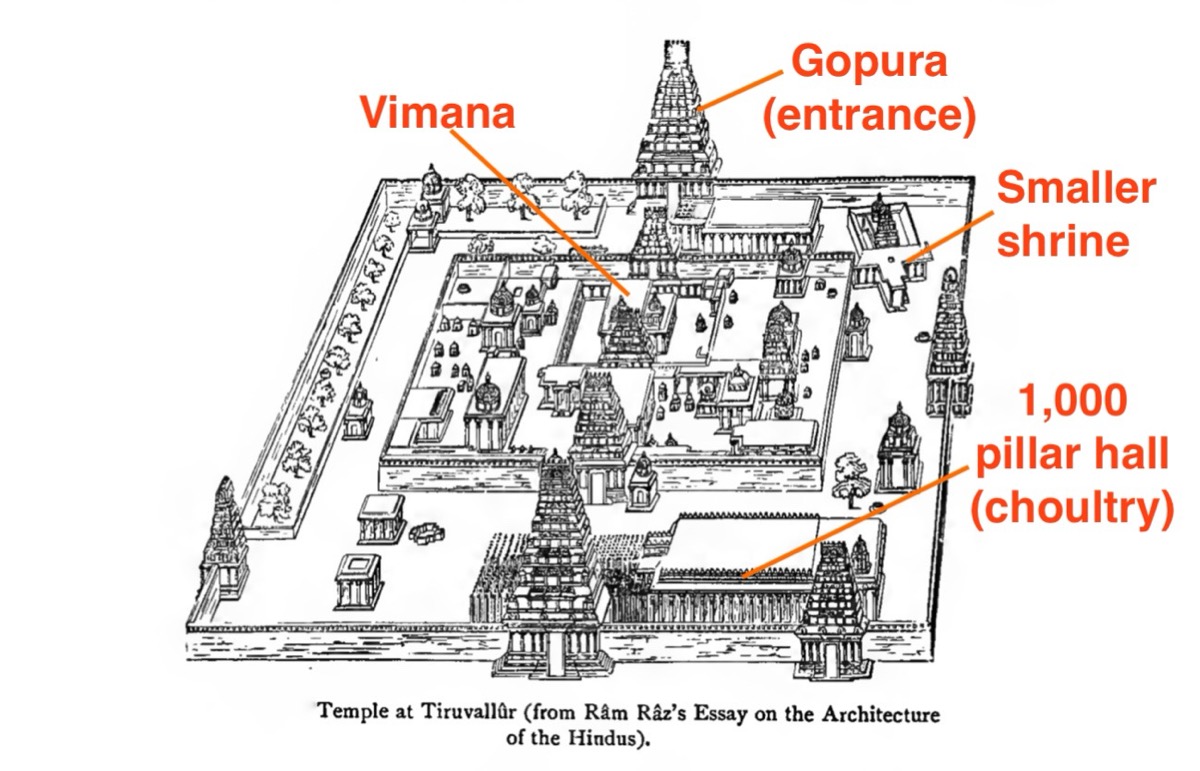
The ritual action section provides the tangible, practical rules governing the construction of temples (devalaya vastu), the sculpting and iconographic specifications of deity images (śilpa), the consecration ceremonies (pratiṣṭhā), and the installation of sacred objects. The Kriyā Pāda is essentially the architectural and engineering manual of the Āgamic tradition, prescribing everything from the proportions of a temple’s garbhagṛha (sanctum) and vimāna (tower) to the materials used for different classes of images.
Caryā Pāda
The conduct section describes the rules for daily worship (nitya pūjā), periodic festivals (naimitta pūjā), and the code of conduct for priests and devotees. It specifies the manner of approaching the deity, the sequence of offerings, the mantras to be chanted at each stage, the rules of ritual purity, and the observances expected of temple functionaries. The Caryā Pāda ensures that the sacred knowledge of the Āgama finds expression in lived, daily religious practice.
Temple Architecture: The Āgamic Blueprint
One of the most consequential contributions of the Āgamas is their detailed prescriptions for temple design and construction. The Kriyā Pāda of each Āgama provides comprehensive architectural specifications based on the Vāstu Puruṣa Maṇḍala — a sacred geometric diagram that maps cosmic principles onto a grid pattern. The Kāmikāgama and Suprabheda Āgama are particularly renowned for their architectural sections.
Key architectural principles prescribed by the Āgamas include:
Garbhagṛha (Womb Chamber): The innermost sanctum where the principal deity resides, conceived as the cosmic womb from which all creation emerges. It must be a perfect square, oriented precisely to the cardinal directions, with the deity image placed at the intersection of the diagonals — the brahmasthāna (Brahman’s place).
Vimāna (Tower): The superstructure rising above the garbhagṛha, symbolising Mount Meru, the cosmic axis. The Āgamas classify vimānas into types — nāgara (northern, curvilinear), drāviḍa (southern, stepped pyramid), and vesara (hybrid) — each with precise mathematical proportions.
Prākāra (Enclosure Walls): Concentric courtyard walls surrounding the sanctum, representing progressively outer layers of cosmic manifestation. A great South Indian temple like Mīnākṣī at Madurai may have three or more prākāras, each with its own gopura (monumental gateway tower).
Maṇḍapa (Pillared Halls): Assembly halls for congregational worship, dance, music, and religious discourse, with specific prescriptions for pillar counts, spacing, and ornamentation.
The Āgamas employ the 64-square Maṇḍuka and 81-square Paramasāyika grid systems as the fundamental templates for temple layouts, ensuring that every element of the structure aligns with cosmic harmonics.
Prāṇa Pratiṣṭhā: Breathing Life into the Deity
Perhaps the most sacred and dramatic ritual prescribed by the Āgamas is Prāṇa Pratiṣṭhā — literally “establishing the life-breath.” This elaborate consecration ceremony transforms a stone, metal, or wooden image from mere material into a living receptacle of divine presence. The Kāmikāgama (Chapter 59) provides detailed instructions for this process.
The ceremony unfolds over several days and includes:
Adhivāsa (preparatory rites): The image is placed in a specially prepared pavilion and subjected to a series of purificatory baths (abhiṣeka) with sacred substances — milk, honey, turmeric water, sandalwood paste, and consecrated waters from holy rivers.
Nyāsa (placing of mantras): The priest ritually places specific mantras upon different parts of the deity’s body, energising each limb with divine power. This “mantra-body” is superimposed upon the physical form.
Netra-unmīlana (opening of the eyes): Using a golden needle, the priest ceremonially opens the eyes of the deity — a deeply symbolic act signifying that the divine is now “awake” and gazing upon the world. The Āgamas borrowed this practice from Vedic Gṛhya Sūtra traditions while incorporating Tāntric elements of prāṇa installation.
Prāṇāhuti (breath offering): Through specific mantras and breath techniques, the vital force (prāṇa) is invoked and established within the image. From this moment, the image is no longer symbolic but is understood as truly alive with divine consciousness.
The culminating ceremony is the Kumbhābhiṣeka (pot-consecration) — the pouring of consecrated waters from sacred pots (kumbha) over the temple’s vimāna and the deity, sealing the divine energy within the temple precinct.
Daily Worship: Ṣoḍaśopacāra Pūjā
The Āgamas prescribe a detailed daily worship cycle called Ṣoḍaśopacāra Pūjā — the “sixteen-service worship.” This sequence treats the deity as a living, divine guest to whom the priest renders sixteen acts of loving hospitality:
- Āvāhana — Invocation of the deity
- Āsana — Offering a seat
- Pādya — Washing the feet
- Arghya — Offering sanctified water
- Ācamanīya — Water for sipping
- Snāna/Abhiṣeka — Ceremonial bath
- Vastra — Clothing the deity
- Yajñopavīta — Offering the sacred thread
- Gandha — Anointing with sandalwood paste
- Puṣpa — Offering flowers
- Dhūpa — Offering incense
- Dīpa — Waving of lamps (āratī)
- Naivedya — Offering food
- Tāmbūla — Offering betel
- Pradakṣiṇa — Circumambulation
- Namaskāra — Prostration
The Pañcopacāra (five-service) subset — gandha (fragrance/touch), puṣpa (flowers/sight), dhūpa (incense/smell), dīpa (light/vision), and naivedya (food/taste) — correlates directly with the five senses, reflecting the Āgamic philosophy that worship engages the totality of human experience in the service of the divine.
In major temples, the daily cycle includes multiple worship sessions: typically dawn (uṣaḥ-kāla pūjā), morning (prātaḥ-kāla), midday (madhyāhna), afternoon (aparāhṇa), evening (sāyam), and night (ardha-yāma) — each with specific offerings, mantras, and decorations prescribed by the governing Āgama.
The Kāmikāgama: The Premier Āgamic Text
Among the twenty-eight Śaiva Āgamas, the Kāmikāgama holds a position of supreme importance. It is the most comprehensive, encyclopaedic, and widely followed Āgamic text, serving as the primary manual for Śaiva temple worship across South India.
The Kāmikāgama is divided into two parts: Pūrva-bhāga (earlier portion) and Uttara-bhāga (later portion). The Pūrva-bhāga contains detailed prescriptions for temple construction, including the selection of the temple site, soil testing, orientation, the laying of the foundation, the proportions of the vimāna, the specifications for the garbhagṛha, and the iconographic rules for deity images. The Uttara-bhāga covers the daily and festival worship procedures, the consecration ceremonies, the rules for temple administration, and the duties and qualifications of the temple priest (śivācārya).
The text enumerates the entire corpus of the 28 Āgamas, listing them in serial order with the number of verses in each, the organ of Śiva from which each emerged, and the divine being to whom each was first revealed — making it an invaluable reference for understanding the entire Āgamic tradition.
Āgama and Tantra: A Complex Relationship
The relationship between Āgama and Tantra is nuanced and often misunderstood. While the terms are sometimes used interchangeably, particularly in the Śākta context (where the 64 Śākta Āgamas are simply called “Tantras”), there are important distinctions:
The Āgamas in the Śaiva and Vaiṣṇava traditions tend to emphasise orthodox temple worship, Vedic mantras, public ritual, and community-oriented religious life. They present a structured, hierarchical system of worship suitable for large temple institutions.
Tantra, in its more specific sense, often refers to esoteric personal practices — kuṇḍalinī yoga, mantra-sādhana, yantra worship, and initiatory rituals (dīkṣā) — that may depart from Vedic orthodoxy. Tantric practices tend toward the individual and the transformative, sometimes employing transgressive elements to break through conventional limitations.
In historical reality, the Āgamic and Tantric traditions deeply interpenetrate. The Āgamas incorporated Tantric elements such as prāṇa pratiṣṭhā, nyāsa, and mantra-śakti, while maintaining Vedic mantras and orthodox social norms. This synthesis is precisely what defines the distinctive character of Hindu temple worship, especially in the Dravidian South.
The South Indian Temple Tradition
The Āgamas find their fullest and most visible expression in the great temple complexes of South India. The Dravidian temple tradition, shaped primarily by the Śaiva Siddhānta Āgamas and the Vaiṣṇava Pāñcarātra-Vaikhānasa traditions, represents arguably the most elaborate system of religious architecture and ritual worship in human civilisation.
In Tamil Nadu alone, thousands of temples follow Āgamic prescriptions with remarkable fidelity. The Dikṣitars of Chidambaram maintain Vedic-Āgamic worship of Naṭarāja according to procedures that have remained substantially unchanged for over a millennium. The Śaiva Siddhānta temples follow the Kāmikāgama and other Śaiva Āgamas under the guidance of trained Śivācāryas (Śaiva priests) who undergo years of specialised education.
The Tamil devotional poets of the Nāyanār (Śaiva) and Āḻvār (Vaiṣṇava) traditions celebrated the Āgamic temple as the earthly abode of God, making pilgrimage to these consecrated sites a central feature of popular Hindu devotion. The great philosopher-saints Ādi Śaṅkarācārya, Rāmānuja, and Madhvācārya all engaged deeply with Āgamic traditions, establishing the institutional frameworks of temple worship that continue to this day.
Living Tradition: Āgamas in the Modern World
The Āgamic tradition is not a relic of the past but a vigorously living system. Every major Hindu temple constructed today — whether in Chennai, Singapore, London, or New York — follows Āgamic specifications for its design, consecration, and daily worship. Priests are trained in Āgamic procedures at traditional schools (pāṭhaśālā) and modern institutions alike. The consecration of a new temple still requires the full multi-day Āgamic ceremony of prāṇa pratiṣṭhā and kumbhābhiṣeka.
At the same time, the Āgamic tradition faces modern challenges: the need for trained priests, questions about who may access and study these texts, the tension between traditional prescriptions and contemporary social values, and the task of preserving manuscript traditions in a digital age. Efforts to publish, translate, and digitise the vast Āgamic corpus — much of which remains in palm-leaf manuscripts — are ongoing through institutions like the French Institute of Pondicherry, the Śaiva Siddhānta Mahāsamāja, and various university departments of Indology.
The Āgamas remind us that Hinduism is not merely a system of abstract philosophy or private meditation but a comprehensive civilisational tradition that encompasses architecture, music, dance, sculpture, astronomy, and the most intimate details of daily religious life. They are the living blueprint of one of humanity’s oldest and most elaborate traditions of sacred worship — a tradition in which the divine is understood not as distant and abstract but as present, embodied, and actively cared for in the daily rhythms of temple life.