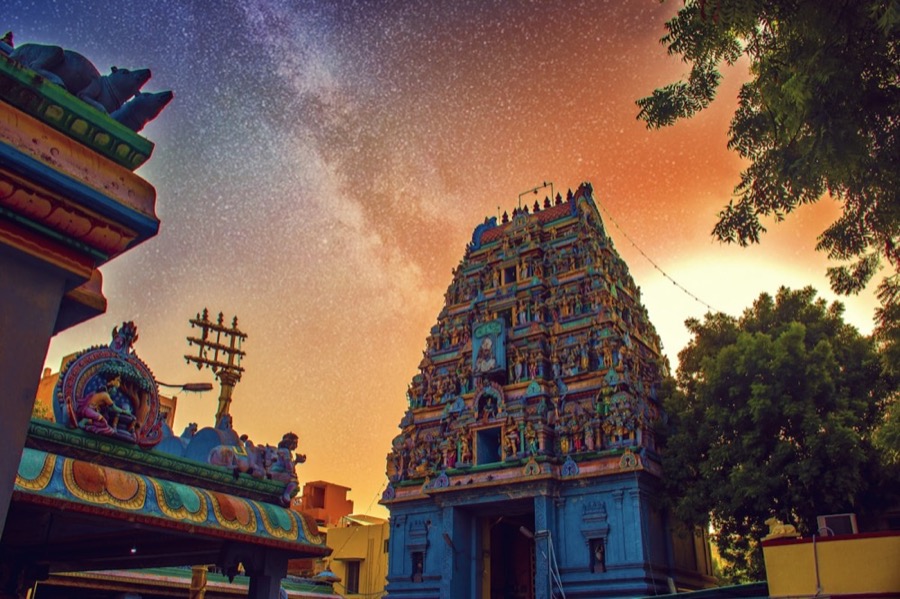
The Hindu temple (mandir) is far more than a place of worship — it is a microcosm of the universe, a dwelling place of the Divine (devālaya), and the meeting point between heaven and earth. Every element of a Hindu temple, from the towering superstructure to the innermost sanctum, is designed according to sacred principles codified in ancient texts known as the Śilpa Śāstras and the Vāstu Śāstra. Over two millennia of continuous architectural evolution, three great regional traditions emerged: the Nāgara style of northern India, the Drāviḍa style of the south, and the Vesara or hybrid style of the Deccan. Together, they represent one of humanity’s most sophisticated sacred architectural traditions.
The Temple as Cosmic Diagram: Vāstu Puruṣa Maṇḍala
Every Hindu temple begins not with stone but with a sacred diagram — the Vāstu Puruṣa Maṇḍala. This geometric grid, described in the Bṛhat Saṁhitā of Varāhamihira (6th century CE) and elaborated in texts like the Mānasāra and the Mayamata, maps the cosmic body of Vāstu Puruṣa (the primordial being embedded in the earth) onto the temple’s ground plan. The maṇḍala divides the site into a grid of 64 or 81 squares (pada), with Brahma at the centre and various deities (Aṣṭadikpāla — guardians of the eight directions) occupying specific positions.
The Mayamata (chapter 7) prescribes: “The temple should be oriented to the cardinal directions, with the entrance facing east, so that the first rays of the rising sun illuminate the deity.” This east-facing orientation (prācī) is the norm, though exceptions exist for temples dedicated to specific deities (Śiva temples sometimes face north or south).
The Vāstu Puruṣa Maṇḍala ensures that the temple is not merely an aesthetic creation but a sacred cosmogram — a physical manifestation of divine order (ṛta).
Core Structural Elements
Despite regional variations, all Hindu temples share a common architectural vocabulary:
Garbhagṛha (Sanctum Sanctorum)
The garbhagṛha (literally “womb-house”) is the innermost and most sacred chamber, housing the principal deity (mūla mūrti). It is typically a small, dark, windowless room — intentionally cave-like, symbolizing the primordial darkness from which creation emerges. The Agni Purāṇa (chapters 42-43) describes the garbhagṛha as the spiritual heart of the temple, where the divine presence (sānnidhya) is most concentrated.
Śikhara / Vimāna (Superstructure)
Rising above the garbhagṛha, the temple’s tower is the most visually dominant element. In northern terminology, this is called the śikhara (“mountain peak”); in southern terminology, the entire towered structure above the sanctum is the vimāna. The tower represents Mount Meru, the cosmic mountain at the centre of the universe according to Hindu, Buddhist, and Jain cosmologies.
Maṇḍapa (Pillared Hall)
The maṇḍapa is the congregational hall preceding the sanctum, used for rituals, devotional singing (kīrtana), and religious discourses. Larger temples feature multiple maṇḍapas: the ardha-maṇḍapa (entrance porch), mahā-maṇḍapa (great hall), and raṅga-maṇḍapa (dance hall). The pillars of the maṇḍapa are often elaborately carved with depictions of deities, celestial beings (apsarā), mythological narratives, and floral motifs.
Antarāla (Vestibule)
The antarāla is the transitional passage between the maṇḍapa and the garbhagṛha, symbolizing the devotee’s passage from the mundane world to the sacred presence.
Prākāra and Gopuram (Enclosure and Gateway)
The prākāra is the outer enclosure wall, and the gopuram is the monumental gateway tower — a defining feature of Drāviḍa architecture that grew to spectacular heights in later centuries.
Nāgara Style: The Temples of the North
The Nāgara style (from Nagara, “city”) predominates across northern India, from Gujarat and Rajasthan to Odisha and Madhya Pradesh. Its defining characteristic is the curvilinear śikhara — a tower that rises in an unbroken, organic curve from base to finial (āmalaka and kalaśa).
Key Features
- Curvilinear śikhara: The tower curves inward as it ascends, culminating in a fluted disc called the āmalaka (named after the āmalā fruit), topped by a kalaśa (sacred pot).
- No boundary walls or gopurams: Unlike southern temples, Nāgara temples typically lack enclosure walls and monumental gateways.
- Elevated platform (jagati): Temples are raised on a high plinth.
- Multiple sub-towers (uraḥśṛṅga): Subsidiary miniature towers cluster around the main śikhara, creating a mountain-like silhouette.
Sub-varieties of Nāgara
The Aparājitapṛcchā and other Śilpa texts classify Nāgara temples into sub-types based on śikhara shape:
- Latina (or rekhā): A single, smooth curvilinear tower — the most common and iconic form. The Kandariyā Mahādeva Temple at Khajurāho (c. 1025-1050 CE) is the supreme example: its 31-metre śikhara, composed of 84 subsidiary miniature towers, represents Mount Meru in stone.
- Phāṁsanā: A rectilinear pyramidal roof, seen in smaller shrines and subsidiary structures.
- Valabhī: A barrel-vaulted roof recalling the form of an overturned boat, derived from early wooden architecture.
Masterpieces of Nāgara Architecture
Khajurāho (Madhya Pradesh): The 25 surviving temples of the Chandella dynasty (c. 950-1050 CE) represent the pinnacle of Nāgara architecture. The UNESCO World Heritage site features temples whose walls are covered in intricate sculptural programmes depicting deities, celestial figures, and the full spectrum of human life.
Konārak Sun Temple (Odisha, c. 1250 CE): Conceived as a colossal chariot of Sūrya, the Sun God, with 24 carved stone wheels and seven horses. Its deul (Odishan term for śikhara) originally stood over 60 metres high.
Lingarāja Temple (Bhubaneswar, c. 1000 CE): The crowning achievement of the Kaliṅga school of Nāgara architecture, with a 55-metre deul exhibiting the mature rekhā form.
Drāviḍa Style: The Temples of the South
The Drāviḍa style dominates southern India — Tamil Nadu, Karnataka, Andhra Pradesh, and Kerala. Its distinguishing feature is the pyramidal, stepped vimāna and the soaring gopuram gateway towers.
Key Features
- Pyramidal vimāna: The tower over the sanctum rises in clearly defined, diminishing horizontal storeys (tala), each decorated with miniature shrine motifs.
- Gopuram gateway towers: The monumental entrance towers, which in later centuries grew far taller than the central vimāna itself. The gopurams of Madurai’s Mīnākṣī Temple (rebuilt 16th-17th century) reach over 50 metres.
- Prākāra enclosure walls: Concentric enclosure walls define sacred precincts, creating a temple-city.
- Pillared corridors (prākāra halls): Long colonnaded corridors surround the inner shrines.
- Water tanks (puṣkariṇī): Sacred temple tanks for ritual bathing.
Evolution of Drāviḍa Architecture
The Drāviḍa tradition traces its origins to the Pallava dynasty (6th-9th century CE), whose rock-cut temples at Māmallapuram (Mahabalipuram) — including the famous Five Rathas and the Shore Temple — represent the experimental phase of southern temple architecture. Each of the five monolithic ratha temples at Māmallapuram embodies a different architectural prototype.
The Chola dynasty (9th-13th century CE) brought Drāviḍa architecture to its classical zenith. The Bṛhadīśvara Temple at Thanjavūr (Tanjore), built by Rājarāja Chola I in 1010 CE, features a vimāna rising to 66 metres — the tallest of its era — crowned by a monolithic granite śikhara weighing approximately 80 tonnes. UNESCO inscribed it as a World Heritage site.
The Vijayanagara Empire (14th-17th century) produced the magnificent temple complexes at Hampi, where the Viṭṭhala Temple with its famous stone chariot and musical pillars exemplifies the mature Drāviḍa style with Vesara influences.
The Nāyaka dynasty (16th-18th century) developed the gopuram into the defining feature of Tamil temple architecture, with increasingly tall and ornate gateway towers covered in painted stucco figures of deities and mythological characters.
Vesara Style: The Hybrid Tradition
The Vesara style (also called Karnāṭa Drāviḍa) emerged in the Deccan plateau as a creative synthesis of Nāgara and Drāviḍa elements. The Mānasāra text describes Vesara as a distinct third mode, and it flourished primarily under the patronage of the Chālukya, Rāṣṭrakūṭa, and Hoysaḷa dynasties.
Key Features
- Stellate (star-shaped) ground plans: The most distinctive Vesara innovation, creating undulating wall surfaces that catch light at multiple angles.
- Hybrid tower forms: Combining the curvilinear tendency of the Nāgara śikhara with the horizontal banding of the Drāviḍa vimāna.
- Extraordinarily detailed sculpture: Hoysaḷa temples feature some of the most intricately carved stone surfaces in all of Indian architecture.
- Lathe-turned pillars: Pillars carved to resemble shapes produced on a lathe, a hallmark of Hoysaḷa craftsmanship.
Masterpieces of Vesara Architecture
The Hoysaḷeśvara Temple at Halebīḍu (c. 1121 CE) and the Chennakēśava Temple at Belūr (c. 1117 CE), both built under King Viṣṇuvardhana of the Hoysaḷa dynasty, are supreme examples. Their soapstone (chloritic schist) walls are carved with a density and delicacy that has been compared to ivory work — featuring friezes of elephants, lions, horsemen, scrollwork, scenes from the epics, and over a thousand individually distinct sculptural compositions.
The Kailāsanātha Temple at Ellora (c. 757-783 CE), carved entirely from a single basalt cliff under Rāṣṭrakūṭa patronage, represents the most ambitious rock-cut architecture ever attempted — a free-standing temple excavated from the living rock from top to bottom.
The Śilpa Śāstras: Canonical Texts
Hindu temple architecture is guided by a rich corpus of canonical texts:
- Mānasāra (c. 5th-7th century CE): Perhaps the most comprehensive Śilpa text, covering town planning, temple architecture, sculpture, and iconography in 70 chapters.
- Mayamata (c. 6th-12th century CE): A South Indian treatise attributed to the celestial architect Maya, detailing temple design, proportional systems, and construction techniques.
- Aparājitapṛcchā (c. 12th century CE): A Gujarati text in dialogue form that classifies temple types and elaborates on Nāgara variations.
- Bṛhat Saṁhitā by Varāhamihira (c. 6th century CE): An encyclopaedic work covering architecture alongside astronomy, gemology, and other sciences (chapters 53-60 address temple and image-making).
- Agni Purāṇa (chapters 42-108): Provides detailed prescriptions for temple construction, image-making, and consecration rituals.
- Kāmikāgama and Kāraṇāgama: Śaiva Āgama texts with extensive sections on Drāviḍa temple architecture, rituals, and iconography.
These texts prescribe not merely aesthetic forms but precise mathematical proportions. The Mānasāra specifies that the height of the śikhara should bear a specific ratio to the width of the garbhagṛha, and that every moulding, projection, and recession on the temple surface follows a modular system based on the tāla (palm-measure) and its subdivisions.
Sacred Geometry and Symbolism
Every element of the Hindu temple carries symbolic meaning:
- The garbhagṛha represents the cave of the heart (hṛdaya guha) where the individual soul meets the Divine.
- The śikhara/vimāna represents Mount Meru, the axis connecting earth to heaven.
- The āmalaka (the ribbed disc atop the Nāgara śikhara) symbolizes the sun and cosmic illumination.
- The kalaśa (the pot finial) represents the vessel of amṛta (the nectar of immortality).
- The circumambulatory path (pradakṣiṇā patha) represents the devotee’s spiritual journey around the divine centre.
- The progressive movement from the outer wall to the garbhagṛha symbolizes the soul’s journey from the material world to spiritual liberation — from complexity and light to simplicity and darkness, from the manifest to the unmanifest.
Regional Variations and Living Traditions
Beyond the three major styles, regional variations add extraordinary diversity:
- Kerala style: Characterized by circular and apsidal ground plans with steeply sloping copper-sheet roofs suited to the heavy monsoon rainfall. The Padmanābhasvāmī Temple in Thiruvananthapuram exemplifies this tradition.
- Bengali style: Terracotta temples with distinctive curved roofs (do-chālā, āṭ-chālā) reflecting the thatched-roof vernacular architecture of Bengal. The temples of Bishnupur are masterpieces of this tradition.
- Himalayan style: Stone and timber temples with pagoda-like wooden roofs, as seen at Jagannāth Temple in Kullu and temples across Himachal Pradesh and Uttarakhand.
- Odishan (Kaliṅga) style: A distinctive sub-school of Nāgara characterized by the deul (tower) and jagamohana (assembly hall) configuration, with some of India’s finest sculptural decoration.
Hindu temple architecture remains a living tradition. New temples continue to be built following the principles of the Śilpa Śāstras — from the Akṣardham complex in New Delhi (2005) to the BAPS Swāminārayaṇ Mandir in London (1995). The tradition’s fundamental insight — that architecture can embody the sacred, that stone and mortar can become a vehicle for divine encounter — continues to inspire builders and devotees across the world.