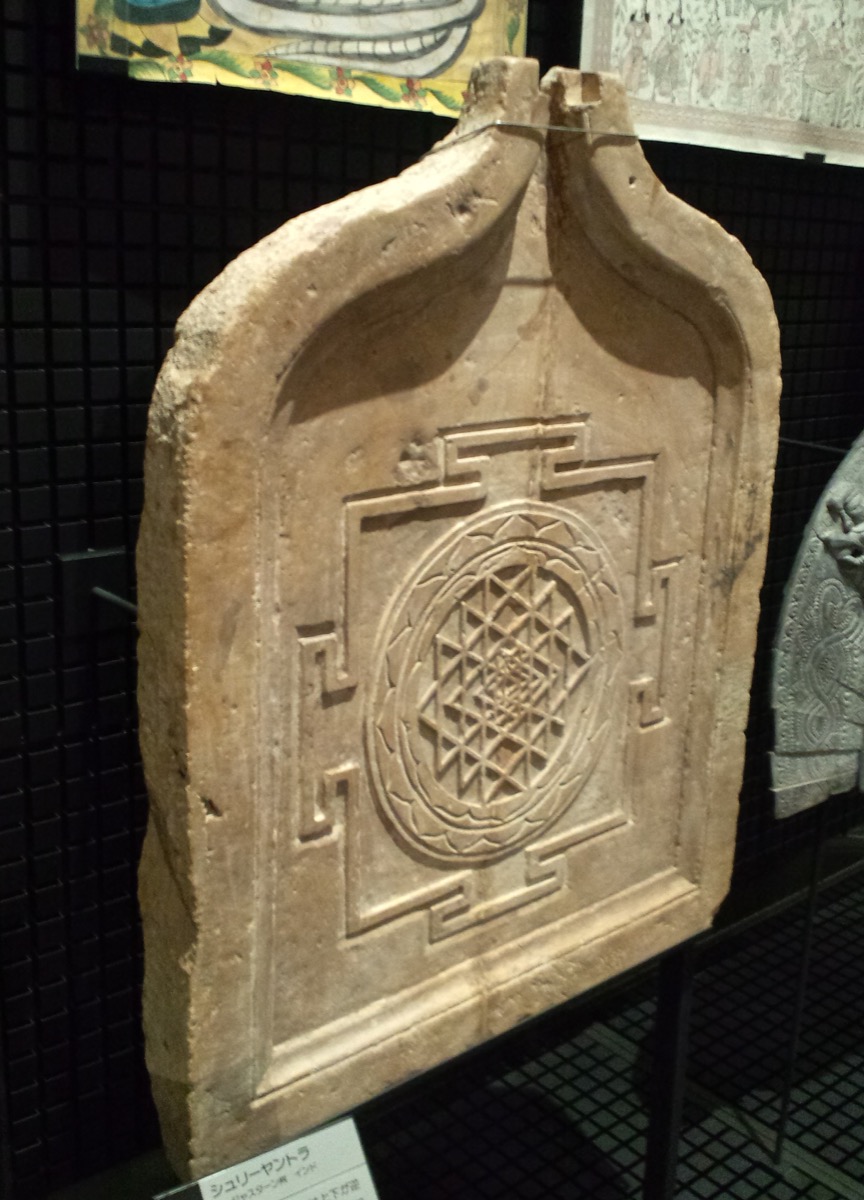
Yantra (यन्त्र) — literally “instrument” or “tool” — is one of the most profound and visually striking expressions of Hindu sacred thought. These precise geometric diagrams serve as instruments for meditation, worship, and the invocation of divine energies. Far from being mere decorative patterns, yantras are understood in the Hindu tantric tradition as visual equivalents of mantras: just as a mantra is a sonic body of the deity, a yantra is the deity’s geometric body. Together with mantra (sacred sound) and tantra (systematic practice), yantra forms the third pillar of the tantric triad that has shaped Hindu worship for over a millennium.
The Kulārṇava Tantra declares: “Yantraṃ mantraṃayaṃ proktaṃ mantratmā devatā smṛtā” — “The yantra is said to be the form of mantra, and the mantra is the soul of the deity.” This concise statement captures the essential relationship: the yantra is the visible form of the invisible sound that is the mantra, and both are manifestations of the divine.
What Is a Yantra?
A yantra is a geometric diagram — typically composed of interlocking triangles, circles, lotus petals, and a square enclosure — that serves as a focal point for meditation and worship. The word derives from the Sanskrit root yam (“to hold, sustain, support”) combined with the suffix -tra (denoting an instrument), yielding the meaning “an instrument for holding or concentrating the mind.”
Unlike representational icons (mūrti), which depict deities in anthropomorphic form, yantras represent the same divine energies through abstract geometry. The Śāradā Tilaka Tantra explains that while the image (mūrti) is the gross form of the deity, the yantra is its subtle form, and the mantra its most subtle form. The three exist on a continuum of abstraction, all pointing to the same transcendent reality.
In practice, a yantra functions as a sacred map of consciousness. The practitioner (sādhaka) traces a path from the outermost boundary inward toward the central point (bindu), symbolically journeying from the manifest, material world toward the unmanifest source of all creation. This inward journey mirrors the spiritual process of withdrawal from external distractions toward inner stillness and union with the divine.
The Mantra-Tantra-Yantra Triad
The three elements of mantra, tantra, and yantra are inseparable in Hindu esoteric practice:
- Mantra is the sonic dimension — the sacred syllables and formulae that embody divine vibration. Each deity has specific mantras, and these sounds are understood as the vibratory essence of the divine.
- Tantra is the systematic practice — the body of techniques, rituals, and philosophical frameworks that govern how mantras and yantras are employed. Tantra provides the method.
- Yantra is the visual dimension — the geometric form that gives spatial structure to the same energies expressed sonically in mantra.
The Tantrarāja Tantra states that worship without yantra is incomplete, likening it to a body without a soul. The yantra provides the ādhāra (support) upon which the deity is invoked through mantra, and the tantric ritual (pūjā) unifies all three elements into a single transformative practice.
Geometric Principles of Yantra Design
Every element in a yantra carries precise symbolic meaning. The major geometric components include:
Bindu (Point)
The bindu is the central dot from which the entire yantra emanates and into which it ultimately dissolves. It represents the unconditioned absolute — pure consciousness prior to all manifestation. In the philosophy of Kashmir Śaivism, the bindu corresponds to parā vāk (supreme speech), the first stirring of creative impulse in undifferentiated awareness. It is simultaneously the smallest conceivable point and the infinite whole from which everything emerges.
Trikoṇa (Triangle)
Triangles are the primary structural elements of most yantras. An upward-pointing triangle (Śiva trikoṇa) represents the male principle — consciousness, fire, ascent, and the transcendent. A downward-pointing triangle (Śakti trikoṇa) represents the female principle — energy, water, descent, and immanence. The interlocking of upward and downward triangles symbolises the inseparable union of Śiva and Śakti, consciousness and energy, the static and the dynamic.
Padma (Lotus Petals)
Concentric rings of lotus petals surround the triangular core of many yantras. These represent stages of spiritual unfoldment — the blossoming of consciousness from its latent state. In the Śrī Yantra, two rings of lotus petals appear: an inner ring of eight petals representing the subtle mental faculties (tanmātrās and buddhīndriyas), and an outer ring of sixteen petals symbolising the fulfilment of desires and the sixteen aspects of attainment (kalā).
Vṛtta (Circle)
Circles represent wholeness, cyclic movement, and the infinite. They form transitional zones between different levels of the yantra, marking boundaries between planes of consciousness.
Bhūpura (Earth Square)
The bhūpura is the outermost square boundary of the yantra, typically depicted with four gates (dvāra) opening to the four cardinal directions. It represents the earth plane, the material world, and the threshold between sacred and profane space. In the Śrī Yantra, the bhūpura is called Trailokya Mohana Cakra — “the enchanter of the three worlds” — and marks the point of entry into the sacred diagram.
The Śrī Yantra: Supreme Among Yantras
The Śrī Yantra (also called Śrī Cakra) is universally regarded as the most important and powerful of all yantras. Central to the Śrī Vidyā tradition of Hindu worship, it represents the goddess Lalitā Tripurasundarī and the entire process of cosmic creation and dissolution.
Structure
The Śrī Yantra consists of nine interlocking triangles — four pointing upward (Śiva) and five pointing downward (Śakti) — arranged around a central bindu. These nine triangles create 43 smaller triangles through their intersections, forming a web of extraordinary geometric complexity. The nine triangles are enclosed by two rings of lotus petals (8 and 16) and three concentric squares with four gates.
The nine interlocking triangles form nine enclosures (āvaraṇas or cakras), each associated with a specific aspect of the goddess, a particular mantra, a group of attendant deities, and a stage on the spiritual path:
- Trailokya Mohana (Bhūpura) — enchanting the three worlds
- Sarvāśā Paripūraka (16-petalled lotus) — fulfilling all desires
- Sarva Saṃkṣobhaṇa (8-petalled lotus) — agitating all
- Sarva Saubhāgya Dāyaka (14 triangles) — bestowing all fortune
- Sarvārtha Sādhaka (10 outer triangles) — accomplishing all purposes
- Sarva Rakṣākara (10 inner triangles) — giving all protection
- Sarva Rogahara (8 triangles) — removing all disease
- Sarva Siddhiprada (innermost triangle) — granting all attainments
- Sarvānandamaya (Bindu) — consisting of all bliss
Mathematical Precision
The construction of an accurate Śrī Yantra is a formidable mathematical challenge. The nine triangles must intersect to form exactly 43 smaller triangles with no gaps or overlaps — a constraint that demands extraordinary precision. Researchers have demonstrated that achieving a “perfect” Śrī Yantra — one in which all triple intersections of lines are exact — is mathematically impossible with nine independent triangles. The best constructions approximate perfection to within extraordinarily small tolerances, and traditional craftsmen developed sophisticated empirical methods to achieve near-perfect results.
The Tantrarāja Tantra and the Śrī Vidyārṇava Tantra provide detailed instructions for constructing the Śrī Yantra, specifying proportions and spatial relationships with remarkable mathematical awareness.
Other Important Yantras
Gaṇeśa Yantra
The Gaṇeśa Yantra is used to invoke Lord Gaṇeśa, the remover of obstacles. It typically features a central triangle or hexagonal star surrounded by lotus petals and a bhūpura. Devotees worship this yantra before beginning new ventures, studies, or important undertakings.
Śiva Yantra
Various yantras are associated with Lord Śiva. The Mṛtyuñjaya Yantra, connected with the Mahāmṛtyuñjaya mantra, is used for healing and protection from untimely death. It typically features concentric triangles and lotus patterns centred on Śiva’s life-giving aspect as the conqueror of death.
Kālī Yantra
The Kālī Yantra consists of five downward-pointing triangles representing the five aspects of Devī Kālī, enclosed within a circle and eight-petalled lotus. It is used in Śākta worship for invoking the fierce, transformative power of the goddess.
Durgā Yantra (Navārṇa Yantra)
Associated with the nine-syllabled mantra of Durgā, this yantra is particularly venerated during Navarātri. Its geometric structure encodes the nine forms of the goddess worshipped over the nine nights of the festival.
Sūrya Yantra
The Sūrya Yantra is associated with the sun god and is used for health, vitality, and overcoming planetary afflictions related to the sun in Jyotiṣa (Hindu astrology).
Construction and Consecration: Prāṇa Pratiṣṭhā
A yantra is not considered spiritually active until it has undergone Prāṇa Pratiṣṭhā — the ritual “installation of life-breath.” This elaborate consecration ceremony transforms the geometric diagram from a mere drawing into a living receptacle of divine presence.
The process typically involves:
- Selection of material: Yantras may be inscribed on copper plates (tāmra yantra), silver, gold, crystal, birch bark (bhūrja patra), or specially prepared paper. Copper is the most common material for permanent yantras.
- Purification: The material and the space are ritually purified through mantras, prāṇāyāma (breath control), and sprinklings of sacred water.
- Inscription: The yantra is engraved or drawn with precise measurements, often accompanied by the chanting of seed syllables (bīja mantras) for each geometric element.
- Invocation: The deity is invoked into the yantra through specific mantras, nyāsa (ritual placement of mantras on the body and yantra), and meditative visualisation.
- Awakening: The prāṇa (life-force) of the deity is “established” in the yantra through the final consecration mantras, after which the yantra is treated as a living divine presence.
The Śāradā Tilaka specifies that the yantra must be worshipped daily once consecrated, and that neglecting a consecrated yantra can bring adverse effects — underscoring that these diagrams are understood not as inert objects but as active centres of spiritual power.
Yantra in Worship and Meditation
Yantras serve multiple functions in Hindu spiritual practice:
As Objects of Worship (Pūjā)
In tantric worship, the yantra replaces or accompanies the mūrti as the seat of the deity. The practitioner performs ṣoḍaśopacāra pūjā (sixteen-fold worship) to the yantra, offering flowers, incense, light, and food, just as one would to an anthropomorphic image. The Śrī Yantra, in particular, is the primary object of worship in the Śrī Vidyā tradition, and elaborate daily rituals (nityā pūjā) are performed before it.
As Aids to Meditation (Dhyāna)
The geometric complexity of yantras provides a powerful support for meditation. The practitioner gazes at the yantra and then internalises its form, constructing it mentally in visualization. This practice of building and dissolving the yantra in the mind trains concentration (dhāraṇā) and develops the capacity for sustained one-pointed attention.
As Protective Devices (Kavaca)
Certain yantras are worn as amulets or placed in homes, vehicles, or places of business for protection and auspiciousness. The Sudarśana Yantra (associated with Viṣṇu’s discus) is a popular protective yantra, as is the Hanumān Yantra for courage and strength.
Temple Architecture as Yantra
Hindu temple design is deeply informed by yantra principles. The Vāstu Puruṣa Maṇḍala — the sacred diagram that governs temple ground plans — is itself a form of yantra. The temple is conceived as a three-dimensional yantra: the garbhagṛha (sanctum) corresponds to the bindu, the surrounding halls and corridors correspond to the concentric circuits of the yantra, and the outer walls correspond to the bhūpura.
The Śilpa Prakāśa, a medieval Orissan architectural text, explicitly states that the temple is a yantra in stone. The ground plan of major temples like Kāñcīpuram’s Kāmākṣī temple and the Śrī Raṅganāthasvāmī temple at Śrīraṅgam (with its seven concentric enclosures) have been analysed as three-dimensional embodiments of the Śrī Yantra.
The connection between yantra and Vāstu Śāstra (the science of sacred architecture) is equally profound. The Vāstu Puruṣa Maṇḍala, a grid of 64 or 81 squares that forms the basis of architectural planning, functions as a yantra that maps cosmic energies onto the built environment. Every Hindu temple, house, or city planned according to Vāstu principles is, in essence, built upon a yantra.
Yantras and Buddhist Maṇḍalas
The Hindu yantra tradition shares deep historical and structural connections with the Buddhist maṇḍala tradition, though significant differences exist. Both traditions employ geometric diagrams as maps of sacred space and aids to meditation. Both trace their roots to common Indian ritual traditions of creating sacred enclosures.
However, while Hindu yantras tend toward abstract geometry — with triangles, circles, and lotus petals dominating — Buddhist maṇḍalas typically incorporate representational imagery of deities, landscapes, and symbolic objects within their geometric framework. Additionally, while yantras are often permanently inscribed on metal plates and worshipped daily, Tibetan Buddhist sand maṇḍalas are intentionally destroyed after completion, embodying the teaching of impermanence.
The exchange of ideas between the two traditions was extensive. The Hevajra Tantra and Kālacakra Tantra of Vajrayāna Buddhism employ geometric structures clearly influenced by Hindu yantra design, while certain later Hindu tantric texts show awareness of Buddhist maṇḍala practices.
Key Texts on Yantra
Several classical texts provide detailed instructions and philosophical frameworks for yantra practice:
- Saundaryalaharī (attributed to Ādi Śaṅkarācārya): This celebrated hymn of 100 verses glorifies the goddess and contains extensive references to the Śrī Yantra and its worship. Verse 11 describes the Śrī Cakra as the abode of Śiva and Śakti.
- Tantrarāja Tantra: A major Śākta tantric text that provides detailed instructions for the construction, consecration, and worship of the Śrī Yantra.
- Śāradā Tilaka Tantra: An encyclopaedic tantric text covering mantras, yantras, and ritual procedures comprehensively.
- Nityāṣoḍaśikārṇava: A foundational Śrī Vidyā text describing the worship of the sixteen Nityā goddesses within the Śrī Yantra.
- Yoginīhṛdaya: The second part of the Vāmakeśvara Tantra, providing profound philosophical commentary on the Śrī Yantra as the body of the goddess.
- Śrī Vidyārṇava Tantra: A comprehensive treatise on Śrī Vidyā worship with detailed yantra construction procedures.
Modern Scientific Interest
The geometric precision of yantras has attracted significant interest from mathematicians, physicists, and researchers in recent decades. Studies have examined the mathematical properties of the Śrī Yantra’s nine interlocking triangles, exploring questions of optimality and precision in its construction. Researchers have noted intriguing correspondences between yantra geometry and concepts in modern physics, including wave interference patterns, holographic principles, and fractal geometry.
The cymatics research of Hans Jenny, which demonstrated that sound vibrations produce geometric patterns in physical media, has been cited as offering a modern parallel to the ancient tantric claim that yantra and mantra are related — that geometric form arises from vibratory sound. While such parallels should not be pushed too far, they have stimulated fruitful dialogue between traditional knowledge and modern science.
Digital reconstruction and analysis of yantras using computer-aided design have also revealed the extraordinary precision achieved by traditional yantra craftsmen, whose empirical methods produced results that rival modern computational approaches.
The Living Tradition
Yantra worship remains a vibrant, living tradition across the Hindu world. From the elaborate Śrī Cakra pūjā performed in Śaṅkara maṭhas and Śrī Vidyā centres to the simple yantras installed in household shrines, from the copper plates worshipped by tantric practitioners to the architectural yantras embedded in temple ground plans — the tradition of sacred geometry continues to serve as a bridge between the visible and the invisible, the finite and the infinite, the human and the divine.
In a tradition that has always understood the cosmos as an expression of divine intelligence, the yantra stands as perhaps the most direct visual testimony to that intelligence — a geometry that is simultaneously mathematical and mystical, precise and numinous, ancient and eternally contemporary.