Introduction
Hinduism speaks through symbols. Long before systematic philosophy was committed to writing, the seers (ṛṣis) of the Vedic age encoded cosmic truths in visual and sonic forms — icons, gestures, diagrams, and sacred syllables — that could transmit meaning across barriers of language, literacy, and even time. Hindu iconography is not mere decoration; it is a visual theology, a precise symbolic language in which every colour, weapon, hand-gesture (mudrā), and geometric form carries doctrinal weight.
This article surveys the most important symbols of the Hindu tradition, tracing their scriptural origins, philosophical meanings, and living presence in worship today.
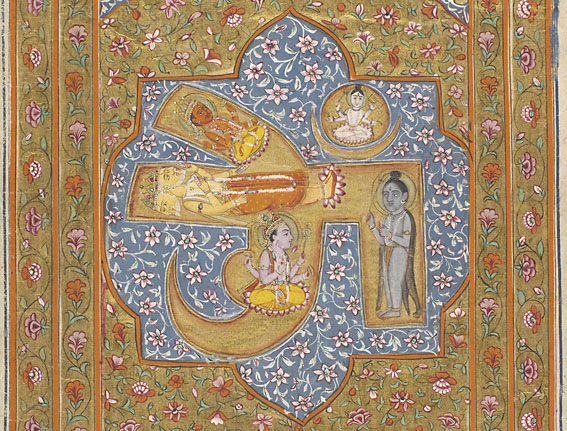
Oṃ (ॐ): The Primordial Sound
Oṃ (also written Auṃ) is the most sacred syllable in Hinduism, regarded as the sonic essence of Brahman — ultimate reality itself. The Māṇḍūkya Upaniṣad devotes its entire exposition to Oṃ, identifying its three phonetic components (A-U-M) with the three states of consciousness — waking (jāgrat), dreaming (svapna), and deep sleep (suṣupti) — while the silence that follows represents turīya, the transcendent fourth state.
“Oṃ ity etad akṣaram idaṁ sarvam” — “Oṃ: this syllable is all this.” (Māṇḍūkya Upaniṣad 1)
The Chāndogya Upaniṣad (1.1.1) calls Oṃ the udgītha, the essence of the Sāma Veda chant. In practice, Oṃ opens and closes virtually every Hindu prayer, mantra, and ritual. The written symbol ॐ, rendered in Devanāgarī, has become the single most recognisable emblem of Hinduism worldwide.
The Svastika (卐): Auspiciousness and Cosmic Motion
The Svastika (Sanskrit: स्वस्तिक, from su + asti = “well-being”) is one of humanity’s oldest symbols, attested in the Indus Valley civilisation (c. 3300-1300 BCE) and ubiquitous in Hindu, Buddhist, and Jain traditions. Its four arms represent the four Vedas, the four directions, or the four puruṣārthas (goals of life: dharma, artha, kāma, mokṣa). The right-angled bends suggest perpetual motion — the turning of the cosmic wheel.
In Hindu ritual, the Svastika is drawn at thresholds, on account books at Dīvālī, and on objects to invoke maṅgala (auspiciousness). The Atharva Veda (3.12) includes the benediction svasti na indro vṛddhaśravāḥ, connecting the concept of svasti directly to divine protection.
The Triśūla (त्रिशूल): Śiva’s Trident
The trident (triśūla) is the primary emblem of Lord Śiva. Its three prongs are interpreted as representing:
- Creation, preservation, and destruction (sṛṣṭi, sthiti, saṃhāra)
- The three guṇas: sattva (purity), rajas (activity), tamas (inertia)
- Past, present, and future
- The three worlds: heaven (svarga), earth (bhū), and the netherworld (pātāla)
Iconographically, Śiva is depicted holding the triśūla in his right hand, often with a ḍamaru (drum) alongside it. The trident signifies that Śiva transcends all trinities — he is the consciousness beyond the three states, the lord beyond the three times.
The Padma (पद्म): The Sacred Lotus
The lotus (padma) is arguably the most pervasive symbol in Hindu art. Growing from muddy waters yet blossoming in pristine beauty, it is the perfect metaphor for spiritual purity arising from the material world. The Bhagavad Gītā (5.10) uses this image directly:
“One who acts without attachment, offering actions to Brahman, is untouched by sin, as a lotus leaf by water.”
Specific lotus associations include:
- Viṣṇu: stands or reclines upon a lotus; holds a lotus in one hand
- Lakṣmī: seated on a lotus (Padmāsanā), symbolising prosperity and purity
- Sarasvatī: associated with the white lotus of knowledge
- Brahmā: born from a lotus emerging from Viṣṇu’s navel
The number of petals in lotus depictions carries meaning: the sahasrāra (crown cakra) is depicted as a thousand-petalled lotus, representing full spiritual awakening.
The Śaṅkha (शंख): The Sacred Conch
The conch shell (śaṅkha) is one of Viṣṇu’s four emblems (along with the discus, mace, and lotus). Named Pāñcajanya in Viṣṇu’s hands, the conch’s spiralling form represents the expansion of creation from a single point. Its sound, believed to contain the vibration of Oṃ, is blown at the start of pūjā and āratī to purify the atmosphere and announce the divine presence.
In the Bhagavad Gītā (1.15), Kṛṣṇa blows his conch Pāñcajanya at the start of the Kurukṣetra war, and Arjuna answers with Devadatta. The conch thus symbolises the call to dharmic action.
The Sudarśana Cakra (सुदर्शन चक्र): Viṣṇu’s Discus
The spinning discus (cakra) of Viṣṇu represents the cosmic order, the wheel of time (kālacakra), and the power of the mind to cut through ignorance. The name Sudarśana means “auspicious vision” or “beautiful to behold.” With 108 serrated edges, it is Viṣṇu’s most fearsome weapon, deployed against forces of adharma.
The cakra also appears in the cakra system of Tantric and Yoga traditions, where six (or seven) subtle energy centres along the spine govern different aspects of consciousness and physiology.
Tilaka and Bindī: Marks of the Divine
The tilaka (forehead mark) is one of the most visible signs of Hindu identity. Its form indicates sectarian affiliation:
- Vaiṣṇava tilaka: a U-shaped mark of white clay (gopīcandana) with a central red or yellow line, representing Viṣṇu’s foot
- Śaiva tripuṇḍra: three horizontal lines of sacred ash (vibhūti), representing Śiva’s three aspects
- Śākta tilaka: a red kuṅkuma dot, associated with Devī worship
The bindī (dot) at the ājñā cakra (the “third eye” point between the eyebrows) signifies the seat of wisdom and the awakened inner vision. It is both a spiritual marker and a cultural ornament.
Rudrākṣa (रुद्राक्ष): Tears of Śiva
Rudrākṣa beads — the seeds of the Elaeocarpus ganitrus tree — are sacred to Śiva. The Śiva Purāṇa narrates that they originated from Śiva’s tears (akṣa) shed during deep meditation. Each bead has natural facets (mukha), and the number of facets determines its deity association and spiritual properties:
- One-faced (eka-mukhī): rarest; represents Śiva himself
- Five-faced (pañca-mukhī): most common; associated with Kālāgni Rudra
- Fourteen-faced: associated with Hanumān
Rudrākṣa mālās (rosaries) of 108 beads are used for japa (mantra repetition) by devotees of Śiva.
The Śiva Liṅga (शिवलिङ्ग): The Formless Form
The liṅga (literally “mark” or “sign”) is the aniconic representation of Śiva, symbolising the formless Brahman manifesting as form. The cylindrical stone set within a circular base (yoni) represents the union of Śiva (consciousness, puruṣa) and Śakti (energy, prakṛti) — the generative principle underlying all creation.
The Liṅga Purāṇa (1.3) and Śiva Purāṇa (Vidyeśvara Saṃhitā 5-9) narrate the liṅgodbhava — the appearance of an infinite pillar of light before Brahmā and Viṣṇu, establishing Śiva’s supremacy. The twelve Jyotirliṅgas across India mark the most sacred sites of Śiva worship.
Yantra (यन्त्र): Sacred Geometry
A yantra is a geometric diagram that serves as a tool (yantra = “instrument”) for meditation and worship. Composed of interlocking triangles, circles, lotus petals, and a central point (bindu), yantras are the visual counterpart of mantras — each deity has both a sonic form (mantra) and a geometric form (yantra).
The most celebrated is the Śrī Yantra (also called Śrī Cakra), consisting of nine interlocking triangles — four pointing upward (Śiva/consciousness) and five pointing downward (Śakti/energy) — forming 43 smaller triangles. It represents the entire cosmos and the union of the divine masculine and feminine. The Saundaryalaharī, attributed to Ādi Śaṅkarācārya, extensively describes the Śrī Yantra’s mystical significance.
Kolam and Raṅgolī: Threshold Art
Kolam (Tamil Nadu) and raṅgolī (North India) are geometric patterns drawn daily at household thresholds with rice flour, coloured powder, or flower petals. While often considered folk art, these designs carry deep symbolic meaning:
- The dot grid represents the cosmic lattice of creation
- Continuous looping lines symbolise the infinite cycle of birth and rebirth
- Floral motifs invoke Lakṣmī and prosperity
The practice is both a devotional offering and an act of hospitality — the rice flour feeds ants and small creatures, embodying ahiṃsā (non-harm). During festivals like Poṅgal and Dīvālī, elaborate kolam competitions transform entire streets into galleries of sacred geometry.
Conclusion: Reading the Visual Theology
Hindu symbols are not arbitrary conventions — they are darśana in visual form, windows onto the structure of reality as perceived by the sages. The lotus teaches non-attachment; the conch proclaims dharma; the yantra maps the cosmos; Oṃ sounds the ground of being. Learning to read this symbolic language is itself a form of spiritual practice, transforming the world of forms into a continuous revelation of the formless.
As the Viṣṇudharmottara Purāṇa (3.46.1) declares: “Without knowledge of iconography (pratimā-lakṣaṇa), the worship of images cannot bear its full fruit.” To understand Hindu symbols is to enter the heart of Hindu worship.