In Hinduism, the boundary between the human and animal worlds is not a rigid wall but a permeable membrane through which divine energy flows freely. Animals are not merely creatures of the natural world; they are manifestations of cosmic principles, companions of the gods, and living symbols of spiritual truths. From the humblest mouse to the mighty elephant, from the coiled serpent to the soaring eagle, every creature in the Hindu cosmos carries a sacred resonance that connects the earthly realm to the divine.
This reverence for animal life is deeply rooted in the Hindu understanding of ātman — the universal Self that pervades all living beings. The Īśa Upaniṣad (1) declares: “The Lord pervades all that exists in this universe.” The Bhagavad Gītā (5.18) affirms that the wise see the same divine presence in a learned brāhmaṇa, a cow, an elephant, a dog, and even an outcaste. This theological foundation gives rise to the principle of ahiṃsā (non-violence) and the recognition that animals deserve respect, protection, and even worship.
Kāmadhenu: The Divine Wish-Fulfilling Cow
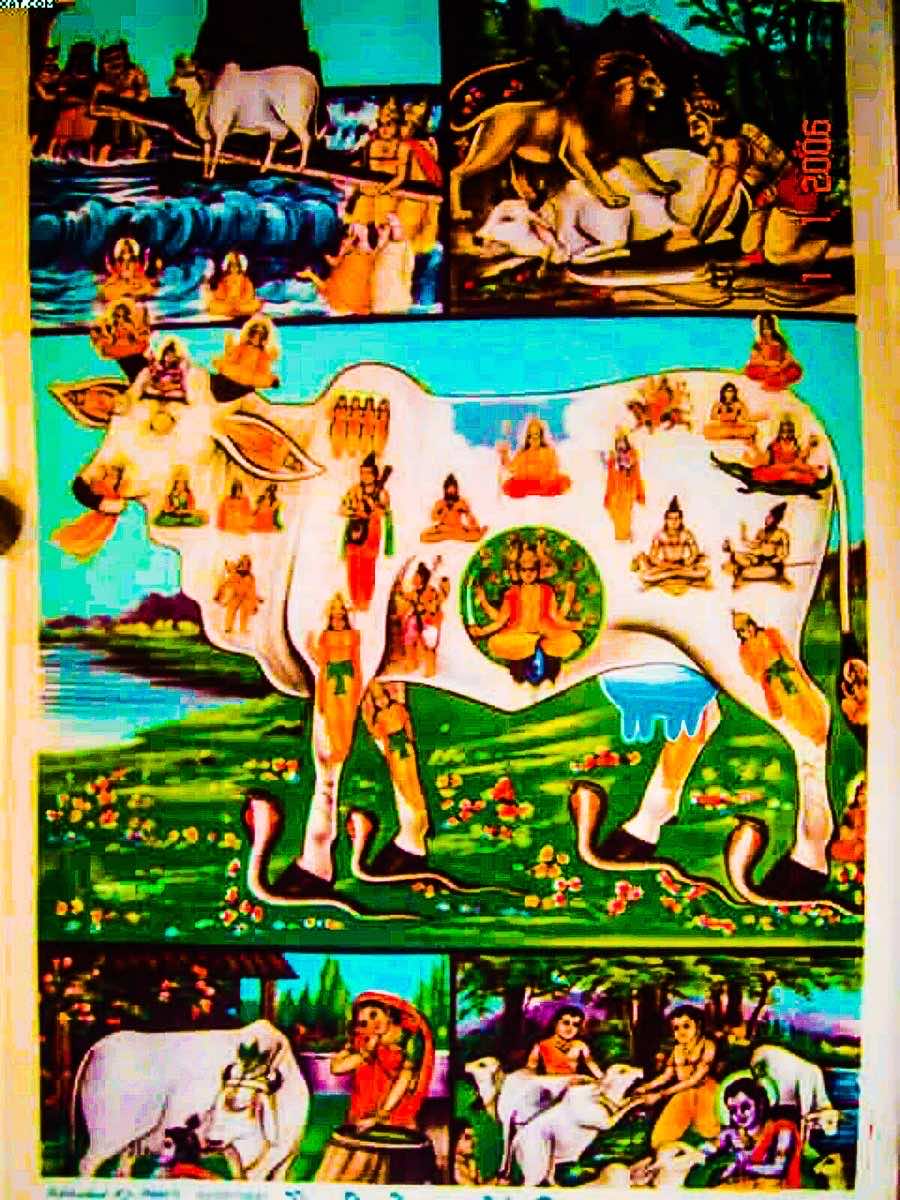
No animal holds a more exalted position in Hindu tradition than the cow. Revered as go-mātā (Mother Cow), the cow is considered sacred across virtually all Hindu communities. At the apex of bovine sanctity stands Kāmadhenu (also called Surabhī), the celestial wish-fulfilling cow who emerged during the churning of the cosmic ocean (samudra manthana).
The Mahābhārata (Anuśāsana Parva 83) describes Kāmadhenu as the mother of all cows, residing in the celestial realm of Goloka. Her body is said to contain all the gods within it — Brahmā, Viṣṇu, Śiva, and the entire pantheon dwell within her divine form. The Matsya Purāṇa states that all the gods reside in the body of the cow: the Sun and Moon in her eyes, Agni in her forehead, and the sacred rivers in her veins.
The practice of go-sevā (service to cows) is considered one of the highest forms of dharmic action. The Viṣṇu Dharma Sūtra declares that protecting a cow earns merit equivalent to visiting all sacred pilgrimage sites. In daily worship, the five products of the cow (pañcagavya) — milk, curd, ghee, urine, and dung — are used in purification rituals, underscoring the cow’s role as a bridge between the material and spiritual worlds.
Nandī: The Sacred Bull of Śiva
Nandī (Sanskrit: नन्दी, “the joyful one”) is the magnificent white bull who serves as the primary vāhana (divine mount) and foremost devotee of Lord Śiva. In every Śiva temple across India, a stone or bronze Nandī faces the sanctum sanctorum, gazing eternally at his Lord with unwavering devotion.
The Śiva Purāṇa recounts that Nandī was born from the sage Śilāda’s penance. Pleased with Śilāda’s austerities, Lord Śiva himself was born as his son in the form of the bull Nandī. He became the chief of Śiva’s gaṇas (celestial attendants) and the gatekeeper of Mount Kailāsa. The Liṅga Purāṇa describes Nandī as the embodiment of dharma — his four legs representing truth (satya), purity (śauca), compassion (dayā), and charity (dāna).
Nandī symbolizes the ideal devotee: steadfast, patient, and completely surrendered to the divine. His constant, unblinking gaze toward the Śiva liṅga represents the soul’s unwavering focus on the Supreme. The monumental Nandī sculptures at temples like the Bull Temple in Bangalore and the Bṛhadīśvara Temple in Thanjavur stand as magnificent testimonials to this devotion.
Garuḍa: The Divine Eagle of Viṣṇu
Garuḍa (Sanskrit: गरुड), the king of birds, is the mighty eagle who serves as the vāhana of Lord Viṣṇu. With his golden body, red wings, and white face, Garuḍa is among the most majestic figures in Hindu iconography. He is depicted carrying Viṣṇu and Lakṣmī across the cosmic skies, his wings generating the winds that sustain the universe.
The Garuḍa Purāṇa and the Mahābhārata (Ādi Parva, chapters 23-34) narrate his origin: Garuḍa was the son of the sage Kaśyapa and Vinatā. To free his mother from servitude to the serpents (nāgas), he undertook a heroic quest to steal the nectar of immortality (amṛta) from the gods. Impressed by his filial devotion and extraordinary strength, Viṣṇu granted him immortality and the honour of being his eternal mount.
Garuḍa represents courage, speed, and the power of devotion to overcome all obstacles. His eternal enmity with serpents symbolizes the triumph of celestial forces over the chthonic powers of the underworld. In Southeast Asia, Garuḍa’s influence extends far beyond India — he appears as the national emblem of Indonesia and Thailand, a testament to the far reach of Hindu animal symbolism.
Hanumān and the Sacred Monkeys
Hanumān, the monkey-faced deity and supreme devotee of Lord Rāma, occupies a unique position as both a divine figure and the reason for the reverence of monkeys throughout Hindu culture. The Rāmāyaṇa of Vālmīki presents Hanumān as the son of the wind-god Vāyu and the apsarā Añjanā. His feats — leaping across the ocean to Laṅkā, carrying the Sañjīvanī mountain, and setting Laṅkā ablaze with his burning tail — have made him the embodiment of strength, loyalty, and selfless service (sevā).
The Sundara Kāṇḍa of the Rāmāyaṇa (5.1) celebrates Hanumān’s leap to Laṅkā as a triumph of devotion over physical limitation. Monkeys (vānaras) are revered at temples throughout India, particularly at Hanumān shrines, where they are fed and protected as living reminders of the divine monkey army that aided Rāma. The reverence extends to the langur monkeys that inhabit temple complexes from Vārāṇasī to Hampi, regarded by devotees as the descendants of Hanumān’s celestial companions.
The Elephant: Airāvata and Gaṇeśa
The elephant holds a dual significance in Hindu tradition. Airāvata, the great white elephant with multiple tusks, is the vāhana of Indra, king of the gods. The Viṣṇu Purāṇa (1.9) describes Airāvata emerging from the churning of the ocean, a being of such magnificence that he was immediately claimed by Indra as his mount. Airāvata is associated with clouds and rain, and his movement across the heavens is said to produce thunderstorms.
More prominently, the elephant is inseparably linked to Gaṇeśa, the beloved elephant-headed god of wisdom, prosperity, and new beginnings. The Śiva Purāṇa narrates how Gaṇeśa received his elephant head after Śiva, in fury, severed his human head and replaced it with that of the first creature encountered — an elephant. The elephant head signifies wisdom (buddhi), its large ears symbolize attentive listening, and the trunk represents the sacred syllable Oṃ. Gaṇeśa’s own vāhana, paradoxically, is the tiny mouse (mūṣaka), symbolizing the mastery of desire and ego through wisdom.
Sacred Serpents: Śeṣa, Vāsuki, and Nāga Worship
Serpents (nāgas) occupy an ambivalent yet profoundly sacred position in Hindu cosmology. Ādi Śeṣa (also called Ananta, “the infinite”) is the thousand-headed cosmic serpent upon whose coils Lord Viṣṇu reclines in the cosmic ocean of milk (Kṣīrasāgara). Śeṣa is said to hold all the planets on his hoods and to sing the glories of Viṣṇu with his thousand mouths (Bhāgavata Purāṇa 5.25).
Vāsuki, another great serpent king, served as the rope that the gods and demons wound around Mount Mandara during the samudra manthana. Lord Śiva wears Vāsuki around his neck as an ornament, symbolizing his mastery over fear and death. The Atharva Veda (8.10) contains hymns invoking serpents, and the festival of Nāga Pañcamī is dedicated to the worship of serpents, during which live cobras are offered milk and prayers.
Nāga worship is especially prevalent in South India and Bengal, where serpent groves (sarpakāvu in Kerala, nāga-sthāna in Karnataka) are maintained as sacred spaces. The serpent symbolizes kuṇḍalinī energy in yogic tradition — the coiled spiritual power at the base of the spine that, when awakened, rises through the cakras to produce enlightenment.
The Peacock: Kārttikeya’s Mount
The peacock (mayūra) is the vāhana of Kārttikeya (also known as Skanda or Murugan), the god of war and the son of Śiva and Pārvatī. According to the Skanda Purāṇa, Kārttikeya defeated the demon Tārakāsura riding upon his peacock mount, named Paravāṇi. The peacock’s ability to kill snakes symbolizes the destruction of harmful tendencies, while its magnificent plumage represents the beauty of divine creation.
Lord Kṛṣṇa is famously depicted wearing a peacock feather (mora-mukuṭa) in his crown, a symbol of divine grace and beauty. The Bhāgavata Purāṇa (10.21) describes the gopīs of Vṛndāvana singing of how even the peacocks dance in ecstasy upon hearing Kṛṣṇa’s flute. India designated the peacock as its national bird in 1963, a choice that reflects the deep cultural and spiritual resonance of this magnificent creature.
Vāhanas: Divine Mounts as Spiritual Symbols
The concept of the vāhana (वाहन, “that which carries”) is central to Hindu iconography. Every major deity has an animal mount, and these pairings carry profound symbolic meaning:
- Śiva rides Nandī (bull) — dharma and virility
- Viṣṇu rides Garuḍa (eagle) — the Vedas and cosmic speed
- Brahmā rides Haṃsa (swan/goose) — discernment between truth and illusion
- Durgā rides Siṃha (lion/tiger) — fearless power and righteous fury
- Lakṣmī is associated with owls and elephants — prosperity and vigilance
- Sarasvatī rides Haṃsa (swan) — wisdom and purity
- Gaṇeśa rides Mūṣaka (mouse) — conquest of ego and desire
- Kārttikeya rides Mayūra (peacock) — beauty and the destruction of evil
- Yama (god of death) rides Mahiṣa (buffalo) — the inevitability of mortality
- Śani (Saturn) rides a crow — karmic justice
The vāhana is never merely a mode of transport. It represents the lower tendencies or natural forces that the deity has mastered and harnessed for divine purposes. Durgā’s lion, for example, represents raw animal power channeled into the service of cosmic righteousness. The Devī Māhātmya (chapters 2-4) describes the Goddess riding her lion into battle against the buffalo-demon Mahiṣāsura, a vivid image of divine feminine power overcoming brutish tyranny.
Kūrma: The Cosmic Tortoise
The tortoise (kūrma) appears as one of the ten primary avatāras of Lord Viṣṇu. In the Kūrma avatāra, Viṣṇu took the form of a gigantic tortoise and placed himself at the bottom of the cosmic ocean, providing a stable foundation upon which Mount Mandara could rest as the gods and demons churned the ocean for amṛta. The Bhāgavata Purāṇa (8.7) describes how without Kūrma’s support, the entire churning operation would have failed.
The tortoise symbolizes stability, patience, and the earth itself. The Śatapatha Brāhmaṇa (7.5.1.5) identifies the tortoise with Prajāpati, the lord of creation, and associates its shell with the dome of heaven above and the flat earth below — making the tortoise a living model of the cosmos.
A Living Theology of Reverence
The Hindu tradition of animal reverence is not merely mythological or symbolic — it is a lived practice that shapes daily life. From the feeding of cows in temple towns to the protection of monkeys at pilgrimage sites, from the milk offerings to cobras during Nāga Pañcamī to the garlands placed on elephants during temple processions, the sacred bond between humans and animals remains a vibrant aspect of Hindu religious life.
This theology flows from a profound metaphysical insight: that the same divine consciousness that animates the human heart also pulses through every creature in creation. As the Mahābhārata (Anuśāsana Parva 116.38-39) declares: “Ahiṃsā is the highest dharma. Ahiṃsā is the supreme self-control. Ahiṃsā is the greatest gift. Ahiṃsā is the best austerity.” In honouring sacred animals, Hinduism honours the divine presence that dwells in all beings, recognizing that the path to spiritual liberation passes through compassion for every form of life.