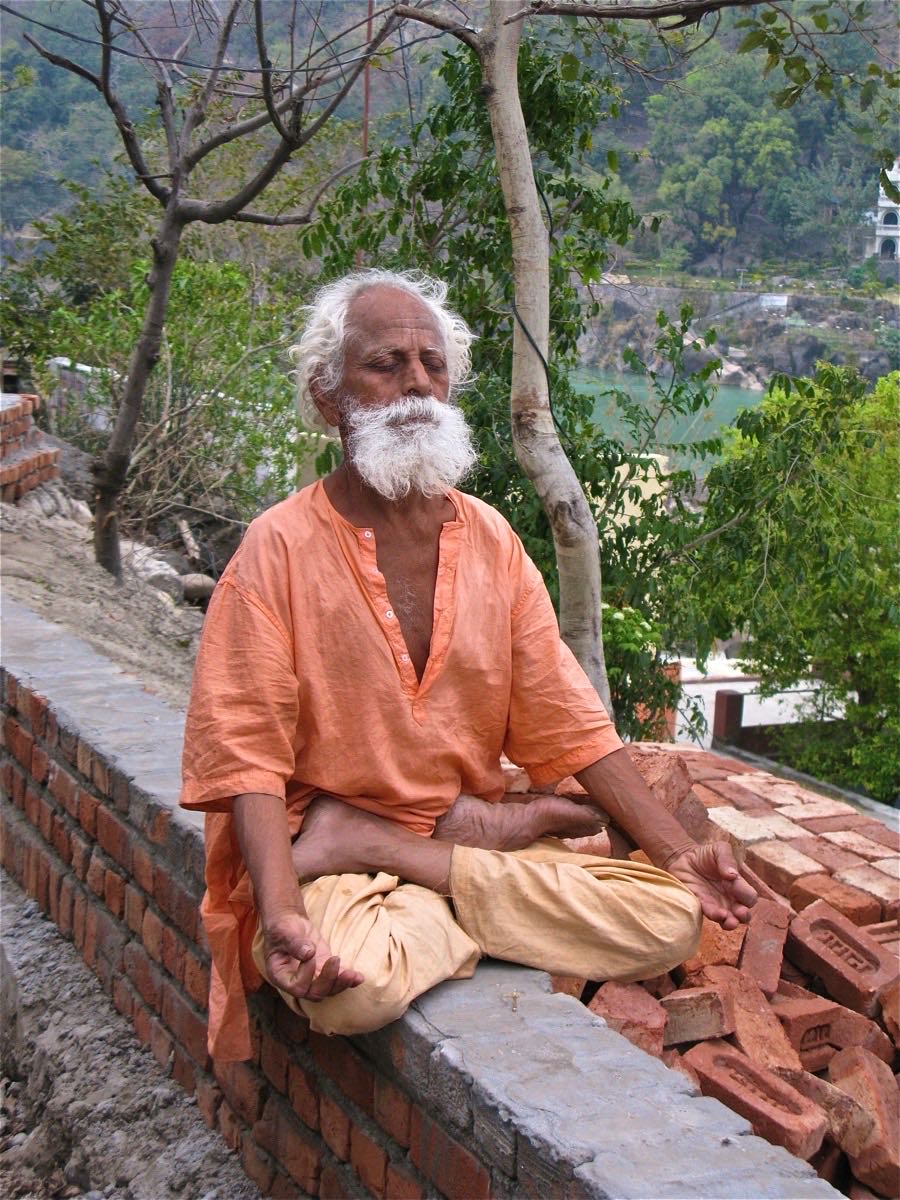
Dhyāna (Sanskrit: ध्यान, “meditation” or “contemplation”) is one of the most profound and enduring contributions of Hindu civilization to human spiritual practice. Far more than a relaxation technique, dhyāna is a systematic discipline of inward attention that aims to still the fluctuations of the mind (citta-vṛtti-nirodha), reveal the true nature of the Self (Ātman), and ultimately dissolve the boundary between the meditator and the Absolute (Brahman). From the fire-altars of the Ṛg Veda to the forest academies of the Upaniṣads, from the crystalline aphorisms of Patañjali to the battlefield counsel of Śrī Kṛṣṇa in the Bhagavad Gītā, dhyāna runs like a luminous thread through the entire fabric of Hindu thought and practice.
Vedic and Upanishadic Roots
The seeds of meditative practice appear in the earliest stratum of Hindu literature. The Ṛg Veda (c. 1500-1200 BCE) describes the sages (ṛṣis) as dhīra — “the wise ones” who perceive truth through inner vision. The hymn to the Keśin (long-haired ascetic, Ṛg Veda 10.136) portrays a wandering sage who has “drunk poison with Rudra” and moves in ecstatic states, suggesting proto-meditative experiences.
It is in the Upaniṣads, however, that dhyāna receives its first systematic treatment. The Bṛhadāraṇyaka Upaniṣad (c. 700 BCE) instructs the seeker to pursue Self-knowledge through śravana (hearing), manana (reflection), and nididhyāsana (sustained contemplation) — the final stage being a deep meditative absorption on the nature of Brahman (Bṛhadāraṇyaka 2.4.5).
The Kaṭha Upaniṣad offers one of the earliest metaphors for meditation: the Self is hidden within the body as fire is hidden in wood, and it can be discovered by the meditator (dhyātā) through sustained practice, “as butter is extracted from cream” (Kaṭha 2.1.15). The same text introduces the famous chariot metaphor (Kaṭha 1.3.3-9), where the body is the chariot, the intellect (buddhi) the charioteer, the mind (manas) the reins, and the senses the horses — establishing the rationale for meditation as the disciplining of the inner faculties.
The Śvetāśvatara Upaniṣad provides remarkably practical instructions for meditation, specifying posture, breath control, and the choice of a clean, level place free from distractions (Śvetāśvatara 2.8-10). It describes the progressive signs of meditative attainment: visions of mist, smoke, sun, fire, wind, fireflies, lightning, crystal, and the moon — an experiential phenomenology of deepening concentration.
The Māṇḍūkya Upaniṣad, among the shortest yet most profound of the Upaniṣads, maps consciousness onto the syllable Oṃ through its four states: waking (jāgrat), dreaming (svapna), deep sleep (suṣupti), and the transcendent fourth state (turīya). This framework provides the theoretical foundation for meditation as a journey from surface awareness through successive layers of consciousness to the non-dual Absolute.
Patañjali’s Yoga Sūtras: Dhyāna as the Seventh Limb
The most systematic classical treatment of dhyāna comes in the Yoga Sūtras of Patañjali (c. 2nd century BCE to 4th century CE), where it occupies the seventh position in the eightfold path (Aṣṭāṅga Yoga). The eight limbs are: yama (ethical restraints), niyama (observances), āsana (posture), prāṇāyāma (breath regulation), pratyāhāra (sense withdrawal), dhāraṇā (concentration), dhyāna (meditation), and samādhi (absorption).
The Inner Triad: Dhāraṇā, Dhyāna, Samādhi
Patañjali treats the final three limbs as a progressive continuum called saṃyama (Yoga Sūtra 3.4). Understanding their relationship is essential:
-
Dhāraṇā (concentration): Fixing the mind on a single point — an image, a mantra, a region of the body, or an abstract concept. Patañjali defines it as “binding the mind (citta) to a single location” (Yoga Sūtra 3.1).
-
Dhyāna (meditation): When concentration becomes unbroken — “a continuous flow of cognition toward that object” (tatra pratyaya-ekatānatā dhyānam, Yoga Sūtra 3.2). The distinction is one of duration and steadiness: dhāraṇā is the initial effort to hold attention; dhyāna is the state where that attention flows without interruption, like oil poured from one vessel to another (tailadhāravat), an analogy used by the commentator Vyāsa.
-
Samādhi (absorption): When the meditator’s awareness merges completely with the object and the sense of a separate self dissolves — “that same [dhyāna], when the object alone shines forth and the mind is, as it were, devoid of its own form” (Yoga Sūtra 3.3).
Patañjali further distinguishes between samprajñāta samādhi (cognitive absorption, with a seed-object) and asamprajñāta samādhi (non-cognitive absorption, beyond all objects), the latter being the ultimate goal of yoga — kaivalya, the liberation of pure consciousness from the entanglements of prakṛti (matter).
The Role of Obstacles and Their Removal
The Yoga Sūtras identify nine obstacles (antarāya) to meditation, including illness, doubt, carelessness, laziness, sensual attachment, false perception, failure to reach firm ground, and instability (Yoga Sūtra 1.30). Patañjali prescribes several remedies, foremost among them the cultivation of friendliness (maitrī), compassion (karuṇā), joy (muditā), and equanimity (upekṣā) toward beings in various conditions (Yoga Sūtra 1.33), as well as sustained practice (abhyāsa) and dispassion (vairāgya) (Yoga Sūtra 1.12).
Bhagavad Gītā Chapter 6: The Yoga of Meditation
The Bhagavad Gītā, embedded within the Mahābhārata, devotes its entire sixth chapter — the Dhyāna Yoga or Ātma-saṃyama Yoga — to meditation. Lord Kṛṣṇa provides Arjuna with detailed practical instructions:
On posture and environment: “In a clean spot, having established a firm seat of his own, neither too high nor too low, made of cloth, skin, and kuśa grass, one over the other — there, having made the mind one-pointed, with the activities of the mind and senses controlled, let him practise yoga for self-purification” (Gītā 6.11-12).
On the quality of attention: “Holding the body, head, and neck erect, motionless and steady, gazing at the tip of his own nose and not looking around” (Gītā 6.13). The meditator should be “serene-minded, fearless, firm in the vow of celibacy, the mind controlled, thinking of Me, sit steadfast, devoted to Me” (Gītā 6.14).
On moderation: Kṛṣṇa emphasizes the Middle Way avant la lettre: “Yoga is not for him who eats too much or too little, who sleeps too much or too little. For him who is moderate in eating, recreation, effort in action, sleep, and waking, yoga becomes the destroyer of sorrow” (Gītā 6.16-17).
On the result: When the mind is perfectly restrained and rests in the Self alone, the yogī is said to be “like a lamp in a windless place that does not flicker” (yathā dīpo nivātastho neṅgate, Gītā 6.19) — one of the most celebrated similes in world spiritual literature.
When Arjuna protests that the mind is as difficult to control as the wind (cañcalaṃ hi manaḥ kṛṣṇa, Gītā 6.34), Kṛṣṇa acknowledges the difficulty but assures him that through abhyāsa (practice) and vairāgya (dispassion), it can be mastered (Gītā 6.35).
Saguṇa and Nirguṇa Meditation
Hindu meditation traditions broadly distinguish between two approaches:
Saguṇa Dhyāna (Meditation with Form)
Saguṇa meditation directs attention toward a deity with attributes — a particular form, name, qualities, and mythology. The practitioner may visualize Viṣṇu reclining on Śeṣa-nāga, Śiva seated in meditation on Mount Kailāsa, the compassionate face of the Divine Mother, or Kṛṣṇa playing the flute in Vṛndāvana.
The Bhāgavata Purāṇa (3.28.12-17) provides an elaborate meditative visualization (dhyāna-śloka) of Lord Viṣṇu — from the lotus feet upward through the yellow silk garment, the Kaustubha gem, the four arms holding conch, disc, mace, and lotus, to the serene face — training the mind to hold an increasingly detailed inner image.
Saguṇa meditation is closely allied with bhakti (devotion) and is recommended for beginners, as the mind more easily grasps a concrete form than an abstract principle.
Nirguṇa Dhyāna (Meditation without Form)
Nirguṇa meditation, emphasized in the Advaita Vedānta tradition of Śaṅkarācārya, contemplates Brahman as formless, attributeless, infinite consciousness. The practitioner may meditate on the great Upanishadic declarations (mahāvākyas) — “Aham Brahmāsmi” (I am Brahman), “Tat tvam asi” (Thou art That), “Prajñānam Brahma” (Consciousness is Brahman) — turning the attention inward to the witnessing awareness that underlies all experience.
Śaṅkara’s Vivekacūḍāmaṇi (verse 363-365) describes nirguṇa meditation as the direct inquiry into one’s own nature: “Continuously fixing the mind on the supreme Brahman, the wise one abides as Brahman itself, like the flame that, having burnt all fuel, subsides into its own nature.”
Both approaches are considered valid, and many practitioners integrate them — beginning with saguṇa meditation to develop concentration, then transitioning to nirguṇa contemplation as the mind becomes subtler.
Classical Meditation Techniques
Hindu tradition has developed a rich arsenal of meditation techniques, each suited to different temperaments and stages of practice:
Mantra Meditation (Japa Dhyāna)
The repetition of sacred syllables or names of God — whether aloud (vācika), in a whisper (upāṃśu), or mentally (mānasika) — is perhaps the most widely practised form of Hindu meditation. The Gayatrī Mantra (Ṛg Veda 3.62.10), Oṃ Namaḥ Śivāya, and the mahā-mantra (“Hare Kṛṣṇa, Hare Rāma”) are among the most common objects of japa. The Yoga Sūtras prescribe meditation on the syllable Oṃ (praṇava) as a direct means to the knowledge of the inner Self (Yoga Sūtra 1.27-28).
The use of a mālā (rosary of 108 beads) provides a tactile anchor, with each bead marking one repetition of the mantra, helping the mind resist distraction.
Breath Meditation (Prāṇāyāma Dhyāna)
While prāṇāyāma (breath regulation) is technically a separate limb in Patañjali’s system, breath awareness is integral to meditation. The practice of ānāpānasati (awareness of inhalation and exhalation) is shared across Hindu and Buddhist traditions. The Haṭha Yoga Pradīpikā (2.1-2) states that “when the breath is unsteady, the mind is unsteady; when the breath is still, the mind is still.” Techniques such as nāḍī-śodhana (alternate nostril breathing) calm the nervous system and prepare the mind for deeper absorption.
Trāṭaka (Steady Gazing)
Trāṭaka involves fixing the gaze upon a single point — traditionally a candle flame, a deity image, a yantra, or the tip of the nose (nāsāgra dṛṣṭi). The Haṭha Yoga Pradīpikā (2.31) lists trāṭaka as one of the six purification practices (ṣaṭkarma). It strengthens concentration, purifies the eyes, and prepares the practitioner for internal visualization (antaraṅga dhyāna).
Kuṇḍalinī Meditation
The Tantric and Śākta traditions describe a dormant spiritual energy — Kuṇḍalinī Śakti — coiled at the base of the spine in the mūlādhāra cakra. Through meditation combined with prāṇāyāma, visualization, and mantra, the practitioner awakens this energy and guides it upward through the six primary cakras (energy centres) — svādhiṣṭhāna, maṇipūra, anāhata, viśuddha, and ājñā — to the crown (sahasrāra), where Śakti unites with Śiva, and the individual consciousness merges with cosmic consciousness.
The Śiva Saṃhitā (5.30-31) and the Ṣaṭ-cakra-nirūpaṇa of Pūrṇānanda (16th century) provide detailed maps of this inner journey, including the colours, syllables, presiding deities, and number of petals associated with each cakra.
Yoga Nidrā
A state of conscious deep sleep, Yoga Nidrā (“yogic sleep”) is described in the Tantric texts as a meditation practised in śavāsana (corpse posture). The practitioner systematically withdraws awareness from the external senses, rotates attention through the body, and enters a state between waking and sleep — accessing the prajna (deep sleep) level of consciousness described in the Māṇḍūkya Upaniṣad while maintaining lucid awareness.
Cross-Cultural Connections: Jhāna, Ch’an, and Zen
The Sanskrit word dhyāna underwent a fascinating linguistic and spiritual journey as meditation practices spread eastward. In the Pāli language of Theravāda Buddhism, dhyāna became jhāna, denoting the four stages of meditative absorption central to the Buddhist path. The Buddha himself, trained in Hindu meditative traditions, attained the formless jhānas under the teachers Āḷāra Kālāma and Uddaka Rāmaputta before discovering his own Middle Way.
When Buddhism reached China (c. 1st century CE), dhyāna was transliterated into Chinese as chán-nà (禪那), later shortened to Chán (禪). The Chán school, founded traditionally by Bodhidharma (5th-6th century CE), emphasized seated meditation (zuòchán) as the primary path to awakening. When Chán reached Japan, it became Zen (禅) — the word that has become virtually synonymous with meditation in the modern Western imagination.
Thus, every time someone speaks of “Zen meditation,” they are unwittingly using a Japanese transliteration of a Chinese transliteration of a Sanskrit word (dhyāna) that originated in the Vedic and Upanishadic traditions of India. This etymological lineage is itself a powerful testament to the global reach of Hindu meditative insight.
Despite shared roots, significant differences exist. Buddhist jhāna practice typically focuses on anicca (impermanence), dukkha (suffering), and anattā (non-self), while Hindu dhyāna aims at the realization of the eternal Self (Ātman). Buddhist meditation tends to be deconstructive — dismantling the sense of a permanent self — while Hindu meditation is often reconstructive, uncovering the radiant Self that was always present beneath the veils of ignorance (avidyā).
Dhyāna in the Six Orthodox Schools
Each of the six āstika (orthodox) schools of Hindu philosophy incorporates meditation, though with different emphases:
- Yoga (Patañjali): Dhyāna as the penultimate limb of the eightfold path, directed toward kaivalya.
- Sāṅkhya: Meditation as discriminative knowledge (viveka-khyāti) between puruṣa (consciousness) and prakṛti (matter).
- Vedānta: Nididhyāsana as sustained contemplation on the Upanishadic truth of the identity of Ātman and Brahman.
- Nyāya and Vaiśeṣika: Meditation as focused reflection (upāsanā) to remove false knowledge.
- Mīmāṃsā: While primarily ritual-oriented, later Mīmāṃsā admits upāsanā as mental worship complementing external rites.
Modern Scientific Research
The past five decades have seen an explosion of scientific research validating what Hindu meditators have known for millennia: that sustained meditative practice transforms the brain and body in measurable ways.
Neuroimaging studies (using fMRI and EEG) have shown that long-term meditators exhibit increased cortical thickness in areas associated with attention and interoception, particularly the prefrontal cortex and the insula. A landmark 2005 study by Sara Lazar at Harvard found that experienced meditators had thicker cortices than age-matched non-meditators.
Stress reduction: Herbert Benson’s research at Harvard Medical School in the 1970s documented what he termed the “relaxation response” — decreased heart rate, blood pressure, and cortisol levels during meditation — closely paralleling the physiological descriptions of praśānta (deep peace) described in the Yoga Sūtras and the Gītā.
Telomere length and ageing: Nobel laureate Elizabeth Blackburn’s research found that meditation practitioners showed longer telomeres — the protective caps on chromosomes associated with longevity — suggesting that meditation may slow cellular ageing.
Mental health: Meta-analyses published in JAMA Internal Medicine (2014) found that mindfulness meditation programmes showed moderate evidence of improved anxiety, depression, and pain outcomes. These findings echo the Gītā’s promise that yoga is the “destroyer of sorrow” (duḥkha-hantā, Gītā 6.17).
Default Mode Network: Research has shown that meditation reduces activity in the brain’s Default Mode Network (DMN) — the neural circuitry associated with mind-wandering, self-referential thought, and the narrative sense of self — paralleling Patañjali’s description of citta-vṛtti-nirodha (cessation of mental fluctuations).
Dhyāna in Daily Life: Practical Guidance
The Hindu tradition does not confine meditation to the cushion or the cave. The Bhagavad Gītā’s concept of Karma Yoga — selfless action performed as meditation — extends dhyāna into every moment of daily life. As Kṛṣṇa declares: “Established in yoga, perform actions” (yogasthaḥ kuru karmāṇi, Gītā 2.48).
Traditional guidelines for meditation practice include:
- Time: The brāhma-muhūrta (approximately 4:00-6:00 AM), when sattva guṇa predominates and the mind is naturally still, is considered ideal. Dusk (sandhyā) is the other auspicious junction.
- Place: A clean, quiet, dedicated space — ideally facing east or north.
- Posture: Any stable, comfortable seated position — padmāsana (lotus), siddhāsana (adept’s pose), or sukhāsana (easy pose) — with the spine erect.
- Duration: The tradition recommends starting with short sessions (10-15 minutes) and gradually extending through daily practice.
- Regularity: The Yoga Sūtras emphasize that practice becomes firmly established when continued for a long time, without interruption, and with devotion (sa tu dīrghakāla-nairantarya-satkāra-āsevitaḥ dṛḍhabhūmiḥ, Yoga Sūtra 1.14).
Conclusion
Dhyāna stands at the very heart of Hindu spiritual life — not as a peripheral technique but as the central mechanism through which the individual soul realizes its identity with the Infinite. From the Vedic ṛṣis who “saw” (paśyanti) the hymns in states of deep contemplation, through the Upanishadic sages who mapped the states of consciousness, the systematic genius of Patañjali, and the compassionate pragmatism of the Gītā, Hindu meditation represents an unbroken lineage of inner exploration spanning at least three thousand years.
In an age of unprecedented distraction and mental fragmentation, the ancient science of dhyāna offers not merely relief but a radical re-orientation of consciousness — from the turbulent surface of the mind to its luminous depths, from the apparent multiplicity of phenomena to the silent unity of Brahman. As the Kaṭha Upaniṣad declares: “When the five senses are stilled, when the mind is stilled, when the intellect is stilled — that, they say, is the highest state” (Kaṭha 2.3.10).