Introduction
Advaita Vedānta (Sanskrit: अद्वैत वेदान्त, literally “non-dual end of the Vedas”) is one of the most influential schools of Hindu philosophy. Rooted in the Upaniṣads and systematised by the towering intellect of Ādi Śaṅkarācārya in the 8th century CE, it proclaims a singular, radical thesis: Brahman alone is real; the world is appearance (māyā); the individual self (Ātman) is none other than Brahman. This deceptively simple formulation unfolds into one of the most rigorous and profound metaphysical systems ever devised.
The word advaita derives from the Sanskrit prefix a- (not) and dvaita (duality), yielding “not-two” or “non-dual.” Advaita does not merely assert oneness; it denies the ultimate reality of any second thing whatsoever.
Ādi Śaṅkarācārya: The Principal Exponent
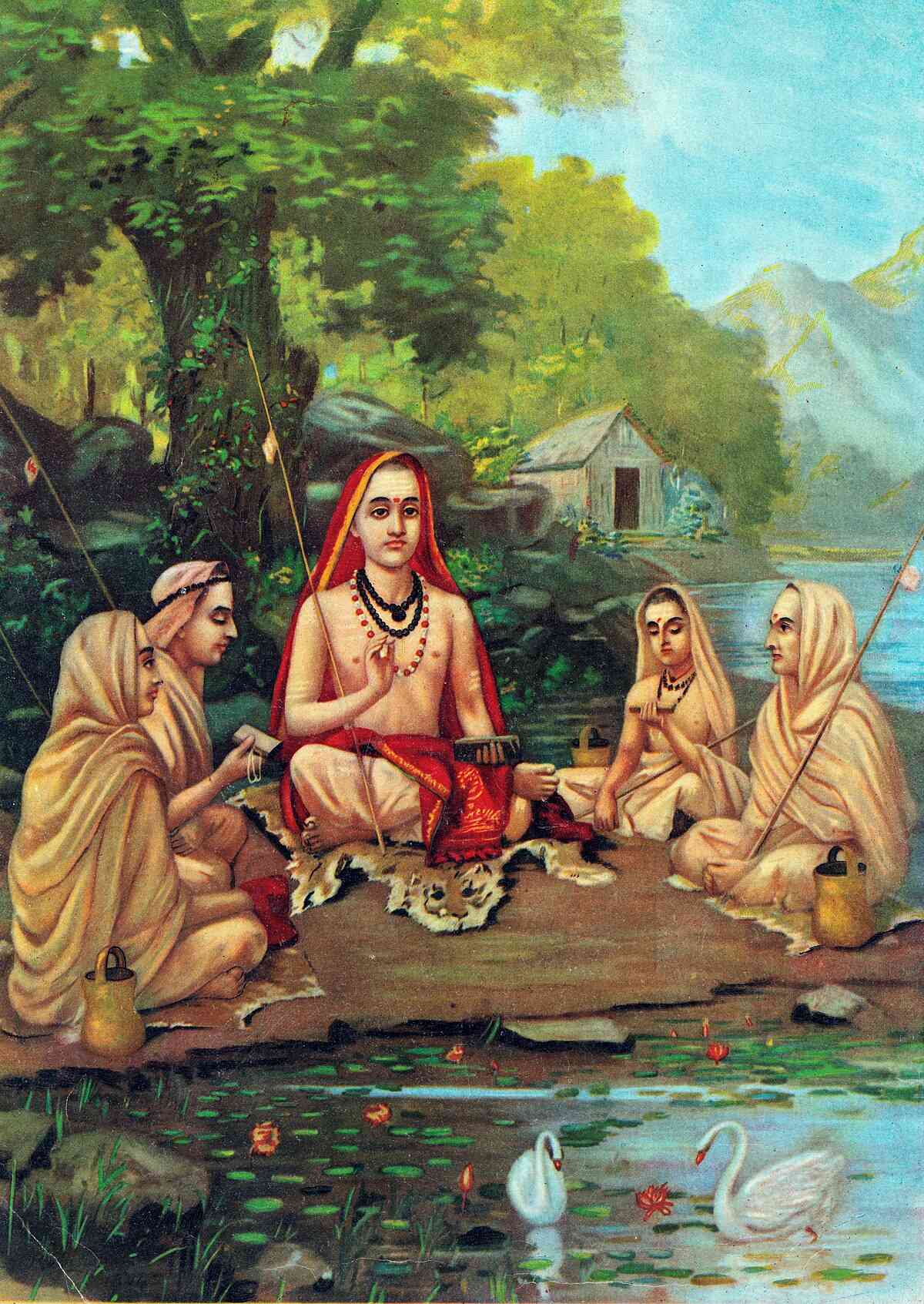
Ādi Śaṅkara (c. 788-820 CE) was born in Kāladī, Kerala, into a Nambūdiri Brāhmaṇa family. Tradition holds that he renounced the world at a remarkably young age and became a disciple of Govindapāda, who was himself a student of Gauḍapāda, the author of the Māṇḍūkya Kārikā. Despite his short life of approximately thirty-two years, Śaṅkara’s intellectual output was staggering.
He traversed the Indian subcontinent engaging scholars of rival traditions in philosophical debate, composed commentaries (bhāṣya) on the foundational texts of Vedānta, wrote independent treatises such as the Vivekacūḍāmaṇi and Upadeśasāhasrī, and established four monastic centres (maṭhas) that endure to the present day. His mission was the revival and consolidation of the Advaita teaching latent in the Vedic scriptures.
Core Doctrine: Brahman, Ātman, and Māyā
Brahman: The Only Reality
In Advaita Vedānta, Brahman is the sole, ultimate reality — infinite, changeless, attributeless pure consciousness (cit). It is described through the triad sat-cit-ānanda (existence-consciousness-bliss), though strictly speaking Brahman transcends all predicates. The Upaniṣads famously characterise it through negation (neti neti — “not this, not this”), indicating that no finite description can capture the infinite.
Nirguṇa and Saguṇa Brahman
Śaṅkara draws a crucial distinction between Nirguṇa Brahman (Brahman without attributes) and Saguṇa Brahman (Brahman with attributes). Nirguṇa Brahman is Brahman as it truly is: beyond name, form, and all conceptual categories. Saguṇa Brahman, also called Īśvara (the Lord), is Brahman as perceived through the lens of māyā — endowed with qualities such as omniscience, omnipotence, and benevolence.
From the standpoint of ultimate reality (pāramārthika), only Nirguṇa Brahman exists. Saguṇa Brahman belongs to the empirical level (vyāvahārika) of experience — real within the transactional world but sublated upon the dawn of liberating knowledge.
Māyā and Avidyā
Māyā (cosmic illusion) is the power by which the one Brahman appears as the manifold world of names and forms. It is neither fully real nor fully unreal — it is anirvachanīya (indescribable). Śaṅkara illustrates māyā with the classic analogy of a rope mistaken for a snake in dim light: the snake is not real, yet it produces genuine fear until the rope is recognised. Likewise, the multiplicity of the world produces genuine experience until the non-dual Brahman is recognised.
Avidyā (ignorance) is the individual counterpart of māyā. It is beginningless (anādi) and causes the jīva (individual soul) to misidentify with the body-mind complex, producing the cycle of birth and death (saṃsāra). The removal of avidyā through knowledge (jñāna) is the sole means to liberation.
Ātman is Brahman
The most revolutionary assertion of Advaita is that the individual self (Ātman) is numerically identical with Brahman. The apparent limitation and suffering of the individual is caused by superimposition (adhyāsa) — the erroneous attribution of properties of the not-self (body, mind, senses) onto the self. When this superimposition is dissolved through discriminative knowledge, the Ātman is revealed as what it always was: infinite Brahman.
The Mahāvākyas: Great Utterances of the Upaniṣads
The identity of Ātman and Brahman is proclaimed in four celebrated sentences drawn from the four Vedas, known as the Mahāvākyas (great sayings):
- Prajñānam Brahma (प्रज्ञानम् ब्रह्म) — “Consciousness is Brahman” (Aitareya Upaniṣad, Ṛg Veda)
- Aham Brahmāsmi (अहम् ब्रह्मास्मि) — “I am Brahman” (Bṛhadāraṇyaka Upaniṣad, Yajur Veda)
- Tat Tvam Asi (तत् त्वम् असि) — “You are That” (Chāndogya Upaniṣad, Sāma Veda)
- Ayam Ātmā Brahma (अयम् आत्मा ब्रह्म) — “This Self is Brahman” (Māṇḍūkya Upaniṣad, Atharva Veda)
These statements are not mere philosophical propositions; in the Advaita tradition they function as direct pointers to immediate self-knowledge when heard from a qualified teacher (guru) and contemplated with a prepared mind.
Mokṣa Through Jñāna
Liberation (mokṣa) in Advaita Vedānta is not the attainment of something new but the recognition of what already is. Since the Ātman is eternally Brahman, bondage is merely ignorance and liberation is merely knowledge. Śaṅkara prescribes a fourfold discipline (sādhana-catuṣṭaya) for aspirants:
- Viveka — discrimination between the eternal and the transient
- Vairāgya — dispassion toward worldly enjoyments
- Ṣaṭsampatti — the six virtues: mental calm (śama), sensory restraint (dama), withdrawal (uparati), endurance (titikṣā), faith (śraddhā), and mental focus (samādhāna)
- Mumukṣutva — an intense longing for liberation
With this preparation, the aspirant engages in śravaṇa (listening to scripture under a guru), manana (rational reflection), and nididhyāsana (deep contemplative meditation). The culmination is aparokṣa jñāna — direct, immediate knowledge that “I am Brahman.” Advaita uniquely upholds jīvanmukti, the possibility of full liberation while still embodied.
The Prasthānatrayī: Śaṅkara’s Commentaries
Śaṅkara’s philosophical authority rests on his masterful commentaries on the three canonical source-texts of Vedānta, collectively called the Prasthānatrayī (triple foundation):
- Upaniṣads (Śruti Prasthāna): Śaṅkara wrote commentaries on ten principal Upaniṣads — Īśā, Kena, Kaṭha, Praśna, Muṇḍaka, Māṇḍūkya, Aitareya, Taittirīya, Chāndogya, and Bṛhadāraṇyaka.
- Brahma Sūtras (Nyāya Prasthāna): His Brahmasūtrabhāṣya is considered the earliest extant and most influential commentary on Bādarāyaṇa’s aphorisms, systematically arguing for non-duality.
- Bhagavad Gītā (Smṛti Prasthāna): His Gītā commentary interprets Lord Kṛṣṇa’s teaching as ultimately pointing to the non-dual Brahman beyond action and devotion.
Together these commentaries established the hermeneutical framework through which Advaita reads the entire Vedic corpus.
The Four Śaṅkarācārya Maṭhas
To preserve and propagate the Advaita tradition across the Indian subcontinent, Śaṅkara established four monasteries (maṭhas) at the cardinal points of India, each assigned a Veda, a Mahāvākya, and a chief disciple:
| Maṭha | Location | Direction | Veda | Mahāvākya | First Head |
|---|---|---|---|---|---|
| Śṛṅgerī Śāradā Pīṭham | Śṛṅgerī, Karnataka | South | Yajur Veda | Aham Brahmāsmi | Sureśvarācārya |
| Dvārakā Pīṭham | Dvārakā, Gujarat | West | Sāma Veda | Tat Tvam Asi | Padmapādācārya |
| Govardhana Maṭha | Purī, Odisha | East | Ṛg Veda | Prajñānam Brahma | Hastāmalakācārya |
| Jyotirmaṭha | Jośīmaṭh, Uttarakhand | North | Atharva Veda | Ayam Ātmā Brahma | Toṭakācārya |
The heads of these institutions continue to bear the title Śaṅkarācārya and serve as the foremost spiritual authorities of the Advaita tradition.
Comparison with Other Vedānta Schools
While all Vedānta schools claim scriptural authority from the same Prasthānatrayī, they arrive at strikingly different conclusions:
Viśiṣṭādvaita (Qualified Non-Dualism)
Propounded by Rāmānujācārya (11th century), this school holds that Brahman, individual souls (cit), and the material world (acit) are three real and eternally distinct categories, but the latter two exist as the “body” of Brahman. Unity is qualified, not absolute. Souls retain their individuality even after mokṣa, dwelling in loving communion with Viṣṇu rather than merging into featureless Brahman.
Dvaita (Dualism)
Systematised by Madhvācārya (13th century), Dvaita asserts five fundamental and permanent differences: between God and soul, God and matter, soul and matter, one soul and another, and one material entity and another. Brahman (identified with Viṣṇu) is the sole independent reality (svatantra); all else is eternally dependent (paratantra). Liberation is eternal blissful service to Viṣṇu, never identity with Him.
Advaita occupies the most radical end of this spectrum: where Viśiṣṭādvaita preserves difference-in-unity and Dvaita insists on irreducible difference, Advaita dissolves all difference into the non-dual Brahman.
Enduring Legacy
Advaita Vedānta has shaped Hindu thought and practice for over twelve centuries. Its influence extends beyond philosophy into devotional literature (Śaṅkara himself composed celebrated hymns to Śiva, Viṣṇu, and Devī), into the modern Hindu renaissance through figures like Svāmī Vivekānanda and Ramaṇa Maharṣi, and into global philosophical dialogue where it is often compared with Western idealism, phenomenology, and mystical traditions.
At its heart, Advaita offers a vision of radical freedom: the recognition that the seeking self and the sought reality were never apart. As the Chāndogya Upaniṣad (6.8.7) declares in the voice of the sage Uddālaka to his son Śvetaketu: Tat Tvam Asi — “You are That.”