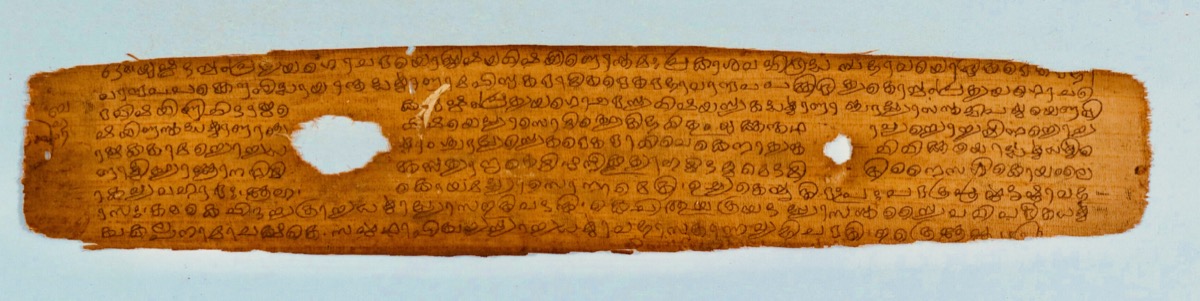
Introduction: The Third Pillar of Vedānta
In the vast landscape of Hindu philosophical literature, few texts occupy as pivotal a position as the Brahmasūtra (also known as Vedānta Sūtra, Śārīraka Sūtra, or Uttara Mīmāṃsā Sūtra). Composed by the sage Bādarāyaṇa, this concise yet extraordinarily dense text of 555 aphoristic verses forms the logical backbone of the Vedānta school --- the most influential and enduring tradition of Indian philosophy.
The Brahmasūtra belongs to the Prasthānatrayī (प्रस्थानत्रयी), the “triple canon” or “three starting points” of Vedānta:
- Upaniṣads --- the Śruti Prasthāna (revealed scriptural foundation)
- Bhagavad Gītā --- the Smṛti Prasthāna (remembered tradition foundation)
- Brahmasūtra --- the Nyāya Prasthāna (logical and reasoning foundation)
While the Upaniṣads provide the primary revelation and the Gītā offers practical spiritual guidance, the Brahmasūtra serves as the systematic, reasoned synthesis that harmonizes the diverse and sometimes apparently contradictory teachings found across the Upaniṣadic literature. Any philosopher who wished to establish a new school of Vedānta was traditionally required to write a commentary (bhāṣya) on all three texts of the Prasthānatrayī, making the Brahmasūtra a battleground where India’s greatest philosophical minds have clashed for over a millennium.
Authorship: Bādarāyaṇa and the Question of Vyāsa
The Brahmasūtra is attributed to Bādarāyaṇa (बादरायण), a sage whose identity has been the subject of scholarly debate for centuries. In the Advaita Vedānta tradition, Bādarāyaṇa is identified with Vyāsa (व्यास), literally “the one who arranges” --- the legendary compiler of the Vedas, author of the Mahābhārata, and narrator of the Purāṇas. The Viṣṇu Purāṇa (3.4.5) explicitly equates the two, stating that Kṛṣṇa Dvaipāyana (Vyāsa) is also known as Bādarāyaṇa because he resided at Badarī (Badrinath).
However, modern scholars have questioned this identification. The Brahmasūtra itself refers to “Bādarāyaṇa” in the third person (e.g., Sūtra 1.2.28: bādarāyaṇasya asti hi gateh, “There is, according to Bādarāyaṇa…”), and also mentions the views of other teachers such as Jaimini, Bādari, Kāśakṛtsna, and Āśmarathya, suggesting an environment of active philosophical debate.
The dating of the text is similarly contested. Most scholars place its composition between 500 BCE and 200 BCE, though some argue for dates as late as 200 CE. Sarvepalli Radhakrishnan and Surendranath Dasgupta independently favour the 2nd century BCE as the most likely period. What is certain is that the Brahmasūtra was not composed in a vacuum --- it presupposes familiarity with earlier sūtra literature, including Jaimini’s Pūrva Mīmāṃsā Sūtra, and engages critically with the Sāṅkhya, Yoga, Vaiśeṣika, and Buddhist philosophical traditions.
Structure: Four Chapters, Sixteen Sections, 555 Sūtras
The Brahmasūtra is organized into 4 Adhyāyas (chapters), each subdivided into 4 Pādas (sections), yielding 16 Pādas in total. These contain 223 Adhikaraṇas (topics or discussions) comprising 555 Sūtras (aphorisms). The sūtras are extraordinarily terse --- often just two or three words --- making them virtually unintelligible without a commentary. This brevity was deliberate: in the ancient Indian pedagogical tradition, sūtras were designed as memory aids for oral instruction, with the teacher providing the full exposition.
Adhyāya I: Samanvayādhyāya (The Chapter on Harmony)
134 Sūtras, 39 Adhikaraṇas
The first chapter establishes that all Vedāntic (Upaniṣadic) texts consistently and harmoniously teach one supreme reality: Brahman. The chapter opens with the most famous sūtra in all of Indian philosophy:
अथातो ब्रह्मजिज्ञासा (Athāto Brahma Jijñāsā) “Now, therefore, the inquiry into Brahman.”
This deceptively simple opening carries immense philosophical weight. The word atha (“now”) signals that the student has completed the prerequisite study of the Vedas and Vedic rituals (Karma Kāṇḍa) and is now qualified for the higher inquiry into ultimate reality. Ataḥ (“therefore”) provides the logical ground: because worldly means cannot produce lasting happiness, therefore one must inquire into Brahman, the source of eternal bliss. Brahma refers to the infinite, all-pervading Reality. Jijñāsā (“desire to know”) indicates that this is not mere intellectual curiosity but a deep existential quest for liberation.
The second sūtra, Janmādyasya yataḥ (“That from which the origin, sustenance, and dissolution of this universe proceeds”), provides the essential definition of Brahman as the ultimate cause of the cosmos. The remainder of the first chapter systematically demonstrates that disputed Upaniṣadic passages (those describing ākāśa, prāṇa, jyoti, and other entities) all ultimately refer to Brahman, not to material elements or individual souls.
Adhyāya II: Avirodhādhyāya (The Chapter on Non-Contradiction)
157 Sūtras, 47 Adhikaraṇas
The second chapter defends the Vedāntic position against rival philosophical schools. It addresses objections from Sāṅkhya (which posits an unconscious Prakṛti as the material cause), Vaiśeṣika (atomism), Buddhism (momentariness and no-self), Jainism, and the Pāśupata Śaiva and Pāñcarātra Vaiṣṇava traditions. The chapter argues that:
- The conscious Brahman, not unconscious Prakṛti, is the material and efficient cause of the universe
- The atomistic theories of the Vaiśeṣika school cannot adequately explain creation
- Buddhist doctrines of momentariness (kṣaṇavāda) and void (śūnyavāda) are self-contradictory
- The Vedāntic teaching is internally consistent and free from logical defects
This chapter also addresses the crucial question of how the individual soul (jīva) relates to Brahman, and how the material world proceeds from a purely spiritual cause.
Adhyāya III: Sādhanādhyāya (The Chapter on Spiritual Practice)
186 Sūtras, 66 Adhikaraṇas
The longest chapter focuses on the means (sādhana) for attaining knowledge of Brahman. It discusses:
- The nature of the individual soul and its journey after death
- The doctrine of karma and rebirth: how past actions determine the soul’s future embodiment
- The various vidyās (meditations) prescribed in different Upaniṣads and whether they can be combined
- The qualifications (adhikāra) necessary for a seeker: viveka (discrimination), vairāgya (dispassion), śamādi-ṣaṭka-sampatti (the sixfold discipline of tranquility, self-restraint, withdrawal, forbearance, concentration, and faith), and mumukṣutva (intense desire for liberation)
- The relative merits of knowledge (jñāna) and action (karma) on the path to liberation
Adhyāya IV: Phalādhyāya (The Chapter on the Fruit)
78 Sūtras, 38 Adhikaraṇas
The shortest but most soteriologically significant chapter describes the result (phala) of Brahman-knowledge:
- The process of meditation leading to realization at the moment of death
- The Devayāna (path of the gods) through which the liberated soul travels to Brahmaloka
- The nature of mokṣa (liberation): the soul’s release from the cycle of birth and death
- Whether the liberated soul retains any individuality or merges entirely with Brahman
- The irreversibility of liberation --- one who attains mokṣa never returns to saṃsāra
Key Philosophical Themes
The Nature of Brahman
The central inquiry of the Brahmasūtra is the nature of Brahman --- the ultimate Reality that is the source, sustainer, and dissolution of the entire universe. The text establishes Brahman as omniscient (sarvajña), omnipotent (sarvaśakta), and the sole cause of creation. Yet the precise nature of Brahman --- whether it is formless (nirguṇa) or possesses qualities (saguṇa), whether it is identical with or distinct from the individual soul --- became the central point of disagreement among later commentators.
Brahman as Both Material and Efficient Cause
Unlike the Sāṅkhya dualism that posits Puruṣa (consciousness) and Prakṛti (matter) as two independent realities, the Brahmasūtra argues for Brahman as both the upādāna kāraṇa (material cause) and the nimitta kāraṇa (efficient cause) of the universe. Just as a spider produces its web from its own body, Brahman manifests the world from itself while remaining unchanged in essence (Sūtra 2.1.25).
The Jīva-Brahman Relationship
How does the individual soul relate to the supreme Brahman? This question receives different treatment in different adhikaraṇas, and the apparent ambiguity has fuelled rival interpretations for centuries. The text states that the jīva is “a part” (aṃśa) of Brahman (Sūtra 2.3.43: aṃśo nānāvyapadeśāt), but whether this “part” signifies identity, qualified identity, or real distinction depends entirely on the commentator’s philosophical commitments.
Liberation (Mokṣa)
The Brahmasūtra teaches that knowledge of Brahman (brahmavidyā) is the direct means to liberation. Ritual action, while valuable for purification, cannot by itself produce mokṣa. The text affirms that upon realization, the liberated soul attains a state of infinite bliss, free from the bonds of karma and rebirth, and does not return to worldly existence (Sūtra 4.4.22: anāvṛttiḥ śabdāt, “non-return, on the basis of scripture”).
The Great Commentaries: One Text, Many Philosophies
The extreme brevity of the sūtras --- almost always requiring interpretation --- made the Brahmasūtra the primary arena for philosophical debate in India. Every major Vedāntic ācārya wrote an elaborate commentary (bhāṣya), and the astonishing fact is that the same 555 sūtras were used to defend radically different metaphysical systems.
Śaṅkara (788—820 CE): Advaita Vedānta
Śārīraka Bhāṣya --- Śaṅkara’s commentary is the earliest surviving complete bhāṣya and remains the most influential. He reads the Brahmasūtra as teaching Advaita (non-duality): Brahman alone is real (satya), the world is an illusory superimposition (adhyāsa) upon Brahman, and the individual self is in reality identical with Brahman. The famous opening section of his commentary, the Adhyāsa Bhāṣya, establishes mutual superimposition of self and not-self as the root cause of bondage. For Śaṅkara, the nirguṇa (attributeless) Brahman is the ultimate truth, and saguṇa (qualified) Brahman is a provisional description useful for meditation.
Rāmānuja (1017—1137 CE): Viśiṣṭādvaita Vedānta
Śrī Bhāṣya --- Rāmānuja’s magisterial commentary challenges Śaṅkara at every turn. He argues for Viśiṣṭādvaita (qualified non-duality): Brahman is real and possesses infinite auspicious qualities; the individual souls and the material world are real but exist as the “body” (śarīra) of Brahman. Liberation is not the dissolution of individuality but the soul’s eternal, blissful communion with the personal God (Nārāyaṇa/Viṣṇu). Rāmānuja rejects māyā as cosmic illusion, arguing instead that Brahman transforms itself into the world through a real process.
Madhva (1238—1317 CE): Dvaita Vedānta
Brahmasūtra Bhāṣya and Anuvyākhyāna --- Madhva’s commentary propounds Dvaita (dualism): God (Viṣṇu), individual souls, and matter are eternally real and irreducibly distinct. The souls are not identical with God but are eternally dependent on Him. Liberation consists in the soul’s experience of its own intrinsic bliss in eternal service to Viṣṇu. Madhva is notable for positing a hierarchy among souls, with some destined for liberation, others for eternal transmigration, and others for eternal damnation --- a unique position in Hindu theology.
Nimbārka (13th century CE): Dvaitādvaita
Vedānta Pārijāta Saurabha --- Nimbārka’s commentary advances Dvaitādvaita (duality-in-non-duality or Bhedābheda): Brahman is simultaneously different from and identical with souls and the world. The jīva is a real part of Brahman, distinct yet inseparable, like the sun and its rays.
Vallabha (1479—1531 CE): Śuddhādvaita
Aṇu Bhāṣya --- Vallabha’s commentary teaches Śuddhādvaita (pure non-duality): the world is real because it is Brahman itself, not an illusion. Unlike Śaṅkara’s Advaita, which relegates the world to māyā, Vallabha insists that everything is a real manifestation of Kṛṣṇa (Brahman). Liberation comes through puṣṭi (divine grace) and selfless devotion (bhakti).
Baladeva Vidyābhūṣaṇa (18th century): Acintya Bhedābheda
Govinda Bhāṣya --- The most recent major commentary, written in the Gauḍīya Vaiṣṇava tradition of Caitanya Mahāprabhu, propounds Acintya Bhedābheda (inconceivable simultaneous oneness and difference): the relationship between God, souls, and the world involves both identity and difference in a manner that transcends rational comprehension.
How the Same Sūtras Yield Different Philosophies
The diversity of interpretations is not arbitrary --- it arises from genuine hermeneutical choices. Consider the second sūtra: Janmādyasya yataḥ (“That from which the origin etc. of this [universe] proceeds”). Śaṅkara reads this as a provisional characterization of Brahman through its effects, ultimately to be transcended. Rāmānuja reads it as affirming Brahman’s real qualities of creatorship. Madhva reads it as establishing Viṣṇu as the independent Lord distinct from dependent souls.
Similarly, the sūtra Aṃśo nānāvyapadeśāt (2.3.43, “A part, because of the varied scriptural declarations”) is interpreted by Śaṅkara as meaning the jīva is Brahman reflected in māyā (like the sun reflected in water), by Rāmānuja as meaning the jīva is a real mode (prakāra) of Brahman, and by Madhva as meaning the jīva is a real but subordinate entity wholly dependent on Viṣṇu.
These divergences reveal that the Brahmasūtra functions less as a closed doctrinal statement and more as an open philosophical framework --- a set of logical coordinates within which multiple coherent systems can be constructed.
Modern Relevance and Study
The Brahmasūtra continues to be studied in traditional Sanskrit pāṭhaśālās (schools) and maṭhas (monasteries) across India, particularly at the Sringeri, Kanchi, Dwaraka, and Puri Shankaracharya maṭhas, and at major Vaiṣṇava centres like Melkote and Udupi. In the modern academy, the text is central to courses in Indian philosophy, comparative religion, and the history of ideas.
Swami Vivekananda brought the Brahmasūtra to global attention through his lectures on Vedānta in the late 19th century, and scholars such as S. Radhakrishnan, Hajime Nakamura, and George Thibaut (who translated Śaṅkara’s and Rāmānuja’s commentaries into English for Max Muller’s Sacred Books of the East series) made the text accessible to Western audiences.
For the contemporary seeker, the Brahmasūtra offers a rigorous framework for investigating life’s most fundamental questions: What is the nature of ultimate reality? What is the self? How does the world relate to its source? And what constitutes true liberation? The fact that these 555 terse aphorisms have generated such a rich and diverse philosophical tradition --- spanning non-dualism, qualified non-dualism, dualism, and beyond --- testifies to the text’s extraordinary depth and enduring power.
Conclusion
The Brahmasūtra stands as one of humanity’s great intellectual achievements --- a work that distills the vast ocean of Upaniṣadic wisdom into a systematic, logically structured inquiry into the nature of Brahman. For over two millennia, it has served as the common reference point for Hindu philosophical debate, the text upon which India’s most brilliant minds have tested and refined their understanding of reality. Whether one approaches it through Śaṅkara’s radical non-dualism, Rāmānuja’s devotional theism, Madhva’s rigorous dualism, or any of the other great commentarial traditions, the Brahmasūtra remains what its opening words declare it to be: an invitation to the most profound inquiry a human being can undertake --- the inquiry into Brahman.