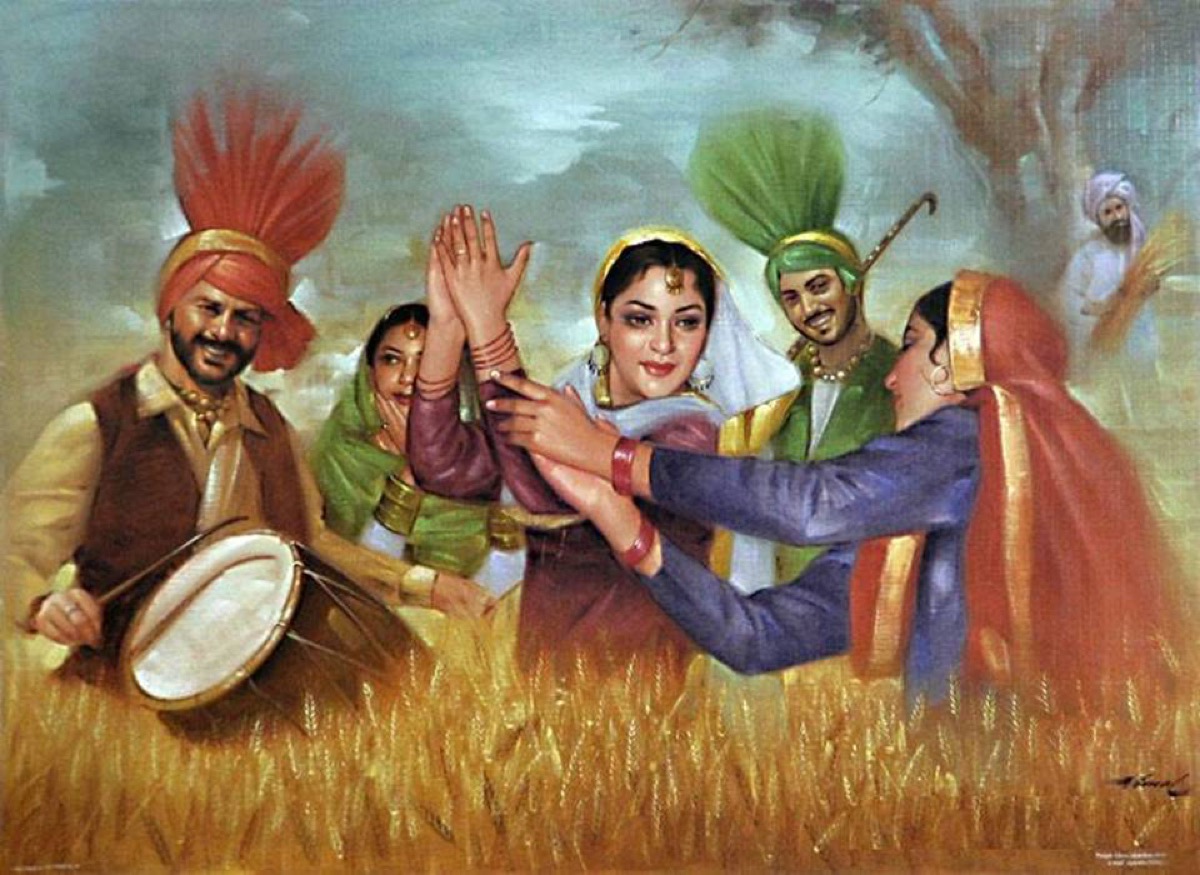
Baisākhī (बैसाखी), also spelled Vaishākhī (वैशाखी), is the great spring harvest festival of Punjab and North India, celebrated on the first day of the solar month of Vaishākha — typically falling on 13 or 14 April each year. It marks the solar new year in the Vikramī (Bikrami) calendar used traditionally in Punjab, Haryana, Himachal Pradesh, and parts of North India, and coincides with the Meṣa Saṅkrānti — the Sun’s entry into the zodiac sign of Aries (Meṣa Rāśi). As a harvest festival, Baisākhī celebrates the culmination of the rabi (winter-sown) wheat harvest, the backbone of Punjab’s agricultural economy. As a religious observance, it honours Sūrya (the Sun God), involves ritual bathing at sacred rivers and temples, and embodies the Hindu theology of gratitude toward the cosmic forces that sustain human life.
Etymology and Calendrical Significance
The word Vaishākhī derives from the Sanskrit month name Vaishākha (वैशाख), which is itself derived from the nakṣatra (lunar mansion) Viśākhā — the sixteenth of the twenty-seven asterisms in Vedic astronomy. Viśākhā is presided over by Indra and Agni jointly, connecting the month’s name to the two deities most associated with agriculture: Indra as the lord of rain and Agni as the lord of the sacrificial fire that consecrates the harvest.
In the Vikramī calendar (also called the Bikrami or Punjabi calendar), Vaishākha is the first month of the new year. The Vikramī era is traditionally dated to 57 BCE, attributed to the legendary king Vikramāditya of Ujjain. Thus Baisākhī is simultaneously a harvest festival and a New Year celebration, marking both the agricultural and calendrical beginning of a new cycle.
The astronomical precision of the date is significant. Baisākhī falls on the day of Meṣa Saṅkrānti — the Sun’s transit into Aries — which is calculated according to the Sūrya Siddhānta, the foundational text of Indian positional astronomy. The Sūrya Siddhānta (1.13–14) describes the mathematical methods for computing solar transits with remarkable accuracy. The Sun’s entry into Aries marks the true astronomical equinox in the sidereal (as opposed to tropical) zodiac system used in Hindu astronomy, making Baisākhī fundamentally an astronomical celebration.
Agricultural Significance
Baisākhī is, at its heart, a harvest thanksgiving festival. The timing is dictated by the agricultural calendar of the Indo-Gangetic Plain: the rabi crops — primarily wheat (gēhūṅ), mustard (sarsoṅ), barley (jau), and chickpeas (chanā) — sown in October–November are harvested in March–April. Baisākhī falls precisely at the moment when the harvest is complete and the granaries are full, making it a natural occasion for celebration and thanksgiving.
The Punjab plains, watered by the five rivers (Pañcanada) that give the region its name — Jhelum, Chenab, Ravi, Beas, and Sutlej — have been among the most productive agricultural lands in the Indian subcontinent since the Vedic period. The Ṛg Veda (7.95) contains hymns to the river Sarasvatī (often identified with the ancient course of the Ghaggar-Hakra) as the nourisher of crops, and the Atharva Veda (6.142) includes prayers for abundant harvests — testifying to the centrality of agriculture in the spiritual consciousness of the region.
For Punjabi farming families, Baisākhī represents the culmination of an entire agricultural cycle: the sowing, the anxious months of tending the crops through the cold winter, and finally the joyous harvesting when the wheat fields turn golden. The day’s celebrations — feasting, dancing, music, and communal gathering — express the profound relief and gratitude of a community that has successfully navigated another cycle of dependence on the land and the elements.
Religious Observances
Sūrya Worship
Baisākhī’s connection to the solar transit into Aries makes it a natural occasion for Sūrya pūjā (Sun worship). In Hindu temples across North India, special prayers are offered to Sūrya on Baisākhī morning. The Āditya Hṛdayam (Rāmāyaṇa, Yuddha Kāṇḍa, canto 107) — the great hymn in which the sage Agastya instructs Lord Rāma to worship the Sun before the final battle with Rāvaṇa — is recited in many households and temples.
The theological significance of worshipping Sūrya at the beginning of the solar new year reflects the Vedic understanding of the Sun as the source and sustainer of all life. The Ṛg Veda (1.115.1) declares: “chitram devānām ud agād anīkaṃ cakṣur mitrasya varuṇasyāgneḥ / āprā dyāvā-pṛthivī antarikṣaṃ sūrya ātmā jagatas tasthuṣaś ca” — “The brilliant face of the gods has risen, the eye of Mitra, Varuṇa, and Agni; he has filled heaven, earth, and the atmosphere — Sūrya is the soul of all that moves and stands still.”
Sacred Bathing
Ritual bathing at sacred rivers and tanks is a central Baisākhī observance. In Punjab, devotees flock to the sacred tanks at Amritsar and the rivers Beas and Sutlej for purificatory baths. In Haridwar, Baisākhī coincides with one of the four great bathing days of the Kumbha Melā cycle — the Sun’s transit into Aries at Haridwar is one of the astronomical conditions that triggers the twelve-yearly Kumbha Melā.
The Matsya Purāṇa (chapters 100–110) describes the spiritual merit (puṇya) of bathing at sacred rivers on astronomically significant days: “saṅkrāntau yo naraḥ snāti nīrāhāraḥ samāhitaḥ / sarva-pāpa-vinirmukto viṣṇu-lokaṃ sa gacchati” — “One who bathes on the day of a saṅkrānti, fasting and concentrated, is freed from all sins and attains the world of Viṣṇu.” Baisākhī’s Meṣa Saṅkrānti carries particular power because it initiates the first sign of the zodiac, symbolizing new beginnings and cosmic renewal.
Temple Celebrations
Hindu temples throughout North India hold special celebrations on Baisākhī. In Haridwar and Rishikesh, the Gaṅgā āratī (evening fire ceremony) on the banks of the Gaṅgā is performed with extraordinary grandeur. In the Jwalamukhi Temple of Himachal Pradesh (one of the Śakti Pīṭhas), Baisākhī marks the beginning of the annual fair that attracts hundreds of thousands of pilgrims. The Chintpurni and Naina Devī temples in the Śivālik hills also host major Baisākhī melās.
In the Brij region (Mathura-Vrindavan), Baisākhī falls during the spring festival season and is celebrated alongside Akṣaya Tṛtīyā (which occurs later in Vaishākha) as part of the extended spring celebrations honouring Kṛṣṇa and Rādhā.
Mela and Folk Traditions
The Baisākhī Melā
The Baisākhī Melā (fair) is one of the most vibrant folk traditions of Punjab and North India. These melās are held in towns, villages, and at pilgrimage sites, featuring:
-
Bhāṅgṛā (ਭੰਗੜਾ / भांगड़ा): The iconic Punjabi folk dance performed by men, characterized by high leaps, vigorous shoulder movements, and the rhythmic beating of the ḍhol (double-headed drum). Bhāṅgṛā originated as a harvest dance — its energetic movements mimic the actions of ploughing, sowing, and reaping. On Baisākhī, Bhāṅgṛā reaches its fullest expression as farming communities celebrate the completed harvest.
-
Giddā (ਗਿੱਧਾ / गिद्धा): The women’s folk dance of Punjab, performed in a circle with complex rhythmic clapping patterns (tālīs) and accompanied by short witty songs called boliyāṅ that comment on daily life, love, family relations, and the seasons.
-
Kabaddi and wrestling (kushtī) matches: Baisākhī melās traditionally include competitive sports that showcase the physical prowess of the agricultural community.
-
Folk singing: Māhiyā (couplet-based love songs), ṭapppā (a classical-folk vocal form), and sufi kāfī performances are integral to the Baisākhī melā atmosphere.
Food Traditions
Baisākhī feasting reflects the freshness of the spring harvest:
- Makki dī roṭī (cornbread) and saroṅ dā sāg (mustard greens) — the iconic Punjabi dish, though technically a winter preparation, is often served as a farewell to the rabi season.
- Kheēr (rice pudding) prepared with freshly harvested grain and jaggery
- Laṅgar (communal meals) served at temples and gurdwaras
- Mithāīyāṅ (sweets) — particularly jalebī, laddū, and barfī distributed among family and neighbours
The Jallianwala Bagh Connection
Baisākhī carries a profound historical resonance due to the Jallianwala Bagh Massacre of 13 April 1919 — one of the most tragic events in modern Indian history. On that Baisākhī day, thousands of unarmed men, women, and children had gathered in the walled garden of Jallianwala Bagh in Amritsar for the Baisākhī melā and to peacefully protest the oppressive Rowlatt Act. Without warning, British Brigadier-General Reginald Dyer ordered his troops to open fire on the trapped crowd. The official death toll was 379, though Indian estimates place the number much higher — some accounts suggest over 1,000 killed and over 1,500 wounded.
The massacre transformed Baisākhī from a purely agricultural and religious festival into a day of national remembrance. The Jallianwala Bagh is now a national memorial, and every Baisākhī commemorations are held there honouring the martyrs. The event profoundly altered the course of India’s independence movement: Rabindranath Tagore renounced his knighthood in protest, and Mahatma Gandhi launched the Non-Cooperation Movement partly in response to the atrocity. The connection between Baisākhī and the struggle for freedom has given the festival an added dimension of civic consciousness and national pride.
Baisākhī Across Regions
Himachal Pradesh
In the hill state of Himachal Pradesh, Baisākhī is celebrated with particular devotion at the major Devī temples. The Jwalamukhi temple fair attracts devotees from across North India. In the Kullu valley, Baisākhī marks the beginning of the agricultural season, and local deities (devtā) are carried in processions through the villages.
Haryana
Haryanvi Baisākhī celebrations include traditional sāṅg (folk opera) performances, raagni singing, and wrestling matches. The festival is closely tied to the agricultural cycles of the fertile Haryanvi plains.
Uttar Pradesh and Bihar
In the upper Gangetic plain, Baisākhī is observed primarily as a ritual bathing day. Devotees flock to the Gaṅgā at Prayāgraj (Allahabad), Varanasi, and Haridwar for the Meṣa Saṅkrānti bath. In Bihar, the day is associated with the beginning of the Bengali/Assamese New Year (Pōhēlā Baishākh / Rongali Bihu), though the precise date may differ by a day due to differing calendar calculations.
Bengal and Assam
The same solar transit that creates Baisākhī in Punjab creates Pōhēlā Baishākh (পহেলা বৈশাখ) in Bengal and Rongali Bihu (ৰঙালী বিহু) in Assam — the Bengali and Assamese New Year celebrations respectively. While the cultural expressions differ dramatically — Pōhēlā Baishākh features processions, music, and the inauguration of new business ledgers, while Bihu involves distinctive dance forms and community feasting — the underlying astronomical event and agricultural logic are identical.
The Solar New Year in Hindu Theology
Baisākhī’s identity as a solar new year connects it to the broader Hindu theology of time. The Sūrya Siddhānta divides the solar year into twelve solar months, each defined by the Sun’s transit through a zodiac sign. The Sun’s entry into Meṣa (Aries) — the first sign — marks the beginning of the solar year, just as Aries marks the beginning of the zodiac itself.
In the Vedic cosmological framework, the Sun is not merely a celestial body but a manifestation of the divine. The Chāndogya Upaniṣad (3.19.1) declares: “ādityo brahmety ādeśaḥ” — “The Sun is Brahman — this is the teaching.” The Īśa Upaniṣad (verse 15) contains the famous prayer: “hiraṇmayena pātreṇa satyasyāpihitaṃ mukham / tat tvaṃ pūṣan apāvṛṇu satya-dharmāya dṛṣṭaye” — “The face of Truth is covered with a golden disc. O Pūṣan (Sun), remove it, so that I, a devotee of Truth, may see.”
Baisākhī, as the Sun’s annual rebirth in Aries, thus becomes a cosmic metaphor for spiritual awakening — the removal of the golden disc of ignorance and the revelation of truth. The harvest of wheat is simultaneously the harvest of the soul’s karma accumulated over the preceding year, and the new solar year offers a fresh beginning for spiritual as well as agricultural endeavour.
Contemporary Relevance
In modern India, Baisākhī remains one of the most widely celebrated festivals of Punjab and North India, though its character has evolved. Urbanization has diminished the direct agricultural connection for many celebrants, but the festival’s spirit of communal joy, gratitude for abundance, and cultural pride remains undiminished. The global Punjabi diaspora celebrates Baisākhī with elaborate programmes in the United Kingdom, Canada, the United States, Australia, and wherever Punjabi communities have settled.
Baisākhī’s agricultural roots carry renewed significance in an era of environmental crisis. The festival’s insistence on gratitude toward the Sun, the earth, and the water that produces the harvest offers a worldview in which agriculture is not mere industry but a sacred partnership between humans and the cosmos. As the Bhagavad Gītā (3.14) teaches: “annād bhavanti bhūtāni parjanyād anna-sambhavaḥ / yajñād bhavati parjanyo yajñaḥ karma-samudbhavaḥ” — “From food all beings are born, from rain food is produced, from yajña (sacrifice) rain comes forth, and yajña arises from action.” Baisākhī celebrates this sacred cycle — from sun to rain to harvest to thanksgiving — reminding humanity that every grain of wheat is a gift of the divine, worthy of reverence and gratitude.