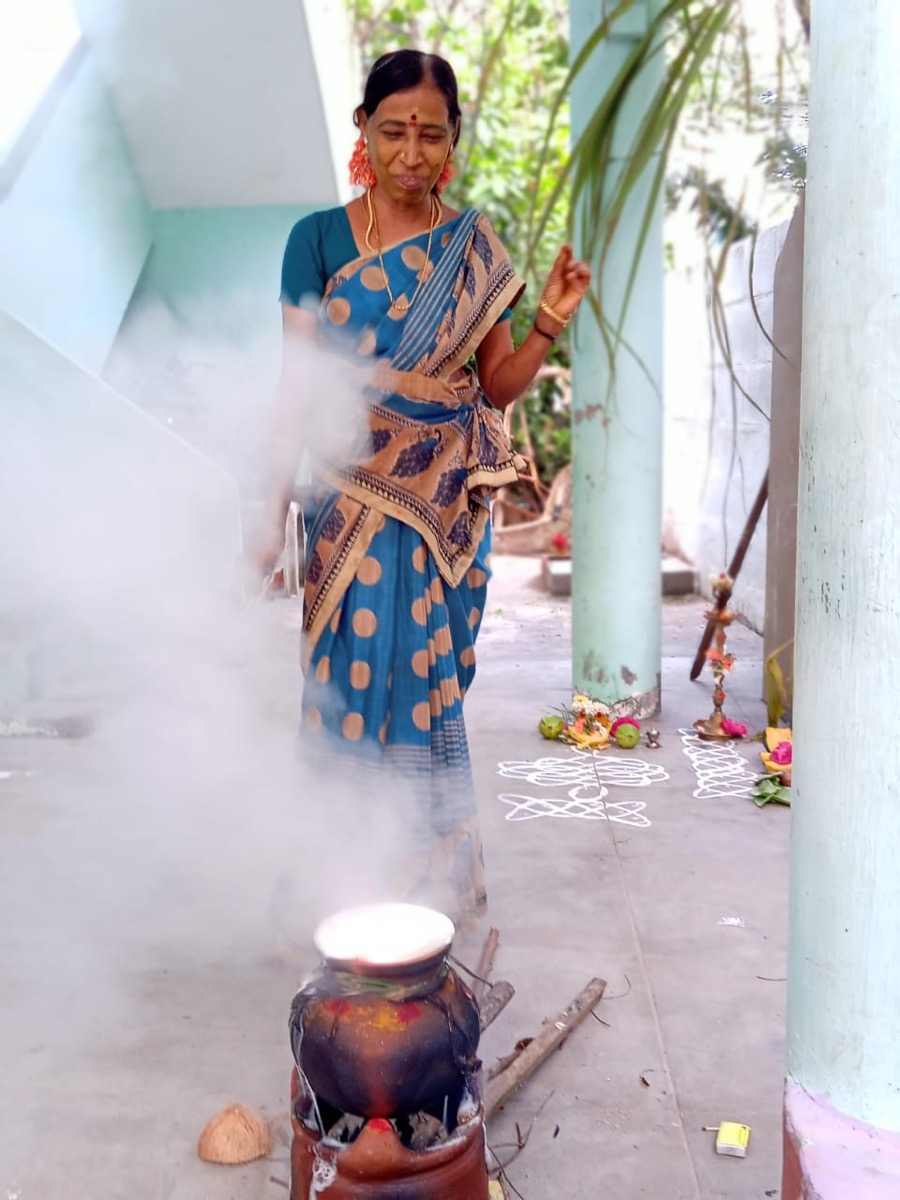
Pongal (பொங்கல்) is the most important festival of Tamil Nadu, a four-day harvest thanksgiving celebration that marks the beginning of the Tamil month of Thai (mid-January) and coincides with the winter solstice transition known as Uttarāyaṇa — the northward journey of the Sun. The word pongal literally means “to boil over” or “to overflow” in Tamil, referring to the central ritual of boiling freshly harvested rice with milk until the pot overflows — a joyous symbol of abundance, prosperity, and divine grace spilling into human life. Dedicated primarily to Sūrya (the Sun God) and to the agricultural bounty that sustains human civilization, Pongal is one of the oldest continuously celebrated harvest festivals in the world, with roots stretching back to the Sangam period (c. 300 BCE – 300 CE).
Historical Origins and Sangam Literature
Pongal’s antiquity is attested by the classical Sangam literature of ancient Tamil Nadu. The Puṟanānūṟu and Akanānūṟu anthologies contain references to harvest celebrations, cattle worship, and offerings to the Sun that closely mirror contemporary Pongal practices. The Cilappatikāram (c. 2nd century CE), one of the five great Tamil epics, describes festivities associated with the harvest season that scholars identify as proto-Pongal celebrations.
The festival’s association with Uttarāyaṇa — the Sun’s northward movement from the Tropic of Capricorn — connects it to the broader pan-Indian observance of Makara Saṅkrānti. The Sūrya Siddhānta, the foundational text of Indian astronomy, identifies this astronomical transition as an auspicious turning point in the solar year. In Tamil tradition, Thai (the month beginning with Uttarāyaṇa) is considered the start of the auspicious half of the year, as expressed in the proverb: “Thai piṟandāl vali piṟakkum” — “When Thai is born, the path to prosperity opens.”
The Pallava and Chola dynasty inscriptions (7th–13th centuries CE) contain references to harvest festivals with offerings to temples, cattle decorations, and communal feasting that correspond directly to Pongal customs. The great Bṛhadīśvara Temple at Thanjavur, built by Rājarāja Chola I (r. 985–1014 CE), has inscriptional evidence of harvest festival endowments, suggesting that Pongal-like celebrations were embedded in the political and religious economy of medieval Tamil Nadu.
The Four Days of Pongal
Day One: Bhogi Pongal
The festival begins with Bhogi Pongal, dedicated to Indra, the Vedic king of the devas and lord of rain and storms. Since agriculture depends entirely on rainfall, Bhogi is an act of thanksgiving to the deity who sends the monsoon rains that nourish the crops.
The signature ritual of Bhogi is the Bhogi Manṭai — a bonfire lit before dawn in which families burn old clothes, broken furniture, and discarded household items. This fire symbolizes the destruction of the old and the welcoming of the new — a purification ritual that clears both physical and spiritual clutter. The bonfire is also interpreted as an offering to Agni (the fire god), who in Vedic theology serves as the intermediary between humans and the divine realm (Ṛg Veda 1.1.1: “agnim īḷe purohitam” — “I praise Agni, the foremost priest”).
Children dance around the Bhogi fire singing traditional songs, and homes are thoroughly cleaned and decorated with fresh kōlam (கோலம்) — intricate geometric patterns drawn with rice flour on the ground before the entrance. The kōlam serves both an aesthetic and ritual purpose: as a form of maṇḍala, it creates a sacred threshold between the profane outside world and the consecrated domestic space.
Day Two: Thai Pongal (Sūrya Pongal)
The second day is Thai Pongal or Sūrya Pongal, the main day of the festival and the one from which the entire celebration derives its name. This day is dedicated entirely to Sūrya, the Sun God, whose warmth and light make agriculture — and therefore human survival — possible.
The central ritual is the preparation of the pongal dish itself. A new clay pot (paṇai) is placed on a makeshift stove in the open courtyard, facing the Sun. Freshly harvested rice is combined with milk and jaggery (vellam) and boiled over a wood fire. As the mixture heats, the family watches with intense anticipation. When the milk-rice begins to froth and rise, the moment it overflows the rim of the pot is greeted with joyous shouts of “Pongalō Pongal!” (பொங்கலோ பொங்கல்!) — an ecstatic declaration that abundance has arrived.
The overflowing pot is a potent agricultural metaphor: just as the rice-milk cannot be contained, so too the blessings of Sūrya overflow the boundaries of human expectation. The dish is first offered to Sūrya with prayers of gratitude, then shared among the family. The pot is traditionally decorated with turmeric plants, sugarcane stalks, and ginger — all freshly harvested crops — creating a miniature altar of agricultural abundance.
The theological significance of Sūrya worship on this day draws from the Vedic hymns. The Ṛg Veda (1.50.1) declares: “ud u tyaṃ jātavedasam devaṃ vahanti ketavaḥ / dṛśe viśvāya sūryam” — “The brilliant rays carry aloft that Sun, the god who knows all beings, so that all may see.” The Āditya Hṛdayam, the great Sūrya hymn from the Rāmāyaṇa (Yuddha Kāṇḍa, canto 107), extols the Sun as the source of all life, the remover of darkness, and the sustainer of the cosmos — themes that resonate directly with the gratitude expressed during Thai Pongal.
Day Three: Maṭṭu Pongal
The third day, Maṭṭu Pongal (மாட்டுப் பொங்கல்), is dedicated to cattle — the indispensable partners of Indian agriculture. The word maṭṭu means “cattle” in Tamil. On this day, cows and bulls are bathed, their horns are painted in vibrant colours, and they are garlanded with flowers, beads, and bells. The pongal dish prepared the previous day is fed to the cattle as a mark of reverence and gratitude.
The veneration of cattle on Maṭṭu Pongal reflects the deep Hindu theological tradition of honouring the cow as Kāmadhenu — the wish-fulfilling celestial cow mentioned in the Mahābhārata (Anuśāsana Parva) and Rāmāyaṇa. The Atharva Veda (9.7) contains hymns glorifying the cow as the embodiment of abundance and maternal nourishment. In the agricultural context of Tamil Nadu, where cattle were historically the primary means of ploughing, threshing, and transportation, Maṭṭu Pongal transforms economic dependence into spiritual reverence.
A Purāṇic narrative associated with this day tells of Basava (Nandi), the sacred bull of Lord Śiva. According to tradition, Śiva once sent Nandi to earth with a message instructing humans to eat once a day and bathe with oil once a month. Nandi confused the message and told humans to bathe with oil daily and eat three times a day. As punishment, Śiva banished Nandi to earth to help humans plough the fields needed to produce the extra food — thus explaining why cattle labour alongside farmers.
Day Four: Kāṇum Pongal
The fourth and final day is Kāṇum Pongal (காணும் பொங்கல்), also called Thiruvalluvar Day in honour of the great Tamil poet-sage Thiruvaḷḷuvar, author of the Tirukkuṟaḷ. The word kāṇum means “to see” or “to visit,” and this day is dedicated to social visits, family reunions, and communal celebration.
On Kāṇum Pongal, families gather for outings to rivers, beaches, and temple towns. Younger family members pay respects to elders, and married women perform special prayers for the well-being of their brothers — a tradition that parallels aspects of the North Indian Bhāī Dūj. In rural Tamil Nadu, the day often includes community games, folk dances like kummi and kolattam, and the sharing of leftover pongal dishes with neighbours and the poor.
Jallikkattu: The Bull-Taming Tradition
The most dramatic and controversial element of the Pongal celebrations is Jallikkattu (ஜல்லிக்கட்டு), the ancient Tamil bull-taming sport typically held on Maṭṭu Pongal day and the days following. The word jallikkattu derives from jalli (gold or silver coins) and kattu (tied), referring to the prize money traditionally tied to the bull’s horns.
In Jallikkattu, a bull is released into an open arena, and unarmed participants attempt to hold onto the bull’s hump as it charges through. The sport requires immense physical courage and skill, and successful tamers are celebrated as heroes. Jallikkattu has ancient roots: Indus Valley Civilization seals (c. 2600–1900 BCE) depict bull-leaping scenes that some scholars associate with proto-Jallikkattu practices. Sangam literature references ēṟu taḻuvutal (“bull embracing”), confirming the sport’s existence in classical Tamil culture.
Beyond entertainment, Jallikkattu serves a crucial agricultural function: it is a traditional method of identifying the strongest, most vigorous bulls for breeding purposes. The bulls that prove untameable are considered superior breeding stock, ensuring the genetic quality of draught cattle essential for traditional farming. This connection between sport, animal husbandry, and agricultural sustainability gives Jallikkattu significance far beyond mere spectacle.
The Kōlam Tradition
An integral artistic expression of Pongal is the kōlam — the geometric patterns drawn with rice flour at the entrance of every home during the festival days. During Pongal, kōlams reach their most elaborate forms, with some designs extending several metres across the threshold.
The kōlam tradition has deep mathematical and spiritual significance. The patterns are drawn in a single continuous line that loops around dots arranged in a grid — a practice that mathematicians have connected to concepts in graph theory and topology. Spiritually, the kōlam is understood as a form of yantra (sacred diagram) that invites Lakṣmī, the goddess of prosperity, into the home while warding off negative energies. The use of rice flour is itself significant: it feeds ants, birds, and small creatures, embodying the Hindu ideal of anna-dāna (the gift of food) as the highest form of charity.
Pongal Beyond Tamil Nadu
While Pongal is quintessentially Tamil, parallel harvest festivals are celebrated across South India and Sri Lanka under different names. In Andhra Pradesh and Telangana, the festival is observed as Saṅkrānti with the flying of kites and the preparation of special dishes. In Karnataka, Makara Saṅkrānti celebrations include cattle processions and the exchange of ellu-bella (sesame-jaggery mixtures). In Kerala, the period corresponds to the beginning of the Śabari-mala season and the harvest of rice paddies.
The Sri Lankan Tamil community celebrates Pongal with the same four-day structure, maintaining traditions that predate the medieval period. The festival serves as a powerful marker of Tamil cultural identity both within the Indian subcontinent and in the global Tamil diaspora — with elaborate Pongal celebrations held in Singapore, Malaysia, South Africa, Mauritius, the United Kingdom, Canada, and Australia.
Astronomical and Agricultural Significance
Pongal is fundamentally an astronomical festival marking the Sun’s entry into Makara Rāśi (Capricorn) — the beginning of Uttarāyaṇa. In the Hindu cosmological framework, Uttarāyaṇa is the “path of the gods” (devayāna), the auspicious half of the year when the Sun moves northward and the days grow longer. The Bhagavad Gītā (8.24) states: “agnir jyotir ahaḥ śuklaḥ ṣaṇmāsā uttarāyaṇam / tatra prayātā gacchanti brahma brahmavido janāḥ” — “Fire, light, daytime, the bright fortnight, the six months of the northern solstice — departing by this path, the knowers of Brahman reach Brahman.”
The agricultural dimension is equally significant. Pongal falls at the end of the northeast monsoon season and the beginning of the rice harvest in Tamil Nadu. The festival thus marks the culmination of an entire agricultural cycle — from the monsoon rains (honoured on Bhogi) to the sun’s nurturing warmth (honoured on Thai Pongal) to the labour of cattle (honoured on Maṭṭu Pongal) to the communal sharing of abundance (honoured on Kāṇum Pongal). The four days mirror the four essential elements of agriculture: water, sun, animal power, and human community.
Spiritual Significance and Contemporary Relevance
Pongal encapsulates the Hindu understanding that the material and the spiritual are not opposed but interwoven. The act of boiling rice — an utterly mundane, everyday activity — becomes, through ritual intention (saṅkalpa), a sacred offering to the divine. The overflowing pot is simultaneously a practical agricultural celebration and a theological statement about the nature of divine grace: like the milk-rice that cannot be contained, the blessings of Sūrya, of Bhūmi Devī (Earth Goddess), and of the cattle who labour alongside humans overflow all boundaries when met with gratitude and reverence.
The Taittirīya Upaniṣad (3.10.1) proclaims: “annaṃ na nindyāt / tad vrataṃ” — “Do not despise food; that is the sacred vow.” Pongal transforms this Upaniṣadic instruction into a four-day celebration of food — its cultivation, its preparation, and its sharing — as the most fundamental expression of the divine in human life. In an era of industrialized agriculture and environmental degradation, Pongal’s insistence on gratitude toward the Sun, reverence for cattle, and communal sharing of the harvest offers a vision of agriculture as sacred partnership between humans, animals, and the cosmos — a vision that is both ancient and urgently contemporary.