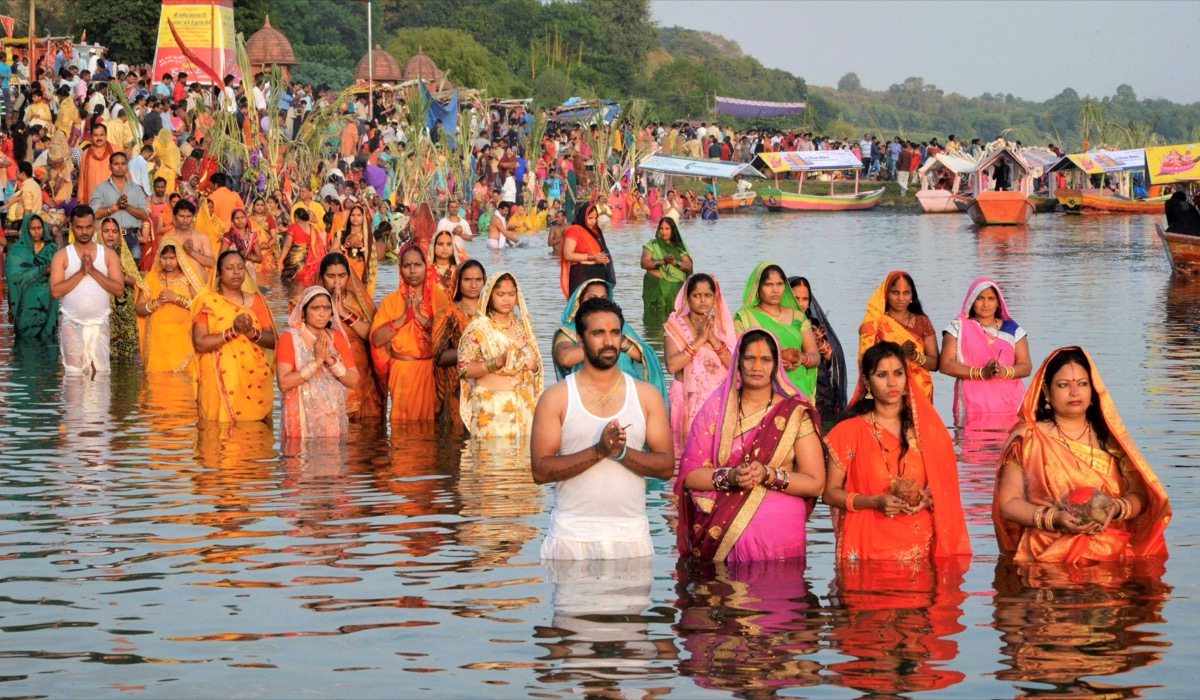
Chhath Pūjā (छठ पूजा) is one of the most ancient, rigorous, and theologically significant Hindu festivals, dedicated primarily to Sūrya (the Sun God) and Chhathī Maiyā (Ṣaṣṭhī Devī, the goddess of the sixth day). Observed predominantly in Bihar, Jharkhand, eastern Uttar Pradesh, and the Terai region of Nepal, Chhath is a four-day festival of extreme austerity — involving prolonged fasting without water (nirjala vrata), standing in rivers and water bodies for hours, and offering arghya (oblations) to both the setting and rising sun. Unlike most Hindu festivals that centre on temple worship or idol veneration, Chhath is performed entirely in the open — at riverbanks, ponds, and natural water bodies — making it one of the purest expressions of Vedic nature worship surviving in contemporary Hinduism.
Etymology and Dating
The word Chhath derives from the Sanskrit ṣaṣṭhī (षष्ठी), meaning “sixth” — referring to the sixth day of the Hindu month. The festival is observed twice a year: during Kārtika (October-November, six days after Diwali) and during Chaitra (March-April). The Kārtika celebration, called Kārtika Chhath or simply Chhath Pūjā, is by far the more widely observed and is considered the principal observance.
The timing — six days after the Diwali Amāvasyā — is liturgically significant. While Diwali celebrates the worship of Lakṣmī and the lighting of lamps on the darkest night, Chhath marks the transition to solar worship as the waxing moon grows. The festival begins on Caturthi (the fourth day) and culminates on Saptamī (the seventh day), with the main rituals occurring on the Ṣaṣṭhī (sixth day) — hence the name.
Vedic Origins
Chhath Pūjā represents perhaps the most direct continuation of Vedic solar worship in contemporary Hindu practice. The Ṛg Veda contains numerous hymns to Sūrya, Savitṛ (the solar deity as the impeller of creation), and Uṣas (Dawn), establishing sun worship as one of the oldest strands of Hindu devotion.
The Sūrya Sūkta (Ṛg Veda 1.115) declares:
citram devānām ud agād anīkaṃ cakṣur mitrasya varuṇasyāgneḥ — “The brilliant face of the gods has risen, the eye of Mitra, Varuṇa, and Agni.”
The Ṛg Vedic practice of offering arghya (water oblations) to the sun at dawn is directly preserved in the Chhath ritual. The Gāyatrī Mantra (Ṛg Veda 3.62.10), the most sacred of all Vedic mantras, is addressed to the solar deity Savitṛ — making sun worship the very foundation of Vedic spiritual practice.
The unique Chhath practice of worshipping the setting sun — in addition to the rising sun — has no parallel in other Hindu traditions and may preserve an extremely ancient layer of solar theology. While most traditions associate sanctity with sunrise, Chhath honours the astamaṇa sūrya (setting sun) with equal reverence, teaching that divinity does not diminish with decline and that the cosmic cycle of dissolution and renewal deserves equal veneration.
The Four Days of Chhath
Day 1: Nahāy-Khāy (Caturthi)
The festival begins with Nahāy-Khāy (literally “bathe and eat”). The vrati (devotee performing the vow, usually a woman) takes a ritual bath in a river or sacred water body at dawn, purifying herself for the austerities ahead. A single sāttvika (pure, vegetarian) meal is prepared — traditionally kaddu-bhāt (pumpkin with rice) or chane kī dāl (split chickpea lentils) — cooked using mango wood fire, in a bronze or clay vessel, without salt, onions, or garlic. This meal is first offered to Sūrya before the vrati eats.
The emphasis on specific cooking materials (mango wood, bronze vessels) and the prohibition on certain ingredients reflects the Vedic principle of śauca (purity) — ensuring that every element of the offering meets the highest standards of ritual cleanliness.
Day 2: Kharanā / Lohanda (Pañcamī)
On the fifth day, the vrati observes a full-day fast, breaking it only after sunset with an offering of khīr (rice pudding), purī (fried bread), and fruits. This meal, called kharanā or lohanda, is prepared with the same ritual purity as the previous day. After making the offering to Sūrya and distributing prasāda to family and neighbours, the vrati begins the most demanding phase of the festival — a 36-hour nirjala (waterless) fast that continues through the next day and night until the final arghya at sunrise on the fourth day.
Day 3: Sandhyā Arghya — The Evening Offering (Ṣaṣṭhī)
The Ṣaṣṭhī evening is the climactic moment of Chhath Pūjā. The vrati, accompanied by family members, proceeds to a riverbank, pond, or specially prepared water body (ghāṭ) carrying elaborate offerings arranged in bamboo baskets (sūp and daura). The offerings include:
- Ṭhekuā — a sweet made from wheat flour, jaggery, and ghee, considered the signature prasāda of Chhath
- Kasar — a preparation of rice flour and jaggery
- Fresh fruits — sugarcane, bananas, coconuts, sweet potatoes, turmeric roots
- Dīyā — clay lamps lit with ghee
The vrati wades into the water, sometimes waist-deep, and offers arghya — water oblations held in the bamboo sūp — to the setting sun while chanting prayers and folk hymns. The entire community gathers at the ghāṭ; the atmosphere is charged with devotion as hundreds or thousands of vratis stand in the water simultaneously, the golden light of the setting sun reflected in the river.
Day 4: Uṣā Arghya — The Dawn Offering (Saptamī)
Before dawn on the final day, the vrati returns to the ghāṭ for the concluding ritual: the offering of arghya to the rising sun (uṣā arghya). Having fasted without water for 36 hours and stood in the cold river water through the night, the vrati faces east, waiting for the first rays of the sun to appear above the horizon. As the sun rises, water and milk oblations are offered along with the same prasāda.
The fast is broken only after this final offering, when the vrati distributes prasāda to all gathered devotees and then takes food and water — concluding one of the most demanding observances in all of Hindu practice.
Ṣaṣṭhī Devī: Chhathī Maiyā
While Sūrya is the primary deity of the festival, Chhathī Maiyā (Ṣaṣṭhī Devī) occupies a central role in the folk theology of Chhath. In the Skanda Purāṇa and the Brahma Vaivarta Purāṇa, Ṣaṣṭhī is described as a form of Prakṛti (the primordial feminine creative energy) and a manifestation of Devī who protects children and blesses families with progeny and good health. She is sometimes identified as the sister or mānasa-putrī (mind-born daughter) of Sūrya.
In Chhath theology, the relationship between Sūrya and Ṣaṣṭhī mirrors the Vedic concept of the complementary divine pair — the masculine solar principle (consciousness, puruṣa) and the feminine creative principle (nature, prakṛti). The vrati worships both simultaneously, recognizing that sustenance, health, and progeny require the harmonious cooperation of both cosmic forces.
The Unique Theology of Chhath
Several features distinguish Chhath from other Hindu festivals and give it a unique theological character:
No Idol, No Temple, No Priest: Chhath is performed entirely without mūrtis (idols), temple structures, or Brāhmaṇa intermediaries. The sun itself is the deity, the river is the temple, and the vrati is her own priest. This radical directness — the individual devotee facing the cosmic deity without any mediation — preserves the spirit of the earliest Vedic worship, before the development of temple culture.
Worship of the Setting Sun: As noted above, the veneration of the astamaṇa sūrya (setting sun) is unique to Chhath. This practice embodies a profound philosophical principle: that the divine is equally present in creation and dissolution, in growth and decline, in the rising and setting phases of cosmic cycles. The Īśa Upaniṣad (verse 1) declares: “īśāvāsyam idaṃ sarvaṃ” — “All this is pervaded by the Lord.” Chhath enacts this verse by finding the divine in the sun’s departure as well as its arrival.
Extreme Physical Austerity: The 36-hour nirjala fast, combined with hours of standing in cold water, makes Chhath one of the most physically demanding Hindu observances. This austerity is not masochistic but purposeful: it purifies the body, disciplines the mind, and demonstrates the devotee’s śraddhā (faith) and tapas (spiritual heat). The Bhagavad Gītā (17.5-6) warns against extreme penances done from ego, but Chhath austerity is performed with humility, community support, and the specific intention of expressing gratitude to the cosmic sustainer.
Community and Ecology: Chhath is inherently communal and ecological. It requires clean rivers and water bodies — creating a powerful social incentive for environmental conservation. The rise of Chhath in urban India has led to significant efforts to clean rivers and construct proper ghāṭs, making the festival a practical force for environmental action.
Regional Significance
Chhath is the pre-eminent festival of Bihar and Jharkhand, where it holds a cultural status comparable to Durga Pūjā in Bengal or Ganesh Chaturthi in Maharashtra. The festival is central to the identity of the Maithili, Bhojpuri, Magahi, and Angika linguistic communities. The Chhath folk songs (chhath gīt), sung by vratis during the rituals, constitute a significant corpus of devotional poetry in Bhojpuri and Maithili, expressing themes of feminine strength, solar devotion, familial love, and the longing for divine grace.
With the large-scale migration of Bihari and Jharkhandī communities to cities across India (Delhi, Mumbai, Bengaluru, Kolkata), Chhath has spread far beyond its traditional geographic base. Today, it is celebrated in virtually every major Indian city, with municipal authorities preparing temporary ghāṭs at lakes, rivers, and even beaches. The festival’s expansion has brought national attention to the cultural richness of eastern India’s traditions.
The Deeper Philosophy
Chhath Pūjā teaches that the most profound worship requires no intermediary between the human soul and the divine. The vrati stands in the water, faces the sun, and offers the fruits of the earth back to their cosmic source. No Sanskrit śloka is required — the folk songs of Bihar serve as the liturgy. No temple is needed — the river is the sanctum. No priest is necessary — the mother of the household is the celebrant.
This radical simplicity connects Chhath to the deepest stratum of Vedic religion — the vision expressed in the Ṛg Veda (1.164.46): “ekaṃ sad viprā bahudhā vadanti” — “That which is One, the wise call by many names.” In Chhath, that One is the visible sun — the most direct and undeniable manifestation of divine power available to human perception. The vrati who stands in the river at dawn, offering water to the sun that sustains all life, performs an act of worship as ancient as the Vedas themselves — a living connection to the earliest human recognition that light, warmth, and life are gifts that demand our deepest gratitude.