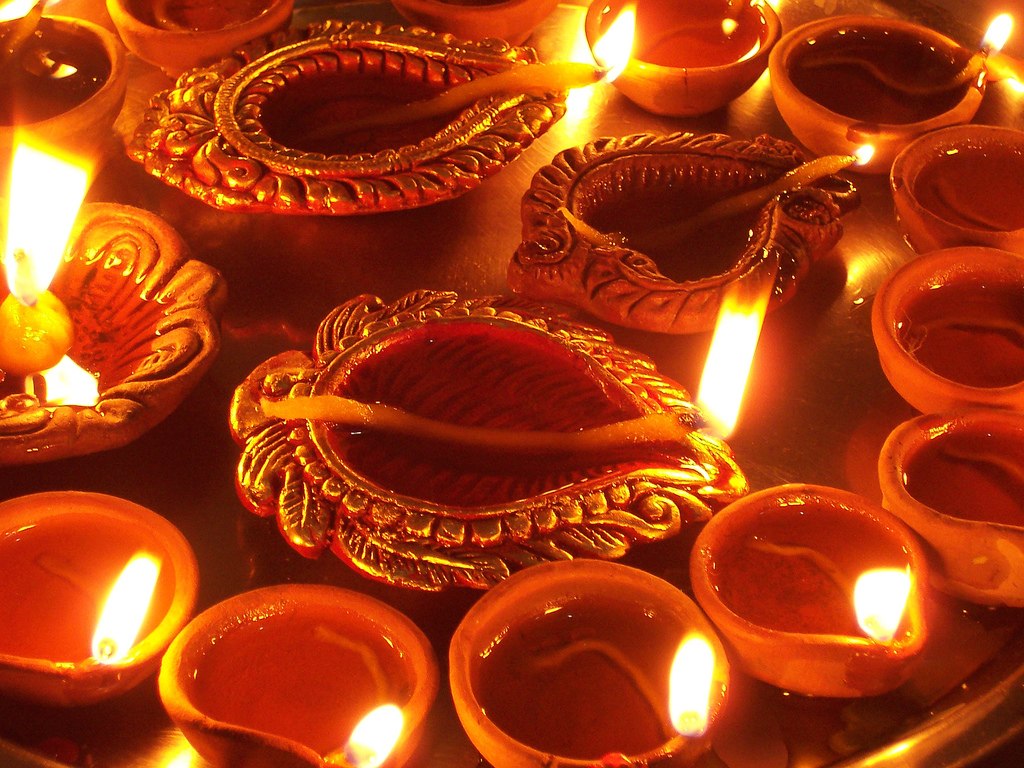
Dīpāvalī (दीपावली, “a row of lamps”), commonly shortened to Diwali, is the most widely celebrated festival in Hinduism and one of the major cultural events of South Asia. Observed over five days in the Hindu months of Ashvin and Kārtika (typically mid-October to mid-November), Diwali celebrates the spiritual victory of dharma over adharma, light over darkness, and knowledge over ignorance. The festival’s luminous imagery — oil lamps (dīyas) lining rooftops, raṅgolī patterns adorning thresholds, the night sky ablaze with fireworks — has made it one of the most visually recognizable celebrations on earth, observed today by over a billion people across India, Nepal, Sri Lanka, and the global Hindu, Jain, Sikh, and Buddhist diasporas.
Etymology and Scriptural Origins
The Sanskrit word dīpāvalī is a compound of dīpa (lamp, light) and āvalī (row, line), literally meaning “a row of lights.” The festival is mentioned in several early Sanskrit texts and Purāṇas, establishing its antiquity well beyond the Common Era.
The Padma Purāṇa provides one of the earliest detailed prescriptions for the Dīpāvalī vrata. It links the festival to the emergence of Goddess Lakṣmī during the Samudra Manthana (the churning of the cosmic ocean), when she arose alongside a pot of ambrosia (amṛta), choosing Lord Viṣṇu as her eternal consort. The Purāṇa prescribes lighting lamps on the Amāvasyā (new moon) night of Kārtika as a way to honour Lakṣmī and invite her blessings of prosperity into the home (WisdomLib - Padma Purāṇa, Chapter 122).
The Skanda Purāṇa elaborates the Dīpāvalī Vrata in detail, prescribing the lighting of lamps facing south on Trayodaśī (the thirteenth day) to honour Yamadeva (the god of death) and ward off untimely death. It also connects the festival to Lord Kṛṣṇa’s victory over the demon Narakāsura on the day before the main Diwali night.
Classical Sanskrit literature provides further attestation. The seventh-century playwright Harṣa (Harṣavardhana) describes Dīpāvalī as dīpotsava (“festival of lamps”) in his play Nāgānanda, mentioning the exchange of gifts and the illumination of cities. Epigraphic evidence from the 10th through 13th centuries — Rajput, Chola, and Rashtrakuta inscriptions — corroborates the pan-Indian observance of the festival across dynasties and regions (Sahapedia).
The Mythological Narratives
Diwali is remarkable in that it weaves together multiple mythological narratives, varying by region but unified by the theme of light’s triumph over darkness.
Rāma’s Return to Ayodhyā
The most widely known narrative, predominant in North India, comes from the Rāmāyaṇa. After fourteen years of exile in the forest and a decisive war against the demon king Rāvaṇa in Laṅkā, Lord Rāma returns to his kingdom of Ayodhya with his wife Sītā and brother Lakṣmaṇa. The citizens of Ayodhya, overjoyed at the return of their righteous king, illuminate the city with rows of oil lamps, transforming the moonless night into a blaze of light. Tulsīdāsa’s Rāmacaritamānasa (Uttarakāṇḍa) describes this scene with vivid poetry, portraying the entire city ablaze with dīyas on every rooftop and doorstep.
Kṛṣṇa and Narakāsura
In South India and Maharashtra, Diwali centres on Lord Kṛṣṇa’s defeat of the demon Narakāsura (also called Bhauma), a tyrannical king who had imprisoned 16,100 princesses and terrorized the three worlds. According to the Bhāgavata Purāṇa (10.59), Kṛṣṇa, accompanied by his wife Satyabhāmā, slew Narakāsura on the Caturdaśī (fourteenth day) preceding Diwali. The liberated world celebrated with lamps and festivities. This narrative is the reason Naraka Caturdaśī (the second day of the five-day festival) involves an early morning oil bath — symbolizing the washing away of sins — and is considered the actual Diwali day in Karnataka, Tamil Nadu, Andhra Pradesh, and Goa.
Lakṣmī and the Samudra Manthana
The central pūjā of Diwali night — Lakṣmī Pūjā — draws from the Purāṇic narrative of the Samudra Manthana (“Churning of the Ocean of Milk”). When the devas and asuras churned the cosmic ocean using Mount Mandara as the churning rod and the serpent Vāsuki as the rope, fourteen precious things emerged — among them Goddess Lakṣmī, radiant and seated upon a lotus. She chose Viṣṇu as her lord, and the universe was blessed with prosperity. On the Amāvasyā night of Kārtika, this primordial emergence is re-enacted through the worship of Lakṣmī, who is invited into homes that are clean, illuminated, and welcoming.
The Return of the Pāṇḍavas
Some traditions, particularly in regions influenced by the Mahābhārata, associate Diwali with the return of the five Pāṇḍava brothers from their thirteen years of exile and one year of incognito living. The people of Hastināpura celebrated their return by lighting lamps across the kingdom.
The Five Days of Diwali
The full Diwali celebration spans five consecutive days, each with its own ritual significance, deities, and observances.
Day 1: Dhanteras (Dhantrayodaśī)
Dhanteras marks the official commencement of Diwali. The word combines dhana (wealth) and trayodaśī (thirteenth day of the lunar fortnight). On this evening, devotees worship Dhanvantari — the physician of the gods and the originator of Āyurveda, who emerged from the Samudra Manthana carrying the pot of amṛta. It is considered exceptionally auspicious to purchase gold, silver, or new utensils. Small dīyas are lit outside the home facing south in honour of Yamadeva, a custom prescribed in the Skanda Purāṇa to prevent untimely death. In the business community, Dhanteras marks the worship of account books and the closing of the old financial year.
Day 2: Naraka Caturdaśī (Choti Diwali)
The fourteenth day of the dark fortnight commemorates Kṛṣṇa’s slaying of Narakāsura. Devotees rise before dawn for an oil bath (abhyaṅga snāna), symbolizing the purification of body and spirit. Small firecrackers are burst to celebrate the demon’s defeat. In many households, the courtyard is decorated with small footprints made of rice flour and vermilion, symbolizing the approaching steps of Goddess Lakṣmī. This day is also called Rūpa Caturdaśī — the “day of beauty” — as the oil bath is believed to bestow radiance and health.
Day 3: Diwali / Lakṣmī Pūjā (Amāvasyā)
The main Diwali night falls on the Amāvasyā (new moon), the darkest night of the lunar month — chosen deliberately so that the light of human devotion can shine most brilliantly against absolute darkness. The central ritual is Lakṣmī Pūjā, performed during the auspicious pradoṣa kāla (the period after sunset). The pūjā follows a specific sequence:
- Purification: The home is cleaned spotlessly; a fresh raṅgolī is drawn at the entrance.
- Installation: Images or mūrtis of Lakṣmī and Gaṇeśa are placed on a consecrated platform (caukhī), adorned with flowers, turmeric, and vermilion.
- Invocation: Lakṣmī is invoked with the Śrī Sūkta (Ṛg Veda, Khilāni 5.87) — the most ancient hymn to prosperity.
- Offerings: Dīyas, flowers, fruits, sweets (especially khīr and laḍḍū), betel leaves, and coins are offered.
- Āratī: The worship concludes with the waving of a camphor flame and the singing of the Oṃ Jaya Lakṣmī Mātā āratī.
It is believed that Lakṣmī roams the earth on this night seeking homes that are clean, well-lit, and joyful. The worship of Gaṇeśa alongside Lakṣmī signifies that true prosperity requires both wisdom (buddhi, Gaṇeśa’s gift) and material abundance (Lakṣmī’s blessing).
Day 4: Govardhan Pūjā / Annakūṭa
The day after Diwali celebrates Lord Kṛṣṇa’s legendary lifting of Mount Govardhan to shelter the people of Vraja from the wrathful deluge sent by Indra, the king of the gods, after Kṛṣṇa persuaded the cowherds to worship the mountain instead of Indra (Bhāgavata Purāṇa 10.24-25). This day is marked by the preparation of annakūṭa — a “mountain of food” comprising dozens of dishes, offered to the deity and then shared communally. In many regions, cow dung is shaped into small hillocks representing Govardhan and decorated with flowers. The festival celebrates humility over arrogance, community over hierarchy, and the sacredness of nature.
Day 5: Bhāī Dūj (Yama Dvitīyā)
The final day celebrates the bond between brothers and sisters. It commemorates the mythological visit of Yama (the god of death) to his sister Yamunā (the river goddess), who applied a ceremonial tilaka on his forehead and fed him a loving meal. Yama was so moved that he declared: any brother who receives a tilaka from his sister on this day shall be protected from untimely death. Sisters apply tilaka, perform āratī for their brothers, and pray for their longevity, while brothers give gifts in return.
Regional Variations
West Bengal: Kālī Pūjā
While the rest of India worships Lakṣmī on Diwali night, West Bengal and parts of Odisha and Assam celebrate Kālī Pūjā — the worship of Goddess Kālī, the fierce destroyer of evil and ignorance. The pūjā is performed at midnight on the Amāvasyā, when the darkness is absolute — considered the most auspicious moment for invoking Kālī, who herself represents the transcendence of darkness. Offerings include red hibiscus flowers, rice, lentils, and fish — a marked contrast to the vegetarian offerings of Lakṣmī Pūjā. The festival affirms the Bengali Śākta theological vision that the Goddess in her fearsome form is as worthy of devotion as in her benign manifestation. Kālī Pūjā has its own distinct identity and history, though it shares the Diwali date (Kālī Pūjā - Wikipedia).
South India: Oil Bath and Narakāsura
In Tamil Nadu (Dīpāvaḷi), Karnataka, and Andhra Pradesh, the festival centres on the pre-dawn oil bath on Naraka Caturdaśī, considered the actual day of Diwali. The custom involves applying sesame oil and ubṭan (turmeric-gram flour paste), followed by a ritual bath. New clothes are worn, firecrackers are burst at dawn, and a special breakfast of sweets — laḍḍū, mūrkku, and cakkalī — is shared. The emphasis on the Narakāsura narrative over the Rāma narrative reflects the distinct regional Purāṇic traditions.
Jain, Sikh, and Buddhist Observances
Diwali’s significance extends beyond Hinduism. Jains celebrate it as the day of Mahāvīra’s final liberation (mokṣa) at Pāvāpurī in 527 BCE — the nirvāṇa divas. Sikhs observe Bandī Chhor Divas, marking Guru Hargobind Sahib’s release from Gwalior Fort along with 52 Hindu kings imprisoned by Mughal Emperor Jahangir. Newar Buddhists in Nepal worship Lakṣmī and celebrate the festival with their own cultural additions. This multi-faith observance makes Diwali one of the most inclusive festivals in the Indian cultural sphere.
The Symbolism of Light
The lighting of lamps during Diwali carries layered symbolic meaning that operates on cosmological, social, and personal levels:
Cosmological: The row of lamps re-enacts the cosmic act of creation — the emergence of light from the primordial darkness (tamasā āvṛtam — “covered in darkness,” Ṛg Veda 10.129.3). Each dīya is a miniature sun, echoing the Vedic understanding that Agni (fire) on earth mirrors Sūrya (the sun) in the heavens.
Social: Light is an act of hospitality — the illuminated home signals welcome, openness, and generosity. The shared brightness of a neighbourhood lit up with thousands of lamps dissolves social boundaries and creates a commons of celebration.
Personal: The Bṛhadāraṇyaka Upaniṣad (1.3.28) contains the prayer: “Tamaso mā jyotirgamaya” — “From darkness, lead me to light.” Diwali enacts this prayer physically. The devotee lights the external lamp as a reminder to kindle the inner light of ātma-jñāna (self-knowledge) that alone can dispel the darkness of avidyā (ignorance).
The Deeper Philosophy
Diwali’s choice of the Amāvasyā — the darkest possible night — as the night of celebration is not coincidental but deeply intentional. The festival teaches that light is most meaningful when darkness is most complete. A lamp lit at noon adds nothing; a lamp lit in total darkness transforms the world. This is the core teaching: human effort, devotion, and spiritual knowledge have their greatest power precisely when circumstances are most dire.
The worship of Lakṣmī — the goddess of śrī (beauty, prosperity, grace) — on this night teaches that true wealth is not merely material but encompasses aṣṭa-lakṣmī (the eight forms of Lakṣmī): spiritual wisdom (ādi-lakṣmī), food (dhānya-lakṣmī), courage (dhairya-lakṣmī), progeny (santāna-lakṣmī), victory (vijaya-lakṣmī), knowledge (vidyā-lakṣmī), material prosperity (dhana-lakṣmī), and royal authority (gaja-lakṣmī).
The Īśa Upaniṣad (verse 15) captures the essence of Diwali in a single verse:
hiraṇmayena pātreṇa satyasyāpihitaṃ mukham / tat tvaṃ pūṣan apāvṛṇu satyadharmāya dṛṣṭaye — “The face of truth is covered by a golden disc. O Sun, remove it so that I, a devotee of truth, may behold the reality.”
Diwali is the night when that golden disc is lifted — when the light of a billion lamps, lit in homes from Kashmir to Kanyakumari and from Varanasi to Vancouver, declares collectively that darkness, however deep, is never the final word. The human soul, like the tiny flame of a dīya, possesses within itself the power to illuminate the entire world.