Introduction
Saṃnyāsa (Sanskrit: संन्यास, “putting down, laying aside”) is the ancient Hindu institution of total renunciation — the formal abandonment of all worldly ties, possessions, social identity, and ritual obligations in single-minded pursuit of liberation (mokṣa). The person who takes this vow is called a saṃnyāsī (masculine) or saṃnyāsinī (feminine), and is also known by terms such as sādhu, svāmī, yati, parivrājaka (wandering mendicant), or sannyāsin.
Within the classical Hindu system of the four āśramas (stages of life) — brahmacarya (studentship), gṛhastha (householdership), vānaprastha (forest-dwelling retirement), and saṃnyāsa (renunciation) — saṃnyāsa occupies the final and highest position. It represents the ultimate stage in which the individual dissolves all social identity and devotes every waking moment to the direct realisation of Brahman or the Divine.
The institution of saṃnyāsa has produced some of Hinduism’s greatest philosophers, reformers, and saints — from Ādi Śaṅkarācārya and Rāmānujācārya to Svāmī Vivekānanda and the monks of the Rāmakṛṣṇa Mission. It continues to be a living tradition, with hundreds of thousands of renunciants walking the roads of India today.
Upaniṣadic and Scriptural Origins
The roots of saṃnyāsa lie in the oldest layers of Hindu scripture. The Bṛhadāraṇyaka Upaniṣad (c. 800-600 BCE) describes the sage Yājñavalkya’s dramatic renunciation of his household life and his two wives to pursue the knowledge of Brahman: “It is not for the sake of the husband that the husband is dear, but for the sake of the Self” (Bṛhadāraṇyaka Upaniṣad 2.4.5). This passage is regarded as one of the earliest literary accounts of formal renunciation.
The Muṇḍaka Upaniṣad (3.2.6) declares: “Those who have ascertained the meaning of the Vedānta knowledge, who are purified by the practice of saṃnyāsa — they, in the worlds of Brahman, are liberated beyond death at the end of time.” The Kaṭha Upaniṣad similarly exalts the path of nivṛtti (withdrawal) over pravṛtti (worldly engagement).
A distinct group of texts called the Saṃnyāsa Upaniṣads — including the Jābāla Upaniṣad, Paramahaṃsa Upaniṣad, Nārada-parivrājaka Upaniṣad, Āśrama Upaniṣad, and Kaṭhaśruti Upaniṣad — provide detailed prescriptions for the renunciant’s vows, conduct, and spiritual practice. The Jābāla Upaniṣad notably permits immediate renunciation from any stage of life (āturāśrama saṃnyāsa), not only after completing the householder stage.
In the Bhagavad Gītā (18.2), Lord Kṛṣṇa distinguishes between tyāga (relinquishing the fruits of action) and saṃnyāsa (abandoning action itself), ultimately affirming that true renunciation is the inner detachment from desire rather than mere external abandonment: “The wise understand saṃnyāsa as the renunciation of desire-prompted actions.”
The Manusmṛti (6.33-85) provides an elaborate code of conduct for the saṃnyāsī, prescribing solitary wandering, begging for food, non-injury to all creatures, and constant meditation on the Self. The Dharmasūtras of Āpastamba and Gautama likewise discuss the duties and rights of the renunciant order.
The Fourth Āśrama: Structure and Meaning
In the Varṇāśrama Dharma system, saṃnyāsa is the culmination of a progressive spiritual journey. After completing education (brahmacarya), fulfilling family and social duties (gṛhastha), and gradually withdrawing from worldly affairs (vānaprastha), the individual is considered ready to renounce everything.
However, this sequential model has always coexisted with a more radical tradition. Many of Hinduism’s greatest saints — Śaṅkarācārya, Caitanya Mahāprabhu, Svāmī Vivekānanda — took saṃnyāsa in their youth, bypassing the householder stage entirely. The Jābāla Upaniṣad explicitly sanctions this, stating: “On the very day one develops dispassion (vairāgya), one should renounce” (yadahareva virajet tadahareva pravrajet).
Upon entering saṃnyāsa, the renunciant undergoes a profound social and ritual death. All caste distinctions are abandoned. The saṃnyāsī no longer belongs to any varṇa, gotra (clan lineage), or family. Former name, social identity, and ritual obligations are relinquished entirely. The renunciant is, in the eyes of the tradition, already dead to the world — which is why the funeral rites (antyeṣṭi) are symbolically performed for the person at the time of initiation.
The Initiation Ceremony: Virajā Homa
The formal initiation into saṃnyāsa is a solemn and elaborate ritual known as Virajā Homa (the “fire of purification beyond passion”). The ceremony varies across traditions but generally includes the following elements:
-
Final Śrāddha: The aspirant performs his own funeral rites (ātma-śrāddha), offering piṇḍas (rice balls) for himself and ritually severing all ancestral obligations.
-
Cutting of the Sacred Thread: The yajñopavīta (sacred thread worn by twice-born Hindus) and the śikhā (tuft of hair) are removed, symbolising the dissolution of caste and the end of Vedic ritual duties.
-
Virajā Homa Proper: A fire ceremony in which the aspirant makes offerings into the sacred fire, reciting mantras that declare the renunciation of all desires, fears, and attachments. The praiṣa mantras proclaim fearlessness toward all beings: “May all beings be without fear from me” (abhayaṃ sarva-bhūtebhyo mattaḥ).
-
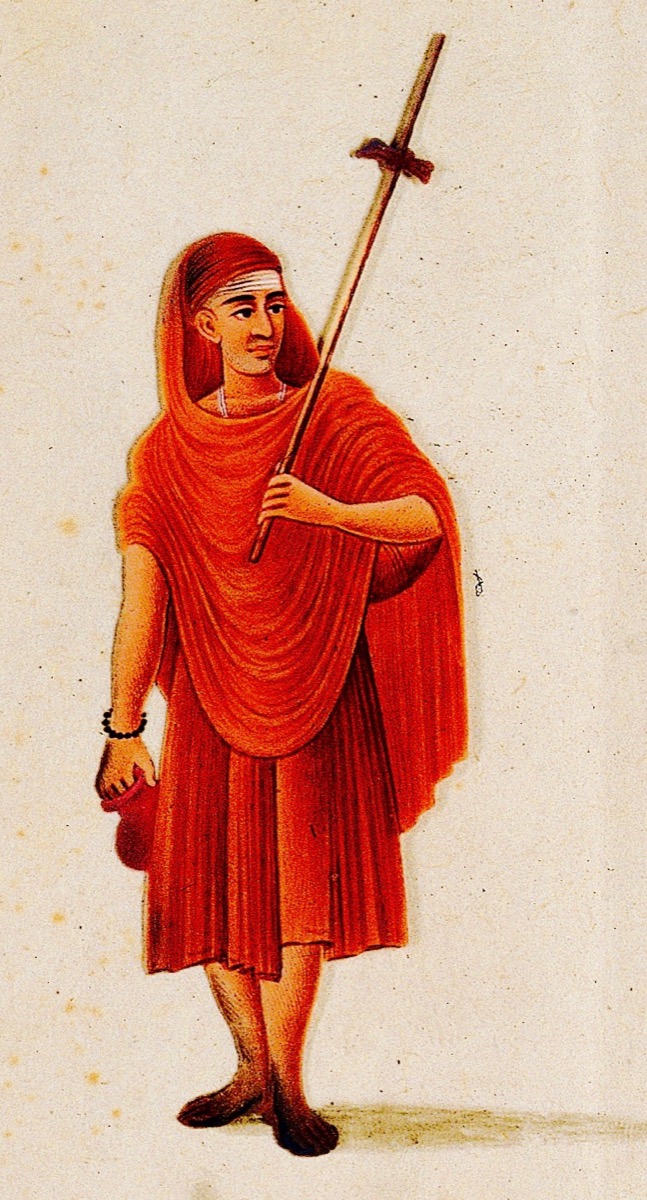
Receiving the Ochre Robes: The new saṃnyāsī receives the kāṣāya vastra (ochre or saffron-dyed cloth), symbolising the colour of fire — the element that has consumed all worldly attachments.
-
Receiving the Daṇḍa and Kamaṇḍalu: The monastic staff (daṇḍa) and water vessel (kamaṇḍalu) are given as the only possessions of the renunciant.
-
Bestowing the New Name: The guru bestows a new monastic name, typically ending in one of the ten suffixes of the Daśanāmī order (for Śaiva-Advaita monastics) or appropriate Vaiṣṇava titles.
-
Recitation of the Praṇava: The saṃnyāsī recites the syllable Oṃ as the essence of all Vedic knowledge, marking the beginning of a life devoted entirely to meditation and Self-knowledge.
Śaṅkarācārya’s Daśanāmī Order
The most influential monastic organisation in Hindu history is the Daśanāmī Sampradāya (“Order of Ten Names”), traditionally attributed to Ādi Śaṅkarācārya (c. 788-820 CE). Śaṅkara is said to have organised the disparate communities of Śaiva renunciants into a single, structured order with ten lineage names (nāma):
| Name | Meaning | Associated Maṭha |
|---|---|---|
| Giri | Mountain | Śṛṅgerī |
| Purī | City / Fullness | Govardhana (Purī) |
| Bhāratī | Learning | Śṛṅgerī |
| Vana | Forest | Śṛṅgerī |
| Āraṇya | Wilderness | Govardhana (Purī) |
| Sagara | Ocean | Govardhana (Purī) |
| Tīrtha | Sacred Ford | Dvārakā |
| Āśrama | Hermitage | Dvārakā |
| Sarasvatī | River of Knowledge | Jyotirmaṭha |
| Parvata | Peak | Jyotirmaṭha |
Each name is appended as a surname to the monastic name given at initiation. Thus, Svāmī Vivekānanda’s monastic name within the order was “Vivekānanda Sarasvatī.” The ten names are distributed among Śaṅkara’s four principal monasteries (maṭhas): Śṛṅgerī in the south, Govardhana in the east, Dvārakā in the west, and Jyotirmaṭha in the north.
The Daśanāmī monks follow the Advaita Vedānta philosophy and are devoted to the pursuit of jñāna (knowledge) as the primary means of liberation. They are predominantly Śaiva in orientation, worshipping Śiva as the supreme reality, though the order is philosophically non-sectarian at its core.
Vaiṣṇava Saṃnyāsa Traditions
Distinct from the Śaiva-Advaita Daśanāmī order, several major Vaiṣṇava traditions have their own forms of monasticism:
Śrī Vaiṣṇava Saṃnyāsa
Rāmānujācārya (11th century) established a monastic order within the Śrī Vaiṣṇava tradition. Vaiṣṇava saṃnyāsīs, called yatis or tridaṇḍi-saṃnyāsīs, carry a triple staff (tridaṇḍa) symbolising the dedication of body, speech, and mind to Viṣṇu. Unlike the Daśanāmī ekadaṇḍī (single-staff) monks, the tridaṇḍī renunciant maintains certain ritual practices and wears white or saffron robes with the Vaiṣṇava ūrdhvapuṇḍra (vertical forehead mark).
Madhva (Dvaita) Saṃnyāsa
Madhvācārya (13th century) established eight monasteries (aṣṭa maṭha) in Uḍupī, Karnataka. The svāmīs of these maṭhas follow a rotational system (paryāya) for worshipping Lord Kṛṣṇa at the Uḍupī temple. Madhva saṃnyāsīs emphasise devotion (bhakti) and service to Viṣṇu as the highest goal, reflecting the dualistic theology of the Dvaita school.
Gauḍīya Vaiṣṇava Saṃnyāsa
Caitanya Mahāprabhu (1486-1534) took saṃnyāsa in the ekadaṇḍī tradition but devoted himself to ecstatic devotion (prema bhakti) to Rādhā-Kṛṣṇa. The modern International Society for Krishna Consciousness (ISKCON), founded by A.C. Bhaktivedānta Svāmī Prabhupāda, continues this tradition with a formalised saṃnyāsa order.
Nāga Sādhus: The Warrior Ascetics
Among the most striking manifestations of Hindu monasticism are the Nāga Sādhus (literally “naked holy men”), warrior-ascetics who belong to specific akhāḍās (monastic regiments). Historically, Nāga Sādhus served as armed defenders of Hindu temples and pilgrimage routes during periods of foreign invasion. They trained in martial arts, carried weapons, and organised themselves into military-style formations.
There are traditionally thirteen principal akhāḍās, divided among Śaiva, Vaiṣṇava, and Udāsīn (non-sectarian) lineages. The seven Śaiva akhāḍās include the Jūnā Akhāḍā, Nirañjanī Akhāḍā, and Mahānirvaṇī Akhāḍā. The three Vaiṣṇava akhāḍās include the Digambar Anī and Nirmohi Anī.
Nāga Sādhus undergo an extremely austere initiation process, sometimes lasting twelve or more years. They renounce all clothing, smear their bodies with sacred ash (vibhūti), and often mat their hair into long jaṭā (dreadlocks). Their most visible public appearance is at the Kumbha Melā, where they lead the sacred procession (śāhī snān) into the holy rivers, a privilege that reflects their exalted ritual status.
Accoutrements and Symbols of the Saṃnyāsī
The traditional possessions of a Hindu renunciant are minimal but deeply symbolic:
- Kāṣāya Vastra (ochre/saffron robes): The colour of fire, signifying the burning of all attachments. Some traditions prescribe a single unstitched cloth, others allow two pieces.
- Daṇḍa (staff): The ekadaṇḍī (single staff) is associated with Advaita Śaiva monks; the tridaṇḍī (triple staff) with Vaiṣṇava monks. It symbolises self-discipline and the authority of the renunciant order.
- Kamaṇḍalu (water vessel): A gourd or clay pot for carrying water, representing purification and simple living.
- Rudrakṣa Mālā (prayer beads): Used for japa (repetitive chanting), typically of 108 beads made from rudrakṣa seeds (Śaiva) or tulasī wood (Vaiṣṇava).
- Vibhūti or Tilakas: Sacred ash (Śaiva) or vertical clay marks (Vaiṣṇava) applied to the forehead and body, indicating sectarian affiliation and spiritual identity.
Daily Life of a Saṃnyāsī
The daily routine of a traditional saṃnyāsī is governed by strict discipline and devotion. A typical day includes:
Pre-dawn (Brāhma Muhūrta, 4:00 AM): Rising before dawn for ablutions and prayer. The day begins with meditation on Oṃ or the chosen deity’s mantra.
Morning: Extended meditation (dhyāna), study of scriptures (svādhyāya) — particularly the Upaniṣads, Brahma Sūtras, and Bhagavad Gītā — and, for teaching monks, instruction of disciples.
Midday: The single meal of the day, obtained through bhikṣā (alms-begging). The saṃnyāsī traditionally goes from house to house accepting whatever food is offered, eating only enough to sustain the body. Many monastic institutions now provide communal meals.
Afternoon: Further study, philosophical discussion (śāstrārtha), or solitary contemplation. Wandering monks (parivrājakas) spend this time travelling between sacred sites.
Evening: Sandhyā (twilight) worship, further meditation, and silence. Many saṃnyāsīs observe mauna (vows of silence) during specific periods.
Night: Minimal sleep, often on the bare ground or a thin mat. Advanced practitioners may reduce sleep to only a few hours, devoting the night to meditation.
Women Monastics: Saṃnyāsinīs
The tradition of female renunciation in Hinduism, though less visible than its male counterpart, has ancient roots. The Bṛhadāraṇyaka Upaniṣad records the philosophical dialogues of Gārgī Vācaknavī and Maitreyī, both of whom exhibit the qualities of renunciants. The Ṛg Veda mentions brahmavādinīs (women who discourse on Brahman).
Historically, women ascetics have been known by various names: saṃnyāsinī, sādhvī, māī, or mātājī. Prominent women renunciants include Āṇḍāl (8th century Tamil poet-saint), Akkamahādevī (12th century Vīraśaiva saint), Mīrābāī (16th century Rajput princess who renounced royalty for devotion to Kṛṣṇa), and Śāradā Devī (wife of Śrī Rāmakṛṣṇa, revered as the Holy Mother).
In modern times, several organisations actively ordain women as saṃnyāsinīs. The Śṛṅgerī Maṭha and other Śaṅkarācārya institutions have historically been more conservative, but the Rāmakṛṣṇa Sāradā Mission (founded 1954) is run entirely by women monastics. The Ānanda Maṭha movement and Chinmaya Mission also accept women into their renunciant orders.
Major Monasteries (Maṭhas) of India
Hindu monastic life centres around maṭhas (monasteries), which serve as centres of learning, worship, and community service. The most prominent include:
- Śṛṅgerī Śāradā Pīṭham (Karnataka): The southern seat of Śaṅkara’s four maṭhas, continuously active since the 8th century.
- Govardhana Maṭha (Purī, Odisha): The eastern seat, closely associated with the Jagannātha temple.
- Dvārakā Pīṭham (Gujarat): The western seat, near the sacred temple of Dvārakādhīśa.
- Jyotirmaṭha (Uttarakhand): The northern seat, revived in the 20th century by Svāmī Brahmānanda Sarasvatī.
- Aṣṭa Maṭha of Uḍupī (Karnataka): Eight Madhva Vaiṣṇava monasteries centred on the Kṛṣṇa temple.
- Śrīraṅgam (Tamil Nadu): The principal Śrī Vaiṣṇava monastic centre.
- Belur Maṭh (West Bengal): The headquarters of the Rāmakṛṣṇa Order, founded in 1899.
- Kāñcīpuram Maṭha (Tamil Nadu): An influential Śaṅkarācārya institution, though its historical connection to Śaṅkara is debated.
Modern Monastic Movements
The 19th and 20th centuries witnessed a remarkable revival and transformation of Hindu monasticism:
Rāmakṛṣṇa Mission (founded 1897): Svāmī Vivekānanda, the foremost disciple of Śrī Rāmakṛṣṇa Paramahaṃsa, established this order combining the Daśanāmī saṃnyāsa tradition with active social service — education, healthcare, disaster relief, and rural development. The Rāmakṛṣṇa Order represents perhaps the most influential modern adaptation of traditional monasticism, interpreting the Advaita vision of “seeing God in all beings” as a mandate for selfless service (sevā).
Chinmaya Mission (founded 1953): Svāmī Chinmayānanda established this organisation to propagate Vedānta through systematic study groups, educational institutions, and publications. Its monastic wing, the Chinmaya Order of Saṃnyāsa, trains monks and nuns in a structured curriculum.
Divine Life Society (founded 1936): Svāmī Śivānanda of Rishikesh established this ashram-based order emphasising the integration of Yoga and Vedānta. His motto — “Serve, Love, Meditate, Realise” — captures the synthesis of karma, bhakti, and jñāna yoga.
Ārśa Vidyā Gurukulam (founded 1986): Svāmī Dayānanda Sarasvatī established this Vedāntic teaching centre with traditional gurukulam-style residential education in Vedānta and Sanskrit.
Comparison with Buddhist and Jain Monasticism
Hindu saṃnyāsa shares historical roots with the renunciant traditions of Buddhism and Jainism, all three having emerged from the śramaṇa (striver) movement of the 6th-5th centuries BCE. However, significant differences exist:
Buddhist Monasticism (Saṅgha): The Buddhist monastic order, established by the Buddha, is more institutionalised than traditional Hindu saṃnyāsa. Buddhist monks follow the Vinaya Piṭaka, a detailed code of 227 rules (for Theravāda monks). Unlike Hindu saṃnyāsīs, Buddhist monks typically live in permanent monasteries (vihāras) rather than wandering. Buddhist monasticism does not require the symbolic death ceremony found in Hindu saṃnyāsa, and Buddhist monks may return to lay life without stigma.
Jain Monasticism: Jain renunciants follow perhaps the most austere ascetic discipline of any Indian tradition. Digambara Jain monks renounce all clothing (going entirely naked), while Śvetāmbara monks wear white garments. Jain monks practice extreme non-violence (ahiṃsā), including wearing mouth-cloths to avoid inhaling insects and sweeping the ground before sitting. Unlike Hindu saṃnyāsa, Jain monasticism does not recognise stages of life (āśramas) — renunciation is available at any time but is considered irreversible.
Distinctive Features of Hindu Saṃnyāsa: Hindu monasticism is distinguished by its diversity of philosophical orientations (Advaita, Dvaita, Viśiṣṭādvaita), its integration with the āśrama system, the practice of Virajā Homa, the institution of the guru-śiṣya paramparā (teacher-disciple lineage), and the freedom for different orders to develop their own rules and practices.
The Living Tradition
Today, Hindu monasticism remains a vibrant and evolving tradition. Estimates suggest that India is home to between four and five million sādhus and saṃnyāsīs. They range from solitary cave-dwellers in the Himālayas to abbots of wealthy monasteries, from ash-smeared Nāga Sādhus to technologically savvy monks using social media to teach Vedānta.
The great assemblies of renunciants continue at the Kumbha Melā — the largest peaceful gathering on earth, where tens of millions of pilgrims converge to bathe alongside the saṃnyāsī orders. The 2019 Kumbha Melā at Prayāgrāj drew an estimated 150 million visitors over 49 days.
At its essence, saṃnyāsa embodies a timeless human aspiration: the conviction that there exists a reality beyond the transient world of name and form, and that this reality can be directly known. As the Kaivalya Upaniṣad (1.2) declares: “Neither by rituals, nor by progeny, nor by wealth, but by renunciation alone is immortality attained” (na karmaṇā na prajayā dhanena tyāgenaike amṛtatvam ānaśuḥ).