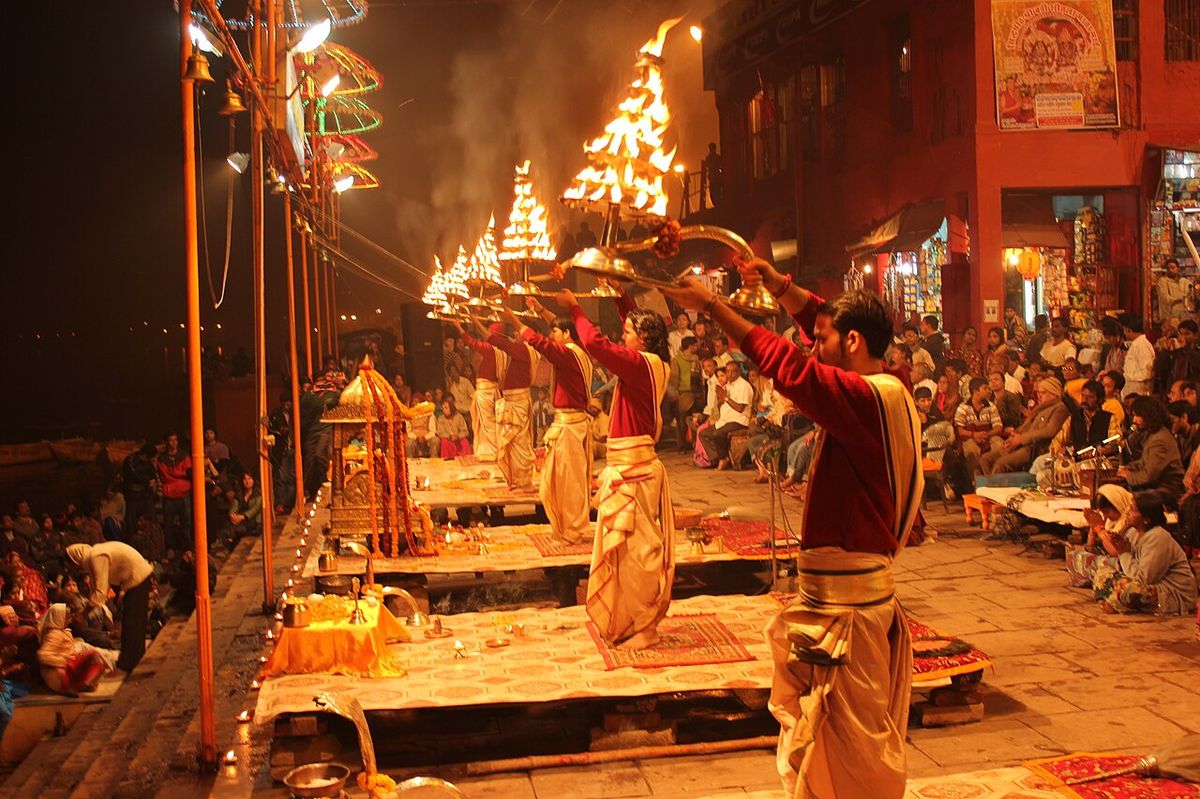
Hinduism (हिन्दू धर्म), known to its adherents as Sanātana Dharma (सनातन धर्म, “the Eternal Way”), is the world’s third-largest religion with over 1.2 billion followers and the oldest major religion still practised today. Unlike other world religions, Hinduism has no single founder, no central ecclesiastical authority, and no single creed or sacred text. It is a vast, living civilization of beliefs, practices, philosophies, and traditions that has evolved continuously over at least four thousand years — from the hymns of the Ṛg Veda composed on the banks of the Sindhu (Indus) river to the vibrant temple festivals and philosophical discourses of the twenty-first century.
The very word “Hindu” derives from the Sanskrit Sindhu (the Indus River), used by the ancient Persians to refer to the people living beyond that river. Over centuries, this geographical term became a religious and cultural identifier. Practitioners themselves increasingly use the term Sanātana Dharma — emphasizing that the truths at the heart of the tradition are not inventions of any historical moment but eternal principles woven into the fabric of reality itself.
Core Beliefs: The Four Great Ideas
At the philosophical heart of Hinduism lie four interconnected concepts that together form a comprehensive worldview.
Dharma: The Cosmic and Moral Order
Dharma (धर्म) is perhaps the most central concept in Hinduism, though it resists easy translation. At its broadest, dharma means “that which upholds” — the cosmic law that sustains the universe. At the personal level, it denotes one’s duty, righteousness, and right conduct. The Mahābhārata declares: dharmo rakṣati rakṣitaḥ — “dharma protects those who protect it” (Mahābhārata, Vana Parva 313.128).
Hindu thought recognizes multiple layers of dharma. Ṛta is the cosmic order underlying all existence. Sanātana dharma refers to the universal ethical principles — truthfulness (satya), non-violence (ahiṃsā), purity (śauca), self-restraint (dama) — that apply to all beings. Varṇa dharma and āśrama dharma describe the specific duties appropriate to one’s social role and stage of life. Svadharma is one’s own unique duty, shaped by individual nature and circumstance — a concept Kṛṣṇa emphasizes in the Bhagavad Gītā (3.35): “Better is one’s own dharma, though imperfectly performed, than the dharma of another well performed.”
Karma: The Law of Moral Causation
Karma (कर्म, “action”) is the law of cause and effect applied to the moral realm. Every intentional action — physical, verbal, or mental — produces a consequence (phala) that shapes one’s future experience. Good actions (puṇya) lead to favourable conditions; harmful actions (pāpa) lead to suffering. The Bṛhadāraṇyaka Upaniṣad (4.4.5) articulates this principle: “You are what your deep, driving desire is. As your desire is, so is your will. As your will is, so is your deed. As your deed is, so is your destiny.”
Karma is not fatalism. Hindu thought emphasizes that while past karma shapes present circumstances, present actions can create new karma and alter one’s trajectory. Free will and moral agency operate within the karmic framework, giving every individual the power to shape their future through conscious, righteous action.
Saṃsāra: The Cycle of Existence
Saṃsāra (संसार) is the beginningless cycle of birth, death, and rebirth through which the soul (ātman) transmigrates. Driven by accumulated karma and unfulfilled desires, the ātman takes successive physical embodiments — human, animal, or divine — across cosmic time. The Śvetāśvatara Upaniṣad (5.11-12) describes the soul wandering through saṃsāra, bound by the three guṇas (qualities of nature), until it attains liberating knowledge.
Saṃsāra is not merely a theory of reincarnation; it is the fundamental problem that Hindu spiritual practice seeks to address. The cycle is characterized by duḥkha (suffering) — not because life contains no joy, but because all conditioned experience is impermanent and ultimately unsatisfying.
Mokṣa: Liberation
Mokṣa (मोक्ष) is liberation from the cycle of saṃsāra — the ultimate goal of Hindu spiritual life. Different philosophical schools define mokṣa differently: for Advaita Vedānta, it is the realization that the individual ātman is identical with Brahman, the Absolute; for Viśiṣṭādvaita, it is eternal communion with a personal God; for Dvaita, it is eternal proximity to and service of the Supreme Lord. But all schools agree that mokṣa represents the highest fulfilment of human existence — a state of infinite knowledge, bliss, and freedom.
The Four Puruṣārthas: Goals of Human Life
Hinduism does not demand that every person pursue only spiritual liberation. It recognizes four legitimate goals of life (puruṣārthas), forming a balanced framework for human flourishing:
- Dharma (धर्म) — Righteous conduct, moral duty, and ethical living
- Artha (अर्थ) — Material prosperity, wealth, and worldly achievement
- Kāma (काम) — Sensory pleasure, aesthetic enjoyment, love, and emotional fulfilment
- Mokṣa (मोक्ष) — Spiritual liberation from the cycle of rebirth
These four goals are not in conflict but hierarchically ordered: artha and kāma are to be pursued under the guidance of dharma, and all three ultimately point toward mokṣa. This framework is remarkably life-affirming — Hinduism celebrates material success and sensory joy as legitimate human pursuits, provided they are governed by ethical principles.
Sacred Texts: Śruti and Smṛti
Hinduism possesses one of the richest literary traditions of any world religion. Its sacred literature is classified into two broad categories.
Śruti: “That Which Is Heard”
Śruti (श्रुति) refers to the most authoritative scriptures, believed to be directly revealed to ancient sages (ṛṣis) in states of deep meditation. The Śruti texts include:
The Vedas (वेद, “knowledge”) are the oldest Hindu scriptures, composed in Vedic Sanskrit roughly between 1500 and 500 BCE. There are four Vedas, each containing four layers of text:
- Ṛg Veda — The oldest, containing 1,028 hymns (sūktas) to various deities, organized in ten books (maṇḍalas)
- Yajur Veda — Ritual formulas and prose mantras for the performance of yajña (sacrifice)
- Sāma Veda — Musical settings of Ṛg Vedic hymns, chanted during rituals
- Atharva Veda — Hymns, spells, and incantations dealing with everyday life, healing, and philosophy
Each Veda contains four layers: the Saṃhitās (hymns and mantras), the Brāhmaṇas (ritual commentaries), the Āraṇyakas (“forest texts” bridging ritual and philosophy), and the Upaniṣads (philosophical dialogues on the nature of reality).
The Upaniṣads (उपनिषद्, “sitting near” a teacher) are the philosophical culmination of the Vedas, often called Vedānta (“the end of the Vedas”). The principal Upaniṣads — including the Bṛhadāraṇyaka, Chāndogya, Taittirīya, Kaṭha, Muṇḍaka, and Māṇḍūkya — explore the nature of Brahman (the Absolute Reality), ātman (the individual Self), and the relationship between them. The great declarations (mahāvākyas) of the Upaniṣads — such as tat tvam asi (“thou art that,” Chāndogya 6.8.7) and aham brahmāsmi (“I am Brahman,” Bṛhadāraṇyaka 1.4.10) — form the bedrock of Hindu philosophical thought.
Smṛti: “That Which Is Remembered”
Smṛti (स्मृति) texts are considered authoritative but of human authorship. They include:
The Epics:
- Mahābhārata — The world’s longest poem (~100,000 verses), attributed to Vyāsa, narrating the great war between the Pāṇḍavas and Kauravas. It contains the Bhagavad Gītā, one of the most important texts in all of Hinduism.
- Rāmāyaṇa — Composed by Vālmīki, the story of Lord Rāma’s exile, the abduction of Sītā, and the triumph of dharma over adharma.
The Purāṇas (पुराण, “ancient stories”) are a genre of encyclopaedic texts containing cosmology, mythology, genealogies, and religious instruction. The eighteen Mahāpurāṇas — including the Viṣṇu Purāṇa, Śiva Purāṇa, Bhāgavata Purāṇa, and Mārkaṇḍeya Purāṇa — made the profound truths of Vedic philosophy accessible to the broader population through narrative and devotion.
The Dharmaśāstras — Legal and ethical codes such as the Manusmṛti and the Yājñavalkya Smṛti, which prescribe rules for social conduct, duties of kings, and domestic rituals.
Major Deities: One Reality, Many Names
One of Hinduism’s most distinctive features is its simultaneous embrace of monotheism, polytheism, and monism. The Ṛg Veda declares: ekaṃ sad viprā bahudhā vadanti — “The Real is One; the wise call it by many names” (Ṛg Veda 1.164.46). Behind the rich diversity of Hindu deities lies the understanding that all divine forms are manifestations of one ultimate reality — Brahman (ब्रह्मन्), the infinite, formless, attributeless Absolute.
The Trimūrti
- Brahmā (ब्रह्मा) — The creator deity, associated with knowledge and the Vedas, often depicted with four faces and the sacred texts in his hands
- Viṣṇu (विष्णु) — The preserver, who descends to earth in various forms (avatāras) — including Rāma and Kṛṣṇa — to restore cosmic order
- Śiva (शिव) — The destroyer and transformer, the great ascetic and supreme yogī, worshipped both in the aniconic liṅga form and in anthropomorphic imagery
The Great Goddesses (Devī)
- Śakti — The divine feminine energy underlying all creation
- Durgā — The invincible warrior goddess who vanquishes the demon Mahiṣāsura
- Pārvatī — The gentle consort of Śiva, the ideal of devotion and wifely virtue
- Sarasvatī — Goddess of knowledge, music, and the arts
- Lakṣmī — Goddess of wealth, fortune, and prosperity
- Kālī — The fierce form of the Goddess, associated with time, destruction, and liberation
Other Important Deities
- Gaṇeśa — The elephant-headed god, remover of obstacles, invoked at the beginning of every undertaking
- Hanumān — The exemplar of devotion (bhakti) and selfless service, devoted to Lord Rāma
- Kṛṣṇa — The Supreme Lord as divine child, lover, friend, and teacher
- Rāma — The ideal king and embodiment of dharma
- Kārttikeya (Murugan/Skanda) — The warrior god, son of Śiva, especially beloved in South India
- Sūrya — The solar deity, worshipped since Vedic times
The Six Orthodox Philosophical Schools (Ṣaḍ Darśana)
Hinduism is unique among world religions in producing a rich tradition of systematic philosophical inquiry. The six orthodox schools (āstika darśanas), so called because they accept the authority of the Vedas, represent distinct approaches to understanding reality:
-
Sāṅkhya — Founded by the sage Kapila, this dualistic system enumerates twenty-five principles (tattvas) and distinguishes between consciousness (puruṣa) and matter (prakṛti). It provides the metaphysical framework adopted by Yoga and the Bhagavad Gītā.
-
Yoga — Systematized by Patañjali in the Yoga Sūtras, this school provides the practical disciplines — ethical observances, postures, breath control, concentration, and meditation — for achieving liberation. Patañjali defines yoga as citta-vṛtti-nirodhaḥ — “the cessation of the fluctuations of the mind” (Yoga Sūtras 1.2).
-
Nyāya — Founded by Gautama, this school develops rigorous methods of logic, epistemology, and debate. It identifies four valid means of knowledge (pramāṇas): perception, inference, comparison, and testimony.
-
Vaiśeṣika — Founded by Kaṇāda, this school proposes an atomic theory of the physical universe, classifying all objects into six (later seven) categories (padārthas).
-
Mīmāṃsā (Pūrva Mīmāṃsā) — Founded by Jaimini, this school focuses on the interpretation of Vedic ritual commands and develops sophisticated theories of language and meaning.
-
Vedānta (Uttara Mīmāṃsā) — The most influential school, which interprets the philosophical teachings of the Upaniṣads. Its three major sub-schools — Advaita (non-dualism) of Śaṅkara, Viśiṣṭādvaita (qualified non-dualism) of Rāmānuja, and Dvaita (dualism) of Madhva — represent distinct visions of the relationship between God, soul, and world.
Practices: Worship, Meditation, and Sacred Life
Pūjā (Worship)
Pūjā (पूजा) is the act of worship performed in the home shrine or temple, involving offerings of flowers, incense, light (āratī), food (naivedya), and water to the deity’s image (mūrti). The practice is based on the understanding that God accepts the devotion behind the offering — as Kṛṣṇa declares in the Gītā (9.26): “Whoever offers Me with devotion a leaf, a flower, a fruit, or water — I accept that.”
Yoga and Meditation
Yoga (योग) in its broader sense encompasses physical, mental, and spiritual disciplines. Dhyāna (meditation) — the sustained, one-pointed focus of the mind — is practised across all Hindu traditions as a means of calming the mind and directly experiencing the Divine.
Mantra and Japa
Mantras (मन्त्र) are sacred sounds, syllables, or phrases believed to carry spiritual power. The syllable Oṃ (ॐ) is considered the primordial sound from which the universe emerged (Māṇḍūkya Upaniṣad 1). The practice of japa — repetitive chanting of a mantra — is one of the most widespread forms of Hindu devotion.
Tīrtha Yātrā (Pilgrimage)
Pilgrimage to sacred sites — tīrthas (तीर्थ, “crossing places”) — is a vital practice. Major pilgrimage centres include Vārāṇasī (Kāśī), Prayāgrāj, Rāmeśvaram, Dvārakā, Purī, Haridvār, and Tirupati. The belief is that these sacred places, sanctified by divine presence and the prayers of countless devotees, accelerate spiritual progress.
Saṃskāras (Life-Cycle Rituals)
Hinduism marks the journey of human life with saṃskāras — sacred rituals from conception to death. The most widely observed include nāmakaraṇa (naming ceremony), upanayana (sacred thread ceremony), vivāha (marriage, centred around the sacred fire), and antyeṣṭi (last rites).
Sacred Symbols
- Oṃ (ॐ) — The supreme sacred syllable, representing Brahman and the essence of the Vedas
- Svastika (स्वस्तिक) — An ancient symbol of auspiciousness, well-being, and good fortune (from su + asti = “it is well”)
- Tilaka — The mark on the forehead denoting sectarian affiliation and divine blessing
- Mālā — A string of 108 beads used for japa (mantra repetition)
The Four Āśramas: Stages of Life
The Dharmasūtras prescribe four stages of life, forming an ideal trajectory of human development:
- Brahmacarya (student life) — Devoted to learning, self-discipline, and study under a guru
- Gṛhastha (householder) — Marriage, raising a family, earning a livelihood, and contributing to society — considered the most important stage, as it supports all others
- Vānaprastha (retirement) — Gradual withdrawal from worldly affairs, turning toward contemplation and spiritual pursuits
- Sannyāsa (renunciation) — Complete renunciation of material attachments, devoted solely to the pursuit of mokṣa
Festivals: Celebrating the Sacred Cycle
Hindu festivals mark the rhythms of the cosmic, agricultural, and devotional calendar. Dīpāvalī (Diwali) celebrates the victory of light over darkness. Navarātri honours the nine forms of the Goddess. Holī welcomes spring with colour and joy. Gaṇeśa Catuthī, Janmāṣṭamī, Mahāśivarātri, and hundreds of regional celebrations keep the sacred stories alive in lived community experience.
A Living Tradition
Hinduism is not a fossil from antiquity but a living, evolving tradition that continues to shape the spiritual lives of over a billion people worldwide. Its emphasis on dharma, karma, and mokṣa provides a framework for ethical living and spiritual progress. Its acceptance of multiple paths to the Divine — through knowledge, action, devotion, and meditation — makes it one of the most inclusive and adaptable religious traditions in human history.
Whether one is drawn to its philosophical depth, its rich mythology, its devotional fervour, its yogic disciplines, or its holistic understanding of human life, Sanātana Dharma offers a profound and time-tested path for seekers of truth in every age.