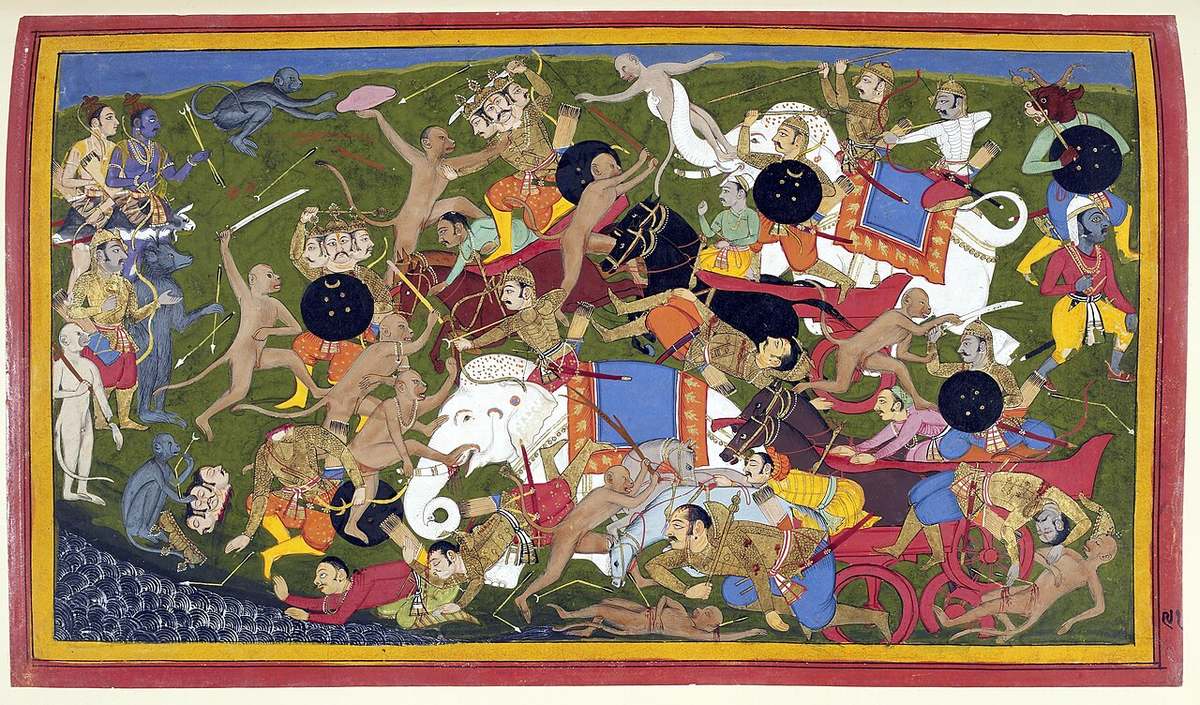
The Rāmāyaṇa (रामायण, “The Journey of Rāma”) is one of the two great epics (itihāsa) of Hinduism and one of the most influential literary works in human history. Composed by the sage Vālmīki — honoured as the Ādikavi (“first poet”) — in approximately 500–100 BCE, this monumental poem of over 24,000 ślokas (couplet verses) in the anuṣṭubh metre tells the story of Prince Rāma of Ayodhyā: his exile, the abduction of his wife Sītā by the demon king Rāvaṇa, the great war in Laṅkā, and his triumphant return. Yet the Rāmāyaṇa is far more than a narrative of heroic adventure — it is a profound meditation on dharma (righteous duty), the nature of ideal relationships, the cost of moral commitment, and the possibility of divine grace in a world governed by suffering and injustice.
The epic’s influence extends far beyond India’s borders. Over three millennia, it has been translated, adapted, and re-imagined in over 300 versions across more than a dozen Asian languages — from Kambaṉ’s Tamil Rāmāvatāram to the Thai Rāmakien, from the Javanese Kakawin Rāmāyaṇa to Tulsīdāsa’s Awadhi Rāmacaritamānasa. Today, the Rāmāyaṇa continues to be recited in homes, performed in theatres, and debated in seminaries — a living scripture that shapes the moral imagination of over a billion people.
Vālmīki: The First Poet
The composition of the Rāmāyaṇa is itself a legendary origin story. According to tradition, Vālmīki was originally a hunter (or, in some versions, a bandit named Ratnākara) who was transformed by years of penance and the guidance of the sage Nārada. While performing austerities by the banks of the river Tamasā, Vālmīki observed a hunter kill the male of a pair of krauñca (curlew) birds in the act of mating. Overcome by grief and compassion (karuṇā), Vālmīki spontaneously uttered the first verse of Sanskrit poetry:
मा निषाद प्रतिष्ठां त्वमगमः शाश्वतीः समाः। यत्क्रौञ्चमिथुनादेकमवधीः काममोहितम्।। “O hunter, may you never find peace for eternity, for you have slain one of a pair of birds absorbed in love.” (Vālmīki Rāmāyaṇa, Bāla Kāṇḍa 2.15)
The god Brahmā then appeared and revealed that this spontaneous outpouring of śoka (grief) had become śloka (verse) — and that Vālmīki was destined to compose the story of Rāma in this same metre. The verse established the anuṣṭubh chhanda (32-syllable metre) that would become the standard verse form of Sanskrit epic and didactic literature, used later in the Mahābhārata, the Purāṇas, and the Bhagavad Gītā.
This origin story carries profound meaning: the first poem in the world’s oldest literary tradition arose not from intellectual design but from an involuntary cry of compassion — establishing karuṇā (compassion) as the emotional foundation of all great literature.
The Seven Kāṇḍas: Structure and Narrative
The Rāmāyaṇa is divided into seven books called kāṇḍas (literally “sections” or “cantos”). Scholarly consensus, following the work of Hermann Jacobi and others, holds that books 2 through 6 form the original core of the epic, with books 1 (Bāla Kāṇḍa) and 7 (Uttara Kāṇḍa) being later additions — identifiable through differences in style, theological emphasis, and narrative continuity. Nevertheless, the traditional seven-kāṇḍa structure has been canonical for at least two millennia.
1. Bāla Kāṇḍa (बालकाण्ड) — The Book of Childhood
The opening book establishes the setting: the prosperous kingdom of Kosala with its capital at Ayodhyā, ruled by the righteous King Daśaratha of the Sūryavaṃśa (Solar Dynasty). Childless despite his three queens — Kausalyā, Sumitrā, and Kaikeyī — Daśaratha performs the Putrakāmeṣṭi yajña (fire sacrifice for obtaining sons) on the advice of the sage Ṛṣyaśṛṅga. From the sacred fire emerges a divine offering (pāyasa), which the queens consume and give birth to four sons: Rāma (Kausalyā), Bharata (Kaikeyī), and the twins Lakṣmaṇa and Śatrughna (Sumitrā).
The Bāla Kāṇḍa also narrates Rāma’s education under the sage Viśvāmitra, his slaying of the demoness Tāṭakā, his breaking of Lord Śiva’s bow at the svayaṃvara (bride-choosing ceremony), and his marriage to Sītā, the daughter of King Janaka of Mithilā — herself an incarnation of the goddess Lakṣmī.
2. Ayodhyā Kāṇḍa (अयोध्याकाण्ड) — The Book of Ayodhyā
This is the moral and emotional heart of the epic. Daśaratha prepares to crown Rāma as heir-apparent (yuvarāja). But Queen Kaikeyī, manipulated by her hunchback maidservant Mantharā, invokes two boons that Daśaratha had promised her years earlier during a battle against the demons: that her own son Bharata be crowned king, and that Rāma be exiled to the Daṇḍaka forest for fourteen years.
Rāma’s response to this catastrophe defines his character and the epic’s central theme. Without anger, bitterness, or protest, Rāma accepts the exile as his dharma — his duty to honour his father’s word. He declares: “pitur vacanam āsthāya… rāmo vai jñātim āgatah” — he would rather fulfil his father’s promise than rule the world. Sītā insists on accompanying him, arguing that a wife’s dharma is to share her husband’s fate. Lakṣmaṇa, enraged at the injustice but bound by fraternal love, joins them.
Daśaratha, unable to bear the separation, dies of grief — making the Ayodhyā Kāṇḍa one of the most emotionally devastating sections of any epic literature. When Bharata learns what has happened, he refuses the throne and travels to the forest to beg Rāma to return. Rāma declines, bound by his vow. Bharata returns to Ayodhyā with Rāma’s sandals (pādukā), which he places on the throne and governs as regent — a poignant symbol of dharmic governance in the king’s absence.
3. Araṇya Kāṇḍa (अरण्यकाण्ड) — The Book of the Forest
In the Daṇḍaka forest, Rāma, Sītā, and Lakṣmaṇa encounter sages, defeat demons who harass the forest-dwelling ascetics, and establish a hermitage at Pañcavaṭī on the banks of the Godāvarī river. The pivotal event occurs when Rāvaṇa’s sister Śūrpaṇakhā approaches Rāma with romantic intent. When rejected and when she threatens Sītā, Lakṣmaṇa disfigures her. Enraged, Rāvaṇa devises a scheme: he sends the demon Mārīca in the form of a golden deer to lure Rāma away from the hermitage. In Rāma’s absence, Rāvaṇa, disguised as an ascetic, abducts Sītā and carries her to his island kingdom of Laṅkā.
The dying vulture Jaṭāyu — an ally of Daśaratha — attempts to rescue Sītā and fights Rāvaṇa valiantly before falling, mortally wounded. His dying testimony to Rāma provides the first clue to Sītā’s whereabouts and direction.
4. Kiṣkindhā Kāṇḍa (किष्किन्धाकाण्ड) — The Book of Kiṣkindhā
Searching for Sītā, Rāma and Lakṣmaṇa reach the monkey kingdom of Kiṣkindhā. Here they form the pivotal alliance with Sugrīva, the exiled monkey king, and encounter Hanumān — the son of Vāyu (the wind god) and the devotee whose name would become synonymous with selfless service. Rāma helps Sugrīva defeat his brother Vāli and regain his kingdom. In return, Sugrīva dispatches search parties in all four directions. It is the party led by Aṅgada (Vāli’s son) and guided by Hanumān that receives the crucial intelligence from Sampāti (Jaṭāyu’s brother) that Sītā is held captive in Laṅkā, across the southern ocean.
5. Sundara Kāṇḍa (सुन्दरकाण्ड) — The Beautiful Book
The most beloved section of the Rāmāyaṇa, the Sundara Kāṇḍa is devoted entirely to Hanumān’s solo mission to Laṅkā. Expanding his body to enormous size, Hanumān leaps across the ocean, overcoming obstacles sent by celestial beings to test him. In Laṅkā, he locates Sītā in the Aśoka Vāṭikā (Aśoka grove), where she is held captive and tormented by Rāvaṇa’s demonesses to accept Rāvaṇa as her husband — a demand she steadfastly refuses.
Hanumān reveals himself to Sītā, presents Rāma’s signet ring as proof of his identity, and assures her of imminent rescue. He offers to carry her back on his shoulders, but Sītā declines, insisting that Rāma himself must come to rescue her — thereby preserving Rāma’s honour as a warrior. Before departing, Hanumān allows himself to be captured by Rāvaṇa’s son Indrajit (Meghanāda). Brought before Rāvaṇa’s court, Hanumān delivers Rāma’s ultimatum. Rāvaṇa orders Hanumān’s tail set ablaze; Hanumān uses the fire to burn down Laṅkā before leaping back across the ocean.
The Sundara Kāṇḍa is considered independently powerful and is recited as a stand-alone text for spiritual merit. It embodies the theme of dāsya bhakti — devotion expressed through selfless service — and Hanumān’s character has inspired countless commentaries on the nature of ideal devotion.
6. Yuddha Kāṇḍa (युद्धकाण्ड) — The Book of War
The climactic book narrates the great war between Rāma’s army and Rāvaṇa’s forces. Rāma’s army — composed of monkeys (vānara) and bears (ṛkṣa) — builds a bridge (setu) across the ocean to Laṅkā, a feat attributed to the engineering of Nala (son of the divine architect Viśvakarmā). The battle rages for many days, featuring single combats between champions, the use of divine weapons (astra), and devastating losses on both sides.
Key episodes include: Rāvaṇa’s brother Vibhīṣaṇa defecting to Rāma’s side out of dharmic conviction; the death of Kumbhakarṇa, Rāvaṇa’s giant brother who sleeps for six months at a stretch; Indrajit’s use of the Nāgāstra (serpent weapon) that binds Rāma and Lakṣmaṇa, and their rescue by Garuḍa; Lakṣmaṇa being struck down by Indrajit’s Śakti weapon and Hanumān’s legendary flight to the Himalayas to fetch the entire Droṇagiri mountain bearing the life-restoring Sañjīvanī herb, because he could not identify the specific plant.
The war culminates in the single combat between Rāma and Rāvaṇa. After a protracted battle, Rāma, guided by the sage Agastya’s counsel to recite the Āditya Hṛdaya Stotra (a hymn to the Sun), defeats Rāvaṇa with the divine Brahmāstra. Rāvaṇa’s death is not portrayed as simple villainy destroyed — Vālmīki describes Rāvaṇa as a great scholar, a devotee of Śiva, a master of the Vedas, and a powerful king. His downfall is attributed to kāma (desire) and ahaṅkāra (ego) — the same flaws that destroy any being, however learned or powerful.
7. Uttara Kāṇḍa (उत्तरकाण्ड) — The Final Book
The most controversial section of the epic narrates Rāma’s reign (Rāma Rājya) and its moral complexities. After the coronation, public gossip questions Sītā’s chastity during her captivity in Rāvaṇa’s palace. Rāma, tormented by the conflict between his personal love and his duty as king to uphold public dharma, makes the agonizing decision to banish Sītā to the forest — despite knowing her innocence. Sītā, pregnant with twins, takes refuge in Vālmīki’s hermitage, where she gives birth to Lava and Kuśa, to whom Vālmīki teaches the Rāmāyaṇa itself.
Years later, Rāma encounters his sons and recognizes them. He summons Sītā for a public vindication. Sītā, unwilling to endure yet another trial, calls upon her mother — the Earth — and is swallowed into the ground, returning to the source from which she was born (she had been found in a furrow by King Janaka). Rāma, grief-stricken, eventually enters the river Sarayū and returns to his celestial form as Lord Viṣṇu.
This ending has been debated for centuries. It raises hard questions: Can a just king sacrifice personal love for perceived public duty? Is Rāma’s banishment of Sītā a failure of dharma or its ultimate, tragic fulfilment? These unresolved tensions are what make the Rāmāyaṇa a true epic — not a simple morality tale but a profound exploration of the agonizing conflicts that arise when different dimensions of duty collide.
Key Characters and Their Dharmic Significance
- Rāma: The maryādā puruṣottama (“the supreme person of propriety”) — the ideal who subordinates personal desire to duty. His character raises the question: what does it cost to be perfectly righteous?
- Sītā: Far more than the “ideal wife,” Sītā embodies svadharma — fidelity to one’s own nature. Her refusal to leave Laṅkā on Hanumān’s back, her fire ordeal, and her final return to the earth all demonstrate an unwavering moral autonomy.
- Lakṣmaṇa: The embodiment of sevā (selfless service), Lakṣmaṇa sacrifices fourteen years of his own life to serve his brother. He represents the dharma of fraternal loyalty.
- Hanumān: The pinnacle of bhakti (devotion). His answer to Rāma’s question — “When I think of my body, I am your servant; when I think of my soul, I am a part of you” — has become the definitive statement of devotional theology.
- Rāvaṇa: A tragic figure of immense learning and power destroyed by desire and ego. He is a Brahmin, a devotee of Śiva, a conqueror of the three worlds — and yet his abduction of Sītā proves his undoing. He embodies the teaching that spiritual knowledge without moral discipline leads to destruction.
- Bharata: Dharma in the form of renunciation. His refusal of the throne, his governance as regent with Rāma’s sandals, and his years of ascetic waiting represent the purest form of selfless duty.
Philosophical Dimensions
The Rāmāyaṇa operates on multiple philosophical levels:
Dharma as tragic dilemma: Unlike the Mahābhārata, where dharma is openly ambiguous, the Rāmāyaṇa presents Rāma as a being who always follows dharma — and shows the terrible cost. His exile, the loss of his father, the abduction of his wife, and the eventual banishment of Sītā are all consequences of his unwavering commitment to duty. The epic asks: is perfect dharma even humanly sustainable?
Avatāra theology: The Rāmāyaṇa is the primary source for the theology of Viṣṇu’s seventh avatāra. Rāma is simultaneously fully divine (an incarnation of Viṣṇu) and fully human (subject to grief, anger, and moral torment). This dual nature — explored extensively by Tulsīdāsa and the Vaiṣṇava commentators — prefigures similar theological debates in other world traditions.
The ethics of kingship: The concept of Rāma Rājya — the ideal kingdom where justice, prosperity, and harmony prevail — has shaped Indian political philosophy for millennia. Mahatma Gandhi invoked Rāma Rājya as his vision for independent India. The Uttara Kāṇḍa’s portrayal of Rāma as a king who sacrifices personal happiness for perceived public duty has generated centuries of debate about the relationship between the ruler and the ruled.
The Rāmāyaṇa Tradition: Versions and Adaptations
The Vālmīki Rāmāyaṇa is the mūla (root) text, but the Rāmāyaṇa tradition encompasses over 300 known versions across Asia (Versions of the Ramayana - Wikipedia). Major adaptations include:
-
Rāmacaritamānasa (Tulsīdāsa, 16th century, Awadhi): The most popular version in North India, written in the vernacular to make the story accessible to all. Tulsīdāsa reimagines Rāma as the supreme Lord, infusing the narrative with intense bhakti devotionalism. It is recited annually in Rāmlīlā performances across the Hindi belt.
-
Kamba Rāmāyaṇam / Rāmāvatāram (Kambaṉ, 12th century, Tamil): Distinguished by its lyrical beauty and emotional depth, Kambaṉ’s version emphasizes bhakti to Rāma and includes distinctly Tamil cultural elements. The character of Rāvaṇa is portrayed with greater psychological complexity than in Vālmīki.
-
Adhyātma Rāmāyaṇa (attributed to Vyāsa, Sanskrit): A philosophical retelling embedded in the Brahmāṇḍa Purāṇa, emphasizing Advaita Vedānta themes. Rāma is portrayed as fully aware of his divinity throughout, and the narrative becomes an allegory of the soul’s journey to self-realization.
-
Ānanda Rāmāyaṇa, Vasiṣṭha Rāmāyaṇa (Yoga Vāsiṣṭha), and Adbhuta Rāmāyaṇa: Additional Sanskrit versions exploring different philosophical and narrative angles.
Southeast Asian Rāmāyaṇas
The Rāmāyaṇa’s influence extends across all of maritime and mainland Southeast Asia:
- Rāmakien (Thailand): The Thai national epic, performed as a masked dance-drama (khon) at the Royal Court, with murals of the narrative decorating the walls of the Grand Palace in Bangkok.
- Reamker (Cambodia): Preserved in Angkor Wat’s bas-reliefs and in Khmer classical dance.
- Kakawin Rāmāyaṇa (Java, Indonesia): An Old Javanese adaptation from the 9th century, performed in wayang (shadow puppet) theatre.
- Phra Lak Phra Lam (Laos): A Buddhist adaptation where Rāma is presented as a previous incarnation of the Buddha.
- Yama Zatdaw (Myanmar/Burma): The Burmese national Rāmāyaṇa tradition.
Cultural Impact and Living Tradition
The Rāmāyaṇa permeates virtually every dimension of Hindu cultural life:
-
Rāmlīlā: Dramatic re-enactments performed annually across North India during Navratri, culminating in the burning of Rāvaṇa’s effigy on Dussehra. The Rāmlīlā of Ramnagar (Varanasi), running continuously since the early 19th century, was inscribed on UNESCO’s Representative List of the Intangible Cultural Heritage of Humanity in 2008.
-
Temple art and architecture: Panels depicting Rāmāyaṇa scenes adorn temples from the Ramaswamy Temple in Kumbakonam to the great Prambanan complex in Java.
-
Hanumān worship: The character of Hanumān has transcended the epic to become one of Hinduism’s most worshipped deities, with Hanumān temples found in virtually every Indian village. The Hanumān Cālīsā (composed by Tulsīdāsa) is among the most recited devotional hymns in Hinduism.
-
Moral and legal influence: The concept of Rāma Rājya (the rule of Rāma) has served as a benchmark for good governance in Indian political discourse for millennia. The Arthaśāstra of Kauṭilya, the dharmaśāstras, and modern Indian political rhetoric all invoke the Rāmāyaṇa’s ideal of righteous kingship.
The Eternal Relevance of the Rāmāyaṇa
For hundreds of millions, the Rāmāyaṇa is not merely a story — it is a darpaṇa (mirror) in which each generation sees reflected its own struggles with duty, love, loyalty, and loss. The exile of Rāma asks: how do we respond when life’s verdict is unjust? Sītā’s ordeal asks: what is the relationship between innocence and the demand for proof? Hanumān’s devotion asks: what does it mean to serve without seeking reward? Rāvaṇa’s fall asks: how does knowledge, divorced from virtue, lead to ruin?
As the last verse of Vālmīki’s epic declares: “He who reads and listens to the Rāmāyaṇa, which is sacred, destructive of sin, and meritorious — such a person is freed from all transgression.” (Uttara Kāṇḍa) For three thousand years, this promise has sustained the Rāmāyaṇa as a living scripture — not frozen in antiquity but continuously reborn in every recitation, every Rāmlīlā stage, every grandmother’s telling, and every child’s first encounter with the tale of Rāma, Sītā, and the faithful Hanumān who carried a mountain to save a life and set a city ablaze with a single flaming tail.