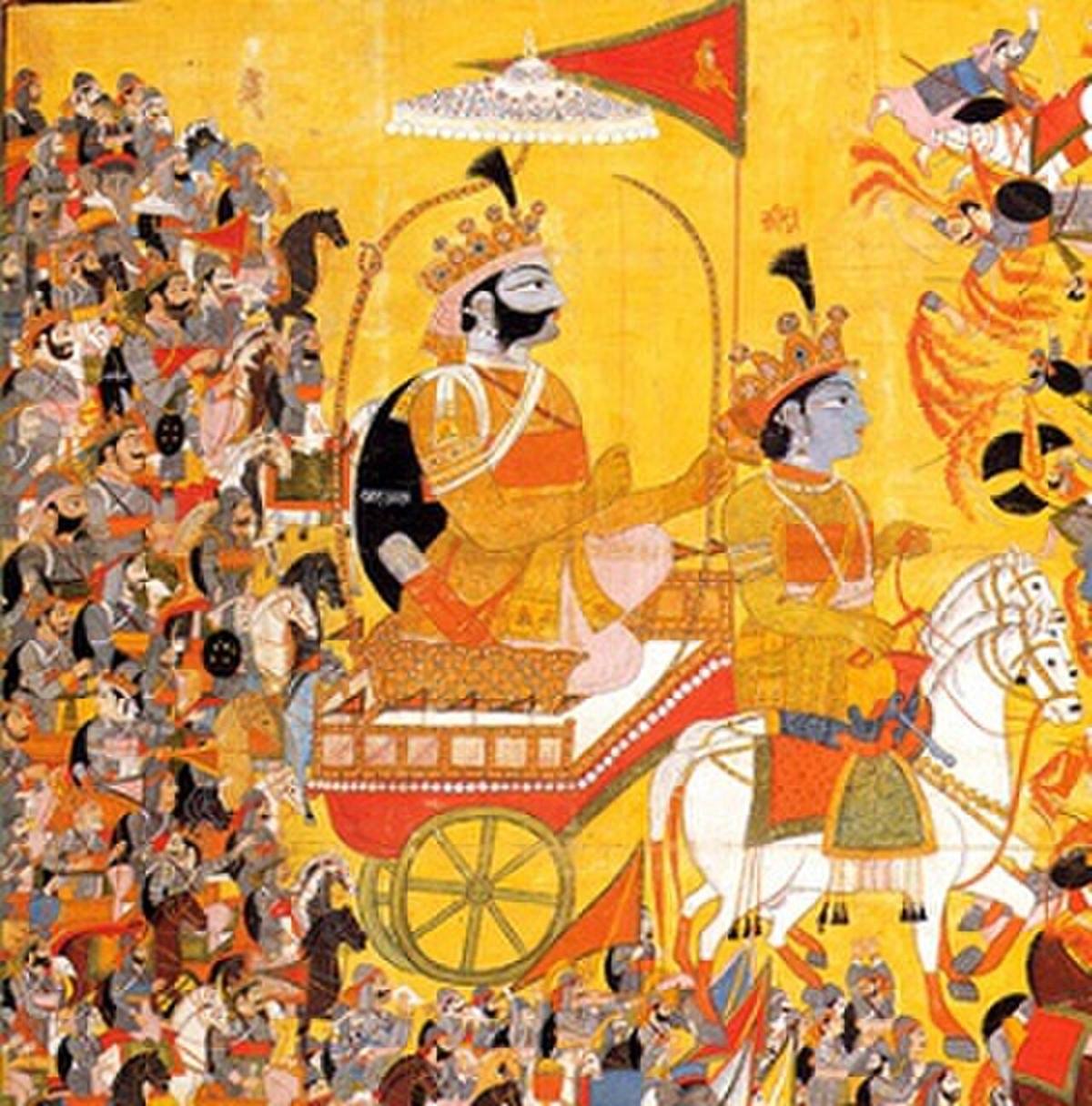
The Bhagavad Gītā (भगवद्गीता, “The Song of the Lord”) is one of the most revered and widely read scriptures in all of Hinduism. A 700-verse dialogue between Śrī Kṛṣṇa and the warrior prince Arjuna, it forms part of the great epic Mahābhārata (chapters 25-42 of Book 6, the Bhīṣma Parva). Composed likely between the second century BCE and the second century CE, the Gītā has been called the quintessence of Hindu spiritual thought — a text that distils the vast ocean of Vedic wisdom into a single, intimate conversation between the Divine and a devoted seeker standing at the crossroads of life.
The Setting: Kurukṣetra and the Crisis of Dharma
The Gītā opens on the battlefield of Kurukṣetra, referred to in the very first verse as dharmakṣetra — “the field of dharma” (Gītā 1.1). The great war between the Pāṇḍavas and the Kauravas, two branches of the Kuru dynasty, is about to begin. King Dhṛtarāṣṭra, blind from birth, asks his minister Sañjaya to narrate what transpires on the field.
Arjuna, the supreme archer among the Pāṇḍavas, asks his charioteer — Śrī Kṛṣṇa, the Supreme Lord incarnate — to drive his chariot between the two assembled armies. There, he sees arrayed before him his own grandfather Bhīṣma, his revered teacher Droṇa, cousins, kinsmen, and beloved friends. Overwhelmed by grief and moral confusion, Arjuna’s bow slips from his hands. He declares he cannot fight:
na kāṅkṣe vijayaṃ kṛṣṇa na ca rājyaṃ sukhāni ca — “I do not desire victory, O Kṛṣṇa, nor kingdom, nor pleasures” (Gītā 1.32).
This moment of existential crisis — a warrior paralyzed by the conflict between personal affection and public duty — becomes the occasion for one of the most profound spiritual teachings in human history. Arjuna’s dilemma is universal: How should one act when every available choice seems to bring suffering?
Structure of the Gītā: Eighteen Chapters of Yoga
The Bhagavad Gītā is organized into eighteen chapters (adhyāya), each titled as a form of yoga — a path or discipline leading to spiritual realization. This structure reflects the Gītā’s central insight that every dimension of human life can become a pathway to the Divine. The chapters can be broadly grouped into three sections of six chapters each:
Chapters 1-6: Karma Yoga — The Path of Action
The first section establishes the philosophical foundation. Kṛṣṇa begins by teaching the immortality of the ātman (Gītā 2.12-30), introduces the doctrine of niṣkāma karma (selfless action), and explains the disciplines of Sāṅkhya (analytical knowledge) and Yoga (practical discipline). Chapter 3 presents Karma Yoga in full — the path of performing one’s duty without attachment to results. Chapter 6 concludes with Dhyāna Yoga, the practice of meditation.
Chapters 7-12: Bhakti Yoga — The Path of Devotion
The middle section reveals the nature of the Supreme. Kṛṣṇa discloses His divine identity, describes His manifestations (vibhūti), and in Chapter 11 grants Arjuna the awe-inspiring Viśvarūpa Darśana — the vision of the Universal Form. Chapter 12 presents Bhakti Yoga, the path of loving devotion, as the most accessible and direct route to the Divine.
Chapters 13-18: Jñāna Yoga — The Path of Knowledge
The final section deals with metaphysical knowledge: the distinction between the field (kṣetra) and the knower of the field (kṣetrajña), the three guṇas (qualities of material nature), and the nature of the Divine and the individual soul. Chapter 18, the climactic Mokṣa Sannyāsa Yoga, synthesizes all the preceding teachings and concludes with Kṛṣṇa’s most intimate instruction.
Core Teachings of the Gītā
The Immortality of the Ātman
The very first teaching Kṛṣṇa imparts to the grieving Arjuna concerns the eternal nature of the soul:
na jāyate mriyate vā kadācin nāyaṃ bhūtvā bhavitā vā na bhūyaḥ / ajo nityaḥ śāśvato ‘yaṃ purāṇo na hanyate hanyamāne śarīre — “The soul is never born, nor does it ever die; it has not come into being, does not come into being, and will not come into being. It is unborn, eternal, ever-existing, and primeval. It is not slain when the body is slain.” (Gītā 2.20)
This foundational teaching — that the true Self (ātman) is distinct from the perishable body — underlies every subsequent instruction. Because the ātman is indestructible, Arjuna need not grieve for the bodies that will fall in battle. The teaching is not, however, a license for violence; it is an invitation to understand reality at a deeper level.
Niṣkāma Karma: Selfless Action
Perhaps the most famous verse of the Gītā encapsulates its teaching on action:
karmaṇy evādhikāras te mā phaleṣu kadācana / mā karmaphalaheturbhūr mā te saṅgo ‘stv akarmaṇi — “You have a right to perform your prescribed duty, but you are not entitled to the fruits of action. Never consider yourself the cause of the results of your activities, and never be attached to not doing your duty.” (Gītā 2.47)
This verse does not counsel indifference to outcomes but rather teaches a profound psychological freedom: act with full engagement and excellence, but surrender the anxiety of results to the Divine. This is the essence of Karma Yoga — action performed as an offering, without selfish attachment, which purifies the heart and leads to liberation.
The Three Yogas: Complementary Paths to Liberation
The Gītā presents three primary paths to mokṣa (liberation), each suited to different temperaments yet ultimately complementary:
Karma Yoga (the path of action) teaches that disciplined, selfless performance of duty — whether as a warrior, householder, teacher, or any other role — is itself a form of worship. Kṛṣṇa declares: “Action is superior to inaction” (Gītā 3.8), and emphasizes that even the maintenance of the body is impossible without action.
Jñāna Yoga (the path of knowledge) leads the seeker to discriminate between the real (sat) and the unreal (asat), between the eternal ātman and the transient body-mind complex. The Jñāna Yoga chapters draw heavily on Sāṅkhya philosophy and the Upaniṣadic teaching of Brahman. Kṛṣṇa states: “There is nothing so purifying in this world as knowledge” (Gītā 4.38).
Bhakti Yoga (the path of devotion) is presented as the most direct and accessible path. It requires no special qualification beyond sincere love for the Divine. Kṛṣṇa promises: “Whoever offers Me with devotion a leaf, a flower, a fruit, or water — I accept that offering of love from the pure-hearted” (Gītā 9.26). In Chapter 12, Kṛṣṇa unambiguously declares the bhakta (devotee) to be the highest of all yogīs (Gītā 12.2).
While these three paths are often described separately, the Gītā does not insist that a seeker follow only one. Rather, it advocates an integrated spiritual life where knowledge illuminates action, action is offered in devotion, and devotion is deepened by knowledge.
The Divine Descent: Avatāra
Kṛṣṇa reveals the doctrine of divine incarnation — one of the most distinctive theological concepts in Hinduism:
yadā yadā hi dharmasya glānir bhavati bhārata / abhyutthānam adharmasya tadātmānaṃ sṛjāmy aham — “Whenever there is a decline of dharma and a rise of adharma, O Bhārata, I manifest Myself.” (Gītā 4.7)
paritrāṇāya sādhūnāṃ vināśāya ca duṣkṛtām / dharmasaṃsthāpanārthāya sambhavāmi yuge yuge — “For the protection of the righteous, the destruction of the wicked, and the establishment of dharma, I appear in every age.” (Gītā 4.8)
These verses establish that the Divine does not remain remote from the world but actively intervenes to restore cosmic order — a teaching that has sustained Hindu devotional life for millennia.
The Viśvarūpa: The Cosmic Vision
In Chapter 11, responding to Arjuna’s request to behold His true form, Kṛṣṇa reveals the Viśvarūpa — the Universal Form encompassing all of creation, destruction, and divinity in a single, terrifying, and magnificent vision. Arjuna beholds all beings, all worlds, all gods, and all times within Kṛṣṇa’s infinite body. Trembling with awe, he cries: “I see in Your body all the gods and multitudes of beings” (Gītā 11.15). This theophany is one of the most dramatic episodes in all of world scripture, demonstrating that the gentle charioteer is simultaneously the infinite Lord of all existence.
Surrender: The Final Teaching
The Gītā’s culminating instruction comes in its closing chapter, where Kṛṣṇa offers what many commentators consider the single most important verse of the entire text:
sarvadharmān parityajya mām ekaṃ śaraṇaṃ vraja / ahaṃ tvāṃ sarvapāpebhyo mokṣayiṣyāmi mā śucaḥ — “Abandon all varieties of dharma and simply surrender unto Me alone. I shall deliver you from all sinful reactions; do not fear.” (Gītā 18.66)
This verse — known as the carama śloka (“ultimate verse”) in the Śrī Vaiṣṇava tradition — represents the apex of the Gītā’s teaching. After expounding all the paths of yoga, all the philosophical frameworks, all the duties and disciplines, Kṛṣṇa distils everything into a single, all-encompassing act: complete surrender (śaraṇāgati) to the Divine.
The Gītā in the Indian Philosophical Tradition
The Bhagavad Gītā occupies a unique position in Indian thought. It is one of the three foundational texts of Vedānta philosophy, known as the Prasthānatrayī (“triple canon”), alongside the Upaniṣads and the Brahma Sūtras. Every major Vedāntic philosopher composed a commentary (bhāṣya) on the Gītā:
- Ādi Śaṅkarācārya (8th century CE) interpreted the Gītā through the lens of Advaita Vedānta, emphasizing jñāna (knowledge of the non-dual Brahman) as the supreme path.
- Rāmānujācārya (11th century CE) read the Gītā through Viśiṣṭādvaita (“qualified non-dualism”), highlighting bhakti and the personal nature of God.
- Madhvācārya (13th century CE) offered a Dvaita (“dualist”) reading, stressing the eternal distinction between the individual soul and the Supreme.
These diverse interpretations demonstrate the Gītā’s extraordinary depth: the same text has served as the scriptural basis for radically different — yet equally rigorous — philosophical systems.
Global Influence and Legacy
The Bhagavad Gītā’s influence extends far beyond the Hindu world. When Charles Wilkins produced the first English translation in 1785, it electrified European intellectual circles. Ralph Waldo Emerson wrote: “I owed a magnificent day to the Bhagavad-gita. It was the first of books; it was as if an empire spoke to us, nothing small or unworthy, but large, serene, consistent.” Henry David Thoreau carried the Gītā with him to Walden Pond, and its influence on the American Transcendentalist movement was profound.
In the twentieth century, Mahātmā Gāndhī called the Gītā his “spiritual dictionary” and drew upon its teachings of niṣkāma karma and non-attachment as the philosophical foundation for his campaign of non-violent resistance (satyāgraha). Robert Oppenheimer, upon witnessing the first nuclear detonation in 1945, famously recalled Gītā 11.32: “Now I am become Death, the destroyer of worlds.”
The Gītā continues to inspire seekers across cultures, religions, and disciplines. Its teachings on duty, detachment, knowledge, and devotion speak to universal human concerns that transcend time and geography.
Practical Spiritual Guidance
Beyond its philosophical grandeur, the Gītā offers intensely practical guidance for daily life:
- Equanimity (samatva): “Yoga is equanimity of mind” (Gītā 2.48). The Gītā teaches practitioners to remain balanced in success and failure, pleasure and pain — a teaching of profound relevance in an age of constant stimulation.
- The three guṇas: Understanding the three qualities of material nature — sattva (goodness), rajas (passion), and tamas (ignorance) — helps practitioners recognize the forces shaping their thoughts, emotions, and actions (Gītā 14.5-18).
- Sāttvika diet, worship, and charity: Chapters 17-18 offer detailed guidance on how the guṇas influence food, sacrifice, austerity, and giving — a remarkably holistic framework for conscious living.
- Daily study: A daily reading of even one verse, paired with japa (mantra repetition), prayer, and silent reflection, can become a transformative spiritual discipline. As the Gītā itself declares: “Even a little practice of this dharma protects one from great fear” (Gītā 2.40).
The Song that Never Ends
The Bhagavad Gītā is simultaneously philosophy and poetry, theology and practical psychology, a call to action and an invitation to surrender. It meets seekers wherever they are — the intellectual finds jñāna, the activist finds karma, the lover of God finds bhakti — and leads them all toward the same goal: freedom from suffering and union with the Divine. In Sañjaya’s concluding words:
yatra yogeśvaraḥ kṛṣṇo yatra pārtho dhanurdharaḥ / tatra śrīr vijayo bhūtir dhruvā nītir matir mama — “Wherever there is Kṛṣṇa, the Lord of Yoga, and wherever there is Arjuna, the wielder of the bow, there will surely be splendour, victory, glory, and righteousness.” (Gītā 18.78)
This is the enduring promise of the Gītā: that when the human soul turns to the Divine with sincerity, courage, and devotion, the highest good is assured.