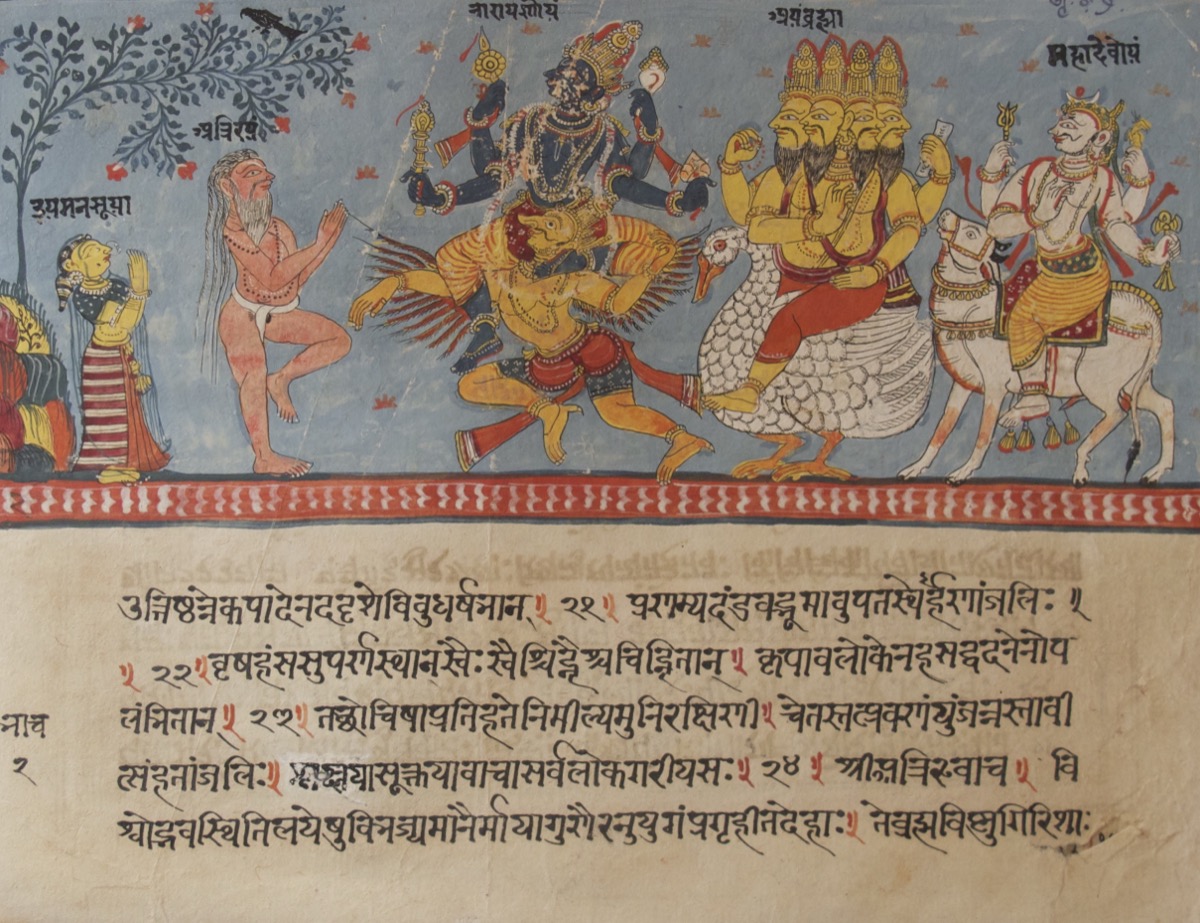
The Bhāgavata Purāṇa (भागवतपुराण), also known as Śrīmad Bhāgavatam, stands as the most revered and widely read of the eighteen Mahāpurāṇas. Comprising 18,000 verses (ślokas) distributed across twelve books (skandhas) and 335 chapters (adhyāyas), this monumental text has shaped Hindu devotional life for over a millennium. Its sublime Sanskrit poetry, philosophical depth, and soul-stirring narratives — particularly those concerning Lord Kṛṣṇa — have earned it a place of supreme honour in the Hindu literary and spiritual canon.
The Padma Purāṇa declares the Bhāgavata to be the “ripened fruit of the wish-fulfilling tree of Vedic literature” (nigama-kalpa-taror galitaṁ phalaṁ, Bhāgavata Purāṇa 1.1.3), suggesting that all the sweetness and nourishment of the Vedas culminates in this single text. For millions of Vaiṣṇava Hindus across the world, the Bhāgavatam is not merely a book to be studied — it is a living scripture to be heard, recited, and experienced as a direct encounter with the Divine.
Authorship and Dating
Traditional Attribution
Hindu tradition ascribes the Bhāgavata Purāṇa to the sage Veda Vyāsa (Kṛṣṇa Dvaipāyana), the legendary compiler of the Vedas and author of the Mahābhārata. According to the text’s own narrative frame (Bhāgavata Purāṇa 1.7.2–8), Vyāsa composed the Bhāgavatam as his final and most mature literary work. Despite having arranged the Vedas, composed the Mahābhārata, and written the other Purāṇas, Vyāsa remained dissatisfied until his spiritual master Nārada Muni directed him to glorify the transcendental qualities and pastimes (līlā) of Lord Viṣṇu. The resulting text became the Bhāgavata Purāṇa, which Vyāsa then taught to his son Śukadeva Gosvāmī, who recited it to King Parīkṣit — the grandson of Arjuna — during the king’s final seven days of life.
Scholarly Perspectives on Dating
Modern scholars have debated the date of the Bhāgavata Purāṇa extensively. Based on the earliest known written references by the Kashmiri polymath Abhinavagupta (c. 950–1020 CE) and the Persian scholar Al-Bīrūnī (c. 973–1048 CE), many academics place its final redaction between 800 and 1000 CE. Scholars such as Friedhelm Hardy have dated it to the 9th or early 10th century, noting its sophisticated integration of Tamil Āḻvār bhakti traditions with Sanskrit Vedāntic philosophy.
However, other scholars argue for an earlier composition. Dennis Hudson’s study of the Vaikuṇṭha Perumāḷ Temple at Kāñcīpuram provides iconographic evidence suggesting that the narratives of the Bhāgavata Purāṇa were well established by the 7th or 8th century CE. The text likely underwent multiple stages of composition, with earlier core material being expanded and refined over centuries within Vaiṣṇava bhakti circles.
Modern scholarship also widely regards the text as a composite work assembled by multiple contributors rather than a single author, reflecting the evolving devotional theology of Vaiṣṇava communities across different regions of India.
Structure: The Twelve Skandhas
The Bhāgavata Purāṇa is organized into twelve books (skandhas), each addressing distinct themes while contributing to the overarching message of bhakti (devotion) as the highest path to liberation (mokṣa).
Canto 1 — Sṛṣṭi (Creation)
19 chapters. The narrative frame is established: Sūta Gosvāmī recounts the dialogue between Śukadeva and King Parīkṣit at Naimiṣāraṇya. It introduces the curse upon Parīkṣit, the departure of Lord Kṛṣṇa from the world, and the onset of Kali Yuga. The canto establishes the supremacy of bhāgavata-dharma (devotion to God) over all other spiritual paths.
Canto 2 — Cosmic Manifestation
10 chapters. Describes the cosmic form (virāṭ-rūpa) of the Lord, the process of creation from the mahat-tattva, and the method of meditation for the departing soul. Śukadeva instructs Parīkṣit on the Lord’s avatāras and the dissolution of the cosmos.
Canto 3 — The Status Quo
33 chapters. Contains the profound philosophical dialogue between Vidura and Maitreya, and the celebrated teachings of Lord Kapila to his mother Devahūti on Sāṅkhya philosophy and devotional yoga (Bhāgavata Purāṇa 3.25–33). Kapila’s exposition synthesizes analytical philosophy with loving devotion.
Canto 4 — The Creation of the Fourth Order
31 chapters. Narrates the stories of Dhruva, the young prince whose unshakeable determination and devotion earned him an eternal celestial position (the Pole Star), and King Pṛthu, the ideal ruler after whom the Earth (Pṛthivī) is named.
Canto 5 — The Creative Impetus
26 chapters. Describes the cosmography of the universe — the planetary systems, continents, oceans, and hells — along with the story of King Ṛṣabhadeva and his son Bharata, from whom India (Bhārata-varṣa) takes its name.
Canto 6 — Prescribed Duties for Mankind
19 chapters. Features the story of Ajāmila, a fallen brāhmaṇa saved by unknowingly chanting the name of Lord Nārāyaṇa at the moment of death (Bhāgavata Purāṇa 6.1–3) — a powerful testimony to the efficacy of the divine Name. Also describes the battle between the Devas and Asuras.
Canto 7 — The Science of God
15 chapters. Centres on the immortal story of Prahlāda, the young devotee whose unwavering faith in Lord Viṣṇu could not be extinguished even by his demonic father Hiraṇyakaśipu. This canto contains the celebrated verse on Navadhā Bhakti — the nine forms of devotion (Bhāgavata Purāṇa 7.5.23–24).
Canto 8 — Withdrawal of the Cosmic Creations
24 chapters. Narrates the story of Gajendra (the elephant king) whose desperate prayer to the Lord is answered by Viṣṇu, and the churning of the cosmic ocean (Samudra Manthana). The canto also recounts the avatāras of Vāmana and Matsya.
Canto 9 — Liberation
24 chapters. Chronicles the royal dynasties (vaṁśas) of the Solar (Sūrya) and Lunar (Candra) lines, including the stories of Lord Rāma, King Ambarīṣa, and other great devotees and kings.
Canto 10 — The Summum Bonum
90 chapters, approximately 4,000 verses. The longest and most beloved section, this canto narrates the complete līlā (divine play) of Lord Kṛṣṇa — from His birth in Mathurā, childhood pastimes in Vṛndāvana (bāla-līlā), the butter-stealing episodes, the subduing of the serpent Kāliya, the rāsa-līlā (divine dance with the gopīs), the lifting of Govardhana Hill, to His later life as king of Dvārakā, the Kurukṣetra war, and His interactions with numerous devotees. The Tenth Canto is regarded as the literary and spiritual heart of the entire Bhāgavatam and accounts for the text’s immense popularity.
Canto 11 — General History
31 chapters. Contains the Uddhava Gītā (Bhāgavata Purāṇa 11.7–29), Lord Kṛṣṇa’s final and most intimate discourse delivered to His dear friend and devotee Uddhava before the Lord’s departure from the world. Many scholars consider the Uddhava Gītā comparable in philosophical depth to the Bhagavad Gītā. This canto also describes the destruction of the Yadu dynasty.
Canto 12 — The Age of Deterioration
13 chapters. Prophesies the degradation of society in Kali Yuga, describes the future avatāra Kalki, summarizes the entire Bhāgavatam, and concludes with the Mahā-Bhāgavata-Māhātmya — the glorification of the text itself.
Key Narratives and Their Teachings
Kṛṣṇa Līlā (Canto 10)
The Tenth Canto’s narrative of Kṛṣṇa’s life is far more than biography — it is theological poetry of the highest order. The childhood pastimes (bāla-līlā) reveal the Supreme as an approachable, playful child whose every act conceals infinite power. The rāsa-līlā (Bhāgavata Purāṇa 10.29–33), often misunderstood, is interpreted by commentators as the supreme expression of prema-bhakti — selfless, all-consuming divine love in which the individual soul merges in ecstatic union with God while retaining its distinct identity. Śrīdhara Svāmī, Jīva Gosvāmī, and Viśvanātha Cakravartī all emphasize that the rāsa-līlā transcends material desire and embodies the ānanda (bliss) aspect of Brahman.
Prahlāda and Navadhā Bhakti (Canto 7)
Prahlāda’s story is among the most inspiring in all of Hindu literature. Despite torture and attempted murder by his own father Hiraṇyakaśipu, the child Prahlāda never wavers in his devotion. His instruction to his classmates introduces the celebrated nine forms of devotion (navadhā bhakti, Bhāgavata Purāṇa 7.5.23–24):
śravaṇaṁ kīrtanaṁ viṣṇoḥ smaraṇaṁ pāda-sevanam | arcanaṁ vandanaṁ dāsyaṁ sakhyam ātma-nivedanam ||
These nine modes — hearing (śravaṇa), chanting (kīrtana), remembering (smaraṇa), serving the Lord’s feet (pāda-sevana), worshipping (arcana), offering prayers (vandana), servitude (dāsya), friendship (sakhya), and complete self-surrender (ātma-nivedana) — constitute the foundational framework of Hindu devotional practice to this day.
Dhruva’s Determination (Canto 4)
The five-year-old prince Dhruva, rejected by his father King Uttānapāda, undertakes severe penance in the forest and achieves a direct vision of Lord Viṣṇu (Bhāgavata Purāṇa 4.8–12). His story teaches that sincere devotion transcends age, status, and circumstance, and that the Lord responds to the genuine seeker with infinite grace.
Kapila’s Teachings (Canto 3)
Lord Kapila’s discourse to Devahūti (Bhāgavata Purāṇa 3.25–33) presents a sophisticated synthesis of Sāṅkhya analytical philosophy with bhakti yoga, demonstrating that intellectual understanding of reality’s structure is incomplete without loving devotion to the personal Godhead.
The Uddhava Gītā (Canto 11)
Kṛṣṇa’s final teachings to Uddhava (Bhāgavata Purāṇa 11.7–29) form a comprehensive manual of spiritual practice. Drawing on the example of an avadhūta (wandering ascetic) who learns wisdom from twenty-four natural gurus — the earth, air, sky, water, fire, moon, sun, pigeon, python, ocean, moth, bee, elephant, deer, fish, the courtesan Piṅgalā, the osprey, the child, the maiden, the arrow-maker, the serpent, the spider, and the wasp — Kṛṣṇa teaches Uddhava to see the divine in all of creation.
Philosophical Framework
Bhakti as the Supreme Path
The Bhāgavata Purāṇa’s central philosophical contribution is its elevation of bhakti (devotion) to the highest spiritual path, surpassing jñāna (knowledge) and karma (ritual action). The text declares: “sa vai puṁsāṁ paro dharmo yato bhaktir adhokṣaje” — “The supreme dharma for all humanity is that by which one attains loving devotion to the transcendent Lord” (Bhāgavata Purāṇa 1.2.6). This bhāgavata-dharma is presented not as sectarian belief but as the natural and universal function of the soul.
Synthesis of Vedāntic Schools
The philosophy of the Bhāgavata Purāṇa has been described by scholar Daniel P. Sheridan as “advaitic theism” — a unique synthesis that incorporates elements from multiple Vedāntic traditions. The text affirms the absolute unity of Brahman while simultaneously celebrating the personal form of God as the highest reality. It employs Sāṅkhya metaphysics, Yoga practice, and Vedānta theology in the service of devotion. The famous verse “vadanti tat tattva-vidas tattvaṁ yaj jñānam advayam / brahmeti paramātmeti bhagavān iti śabdyate” (Bhāgavata Purāṇa 1.2.11) declares that the one non-dual Absolute Truth is known by three names — Brahman, Paramātmā, and Bhagavān — with Bhagavān (the personal God) being the most complete realization.
The Daśa-Lakṣaṇa: Ten Characteristic Topics
The Bhāgavata Purāṇa expands the traditional five characteristics (pañca-lakṣaṇa) of a Purāṇa to ten (daśa-lakṣaṇa), as enumerated in Bhāgavata Purāṇa 2.10.1: sarga (elemental creation), visarga (secondary creation), sthāna (planetary systems), poṣaṇa (divine protection), ūti (creative drive), manvantara (periods of Manu), īśānukathā (stories of the Lord), nirodha (dissolution), mukti (liberation), and āśraya (the ultimate shelter — Bhagavān Himself).
Major Commentaries
The Bhāgavata Purāṇa has attracted more commentaries than perhaps any other Purāṇic text, reflecting its centrality to multiple Vaiṣṇava traditions:
-
Śrīdhara Svāmī (14th century): His Bhāvārtha-dīpikā is the oldest surviving complete commentary on the Bhāgavatam. An Advaitin by philosophical persuasion, Śrīdhara nonetheless wrote with deep devotional feeling. Śrī Caitanya Mahāprabhu himself declared that anyone who rejected Śrīdhara Svāmī’s commentary was no Vaiṣṇava. His work serves as the foundation for all subsequent commentaries.
-
Vallabhācārya (1479–1531): The founder of the Puṣṭimārga tradition wrote the Subodhinī, a rich and detailed commentary emphasizing puṣṭi-bhakti (grace-nourished devotion) and the supremacy of Kṛṣṇa as the Puruṣottama (Supreme Person). Vallabha’s reading of the rāsa-līlā is particularly celebrated.
-
Jīva Gosvāmī (c. 1513–1598): The foremost theologian of the Gauḍīya Vaiṣṇava tradition composed the Krama-sandarbha and the monumental six Ṣaṭ-sandarbhas, which systematically extract the philosophical conclusions of the Bhāgavatam. Jīva established acintya-bhedābheda (inconceivable simultaneous oneness and difference) as the text’s philosophical essence.
-
Viśvanātha Cakravartī Ṭhākura (c. 1638–1708): His Sārārtha-darśinī commentary, also from the Gauḍīya tradition, is renowned for its profound insights into the emotional dimensions of bhakti-rasa (devotional aesthetics).
-
Madhvācārya (1238–1317): The founder of the Dvaita school wrote the Bhāgavata-tātparya-nirṇaya, interpreting the Bhāgavatam through the lens of strict dualism and the eternal distinction between God and the individual soul.
Influence on Hindu Art, Music, and Culture
The Bhāgavata Purāṇa has exercised an incomparable influence on virtually every domain of Hindu cultural expression:
Visual Arts
The text’s vivid narratives — Kṛṣṇa lifting Govardhana, the rāsa-līlā, baby Kṛṣṇa stealing butter, the subduing of Kāliya — have been among the most depicted subjects in Indian painting for centuries. Schools of miniature painting including Rajasthani (Mewar, Bundi, Kishangarh), Pahari (Basohli, Kangra, Guler), and Mughal styles produced thousands of illustrated Bhāgavata Purāṇa manuscripts from the 16th to 19th centuries. The earliest known illustrated manuscript is the Palam Bhāgavata Purāṇa (c. 1520–40), rendered in the Chaurapañcāśikā style. Temple sculpture across India — from the Hoysala temples of Karnataka to the Vijayanagara reliefs at Hampi — draws extensively on Bhāgavata narratives.
Music and Dance
Classical Indian music traditions are deeply indebted to the Bhāgavatam. Countless bhajans, kīrtanas, and classical compositions across Hindustani and Carnatic traditions draw on its verses and stories. The Aṣṭapadī of Jayadeva’s Gīta Govinda (12th century), one of the greatest works of Indian lyric poetry, is directly inspired by the rāsa-līlā of the Tenth Canto. Classical dance forms — Bharatanatyam, Odissi, Kuchipudi, Manipuri, and Kathak — routinely dramatize Bhāgavata episodes, particularly the childhood pastimes and the rāsa-līlā.
Performing Arts and Literature
Regional literary traditions across India have produced vernacular adaptations of the Bhāgavatam that rank among the greatest works in their respective languages. Eknath’s Marathi Bhāgavata, Sankaradeva’s Assamese Bhāgavata (which became the foundation of Assamese Vaiṣṇavism and the Nāmghar tradition), Pothana’s Telugu Śrīmad Bhāgavatamu, and Tunchaththu Rāmānuja Ezhuttacchan’s Malayalam version are all literary masterpieces. The Bhāgavata Saptāha — a seven-day continuous recitation of the text — remains one of the most popular religious observances in India.
Festivals
Several major Hindu festivals trace their narratives to the Bhāgavata Purāṇa: Janmāṣṭamī (Kṛṣṇa’s birth), Holī (Kṛṣṇa’s play with colours and the burning of Holikā), Govardhana Pūjā (the lifting of Govardhana Hill), Dīwālī (in some traditions, Kṛṣṇa’s defeat of Narakāsura), and Rāsa Pūrṇimā (the full-moon night of the rāsa-līlā).
Influence on Devotional Movements
The Bhāgavata Purāṇa has been the foundational text for virtually all major Vaiṣṇava bhakti movements in India:
-
Gauḍīya Vaiṣṇavism: Śrī Caitanya Mahāprabhu (1486–1534) and his followers regarded the Bhāgavatam as the natural commentary on the Vedānta-sūtra and the supreme scriptural authority. The International Society for Krishna Consciousness (ISKCON), founded by A.C. Bhaktivedanta Swami Prabhupāda in 1966, has made the text globally available through its multi-volume translation, Śrīmad-Bhāgavatam.
-
Puṣṭimārga: Vallabhācārya’s tradition centres its theology, liturgy, and artistic expression almost entirely on the Bhāgavatam, particularly the Tenth Canto. The Havelī-saṅgīta tradition of devotional music in the Braj region is a direct cultural expression of Bhāgavata devotion.
-
Vārkarī tradition: The saints of Maharashtra — Nāmdev, Eknāth, Tukārām — drew deeply on Bhāgavata themes in their abhanga compositions and devotional practice.
Modern Relevance
The Bhāgavata Purāṇa continues to resonate powerfully in the modern world. Its teachings on devotion as a universal human capacity transcending caste, gender, and social status have made it a text of remarkable social progressivism — Prahlāda is a child, Dhruva is a boy, Ajāmila is a fallen man, and the gopīs are village women, yet all attain the highest spiritual perfection through love of God.
In academic circles, the Bhāgavatam is increasingly studied as a work of literary and philosophical sophistication. Scholars like Ravi M. Gupta, Kenneth Valpey, Edwin Bryant, and Graham Schweig have produced major studies that situate the text within comparative theology, aesthetics, and phenomenology of religion. The Bhāgavatam’s vision of reality as fundamentally relational — where the Absolute is not an impersonal void but a supremely personal Being who delights in loving exchange with His devotees — offers a distinctive and compelling theological voice in contemporary global discourse.
Whether encountered through scholarly study, devotional recitation, classical dance, miniature painting, or the living tradition of saptāha recitation in temples and homes across India, the Bhāgavata Purāṇa remains what it has been for over a thousand years — the supreme treasure of Hindu devotional literature and a gateway to the transformative experience of divine love.