Introduction
Śrī Kṛṣṇa Chaitanya Mahāprabhu (1486–1534 CE; Bengali: শ্রী কৃষ্ণ চৈতন্য মহাপ্রভু; Sanskrit: श्री कृष्ण चैतन्य महाप्रभु), born Viśvambhara Miśra in Navadvīpa, Bengal, is one of the most transformative figures in the history of Hindu devotional tradition. Revered by his followers as a direct incarnation of Kṛṣṇa — or more precisely, of Rādhā and Kṛṣṇa combined in a single form (rādhā-bhāva-dyuti-suvalitam, “adorned with the mood and lustre of Rādhā”) — Chaitanya inaugurated a radical devotional revolution that swept across eastern India in the sixteenth century and continues to reverberate globally today through the International Society for Krishna Consciousness (ISKCON) and allied Gauḍīya Vaiṣṇava organizations (Wikipedia, “Chaitanya Mahaprabhu”; Britannica, “Chaitanya”).
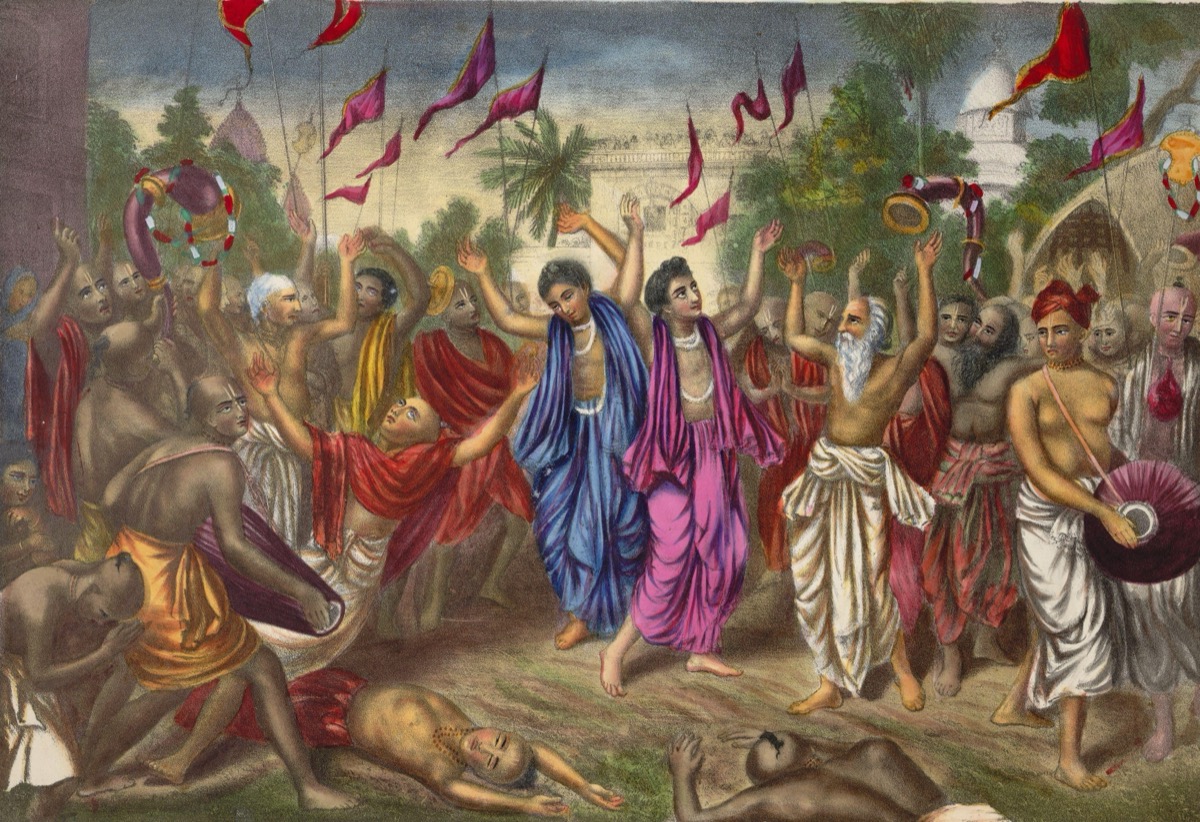
Chaitanya’s primary legacy is the saṅkīrtana movement — the public congregational chanting of the divine names of Kṛṣṇa, especially the mahāmantra: Hare Kṛṣṇa, Hare Kṛṣṇa, Kṛṣṇa Kṛṣṇa, Hare Hare / Hare Rāma, Hare Rāma, Rāma Rāma, Hare Hare. He taught that this chanting was the supreme spiritual practice (yuga-dharma) for the present age of Kali, accessible to all regardless of caste, gender, or social status. In doing so, Chaitanya dismantled many of the social barriers that had calcified around Hindu worship and created a genuinely egalitarian path to divine love (Britannica, “Chaitanya”; Vedabase, “Caitanya-caritāmṛta”).
Early Life in Navadvīpa
Viśvambhara Miśra was born on the full moon night of the month of Phālguna (February–March) in 1486 CE, during a lunar eclipse, in the town of Navadvīpa (modern Nadia district, West Bengal). His parents were Jagannātha Miśra, a Brahmin scholar originally from Sylhet (in modern Bangladesh), and Śacī Devī, a devout and loving mother who would later become one of the most celebrated maternal figures in Vaiṣṇava hagiography. Because of the circumstances of his birth during an eclipse — when Hindus traditionally chant divine names for protection — the chanting of “Hari! Hari!” at the moment of his birth was seen as prophetically linking the child to the divine name from his very first breath.
The young Viśvambhara — also called Nimāi (after the nīm tree under which he was born) — grew up to be a brilliant scholar and was renowned throughout Navadvīpa for his prodigious intellect in nyāya (logic) and Sanskrit grammar. The Caitanya-caritāmṛta by Kṛṣṇadāsa Kavirāja describes him as the foremost paṇḍita (scholar) of Navadvīpa, undefeated in debate, renowned for his wit and learning. He established his own ṭol (traditional school) at a remarkably young age, attracting students from across Bengal (Vedabase, “Caitanya-caritāmṛta”, Ādi-līlā).
The Transformation: From Scholar to Saint
The pivotal transformation in Chaitanya’s life occurred in 1508 CE, when he visited Gayā to perform the śrāddha (ancestral rites) for his recently deceased father. There he met Īśvara Purī, a sannyāsī in the lineage of the great Vaiṣṇava theologian Mādhavendra Purī, and received dīkṣā (spiritual initiation) from him into the gopāla-mantra (a Kṛṣṇa mantra). The effect was instantaneous and dramatic: the brilliant logician was transformed into an ecstatic devotee, weeping incessantly, fainting, trembling, and calling out for Kṛṣṇa with an intensity that astonished all who witnessed it.
Upon his return to Navadvīpa, Viśvambhara was a changed man. He abandoned his scholarly pursno and devoted himself entirely to kīrtana (devotional singing) and prema-bhakti (ecstatic love of God). His raptures drew both wonder and controversy — some saw a divine descent (avatāra), others suspected madness. The Caitanya-bhāgavata of Vṛndāvana Dāsa Ṭhākura records how Chaitanya would lose external consciousness during kīrtana, entering bhāva-samādhi (trance of divine love), his body manifesting the eight sāttvika-bhāvas (sattvic ecstatic symptoms): tears, horripilation, perspiration, trembling, colour change, choking of the voice, fainting, and devastation (Caitanya-bhāgavata, Madhya-khaṇḍa 2; Wikipedia, “Chaitanya Mahaprabhu”).
Acceptance of Sannyāsa
In 1510 CE, at the age of twenty-four, Chaitanya made the momentous decision to accept sannyāsa (the renounced order of life) from Keśava Bhāratī, a Śaṅkarite sannyāsī of the Bhāratī order. He received the sannyāsa name Śrī Kṛṣṇa Chaitanya. This decision caused tremendous grief to his devoted mother Śacī Devī and his young wife Viṣṇupriyā, but Chaitanya felt compelled by a divine mission: to spread the saṅkīrtana of Kṛṣṇa’s name across India and beyond.
The acceptance of sannyāsa from a Śaṅkarite (Advaita Vedānta) guru, while teaching a distinctly Vaiṣṇava theology, has been the subject of much scholarly discussion. Some scholars suggest it was a pragmatic choice — sannyāsīs commanded universal respect in Indian society, and the sannyāsa status gave Chaitanya a platform from which to preach to all sections of society. Others see it as a deliberate theological statement about the universality of bhakti, which transcends sectarian institutional boundaries (Britannica, “Chaitanya”; Journal of the Royal Asiatic Society).
The Saṅkīrtana Movement
Chaitanya’s most enduring contribution to Hindu devotional practice is the saṅkīrtana movement — the public, congregational, ecstatic chanting of the divine names of Kṛṣṇa through the streets. The Caitanya-caritāmṛta (Ādi-līlā 17.21–22) records Chaitanya’s foundational teaching:
Harer nāma harer nāma harer nāmaiva kevalam / Kalau nāsty eva nāsty eva nāsty eva gatir anyathā — “The holy name of the Lord, the holy name of the Lord, the holy name of the Lord — in this age of Kali there is no other means, no other means, no other means for spiritual attainment.” (Bṛhan-nāradīya Purāṇa, cited in Caitanya-caritāmṛta)
This was not merely theological assertion but social revolution. Chaitanya’s saṅkīrtana parties included Brahmins and Śūdras, scholars and the illiterate, men and women, the socially powerful and the marginalized. The Caitanya-bhāgavata records how Chaitanya embraced Haridāsa Ṭhākura, a Muslim convert who became the “Nāmācārya” (teacher of the Holy Name), and elevated Jagāi and Mādhāi, two dissolute drunkards, through the power of the divine name — demonstrating that bhakti recognized no social barriers (Vedabase, “Caitanya-caritāmṛta”, Ādi-līlā 17).
Theological Contributions: Acintya-Bhedābheda
While Chaitanya himself left no written works beyond eight verses known as the Śikṣāṣṭaka (“Eight Instructions”), his theological system was systematized by his followers, the Six Gosvāmīs of Vṛndāvana — Rūpa, Sanātana, Jīva, Raghunātha Bhaṭṭa, Raghunātha Dāsa, and Gopāla Bhaṭṭa Gosvāmī. The resulting philosophical system is called Acintya-Bhedābheda (“inconceivable simultaneous difference and non-difference”), which teaches that the individual soul (jīva) and the Supreme (Bhagavān) are simultaneously and inconceivably one and different — like the sun and its rays, or fire and its heat.
This theology navigated a middle path between Śaṅkara’s pure monism (advaita) and Madhva’s pure dualism (dvaita), while placing prema-bhakti (ecstatic love) rather than jñāna (knowledge) or karma (works) as the supreme spiritual goal. The Bhakti-rasāmṛta-sindhu of Rūpa Gosvāmī, which systematizes the stages of devotion from śraddhā (faith) to prema (divine love), is considered the foundational text of Gauḍīya Vaiṣṇava theology (Gaudiya Vaishnavism, Wikipedia).
The Śikṣāṣṭaka: Eight Verses of Instruction
Chaitanya’s sole literary composition, the Śikṣāṣṭaka, is considered by Gauḍīya Vaiṣṇavas to contain the essence of his entire teaching in just eight Sanskrit verses. The first verse sets the tone:
Ceto-darpaṇa-mārjanaṃ bhava-mahā-dāvāgni-nirvāpaṇaṃ / Śreyaḥ-kairava-candrikā-vitaraṇaṃ vidyā-vadhū-jīvanam / Ānandāmbudhi-vardhanaṃ prati-padaṃ pūrṇāmṛtāsvādanaṃ / Sarvātma-snapanaṃ paraṃ vijayate śrī-kṛṣṇa-saṅkīrtanam — “Let there be supreme victory for the chanting of the holy name of Śrī Kṛṣṇa, which cleanses the mirror of the heart, extinguishes the great forest fire of material existence, spreads the moonlight of auspiciousness, is the life of transcendental knowledge, increases the ocean of transcendental bliss, enables full tasting of nectar at every step, and bathes the entire self.” (Śikṣāṣṭaka 1)
The eighth and final verse reaches the summit of self-surrendered love:
Āśliṣya vā pāda-ratāṃ pinaṣṭu mām / Adarśanān marma-hatāṃ karotu vā / Yathā tathā vā vidadhātu lampaṭo / Mat-prāṇa-nāthas tu sa eva nāparaḥ — “Let Kṛṣṇa embrace me or crush me under His feet; let Him make me broken-hearted by hiding Himself — He may do whatever He likes, for He is my beloved Lord and no one else.” (Śikṣāṣṭaka 8)
Life in Purī
After accepting sannyāsa, Chaitanya settled in Jagannātha Purī, Odisha, where he spent the last twenty-four years of his life (1510–1534 CE). Purī became the centre of his spiritual activities, and the temple of Lord Jagannātha — himself a form of Kṛṣṇa — became the focal point of Chaitanya’s devotion.
During the annual Ratha Yātrā (chariot festival) of Lord Jagannātha, Chaitanya led massive saṅkīrtana processions that are described in the Caitanya-caritāmṛta as involving thousands of devotees dancing in seven groups, with Chaitanya himself manifesting in multiple forms to be simultaneously present in each group. His ecstatic dancing before the chariot of Jagannātha became the template for the Ratha Yātrā celebrations observed by Gauḍīya Vaiṣṇavas worldwide.
The final years of Chaitanya’s life in Purī were characterized by increasingly intense spiritual experiences. The Caitanya-caritāmṛta (Antya-līlā) describes his nightly devotional gatherings with close associates like Svarūpa Dāmodara and Rāmānanda Rāya, during which he would relive the separation (viraha) of Rādhā from Kṛṣṇa, manifesting extreme physical symptoms of divine love that defied ordinary medical or psychological explanation (Vedabase, “Caitanya-caritāmṛta”, Antya-līlā).
Chaitanya as the Combined Form of Rādhā-Kṛṣṇa
The Gauḍīya Vaiṣṇava theological understanding of Chaitanya’s identity is unique among Hindu avatāra doctrines. According to the Caitanya-caritāmṛta (Ādi-līlā 1.5):
Rādhā kṛṣṇa-praṇaya-vikṛtir hlādinī śaktir asmād / Ekātmānāv api bhuvi purā deha-bhedaṃ gatau tau / Caitanyākhyaṃ prakaṭam adhunā tad-dvayaṃ caikyam āptaṃ / Rādhā-bhāva-dyuti-suvalitaṃ naumi kṛṣṇa-svarūpam — “The loving affairs of Rādhā and Kṛṣṇa are the manifestation of the Lord’s internal pleasure potency. Although Rādhā and Kṛṣṇa are one in Their identity, They separated Themselves eternally. Now these two have again united in the form of Śrī Kṛṣṇa Caitanya. I bow down to Him who has manifested Himself with the mood and complexion of Śrīmatī Rādhārāṇī although He is Kṛṣṇa Himself.”
This understanding holds that Kṛṣṇa descended as Chaitanya to experience the prema (love) that Rādhā feels for Him — to understand the sweetness of His own beauty through Rādhā’s eyes. Chaitanya’s golden complexion (earning him the epithet Gaurāṅga, “golden-limbed”) is understood as the radiance of Rādhā adorning Kṛṣṇa’s form (Wikipedia, “Chaitanya Mahaprabhu”; Gaudiya Vaishnavism, Wikipedia).
Influence on Bengali Culture and Literature
Chaitanya’s impact on Bengali culture is incalculable. He is considered the single most important figure in shaping the Bengali language, literature, music, and cultural identity as they exist today:
- Bengali Literature: The outpouring of devotional literature inspired by Chaitanya — including the Caitanya-bhāgavata, the Caitanya-caritāmṛta, and the vast corpus of padāvalī (devotional lyrics) by poets like Caṇḍīdāsa, Vidyāpati, Govindadāsa, and Jñānadāsa — established Bengali as a major literary language and created an aesthetic tradition centred on rasa (devotional flavour).
- Bengali Music: The kīrtana tradition inaugurated by Chaitanya evolved into one of the richest musical traditions of Bengal, eventually influencing Rabindranath Tagore, Kazi Nazrul Islam, and the broader Baul tradition.
- Social Reform: Chaitanya’s embrace of all castes and his elevation of Haridāsa Ṭhākura (of Muslim background) challenged the rigid caste structures of medieval Bengal and anticipated modern social reform movements.
The Caitanya-caritāmṛta, composed by Kṛṣṇadāsa Kavirāja in the late sixteenth century, is regarded not only as the definitive biography of Chaitanya but as one of the supreme masterpieces of Bengali literature — rivaling the Rāmacaritamānasa of Tulasīdāsa in its combination of devotional fervour and literary artistry (Britannica, “Caitanya-caritāmṛta”; JRAS).
Global Legacy Through ISKCON
Chaitanya’s influence reached global dimensions in the twentieth century through A.C. Bhaktivedanta Swami Prabhupāda, who founded the International Society for Krishna Consciousness (ISKCON) in New York City in 1966. Prabhupāda, standing in the disciplic succession (paramparā) of Chaitanya through the Brahma-Madhva-Gauḍīya line, brought the saṅkīrtana movement to the West, fulfilling what Gauḍīya Vaiṣṇavas regard as Chaitanya’s prophecy: pṛthivīte āche yata nagarādi grāma / sarvatra pracāra haibe mora nāma — “In every town and village, the chanting of My name will be heard.”
Today, ISKCON operates over 800 temples, farm communities, and cultural centres across more than 100 countries. The Hare Kṛṣṇa mahāmantra — popularized globally partly through association with countercultural movements and figures like George Harrison of the Beatles — has become perhaps the most widely recognized Hindu devotional chant in the Western world (Wikipedia, “Chaitanya Mahaprabhu”).
Sacred Sites
- Navadvīpa / Māyāpur: Chaitanya’s birthplace, now home to ISKCON’s world headquarters and the Temple of the Vedic Planetarium — one of the largest Hindu temples ever constructed.
- Jagannātha Purī: Where Chaitanya spent his last twenty-four years; the Gambhīrā room where he resided is a major pilgrimage site.
- Vṛndāvana: Where Chaitanya sent the Six Gosvāmīs to rediscover the sacred sites of Kṛṣṇa’s pastimes; now the global centre of Gauḍīya Vaiṣṇava scholarship and worship.
- Gayā: Where Chaitanya received initiation from Īśvara Purī and experienced his spiritual awakening.
Conclusion
Śrī Chaitanya Mahāprabhu stands as one of the most luminous figures in the history of Hindu devotion — a man whose life embodied the teachings he proclaimed. In an age of rigid caste hierarchies, he embraced all; in a culture that prized scholarly disputation, he declared love to be the supreme knowledge; in a world that valued external renunciation, he demonstrated that the highest renunciation is the complete absorption of the self in divine love.
His teaching, distilled in the Śikṣāṣṭaka and lived in every moment of his ecstatic presence, remains as radical and as relevant today as it was five centuries ago: that the chanting of the divine name, performed with sincerity and without expectation of reward, is the most direct path to the supreme goal of human existence — prema, the ecstatic love of God.
As Chaitanya himself proclaimed:
Nāmnām akāri bahudhā nija-sarva-śaktis / Tatrārpitā niyamitaḥ smaraṇe na kālaḥ — “O Lord, Your holy name bestows all benedictions upon the living beings, and You have invested all Your potencies in it. There are no restrictions on chanting the holy name.” (Śikṣāṣṭaka 2)