Introduction
Rādhā (Sanskrit: राधा), also known as Rādhikā, Rādhārānī, and Śrīmatī Rādhā, stands as one of the most beloved and theologically significant figures in the Hindu devotional tradition. Revered as the supreme feminine divine in multiple Vaishnava sampradāyas, she embodies the highest expression of devotional love (bhakti) towards the Supreme Being, Śrī Kṛṣṇa. Her story is not merely a narrative of romantic love but a profound theological metaphor for the soul’s eternal longing for union with the Divine.
Unlike many deities whose origins can be traced to the Vedic corpus, Rādhā’s emergence in Hindu sacred literature follows a distinctive trajectory — from a veiled presence in early texts to a fully elaborated theological concept in the medieval Purāṇas and devotional poetry that transformed the landscape of Hindu worship.
Origins and Theological Development
The development of Rādhā as a theological figure presents one of the most fascinating trajectories in Hindu religious history. Notably, she is not explicitly named in the Bhāgavata Purāṇa, the text most extensively devoted to Kṛṣṇa’s life and pastimes. The Bhāgavata Purāṇa (circa 9th-10th century CE) describes the rāsa-līlā and speaks of a particularly favoured gopī whom Kṛṣṇa leads away from the others (Bhāgavata Purāṇa 10.30.28), but does not identify her by name.
However, Rādhā’s name appears in several other Purāṇic sources. The Padma Purāṇa, Brahmāṇḍa Purāṇa, and Skanda Purāṇa all reference her. She is also mentioned in the Pañcatantra (5th century CE) as a cowherdess associated with Kṛṣṇa. The most extensive Purāṇic treatment comes from the Brahma Vaivarta Purāṇa, whose final section — the Śrī Kṛṣṇa Janma Khaṇḍa — is devoted entirely to the divine pastimes of Rādhā and Kṛṣṇa. In this text, Rādhā is described as an incarnation of Prakṛti, the primordial feminine creative power, and the eternal consort of Kṛṣṇa (Brahma Vaivarta Purāṇa, Śrī Kṛṣṇa Janma Khaṇḍa).
Scholars have debated whether Rādhā is a “late development” in Hindu theology. While her explicit elaboration occurs in medieval texts, commentarial traditions such as those of Śrīdhara Svāmī and later Gauḍīya Vaiṣṇava ācāryas argue that the unnamed gopī of the Bhāgavata Purāṇa is indeed Rādhā, whose name was concealed to protect the sanctity of the most intimate divine relationship.
Rādhā in Jayadeva’s Gīta Govinda
The 12th-century Sanskrit lyric poem Gīta Govinda, composed by Jayadeva in Odisha, represents a watershed moment in Rādhā’s literary and devotional history. This work is considered the earliest major poem to place Rādhā at the centre of the Kṛṣṇa narrative, treating her not merely as one among many gopīs but as the preeminent beloved of the Lord.
Jayadeva’s revolutionary contribution, as the scholar Sisir Das observed, lay in “Sanskritizing” Rādhā and “assuring her immortality in Indian life and literature.” In the Gīta Govinda, Rādhā is portrayed as Kṛṣṇa’s paramour rather than his wife — a characterisation that would profoundly influence subsequent theological discourse. The poem depicts the full emotional arc of divine love: the joy of union, the anguish of separation (viraha), jealousy, longing, and ultimate reconciliation.
The Gīta Govinda achieved extraordinary circulation across the Indian subcontinent within decades of its composition, spreading from Odisha and Bengal to Gujarat, Rājasthān, Kerala, and Nepal. Over forty commentaries were composed on the work across subsequent centuries, and it remains sung daily in the Jagannātha Temple at Purī. Its fusion of dramatic and lyrical modes pioneered a new genre, with each song specifying the exact rāga (melodic mode) and tāla (rhythmic cycle) for its performance.
The Philosophy of Divine Love: Parakīyā and Svakīyā
The theological relationship between Rādhā and Kṛṣṇa has generated one of the most sophisticated philosophical debates in Vaishnava thought: the question of parakīyā-rasa (paramour love) versus svakīyā-rasa (conjugal, wedded love).
The parakīyā tradition, championed especially by Gauḍīya Vaiṣṇavism, holds that Rādhā’s love for Kṛṣṇa transcends social convention and marital obligation. This love is free from expectation, obligation, and worldly recognition — and precisely because of this, it represents the highest possible devotion to God. In this view, love that exists purely for its own sake, unbound by duty or social contract, most perfectly mirrors the soul’s selfless yearning for the Divine.
The svakīyā tradition, favoured by the Nimbārka Sampradāya and certain other schools, holds that Rādhā and Kṛṣṇa are eternally married. Their wedding is described in texts such as the Brahma Vaivarta Purāṇa, where Brahmā himself officiates their union. In this view, the supreme divine couple models the sanctity of the marital bond elevated to cosmic proportions.
Both perspectives agree on Rādhā’s supreme theological status; the debate concerns the particular mode of love that best expresses the soul’s relationship with God. In the Gauḍīya framework, madhurya-rasa — the mellow of conjugal love in the parakīyā mood — is considered the pinnacle of all devotional relationships with the Divine.
Rādhā Across Vaishnava Traditions
Nimbārka Sampradāya
Nimbārkācārya (13th century) is regarded as the first major Vaishnava theologian to place Rādhā at the centre of systematic theology. His dvaitādvaita (dual-nondual) philosophy holds that the highest object of worship is Kṛṣṇa together with Rādhā, attended by thousands of gopīs in the celestial Vṛndāvana. Rādhā is worshipped as Kṛṣṇa’s original śakti and eternal consort.
Vallabhācārya and Puṣṭimārga
In the Puṣṭimārga tradition of Western India founded by Vallabhācārya (15th-16th century), Rādhā is revered as the Svāminī (sovereign mistress) of Kṛṣṇa. The tradition’s śuddhādvaita (pure nondualism) philosophy emphasises that Rādhā’s devotion exemplifies the puṣṭi (divine grace) that nourishes the soul’s path to liberation.
Gauḍīya Vaishnavism and Caitanya Mahāprabhu
Śrī Caitanya Mahāprabhu (1486-1534), the founder of Gauḍīya Vaishnavism in Bengal, is regarded by his followers as a combined incarnation of both Rādhā and Kṛṣṇa — Kṛṣṇa who has assumed the golden complexion and devotional mood of Rādhā to experience the depths of her love. Caitanya’s disciples, the Six Gosvāmīs of Vṛndāvana, systematically elaborated the theology of Rādhā as the hlādinī-śakti — the bliss-bestowing potency of Kṛṣṇa.
In Gauḍīya theology, Kṛṣṇa possesses three primary potencies: hlādinī (spiritual bliss), sandhinī (eternal existence), and saṁvit (transcendental knowledge). Rādhā is the full embodiment and personification of hlādinī-śakti — she is not merely a devotee of Kṛṣṇa but the very capacity of the Divine to experience supreme joy. She is also understood as the origin of all gopīs and the Aṣṭasakhīs (eight principal companions).
The Rāsa-Līlā: Dance of Divine Love
The rāsa-līlā, the celebrated circular dance of Kṛṣṇa with the gopīs described in the tenth book of the Bhāgavata Purāṇa, holds deep spiritual significance. In devotional interpretation, this is not understood as a physical event but as a cosmic spiritual experience in which the individual soul (jīvātmā) dissolves into ecstatic union with the Supreme.
According to Vaishnava commentators, Kṛṣṇa multiplied himself to dance simultaneously with each gopī, symbolising the Divine’s intimate and personal availability to every soul. Rādhā, though not named in the Bhāgavata account, is understood by later traditions as the central axis of this divine dance — the one whose love is so supreme that Kṛṣṇa himself seeks her out when she withdraws.
The rāsa-līlā has profoundly influenced Indian arts, inspiring classical dance forms (particularly Manipuri and Odissi), miniature painting traditions across Rājasthān and the Pahari hills, and centuries of devotional music and poetry.
Iconography and Symbolism
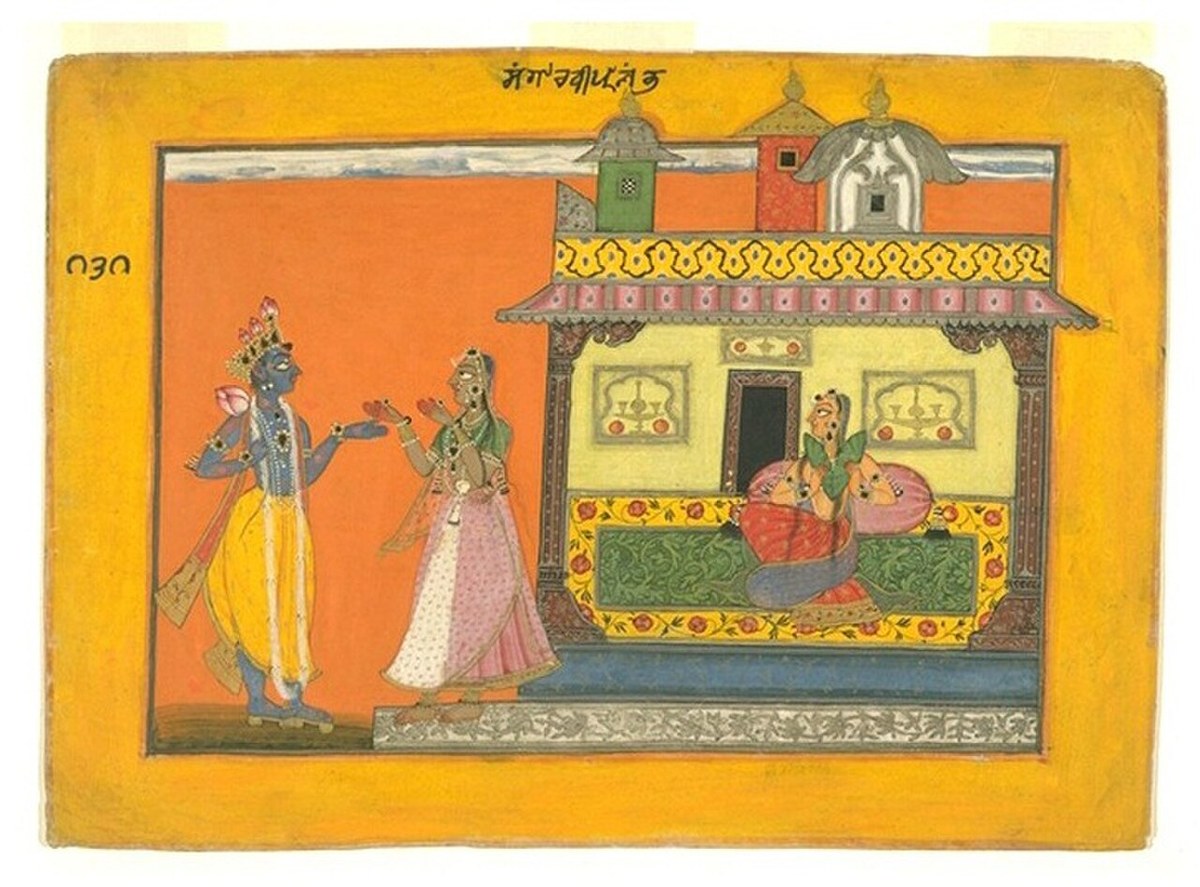
Rādhā’s iconographic representation is rich with symbolic meaning. She is traditionally depicted with a luminous golden complexion (gaura-varṇa), standing in a graceful tribhaṅga (three-bend) posture beside the dark-complexioned Kṛṣṇa. This interplay of golden and dark hues — known as gaurasundara — symbolises the complementary unity of the divine feminine and masculine, the śakti and the śaktimān.
Her primary symbols include:
- The Lotus (padma): Representing purity, spiritual awakening, and divine beauty. Like the lotus that emerges pristine from muddy waters, Rādhā’s love transcends the material world.
- The Peacock and its Feather: Symbolising beauty, grace, and her inseparable bond with Kṛṣṇa, who wears the peacock feather.
- The Flute (vaṁśī): Though primarily associated with Kṛṣṇa, the flute symbolises the call of the Divine that resonates in Rādhā’s heart, drawing her into union.
- Blue and Gold Attire: Her garments often mirror Kṛṣṇa’s colours, signifying their mutual absorption and essential unity.
Temples and Sacred Geography
Rādhā’s worship is centred in the Braj region of Uttar Pradesh, the sacred landscape associated with Kṛṣṇa’s childhood and youth.
Śrī Rādhā Rānī Temple, Barsānā: This is considered the only temple in the world where Rādhā is worshipped as the presiding deity, with Kṛṣṇa in a secondary position. Originally believed to have been established by King Vajranābha, the great-grandson of Kṛṣṇa, the icons were rediscovered by Nārāyaṇa Bhaṭṭa (a disciple of Caitanya Mahāprabhu). The present temple was built in 1675 CE by Rājā Bīr Singh Deo atop the Bhānugarh hills, a magnificent structure of red sandstone with intricate carvings, arches, and domes.
Rādhā Kuṇḍa: Located near Govardhan, this sacred tank is considered by Gauḍīya Vaishnavas to be the most holy place in the entire universe. Caitanya Mahāprabhu himself rediscovered this site in the 16th century.
Vṛndāvana: Numerous temples across Vṛndāvana honour Rādhā, including the Rādhā Vallabha Temple, the Rādhā-Ramaṇa Temple, and the grand Prēm Mandīr.
Rādhā and the Festival of Holī
The festival of Holī in the Braj region is intimately connected with the playful divine love of Rādhā and Kṛṣṇa. The most iconic celebration is Lāṭhmār Holī at Barsānā, where women of the village (representing Rādhā and her sakhīs) playfully strike men from the neighbouring village of Nandgāon (representing Kṛṣṇa and his companions) with long bamboo sticks, while the men defend themselves with leather shields.
This tradition recalls the legend of Kṛṣṇa visiting Rādhā’s village to spray colours on her and her friends, only to be playfully driven away. The celebrations begin with Laḍḍū Holī at the Rādhā Rānī Temple, where sweets are thrown instead of colours. These festivities, which attract immense crowds, embody the joyful, teasing dynamic between the divine lovers and reflect the deep cultural roots of Rādhā-Kṛṣṇa worship in the Braj region.
Conclusion
Rādhā occupies a singular position in Hindu theology and devotional life. She is at once the supreme goddess, the embodiment of divine love, the hlādinī-śakti of the Absolute, and the model for every soul that yearns for the Divine. Her journey from an unnamed gopī in the Bhāgavata Purāṇa to the central figure of multiple Vaishnava traditions testifies to the profound human need to understand the relationship between the soul and God through the language of love.
Whether understood as the eternal wife of Kṛṣṇa or as his transcendent paramour, Rādhā teaches that the highest spiritual attainment is not dry renunciation but passionate, selfless devotion — a love so complete that the lover and the beloved become inseparable. As the Gauḍīya theologians express it, Rādhā is not separate from Kṛṣṇa; she is his own heart, externalised and radiant.