Introduction
Lord Balarāma (Sanskrit: बलराम, IAST: Balarāma), also known as Baladeva, Balabhadra, Haladhara, and Halāyudha, is one of the most revered yet sometimes overlooked deities in Hindu tradition. As the elder brother and constant companion of Lord Kṛṣṇa, Balarāma occupies a singular position in Hindu mythology: he is the incarnation of Ādi Śeṣa (the primordial cosmic serpent upon whom Lord Viṣṇu reclines), the first of the four Vyūha emanations known as Saṅkarṣaṇa, and in several Vaiṣṇava lists he is counted among the Daśāvatāra (ten principal avatars of Viṣṇu). The Bhāgavata Purāṇa, the Mahābhārata, the Harivaṁśa, and the Viṣṇu Purāṇa are the chief scriptural sources for his life and deeds.
Where Kṛṣṇa is dark-complexioned and embodies divine charm (mādhurya), Balarāma is fair-skinned and embodies divine strength (bala). Where Kṛṣṇa carries the flute and the Sudarśana Cakra, Balarāma wields the plough (hala) and the mace (gadā). Together they form a complementary divine pair — grace and power, attraction and protection — who descend to earth to restore dharma and delight devotees.
Divine Identity: Śeṣa Avatāra and Saṅkarṣaṇa
Hindu theology offers two interrelated ways of understanding Balarāma’s divinity:
Incarnation of Ādi Śeṣa
The Bhāgavata Purāṇa (10.1.24) and the Viṣṇu Purāṇa (5.1) describe Balarāma as an incarnation of Śeṣa Nāga (also called Ananta Śeṣa), the thousand-headed cosmic serpent who serves as the reclining couch for Lord Viṣṇu in the cosmic ocean of milk (Kṣīrasāgara). Just as Śeṣa supports Viṣṇu in the transcendent realm, Balarāma supports Kṛṣṇa during his earthly pastimes (līlā). This identity is dramatically confirmed at the end of his life: as the Bhāgavata Purāṇa (11.30.26) narrates, a great white serpent with a thousand hoods emerged from Balarāma’s mouth during his final meditation and returned to the cosmic ocean, signifying the reabsorption of Śeṣa into his original divine form.
Saṅkarṣaṇa in the Vyūha Doctrine
In the Pāñcarātra theological system, the Supreme Godhead manifests through four Vyūha (emanation) forms: Vāsudeva, Saṅkarṣaṇa, Pradyumna, and Aniruddha. Balarāma is identified with Saṅkarṣaṇa, the first emanation from Vāsudeva (Kṛṣṇa). The name Saṅkarṣaṇa itself commemorates the miraculous “drawing away” (saṅkarṣaṇa) of the embryo from Devakī’s womb to Rohiṇī’s womb (Viṣṇu Purāṇa 5.2).
Avatar of Viṣṇu
In some Vaiṣṇava traditions, Balarāma is listed as the eighth avatar of Viṣṇu in the Daśāvatāra, with Kṛṣṇa as the ninth. Jayadeva’s celebrated Gīta Govinda (c. 12th century) includes Balarāma among the ten avatars, the poet singing: “Vahasi vapuṣi viśade vasanaṁ jaladābhaṁ / Hala-hati-bhīti-milita-yamunābham” — praising the fair-bodied wielder of the plough who diverted the course of the Yamunā. The Paripāṭal (c. 3rd–4th century CE), a Tamil Sangam text, also enumerates Balarāma as an avatar of Viṣṇu.
The Miraculous Birth
The story of Balarāma’s birth is among the most dramatic episodes in the Bhāgavata Purāṇa (10.2). The tyrant king Kaṁsa of Mathurā, terrorized by the celestial prophecy (ākāśavāṇī) that the eighth child of his sister Devakī would destroy him, imprisoned Devakī and her husband Vasudeva and murdered their first six sons at birth.
When Devakī conceived her seventh child, Lord Viṣṇu intervened through his divine creative power (Yogamāyā). The embryo was mystically transferred from Devakī’s womb to the womb of Rohiṇī, another wife of Vasudeva who was living in safety at Gokula under the protection of Nanda and Yaśodā. Devakī appeared to have miscarried, and Kaṁsa was deceived. The child was born to Rohiṇī in due time and named Rāma (later called Balarāma, “Rāma of great strength”). Because he was “drawn away” (saṅkarṣaṇa) from one womb to another, he received the epithet Saṅkarṣaṇa (Bhāgavata Purāṇa 10.2.8).
Balarāma thus has two mothers: Devakī by conception and Rohiṇī by birth. He grew up in the pastoral settlement of Gokula alongside Kṛṣṇa, raised by Nanda and Yaśodā, surrounded by cowherds (gopas) and milkmaids (gopīs), amidst the idyllic landscape of Vṛndāvana.
Childhood and Youth in Vṛndāvana
The tenth book (Daśama Skandha) of the Bhāgavata Purāṇa is replete with the joint childhood adventures of Kṛṣṇa and Balarāma. Though Kṛṣṇa is celebrated for such feats as subduing the serpent Kālīya and lifting Govardhana Hill, Balarāma has his own heroic exploits that demonstrate his immense strength and divine nature.
The Slaying of Dhenukāsura
One of Balarāma’s most celebrated feats takes place in the Tālavana (palm grove), described in the Bhāgavata Purāṇa (10.15). The cowherd boys longed to taste the ripe fruits of the palm trees, but the grove was guarded by the fearsome demon Dhenukāsura, who had assumed the form of a gigantic ass (gardabha). When Balarāma entered the grove and shook the trees to bring down the fruits, Dhenukāsura attacked, kicking him with his powerful hind legs. Unfazed, Balarāma seized the demon by his hind legs, whirled him overhead, and hurled him into the tallest palm tree with such force that the tree fell upon other trees, scattering the demon’s body. Dhenukāsura’s companions, also in the form of asses, rushed to avenge him but were all slain in the same manner. The Tālavana was thereby liberated for the cowherds and their cattle.
The Slaying of Pralambāsura
The Bhāgavata Purāṇa (10.18) recounts another episode during a game among the cowherd boys. The demon Pralambāsura disguised himself as a cowherd boy and infiltrated their group. The boys divided into two teams — one led by Kṛṣṇa, the other by Balarāma — and played a game where the losing team had to carry the winners on their backs. Pralambāsura, assigned to Balarāma’s opposing team, deliberately lost and carried Balarāma on his shoulders. But the demon then assumed his terrifying true form — an enormous, dark-bodied asura with blazing eyes — and attempted to fly away with Balarāma. Unperturbed, Balarāma struck Pralambāsura on the head with his mighty fist, and the demon crashed to the ground, dead, “like a mountain struck by the thunderbolt of Indra.”
The Diversion of the Yamunā
One of the most iconic episodes involving Balarāma is his forcible diversion of the river Yamunā. The Bhāgavata Purāṇa (10.65) narrates that during a visit to Vṛndāvana, Balarāma, intoxicated with Vāruṇī wine, wished to sport in the waters of the Yamunā. When the river did not come to him at his command, he plunged his plough into her banks and dragged her toward him, declaring: “You do not come to me though I call you; now I shall force you by my plough.” The terrified Yamunā assumed a human form and begged for mercy. Balarāma relented, but the river forever bore the marks of his plough, its course altered near the region of Vṛndāvana. This story underscores both his extraordinary power and his identification with the plough.
Iconography and Symbolism
Balarāma’s visual representation carries deep symbolic significance:
- Complexion: Fair or white (gaura), contrasting with Kṛṣṇa’s dark blue. He is sometimes depicted with a slightly bluish tinge to his garments, linking him to the waters and the serpentine realm.
- The Plough (Hala or Lāṅgala): His primary weapon and attribute. It symbolizes agriculture, fertility, and the cultivation of the earth. The epithets Haladhara (“bearer of the plough”) and Halāyudha (“he whose weapon is the plough”) directly derive from this emblem.
- The Mace (Gadā or Musala): Represents raw strength and the power to uphold dharma. Balarāma is the supreme master of mace combat (gadā-yuddha) and the teacher who trained the greatest mace fighters of the Mahābhārata era.
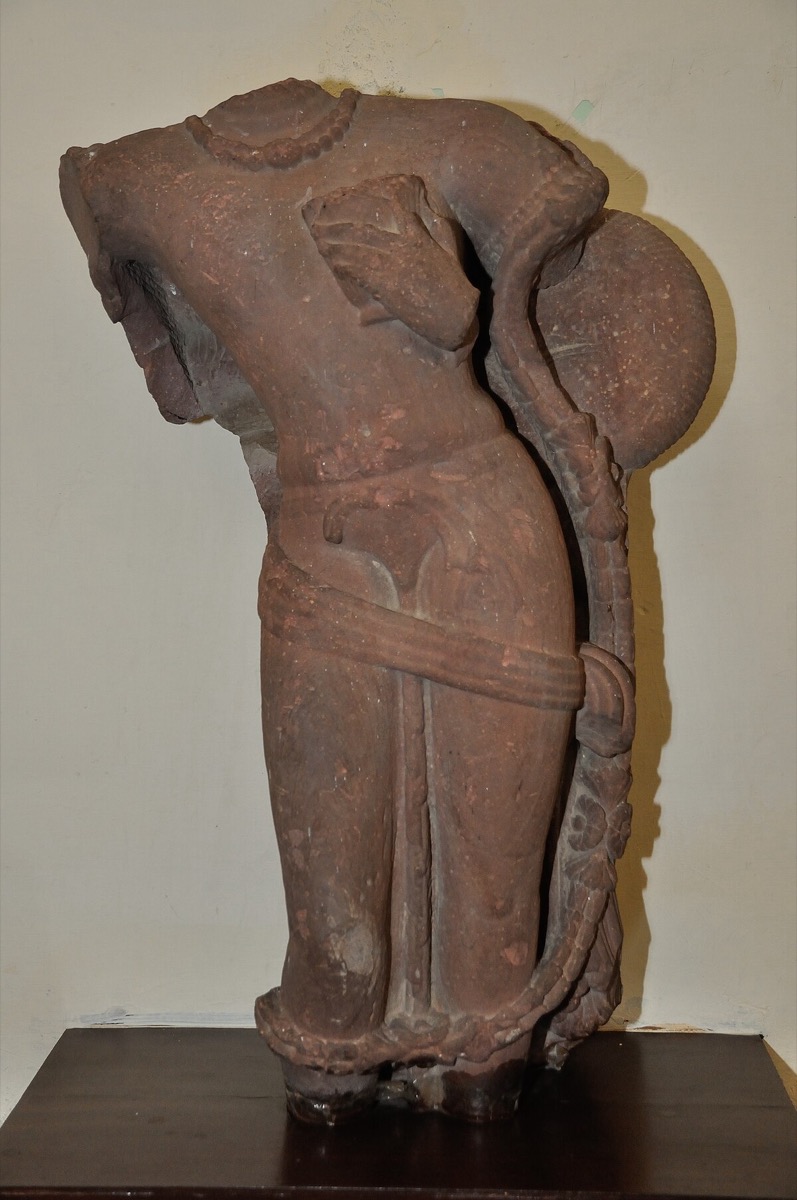
- The Serpent Canopy: Many depictions show Balarāma with a Nāga hood of multiple serpent heads behind him, visually linking him to Śeṣa Nāga. Some sculptures from the Gupta period (4th–6th century CE) and Kuṣāṇa period show him standing beneath a seven-headed serpent canopy.
- The Palm Tree (Tāla): Some iconographic traditions include a palm tree, commemorating his slaying of Dhenukāsura in the Tālavana.
- Blue or White Garments: He wears a single blue garment (nīlāmbara) and is adorned with a garland of forest flowers and a single earring (kuṇḍala). A drinking vessel (kamaṇḍalu or wine cup) sometimes appears in his images, referencing his well-known love of Vāruṇī wine.
The Complementary Pair: Balarāma and Kṛṣṇa
The relationship between Balarāma and Kṛṣṇa is one of the most theologically rich fraternal bonds in Hindu scripture. They are not merely brothers; they are two aspects of the same divine reality. The Bhāgavata Purāṇa presents them as inseparable from childhood through the great events of their adult lives — the journey to Mathurā to confront Kaṁsa, the wrestling match at Kaṁsa’s arena (where Balarāma slew the mighty wrestler Muṣṭika while Kṛṣṇa defeated Cāṇūra), the establishment of Dvārakā, and countless other episodes.
Where Kṛṣṇa embodies mādhurya (sweetness) and jñāna (wisdom), Balarāma embodies bala (strength) and sevā (service). In the Gauḍīya Vaiṣṇava theological framework, Balarāma is understood as the ādya-sevaka — the “first servant” of the Supreme — whose entire existence is oriented toward facilitating Kṛṣṇa’s divine play. This servitor-divinity duality makes Balarāma both supremely powerful and supremely devoted.
Role in the Mahābhārata
Balarāma’s role in the Mahābhārata is complex and morally nuanced, revealing him as a figure who embodies principled neutrality amidst cosmic conflict.
Teacher of Mace Combat
Both Duryodhana and Bhīma — the chief antagonist and protagonist, respectively — learned mace fighting under Balarāma. The Mahābhārata (Śalya Parva) notes that Duryodhana proved exceptionally gifted in technique and became Balarāma’s favourite student, while Bhīma excelled through sheer brute strength rather than refined skill. This created a lasting bond between Balarāma and Duryodhana.
The Pilgrimage During the War
When war between the Kauravas and Pāṇḍavas became inevitable, Balarāma faced an impossible dilemma: his brother Kṛṣṇa supported the Pāṇḍavas, but his personal affection and teacher-student bond drew him toward Duryodhana. Rather than fight against his own brother or betray his student, Balarāma chose to go on a pilgrimage (tīrtha-yātrā) for the entire duration of the eighteen-day war. He visited sacred sites along the Sarasvatī River and performed rituals at numerous holy places, returning only for the final duel.
The Bhīma–Duryodhana Duel
Balarāma returned from his pilgrimage precisely in time to witness the decisive mace duel between Bhīma and Duryodhana on the eighteenth day. When Bhīma struck Duryodhana below the waist — a foul blow forbidden in the rules of mace combat — Balarāma was furious. He raised his plough to attack Bhīma for violating the rules he himself had taught them, and only Kṛṣṇa’s intervention calmed him. This episode poignantly illustrates Balarāma’s unwavering commitment to dharma as he understood it, even when it conflicted with the larger divine plan that Kṛṣṇa was orchestrating.
Marriage to Revatī
The Bhāgavata Purāṇa (9.3.29–36) and the Viṣṇu Purāṇa narrate the remarkable story of Balarāma’s marriage. Revatī, daughter of King Kakudmī (Revata) of Kuśasthalī, was taken by her father to Brahmā’s abode (Brahmaloka) to seek advice on a suitable husband. When they returned to earth, ages had passed due to the difference in the flow of time between the celestial and earthly realms. Brahmā recommended Balarāma as the ideal husband for Revatī. When Kakudmī presented his daughter to Balarāma, she was exceedingly tall due to her ancient origins; Balarāma pressed the tip of his plough on her shoulder, reducing her to a normal stature. They were then wed, and Revatī became his devoted consort. Their sons were Niśatha and Ulmuka.
Balarāma and Jagannāth Purī
One of the most prominent living traditions of Balarāma worship is centred in Purī, Odisha, where he is venerated as Balabhadra, the eldest of the divine triad alongside Jagannāth (Kṛṣṇa) and Subhadrā (their sister). The three wooden deities of the Jagannāth Temple — with their distinctive large eyes, truncated limbs, and vibrant colours — are among the most recognizable sacred images in Hinduism.
In the Jagannāth tradition, Balabhadra is depicted with a white face, representing strength, agriculture, and wisdom. During the annual Ratha Yātrā (Chariot Festival), one of the grandest religious processions in the world, each deity rides a separate chariot. Balabhadra’s chariot is called Tāladhvaja (whose flag bears the palm tree emblem), another link to his slaying of Dhenukāsura. The Ratha Yātrā draws millions of devotees to Purī and has been celebrated continuously for centuries.
The Jagannāth tradition also preserves the unique Nabakalēbara ritual, performed roughly every twelve to nineteen years, in which the wooden bodies of all three deities are ceremonially replaced with new ones carved from sacred neem trees (dāru).
Worship and Temples
Dauji Temple, Baldeo (Mathura)
The most important temple exclusively dedicated to Balarāma is the Dauji Maharaj Temple in Baldeo, approximately 21 km from Mathura in Uttar Pradesh. The name “Dauji” (dāūjī) is the Braj Bhāṣā term for “elder brother.” The temple, originally believed to have been established by Vajranābha (Kṛṣṇa’s great-grandson), was rebuilt in 1535 CE by Raja Mahendra Singh and restored later by Goswami Gokulnāthji. It houses a magnificent 6.5-foot black stone idol of Balarāma alongside his consort Revatī. The temple is famous for the Hurāṅgā festival, celebrated the day after Holi, in which women playfully beat men with sticks and torn clothes — a unique Braj tradition honouring Balarāma’s playful spirit.
Other Important Centres of Worship
- Ananta Padmanābhaswāmy Temple, Thiruvananthapuram: While primarily dedicated to Viṣṇu reclining on Śeṣa, this temple venerates the serpent form associated with Balarāma.
- ISKCON Temples Worldwide: The Kṛṣṇa-Balarāma Mandir in Vṛndāvana, established by Śrīla Prabhupāda in 1975, is one of ISKCON’s most important temples and places Balarāma alongside Kṛṣṇa as a co-equal object of worship.
- Jagannāth Temples: All Jagannāth temples across India — from Purī to Koraput to Ahmedabad — worship Balarāma as Balabhadra within the sacred triad.
Balarāma Jayantī
Balarāma Jayantī (also called Baladeva Ṣaṣṭhī or Haldā Ṣaṣṭhī) falls on the sixth day (ṣaṣṭhī) of the bright half of the month of Bhādrapada (August–September), six days before Kṛṣṇa Janmāṣṭamī. Devotees observe fasts, perform special pūjā, and chant hymns praising his strength and protective nature.
The Agricultural Deity
Balarāma’s deep association with agriculture sets him apart from other Hindu deities. His primary weapon — the plough — is the most fundamental tool of farming. His epithet Haladhara (“plough-bearer”) is not merely a warrior title; it reflects his role as the patron and protector of farmers and agricultural life.
In Vedic and Purāṇic cosmology, the plough symbolizes the cultivation of the earth for sustenance — the act that sustains human civilization. Balarāma’s other epithet, Saṁvartaka (“he who turns the soil”), reinforces this. His story of diverting the Yamunā with his plough can be read as a myth of irrigation — the harnessing of rivers for agricultural purposes. His association with Vāruṇī (wine, which is produced from grapes and other cultivated crops) further connects him to the fruits of agriculture.
Scholars such as D.D. Kosambi have suggested that Balarāma may represent an ancient agricultural deity who was absorbed into the Vaiṣṇava pantheon. Archaeological evidence from the Kuṣāṇa period (1st–3rd century CE) shows Balarāma-Saṅkarṣaṇa iconography that predates much of the classical Kṛṣṇa imagery, suggesting that Balarāma worship may have been independently significant before being integrated into the Kṛṣṇa narrative.
Balarāma in Gauḍīya Vaiṣṇavism
In the Gauḍīya Vaiṣṇava tradition founded by Śrī Caitanya Mahāprabhu (1486–1534), Balarāma holds a position of supreme theological importance. He is understood as the Mūla-Saṅkarṣaṇa — the original source from whom all other expansions of the divine emanate. Lord Nityānanda (c. 1474–c. 1540), the closest companion of Caitanya Mahāprabhu, is regarded as the incarnation of Balarāma in the age of Kali. Just as Balarāma served Kṛṣṇa in Dvāpara Yuga, Nityānanda served Caitanya — distributing the mercy of the Holy Name (nāma-saṅkīrtana) with boundless compassion.
The Gauḍīya theological text Caitanya-caritāmṛta (Ādi 5) by Kṛṣṇadāsa Kavirāja elaborates that Balarāma expands as the dhāma (divine abode), the āsana (divine seat), the parikaras (divine associates), and every element that facilitates Kṛṣṇa’s pastimes. In this understanding, Balarāma is not subordinate to Kṛṣṇa but rather the foundational support of all divine reality — much as Śeṣa supports the entire cosmos.
The Departure
The Bhāgavata Purāṇa (11.30) narrates Balarāma’s departure from the mortal world in deeply symbolic terms. After the tragic self-destruction of the Yādava clan at Prabhāsa, Balarāma withdrew to the banks of the ocean and sat in deep yogic meditation. From his mouth issued a magnificent white serpent (śveta-sarpa) with a thousand hoods and red eyes — his original form as Ādi Śeṣa. The serpent glided toward the ocean, welcomed by celestial serpents, sacred rivers, and the ocean god himself. Thus Balarāma returned to his eternal nature, his earthly mission complete.
Conclusion
Lord Balarāma is far more than “Kṛṣṇa’s elder brother.” He is the cosmic foundation — the serpent who supports Viṣṇu, the first emanation of the Godhead, the divine ploughman who cultivates the earth and sustains life. His strength is not mere physical power but the strength of dharma, service, and devotion. From the pastoral meadows of Vṛndāvana to the grand chariots of Purī, from the wrestling arenas of Mathurā to the philosophical heights of Gauḍīya theology, Balarāma endures as a figure of profound spiritual significance — the gentle giant who carries a farmer’s plough and bears the weight of the universe.