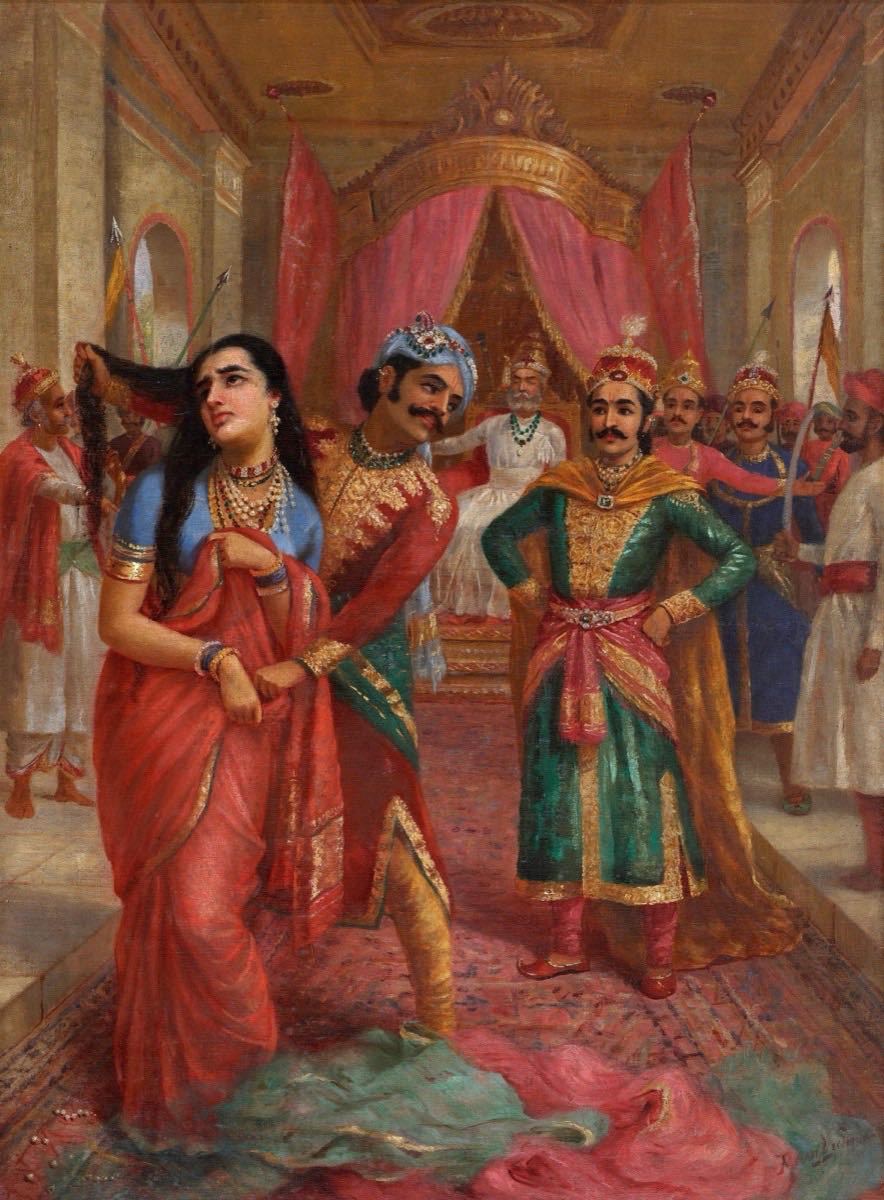
Draupadī (द्रौपदी), also known as Pāñcālī (पाञ्चाली, “Princess of Pāñcāla”), Kṛṣṇā (कृष्णा, “the Dark-complexioned One”), and Yājñasenī (याज्ञसेनी, “Daughter of Yajña”), is one of the most remarkable and complex figures in the entire Hindu literary tradition. As the wife of the five Pāṇḍava brothers and the central female protagonist of the Mahābhārata, Draupadī embodies courage, devotion, intelligence, and an unyielding commitment to dharma and justice. Her life story — from miraculous birth to unimaginable humiliation, from long exile to the triumph of righteousness — forms the emotional and moral heart of the epic.
Birth from the Sacred Fire
Draupadī’s birth is no ordinary event. According to the Ādi Parva of the Mahābhārata, her father King Drupada of Pāñcāla performed a great fire sacrifice (yajña) conducted by the sages Yāja and Upayāja. Drupada’s primary motive was to obtain a son powerful enough to defeat Droṇācārya, who had humiliated him by seizing half his kingdom. From the sacrificial fire first emerged Dhṛṣṭadyumna, a fully armoured warrior destined to slay Droṇa. Immediately after, a beautiful young woman arose from the same flames — dark-complexioned, with lotus-petal eyes and hair that shone like polished copper. A divine voice declared: “This dark-complexioned girl shall be the foremost among women and shall be the cause of the destruction of the Kṣatriyas” (Ādi Parva, Section 169).
She was named Kṛṣṇā for her dark beauty and Draupadī as the daughter of Drupada. The celestial prophecy at her birth foreshadowed her pivotal role in the events that would lead to the cataclysmic Kurukṣetra war.
The Svayaṃvara
King Drupada arranged a magnificent svayaṃvara (self-choice ceremony) for Draupadī, setting a formidable test: the suitor must string a massive steel bow and, using its reflection in water below, shoot five arrows through the eye of a revolving golden fish mounted on a pole high above. Kings and warriors from across Bhārata assembled, but one after another failed even to string the bow.
Karṇa, the great archer, rose to attempt the challenge, but according to the most widely known tradition, Draupadī refused him, declaring she would not wed the son of a charioteer (sūta-putra) — a moment that has been debated extensively by scholars and storytellers. The five Pāṇḍava brothers, disguised as Brāhmaṇas after escaping the house of lac (lākṣāgṛha), were present in the assembly. Arjuna stepped forward and accomplished the impossible feat with seemingly effortless ease, winning Draupadī’s hand (Ādi Parva, Sections 185–190).
Marriage to the Five Pāṇḍavas
The most extraordinary aspect of Draupadī’s story is her marriage to all five Pāṇḍava brothers — Yudhiṣṭhira, Bhīma, Arjuna, Nakula, and Sahadeva. When Arjuna returned with Draupadī to their dwelling, he called out to his mother Kuntī, “Mother, see what I have brought!” Without looking, Kuntī replied, “Share it equally among yourselves, my sons.” A mother’s word, once spoken, could not be retracted.
This arrangement was sanctioned by the sage Vyāsa himself, who revealed that Draupadī was an incarnation of Śrī (Goddess Lakṣmī) and had, in a previous life, prayed to Lord Śiva for a husband with five ideal qualities. Śiva granted her wish, but since no single man possessed all five, she was destined to marry five brothers (Ādi Parva, Section 198). The marriage was also accepted by King Drupada after Vyāsa’s counsel and became a foundational institution within the Mahābhārata narrative. Draupadī maintained an arrangement where she lived with each husband for one year in rotation, preserving the dignity and harmony of the household.
Queen of Indraprastha
After their marriage, the Pāṇḍavas received the barren territory of Khāṇḍavaprastha, which they transformed into the magnificent city of Indraprastha with the help of the divine architect Maya Dānava. Draupadī reigned as queen of this splendid court. The Sabhā Parva describes how she managed the vast royal household with intelligence and grace, earning the admiration of all who visited.
Maya Dānava constructed the famed Palace of Illusions (Mayasabhā), with floors that appeared as water and pools that appeared as solid ground. When Duryodhana visited Indraprastha, he fell into a pool mistaking it for solid floor, and Draupadī — according to some versions of the text — laughed at his discomfiture. This humiliation festered in Duryodhana’s mind and became one of the driving motives behind his terrible vengeance.
The Game of Dice and the Vastrāharaṇa
The most harrowing episode in Draupadī’s life — and arguably the moral turning point of the entire Mahābhārata — is the dyūta (game of dice) described in the Sabhā Parva. Driven by jealousy and guided by his cunning uncle Śakuni, Duryodhana invited Yudhiṣṭhira to a game of dice. Bound by kṣatriya honour to accept a challenge, Yudhiṣṭhira played against Śakuni and, through the latter’s loaded dice, lost everything — his wealth, his kingdom, his brothers, himself, and finally, Draupadī.
When Duryodhana sent the messenger Prātikami to summon Draupadī to the assembly hall, she posed a profound legal and dharmic question: “If my husband had already lost himself before staking me, he was no longer a free man. How then could he stake what he did not possess?” This question — known as Draupadī’s Praśna — echoed through the hall, and not even Bhīṣma, the patriarch of the Kuru dynasty, could provide a definitive answer. He acknowledged: “The course of dharma is subtle” (dharmasya tattvam sūkṣmam, Sabhā Parva 68.9).
Duḥśāsana then dragged Draupadī by her hair into the packed assembly. In her most vulnerable moment, with her husbands bound by their gambling losses and the elders of the court paralysed by complicity, Duryodhana ordered Duḥśāsana to strip Draupadī of her garments — the infamous Vastrāharaṇa (disrobing). Draupadī, abandoned by all human protectors, raised her arms and called upon Lord Kṛṣṇa. In response to her faith, Kṛṣṇa performed a divine miracle: as Duḥśāsana pulled at her sari, an endless stream of cloth appeared, and he collapsed from exhaustion without succeeding. This episode is one of the most powerful depictions of divine grace in all of Hindu literature.
In her anguish, Draupadī uttered terrible vows: she would not tie her hair until it was washed with Duḥśāsana’s blood, and the Pāṇḍavas would avenge her honour. These vows became an unstoppable force propelling the narrative toward the Kurukṣetra war.
The Thirteen Years of Exile
Following the second game of dice, the Pāṇḍavas were condemned to twelve years of forest exile and a thirteenth year of incognito living (ajñātavāsa). Draupadī accompanied her husbands into the wilderness without hesitation, abandoning the luxuries of queenship for the hardships of forest life.
The Vana Parva (Book of the Forest) reveals Draupadī’s intellectual depth and moral clarity. In her famous dialogue with Yudhiṣṭhira, she challenged his passive acceptance of suffering and his philosophy of patience. She argued passionately that dharma without action is impotent and that a king who tolerates injustice fails in his sacred duty. “A man who is too forgiving is despised,” she declared, “the world belongs to those who act” (Vana Parva 31.1–36). This dialogue is one of the great philosophical debates of the Mahābhārata, with Draupadī representing the imperative of righteous action (kṣātra-dharma) against Yudhiṣṭhira’s preference for forbearance and non-violence.
During the year of incognito exile, Draupadī served as Sairandhrī (a hairdresser/attendant) in the court of King Virāṭa. Even in this disguise, her beauty attracted the unwanted attention of Kīcaka, the powerful commander-in-chief of Virāṭa’s army. When Kīcaka assaulted her and dragged her before the court, Draupadī once again found herself humiliated in public — a parallel to the dice-game episode. She arranged for Bhīma to slay Kīcaka, demonstrating her resourcefulness and her refusal to accept injustice silently.
Draupadī’s Role in Triggering the War
Draupadī was the single most powerful catalyst for the Kurukṣetra war. Her unresolved humiliation, her unfulfilled vows, and her relentless demand for justice made peace between the Pāṇḍavas and Kauravas impossible. When Lord Kṛṣṇa went as a peace emissary to Hastināpura, Draupadī reminded him of every wrong she had suffered and declared that she desired war, not peace. Her loose, unbound hair was a visible, daily reminder to the Pāṇḍavas of their oath.
On the battlefield, Bhīma fulfilled her vows: he slew Duḥśāsana and, as promised, brought his blood to wash Draupadī’s hair. He also killed Duryodhana by breaking his thigh — a reference to the infamous moment when Duryodhana had gestured for Draupadī to sit on his thigh in the dice-game assembly. After the war’s conclusion, Draupadī finally tied her hair, signalling that justice had been served after thirteen years.
The Bond with Lord Kṛṣṇa
The relationship between Draupadī and Lord Kṛṣṇa is one of the most profound bonds in Hindu scripture. Kṛṣṇa addressed Draupadī as sakhī (dear friend) and she regarded him as her protector, brother, and divine refuge. Their relationship transcended worldly categories — it was rooted in complete faith and spiritual surrender.
When Draupadī called upon Kṛṣṇa during the Vastrāharaṇa, she initially tried to hold her sari with her own hands. Only when she released her grip entirely and raised both hands in surrender to Kṛṣṇa did the divine miracle occur. This moment is interpreted by Vaiṣṇava commentators as a profound teaching: true divine grace flows only when the ego completely surrenders, when one lets go of all self-effort and relies wholly on God.
Kṛṣṇa also consoled Draupadī during her darkest moments in exile, assuring her that dharma would ultimately prevail and her suffering would not go unanswered. The Bhagavad Gītā promise — paritrāṇāya sādhūnāṃ vināśāya ca duṣkṛtām (“For the protection of the righteous and the destruction of the wicked,” 4.8) — finds its most vivid fulfilment in Kṛṣṇa’s relationship with Draupadī.
Worship and Legacy
Draupadī Amman Temples
In Tamil Nadu and parts of South India, Draupadī is worshipped as a goddess under the name Draupadī Amman. There are over 400 Draupadī Amman temples across Tamil Nadu, with major temples in Dharmaraja Koyil (Gingee) and Pondicherry. The annual Draupadī Amman festival (Paṭukalam) involves elaborate rituals including firewalking (tīmiti), in which devotees walk across burning coals to honour Draupadī’s purity and her trial by fire. The firewalking ceremony re-enacts Draupadī’s agni-parikṣā (ordeal by fire) and is one of the most dramatic folk religious practices in South India.
In these temples, Draupadī is venerated as a form of Śakti — a powerful, chaste, and righteous woman who endured terrible suffering yet never compromised her dharma. The Tamil Mahābhārata tradition, including the Villiputtūr Āḻvār’s Pārata Veṇpā (14th century) and the folk epic Terukkūttu (street drama), places Draupadī at the very centre of the narrative, elevating her even above the Pāṇḍavas in devotional significance.
Symbol of Feminine Strength
Across India, Draupadī has become a powerful symbol of feminine courage, resistance to injustice, and the demand for dignity. Modern feminist readings of the Mahābhārata — including Chitra Banerjee Divakaruni’s The Palace of Illusions (2008) and Pratibha Ray’s Odia novel Yajñasenī (1984, Jnanpith Award) — have reimagined Draupadī’s story from her own perspective, giving voice to her inner experiences and reclaiming her agency.
Names and Epithets
Draupadī is known by many names, each illuminating a different facet of her identity:
- Draupadī — Daughter of Drupada
- Pāñcālī — Princess of Pāñcāla
- Kṛṣṇā — The Dark-complexioned One (sharing the name with Lord Kṛṣṇa)
- Yājñasenī — Daughter of Yajñasena (another name for Drupada)
- Sairandhrī — Her disguise name during the year of incognito exile
- Nityayuvatī — The Eternally Young (a divine epithet)
- Mahābhāratī — The Great One of Bhārata
- Pārṣatī — Granddaughter of Pṛṣata
For millions of Hindus, Draupadī is far more than a character in an epic. She is a living embodiment of the truth that dharma, though it may be tested by the cruelest adversities, ultimately triumphs. Her story teaches that righteous anger against injustice is itself a form of dharma, that suffering borne with dignity becomes a force for cosmic correction, and that divine grace answers the call of those who surrender in absolute faith. As the sage Vyāsa writes, “Where there is dharma, there is Kṛṣṇa; where there is Kṛṣṇa, there is victory” — and it was Draupadī, more than any other figure, who ensured that dharma’s voice was never silenced.