Introduction
Abhimanyu (IAST: Abhimanyu; Sanskrit: अभिमन्यु, meaning “fearless” or “one whose wrath is heroic”) is one of the most beloved and tragic figures of the Mahābhārata, the great Indian epic attributed to the sage Vyāsa. The son of Arjuna — the peerless archer and third Pāṇḍava — and Subhadrā — the sister of Lord Kṛṣṇa — Abhimanyu inherited the martial genius of both the Pāṇḍava and Yādava lineages. Though he fell in battle at the age of sixteen, his courage, skill, and sacrifice have made him an enduring symbol of youthful heroism and the devastating cost of adharmic warfare (Britannica, “Abhimanyu”).
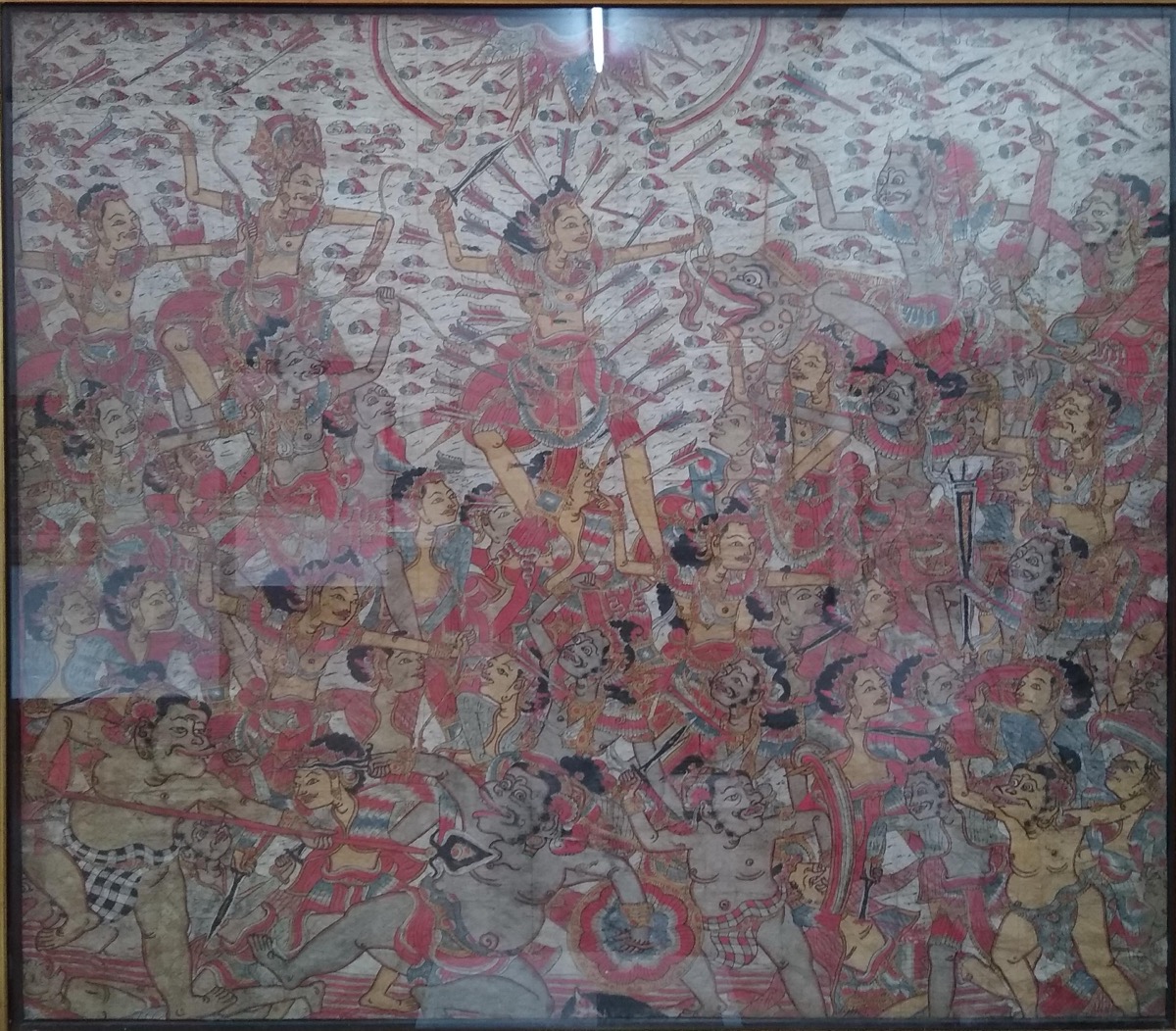
The story of Abhimanyu is inseparable from the Cakravyūha (Sanskrit: चक्रव्यूह, “wheel formation” or “discus array”) — the labyrinthine military formation into which he charged on the fateful thirteenth day of the Kurukṣetra war, knowing how to penetrate its spiralling walls but not how to exit them. His entrapment and killing by multiple warriors acting in concert — a violation of the sacred rules of single combat — remains one of the most emotionally powerful episodes in all of Sanskrit literature.
Birth and Divine Lineage
Abhimanyu was born to Arjuna during the latter’s period of exile, when the Pāṇḍava prince travelled to Dvārakā, the island-city of the Yādavas. There, Arjuna fell in love with Subhadrā, the younger sister of Kṛṣṇa and Balarāma. With Kṛṣṇa’s encouragement, Arjuna eloped with Subhadrā in a chariot — a union that Balarāma eventually blessed (Mahābhārata, Ādi Parva, Chapters 218–221).
Through his father Arjuna, Abhimanyu was the grandson of Indra, king of the gods, and through his mother Subhadrā, he was the nephew of Lord Kṛṣṇa himself — the Supreme Being incarnate according to the Vaiṣṇava tradition. This extraordinary dual heritage endowed him with divine valour, celestial beauty, and a warrior’s instinct that manifested even before birth. The Mahābhārata describes him as possessing the combined qualities of the five Pāṇḍavas: the righteousness of Yudhiṣṭhira, the strength of Bhīma, the archery of Arjuna, and the beauty and grace of the twins Nakula and Sahadeva (Mahābhārata, Virāṭa Parva).
Learning the Cakravyūha in the Womb
One of the most remarkable episodes connected with Abhimanyu concerns his acquisition of military knowledge while still in his mother’s womb. According to the Mahābhārata, Arjuna once described to Subhadrā the intricate technique of penetrating the Cakravyūha — a rotating, multi-layered military formation considered nearly impregnable. The unborn Abhimanyu, resting in Subhadrā’s womb, listened attentively and absorbed every detail of how to breach each successive ring of the formation.
However, as Arjuna explained the method of entering layer after layer, Subhadrā fell asleep. Arjuna, noticing her drowsiness, stopped his explanation. Thus the child in the womb learned the art of entering the Cakravyūha but never heard how to exit it (Mahābhārata, commentarial tradition; Virāṭa Parva context). This incomplete knowledge — so tantalisingly close to completeness — became the defining tragedy of Abhimanyu’s short life. The episode is also cited as evidence of the ancient Indian belief in garbha-saṃskāra — the idea that a child’s education begins in the womb, a concept elaborated in Āyurvedic and Dharmaśāstra texts.
Youth in Dvārakā and Training
While the five Pāṇḍava brothers endured their thirteen years of exile and incognito living, the young Abhimanyu was raised in Dvārakā under the loving care of his maternal uncles Kṛṣṇa and Balarāma. There he received rigorous military training alongside his cousin Pradyumna (Kṛṣṇa’s son) and other Yādava warriors. Balarāma, the supreme master of the mace (gadā), personally instructed Abhimanyu in close combat, while the Yādava military tradition — renowned throughout Bhārata for its sophistication — shaped him into a formidable all-round warrior.
By the time of his first battlefield appearance, Abhimanyu was already recognized as a mahāratha — a warrior capable of fighting ten thousand soldiers simultaneously. Despite his youth, the Mahābhārata consistently places him among the foremost champions of the Pāṇḍava army, equal or superior to veterans many times his age.
Marriage to Uttarā
During the Pāṇḍavas’ year of incognito exile at the court of King Virāṭa of the Matsya kingdom, Arjuna (disguised as the eunuch dance-teacher Bṛhannalā) taught music and dance to the princess Uttarā. When Arjuna’s true identity was revealed after the repulsion of a Kaurava cattle-raid, Virāṭa offered Uttarā in marriage to Arjuna himself. Arjuna graciously declined — having been her teacher, he regarded her as a daughter — and instead proposed the union of Uttarā with his son Abhimanyu (Mahābhārata, Virāṭa Parva, Chapters 67–72).
The wedding of Abhimanyu and Uttarā was celebrated with great splendour, attended by Kṛṣṇa, all the Pāṇḍavas, and the assembled allies of both the Yādava and Matsya kingdoms. This marriage was not merely a personal alliance but a crucial political bond that united the Pāṇḍava cause with King Virāṭa’s resources on the eve of the Kurukṣetra war. Most significantly, it was through this union that the Kuru dynasty would survive the apocalyptic war — for Uttarā was already carrying Abhimanyu’s child when the young warrior rode into the Cakravyūha.
The Thirteenth Day of Kurukṣetra
The first twelve days of the great war had been devastating for both sides. On the thirteenth day, Droṇācārya — the Kaurava commander-in-chief after Bhīṣma’s fall — devised a strategy to capture Yudhiṣṭhira alive. He arranged the Kaurava army in the dreaded Cakravyūha, a rotating, concentric formation whose successive rings were guarded by the mightiest warriors: Droṇa himself, Karṇa, Aśvatthāmā, Kṛpa, Kṛtavarmā, Śalya, Duryodhana, Duḥśāsana, Bhūriśravā, and — most crucially — Jayadratha, the king of Sindhu (Mahābhārata, Droṇa Parva, Chapter 3).
To neutralize the one warrior who could break the formation — Arjuna — Droṇa arranged for the Saṃśaptakas (sworn warriors led by Suśarmā of Trigartta) to challenge Arjuna to a duel on a distant part of the battlefield, drawing him far from the main engagement. With Arjuna absent, the Pāṇḍava army faced an impossible situation: no one among them knew how to penetrate the Cakravyūha.
It was then that the sixteen-year-old Abhimanyu stepped forward. He confessed to Yudhiṣṭhira: “I know how to enter the Cakravyūha, for my father taught the method while I was in my mother’s womb. But I do not know how to come out of it.” Yudhiṣṭhira assured him that Bhīma, Sātyaki, and other warriors would follow close behind, protecting his rear and ensuring his safe exit (Mahābhārata, Droṇa Parva).
Breaking into the Formation
Abhimanyu mounted his chariot and charged into the Cakravyūha with breathtaking audacity. The Mahābhārata devotes extensive passages to describing the devastation he wrought upon the Kaurava ranks. He shattered the first ring of defenders, then the second, then the third — fighting with bow, sword, mace, and bare hands as occasion demanded. The epic compares him to a young lion entering a herd of elephants, to a fire consuming a dry forest, and to a miniature sun blazing amidst the Kaurava hosts (Mahābhārata, Droṇa Parva, Chapters 32–40).
Among his extraordinary feats on that day, Abhimanyu slew Lakṣmaṇa (Duryodhana’s son), routed the divisions of several Kaurava allies, and even forced Droṇa, Karṇa, and Aśvatthāmā to retreat momentarily — a feat that astonished the entire battlefield. Droṇa himself acknowledged: “This boy fights as his father Arjuna does. I see no difference between them.”
Jayadratha’s Role and the Sealing of the Formation
The plan had been for Bhīma, Sātyaki, Dhṛṣṭadyumna, and others to enter the Cakravyūha immediately behind Abhimanyu, widening the breach and supporting him from the rear. However, Jayadratha, the king of Sindhu — who had been granted a boon by Lord Śiva that he could, on a single day, hold back all the Pāṇḍavas except Arjuna — stationed himself at the breach and used this divine power to prevent any Pāṇḍava warrior from following Abhimanyu inside. Bhīma, Sātyaki, and Dhṛṣṭadyumna hurled themselves against Jayadratha’s position repeatedly, but the Sindhu king, empowered by Śiva’s boon, held the gate shut (Mahābhārata, Droṇa Parva).
Abhimanyu was now alone inside the formation — a single warrior surrounded by the combined might of the Kaurava army.
The Adharmic Killing
What followed was among the most grievous violations of dharma-yuddha (the righteous rules of warfare) in the entire Mahābhārata. Rather than engaging Abhimanyu in honourable single combat, the Kaurava commanders — acting on Droṇa’s tactical orders — attacked him simultaneously from all sides, a practice explicitly forbidden by the codes of kṣatriya warfare.
Six mahārathas coordinated their assault. While Abhimanyu fought one warrior, others struck from behind:
- Karṇa severed his bowstring and destroyed his bow from behind.
- Kṛpa killed his charioteer and horses.
- Aśvatthāmā and Kṛtavarmā shattered his chariot wheels and protective armour.
- Droṇa directed the overall strategy of attrition.
- Śalya, Duḥśāsana, and others rained arrows upon him ceaselessly.
Stripped of his chariot, bow, and armour, Abhimanyu fought on with a sword, then a chariot wheel he wrenched from the ground, and finally his bare fists. The Mahābhārata describes this as one of the most awe-inspiring displays of raw courage in the entire epic. Even the gods in heaven were said to have wept at the sight.
Finally, Duḥśāsana’s son (Duḥśāsana-putra) struck the exhausted and unarmed Abhimanyu on the head with a mace, killing him. The young hero fell like a great tree uprooted by a storm (Mahābhārata, Droṇa Parva, Chapters 46–48). His death — achieved not through valour but through coordinated treachery against a solitary, disarmed youth — was universally condemned as adharmic, even by warriors on the Kaurava side.
Arjuna’s Vow to Kill Jayadratha
When Arjuna returned from his diversionary battle against the Saṃśaptakas and learned of his son’s death, his grief was oceanic. The Mahābhārata describes Arjuna collapsing in anguish, weeping inconsolably while Kṛṣṇa stood by his side. But grief swiftly transformed into blazing wrath.
Arjuna took a terrible vow: “Before the sun sets tomorrow, I shall slay Jayadratha, who sealed the Cakravyūha and prevented my son’s rescue. If I fail, I shall enter the fire myself.” This oath — broadcast across the battlefield — sent shockwaves through the Kaurava camp. Droṇa arranged the entire Kaurava army to protect Jayadratha on the fourteenth day, but Arjuna, with Kṛṣṇa as his charioteer, fought his way through every obstacle (Mahābhārata, Droṇa Parva, Chapters 56–146).
As sunset approached and Jayadratha remained alive, Kṛṣṇa used his divine power to create the illusion of darkness (or, in some recensions, caused a momentary solar eclipse), causing the Kaurava army to relax their guard. In that instant, Kṛṣṇa revealed the sun still shining, and Arjuna released a celestial arrow that severed Jayadratha’s head. Crucially, Kṛṣṇa had warned Arjuna that Jayadratha’s father had blessed his son with the curse that whoever caused Jayadratha’s head to fall to the ground would have his own head shatter. Therefore, Arjuna’s arrow carried Jayadratha’s head through the air and deposited it in the lap of his meditating father — whose head then burst when he stood up and the head fell (Mahābhārata, Droṇa Parva).
Parīkṣit: The Posthumous Heir
Abhimanyu’s young wife Uttarā was pregnant at the time of his death. After the cataclysmic eighteen-day war, which claimed the lives of nearly all the warriors on both sides, Uttarā gave birth to a stillborn child — the infant having been killed in the womb by the brahmāstra (supreme weapon) launched by Aśvatthāmā against the Pāṇḍava camp in a final act of vengeance. However, Lord Kṛṣṇa himself restored the child to life, declaring: “This child shall be called Parīkṣit (‘the tested one’), for he was tested by death itself and survived” (Mahābhārata, Āśvamedhika Parva; Bhāgavata Purāṇa 1.12).
Parīkṣit grew to become the emperor of Hastinapura, the sole surviving heir of the Kuru dynasty after the Pāṇḍavas’ departure for heaven. His son Janamejaya performed the great Sarpa Satra (serpent sacrifice), during which the sage Vaiśampāyana recited the entire Mahābhārata — the very epic in which his grandfather Abhimanyu’s story is told. Thus, Abhimanyu’s lineage became the vehicle through which the Mahābhārata itself was transmitted to future generations, creating a profound narrative recursion.
Symbolism of Incomplete Knowledge
Abhimanyu’s story carries deep philosophical resonance far beyond its immediate narrative context. His incomplete knowledge of the Cakravyūha — knowing how to enter but not how to exit — has become a powerful metaphor in Indian thought for:
- The danger of partial knowledge: In the Īśa Upaniṣad (verse 9), it is said that greater darkness awaits those who possess incomplete knowledge than those who are wholly ignorant. Abhimanyu’s fate dramatically illustrates this principle.
- The courage to act despite uncertainty: Abhimanyu knew he could not exit the formation, yet he chose to enter it for the sake of duty (dharma) and family. His decision embodies the Gītā’s teaching of niṣkāma karma — selfless action without attachment to results (Bhagavad Gītā 2.47).
- The irreversibility of certain choices: The Cakravyūha becomes a metaphor for situations in life where one can enter a path but cannot return — commitments, consequences, and the passage of time itself.
In contemporary Indian usage, the phrase “trapped in a Cakravyūha” has become an idiom for being caught in an inescapable situation, a testament to the enduring power of Abhimanyu’s story.
The Tragic Hero Archetype
Abhimanyu stands as perhaps the purest example of the tragic hero in Indian epic literature. Unlike the Western Aristotelian model, where the hero falls due to a personal flaw (hamartia), Abhimanyu’s tragedy arises not from any moral failing but from the failure of dharma itself — the violation of sacred rules by warriors who should have upheld them.
His youth amplifies the tragedy: a sixteen-year-old facing alone the greatest warriors of the age, stripped of weapons one by one, yet fighting to his last breath. The Mahābhārata presents his death as the moment when the Kurukṣetra war crossed an irrevocable threshold — after the adharmic killing of Abhimanyu, all remaining restraints dissolved, leading to the successive deaths of Jayadratha, Droṇa, Karṇa, Duryodhana, and the final nocturnal massacre by Aśvatthāmā.
Artistic Depictions and Cultural Legacy
Abhimanyu’s story has inspired centuries of artistic expression across South and Southeast Asia:
- Miniature paintings: Mughal, Rajasthani, and Pahāṛī miniature traditions frequently depict Abhimanyu’s entry into the Cakravyūha, often showing the concentric rings of warriors surrounding the young hero. The Razmnāma (the Persian translation of the Mahābhārata commissioned by Emperor Akbar) contains several celebrated illustrations of this episode.
- Temple reliefs: The Hoysaḷeśvara temple at Halebīḍu (12th century) features intricate stone carvings of the Cakravyūha, depicting Abhimanyu’s chariot at the centre of the labyrinthine formation.
- Balinese Kamasan painting: The traditional wayang-style paintings of Bali (such as the late 19th-century Abhimanyu Gugur at the Neka Art Museum) portray the battle scene in the vibrant, densely populated style of the Kamasan tradition, testifying to the story’s reach across the Hindu cultural sphere.
- Performing arts: Abhimanyu’s story is a staple of Kathakali, Yakṣagāna, and Javanese wayang (shadow puppet) performances, where the pathos of his final battle is amplified through music, gesture, and dramatic pacing.
- Modern literature and cinema: Numerous novels, plays, and films across Indian languages have retold the Abhimanyu story, often using it as an allegory for the destruction of innocence by systemic injustice.
Lessons about Dharma in War
The death of Abhimanyu raises some of the most searching questions in the Mahābhārata about the nature of dharma in warfare:
- Was Yudhiṣṭhira justified in sending a sixteen-year-old into a formation from which he could not escape? The text acknowledges the agonising necessity: without breaking the Cakravyūha, the Pāṇḍava army faced annihilation.
- Were the Kaurava warriors culpable for attacking a single warrior en masse? The Mahābhārata explicitly condemns this as adharma, and the consequences unfold remorselessly: every warrior who participated in Abhimanyu’s killing meets a violent end before the war concludes.
- Does incomplete knowledge excuse action? Abhimanyu chose to act with the knowledge he possessed rather than remain paralysed by what he did not know — a choice that the epic frames as noble even though it leads to his death.
The Mahābhārata, true to its nature as an itihāsa that resists simple moral conclusions, does not offer easy answers. Instead, it presents Abhimanyu’s story as a mirror in which successive generations may contemplate the inexhaustible complexity of dharma.
Conclusion
Abhimanyu’s life, though tragically brief, reverberates through the entire structure of the Mahābhārata. His heroic entry into the Cakravyūha, his solitary battle against impossible odds, and his death at the hands of warriors who abandoned their own code of honour — all these form a pivotal turning point in the great war. Through his posthumous son Parīkṣit, the Kuru dynasty survived, and through Parīkṣit’s grandson Janamejaya, the Mahābhārata itself was preserved for posterity.
Abhimanyu reminds us that heroism is not measured by victory but by the willingness to act in accordance with dharma, even when the outcome is uncertain and the odds insurmountable. His story, at once heartbreaking and inspiring, continues to speak across millennia to anyone who has faced a Cakravyūha of their own — a labyrinth that can be entered but from which there may be no return.