Introduction
Bhīṣma (IAST: Bhīṣma; Sanskrit: भीष्म, meaning “the terrible” or “the awe-inspiring”), born Devavrata (देवव्रत), is one of the most revered, complex, and tragic figures of the Mahābhārata. As the grandsire (pitāmaha) of both the Pāṇḍavas and the Kauravas, Bhīṣma stands at the very root of the dynastic conflict that drives the epic. His extraordinary life — spanning multiple generations through the boon of choosing his own time of death (icchā mṛtyu) — is defined by a single, devastating act of self-sacrifice: the Bhīṣma Pratigñā (Bhīṣma’s vow), in which the young prince Devavrata renounced his claim to the throne and pledged lifelong celibacy so that his father might marry the woman he loved (Britannica, “Bhishma”).
Bhīṣma is simultaneously the mightiest warrior of his age, an unimpeachable man of honour, a repository of dharmic wisdom, and — in the war’s tragic logic — a man compelled by loyalty to fight for a cause he knows to be unjust. His deathbed teachings, delivered from a bed of arrows over the fifty-eight days between the war’s end and his chosen death on the Uttarāyaṇa (the winter solstice), constitute two of the longest and most philosophically rich books of the Mahābhārata: the Śānti Parva (Book of Peace) and the Anuśāsana Parva (Book of Instructions).
Birth and Parentage
Bhīṣma’s story begins with a celestial origin. He was born as Devavrata, the eighth son of King Śantanu of Hastinapura and the river goddess Gaṅgā (the Ganges personified). According to the Mahābhārata’s Ādi Parva, Gaṅgā had agreed to marry Śantanu on the condition that he never question any of her actions. She then drowned each of their first seven sons immediately after birth — these were the eight Vasus (celestial deities) who had been cursed by the sage Vasiṣṭha to be born as mortals for stealing his divine cow Nandinī (Mahābhārata, Ādi Parva 93–96).
When Śantanu, unable to bear the horror any longer, protested at the eighth child’s birth, Gaṅgā spared the infant but departed, taking the boy with her. She raised Devavrata in the celestial realms, where he received education from the greatest teachers: Vasiṣṭha taught him the Vedas, Bṛhaspati taught him political science (arthaśāstra), and Paraśurāma — the sixth avatar of Viṣṇu — trained him in the martial arts, making him virtually invincible in combat (Mahābhārata, Ādi Parva 97–98).
Years later, Gaṅgā returned the fully-grown Devavrata to his father. Śantanu, overjoyed, declared him the crown prince of Hastinapura.
The Terrible Vow (Bhīṣma Pratigñā)
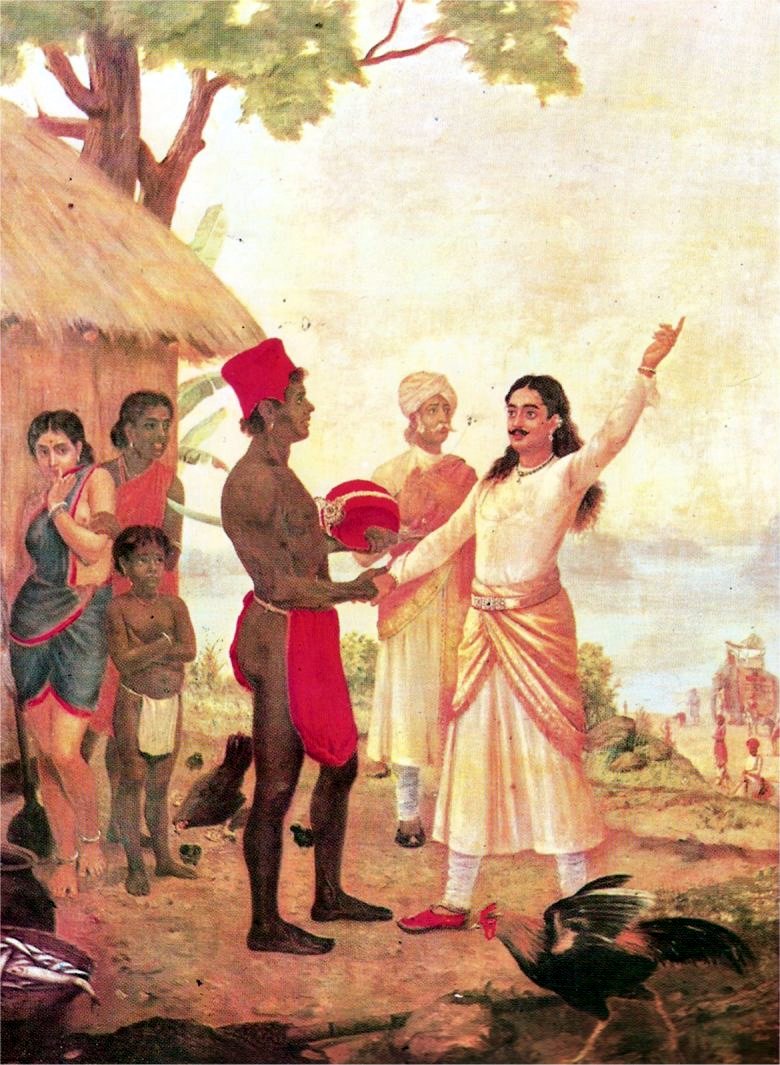
The defining episode of Bhīṣma’s life occurred when King Śantanu fell in love with Satyavatī, the beautiful daughter of the chief of fishermen. When Śantanu sought her hand, Satyavatī’s father refused unless the king guaranteed that Satyavatī’s future sons — not Devavrata — would inherit the throne.
Śantanu, bound by his love for his son, could not make this promise and fell into silent despair. When Devavrata learned the cause of his father’s grief, he went to the fisherman and made two extraordinary pledges:
- He renounced his claim to the throne of Hastinapura forever.
- He vowed to remain celibate for life (brahmacarya), so that no descendant of his could ever challenge the succession of Satyavatī’s line.
At the moment of this second, more terrible vow, the heavens trembled and the gods showered flowers from the sky. It was at this moment that Devavrata earned the name Bhīṣma — “the terrible” — for the fearsome severity of his self-imposed sacrifice. His father Śantanu, moved beyond words, granted him the boon of icchā mṛtyu — death only at his own chosen time (Mahābhārata, Ādi Parva 99–100).
This vow, while noble in its selfless motivation, set in motion the chain of events that would lead to the Kurukṣetra war. Without Bhīṣma as heir, the Kuru succession passed through Satyavatī’s sons and their complex progeny — eventually splitting into the rival lines of the Pāṇḍavas and Kauravas.
Guardian of the Kuru Dynasty
For generations, Bhīṣma served as the protector, regent, and moral anchor of the Kuru dynasty. He outlived his half-brothers Citrāṅgada and Vicitravīrya (Satyavatī’s sons by Śantanu), never himself taking the throne despite being the most capable ruler. When Vicitravīrya died childless, it was Bhīṣma who arranged for the sage Vyāsa to father children through Vicitravīrya’s widows — the process of niyoga — producing Dhṛtarāṣṭra (blind from birth), Pāṇḍu, and Vidura (Mahābhārata, Ādi Parva 105–106).
As the Pāṇḍava and Kaurava princes grew, Bhīṣma presided over their education and upbringing. He arranged for Droṇācārya to be their martial teacher. He served as the court’s supreme elder, whose word carried the weight of dharma itself.
The Abduction of the Princesses of Kāśī
One of Bhīṣma’s most controversial acts was the abduction of the three princesses of Kāśī (Varanasi) — Ambā, Ambikā, and Ambālikā — from their svayaṁvara ceremony to serve as brides for his half-brother Vicitravīrya. While Ambikā and Ambālikā accepted, Ambā declared that she was already pledged to King Śālva. When Bhīṣma released her, Śālva rejected her as having been “won” by another. Humiliated and devastated, Ambā swore vengeance against Bhīṣma — a vow that would be fulfilled across lifetimes when she was reborn as Śikhaṇḍī, the instrument of Bhīṣma’s fall in the Kurukṣetra war (Mahābhārata, Udyoga Parva 170–196).
The Moral Tragedy: Silence in the Sabhā
Bhīṣma’s most agonizing moment, and the one for which he is most criticised, came during the infamous dice game in the Kaurava court. When Yudhiṣṭhira, having lost everything at dice to Śakuni’s trickery, was declared to have wagered and lost Draupadī herself, and the Kaurava prince Duḥśāsana dragged Draupadī by her hair into the assembly hall and attempted to disrobe her, Bhīṣma sat in silence.
Draupadī’s anguished cry — “How can the elders of this assembly sit silent while dharma is being murdered?” — was directed squarely at Bhīṣma and the other patriarchs. Bhīṣma’s response, tortured and ambiguous, was that “the course of dharma is subtle” (dharmasya tattvam sūkṣmam) — an admission that he could not resolve the conflict between his loyalty to the throne (which was occupied by Dhṛtarāṣṭra, father of the Kauravas) and his sense of justice (Mahābhārata, Sabhā Parva 60–68).
This silence haunted Bhīṣma for the rest of his life and is debated to this day. Was he bound by his oath to serve the throne regardless of who sat upon it? Or did his vow of loyalty to the Kuru house override his duty to protect the innocent? The Mahābhārata presents this as a genuine tragedy — a man of dharma trapped by the very vows that define him.
Commander of the Kaurava Army
When war became inevitable, Bhīṣma was appointed the supreme commander (senāpati) of the Kaurava forces. He fought not because he supported Duryodhana’s cause — he explicitly told the Kaurava prince that the Pāṇḍavas were righteous and would prevail — but because his vow bound him to the throne of Hastinapura.
Bhīṣma commanded the Kaurava army for the first ten days of the eighteen-day war. His prowess was devastating: he personally slew ten thousand soldiers daily and held the entire Pāṇḍava army at bay. Yet he had set conditions: he would not kill the Pāṇḍavas (whom he loved as his own grandchildren), and he would not fight Śikhaṇḍī (whom he regarded as the reborn Ambā and thus female-born).
The Pāṇḍavas, realizing they could never defeat Bhīṣma in fair combat, visited him in his own tent on the ninth night and asked the grandsire himself how he could be brought down. In a moment of extraordinary complexity — a commander revealing his own weakness to the enemy because dharma demanded the Pāṇḍavas’ victory — Bhīṣma told them to place Śikhaṇḍī before Arjuna. On the tenth day, with Śikhaṇḍī as a shield, Arjuna pierced Bhīṣma with so many arrows that when the grandsire fell from his chariot, his body did not touch the ground but rested on a bed of arrows (śara-śayyā) (Mahābhārata, Bhīṣma Parva 114–117).
The Bed of Arrows and the Deathbed Teachings
Bhīṣma did not die upon falling. Invoking his boon of icchā mṛtyu, he chose to wait until the Uttarāyaṇa — the auspicious period when the sun begins its northward journey — to depart from the world. For fifty-eight days, he lay on his bed of arrows, sustained by yogic power, his head supported by a pillow of arrows provided by Arjuna at his request.
During this period, after the war’s conclusion, Yudhiṣṭhira — now king but devastated by the carnage — came to Bhīṣma seeking guidance on how to rule righteously. Bhīṣma’s teachings, delivered from the arrow-bed, form the Śānti Parva (Book of Peace) and the Anuśāsana Parva (Book of Instructions) — together comprising over 20,000 verses, nearly a quarter of the entire Mahābhārata (Wikipedia, “Shanti Parva”).
These teachings cover:
- Rāja Dharma — The duties of kings, principles of governance, taxation, justice, diplomacy, and warfare
- Āpad Dharma — Dharma in times of crisis and emergency, when normal rules may be modified
- Mokṣa Dharma — The path to spiritual liberation, including discussions of Sāṅkhya, Yoga, Vedānta, and devotion
- Dāna Dharma — The principles of charity and generosity
- The Viṣṇu Sahasranāma — The famous hymn of the thousand names of Viṣṇu, recited by Bhīṣma to Yudhiṣṭhira, remains one of the most widely chanted devotional hymns in Hinduism (Wikipedia, “Anushāsana Parva”)
Bhīṣma’s deathbed discourses represent one of the most comprehensive treatments of dharma in all of Indian literature. They address not abstract philosophy but the lived, messy reality of ethical life — how to be righteous when circumstances make righteousness seem impossible.
Bhīṣma Aṣṭamī
Bhīṣma’s death is commemorated annually on Bhīṣma Aṣṭamī, observed on the eighth day (aṣṭamī) of the bright fortnight of the month of Māgha (January–February). This is believed to be the day when Bhīṣma finally chose to leave his mortal body. Devotees offer tarpaṇa (water libations) in his memory. The occasion is considered especially auspicious for honouring ancestors and for the study of dharmic texts (Wikipedia, “Bhīṣma Aṣṭamī”).
Names and Epithets
- Devavrata — His birth name, meaning “devoted to the gods”
- Bhīṣma — “The terrible,” earned for his fearsome vow
- Pitāmaha — “Grandsire,” the title by which he is most commonly known
- Gaṅgāputra / Gāṅgeya — “Son of Gaṅgā”
- Śāntanava — “Son of Śantanu”
- Kuruśreṣṭha — “The best of the Kurus”
- Āpagēya — “Son of the river”
Philosophical Significance
Bhīṣma’s life embodies the Mahābhārata’s central philosophical tension: the conflict between personal dharma and situational dharma. His vow — undertaken with the purest of motives — ultimately bound him to serve an unjust cause. His silence during Draupadī’s humiliation, his fighting for Duryodhana while knowing the Pāṇḍavas were righteous, his revealing his own weakness to the enemy — all these reflect the epic’s unflinching examination of what happens when different dharmic obligations collide.
Bhīṣma is not presented as a perfect hero but as a magnificent, flawed human being whose very greatness becomes the source of his tragedy. His life teaches that even the noblest vows can lead to suffering when they become rigid attachments, and that true dharma sometimes demands flexibility, not merely fidelity to sworn oaths.
Yet Bhīṣma’s redemption comes on the arrow-bed, where his suffering becomes the crucible for his greatest contribution: the gift of dharmic wisdom to future generations. In this, the Mahābhārata suggests that even a life marked by painful compromises can culminate in transcendence.
Cultural Legacy
Bhīṣma remains one of the most respected figures in Indian culture. His name is synonymous with unwavering commitment and sacrifice. The phrase “Bhīṣma pratigñā” (Bhīṣma’s vow) is used across Indian languages to describe an irrevocable, iron-willed promise. His deathbed teachings continue to be studied by scholars of political science, ethics, and philosophy. The Viṣṇu Sahasranāma, which he recited, is chanted daily by millions of devotees across India and the Hindu diaspora.
Conclusion
Bhīṣma’s life, as narrated across the vast canvas of the Mahābhārata, is a meditation on the price of honour. His terrible vow — born of filial love — defined and confined him for a lifetime spanning many generations. He was the mightiest warrior who could not fight for justice, the wisest man who could not speak when dharma was defiled, the most selfless soul whose very selflessness perpetuated a dynasty’s suffering. Yet from his bed of arrows, gazing at the sky and waiting for the sun’s northward turn, Bhīṣma found his final purpose: to transmit the accumulated wisdom of a life lived at the crossroads of duty and desire, so that kings yet unborn might rule more justly. In the Mahābhārata’s tragic vision, it is not the absence of suffering that defines greatness, but the capacity to transform suffering into wisdom.