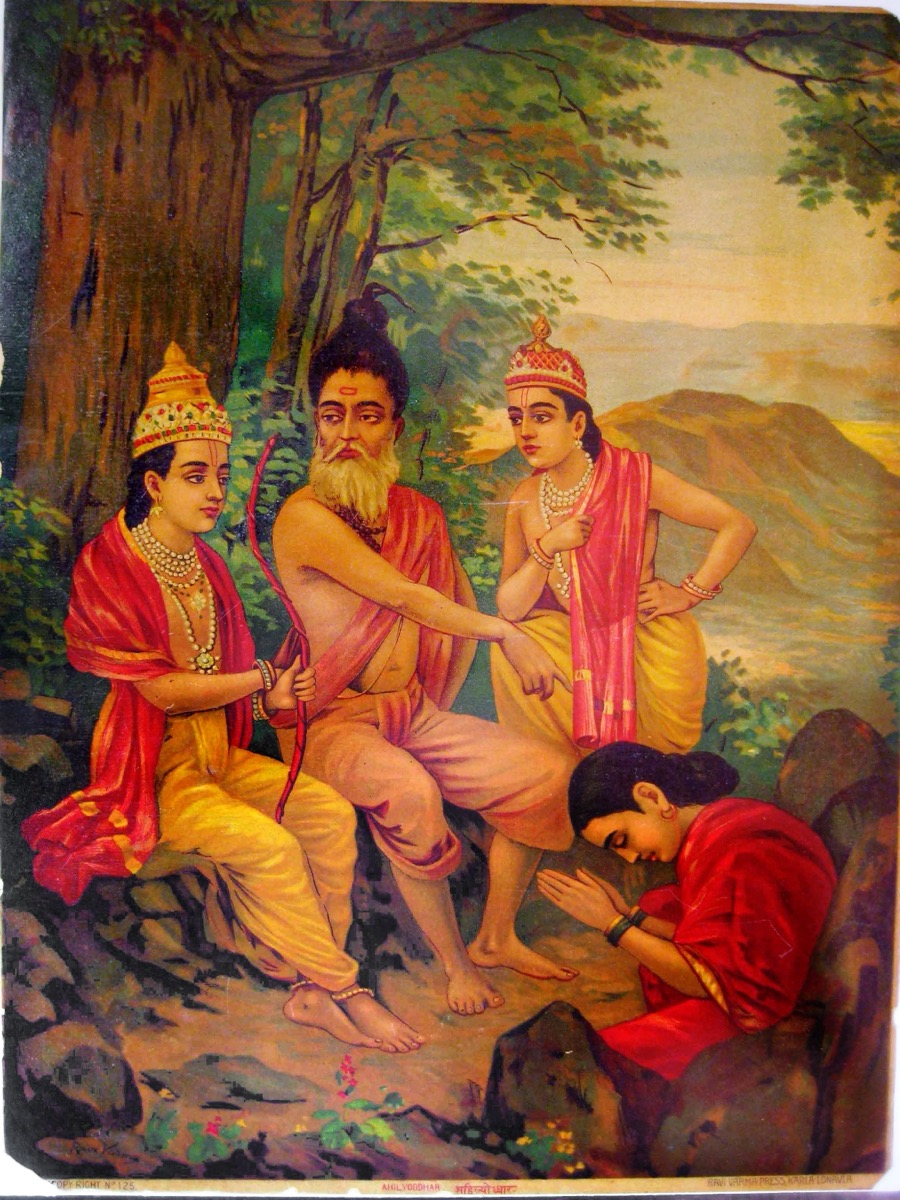
Ahalyā (अहल्या) stands as one of the most poignant and theologically rich figures in Hindu mythology. Created by the god Brahmā as the most beautiful woman in creation, married to the great sage Gautama Maharṣi, deceived by the king of the gods Indra, cursed by her husband, and ultimately liberated by Lord Rāma — her story weaves together themes of divine beauty, moral transgression, severe penance, and the redeeming power of grace. As the first of the Panchakanyā (Five Virgins), Ahalyā occupies a unique place in Hindu ethical discourse, inspiring centuries of devotional poetry, philosophical debate, and artistic expression.
Etymology of the Name Ahalyā
The Sanskrit name Ahalyā (अहल्या) has been interpreted in multiple ways by classical commentators and modern scholars. The most widely accepted etymology derives from the negative prefix a- combined with halyā (हल्या), itself related to hala (हल, “plough”). Thus, a-halyā literally means “one who has not been ploughed” — that is, “untouched,” “virgin,” or “undefiled.”
The Uttara Kāṇḍa of the Vālmīki Rāmāyaṇa provides an alternative and more poetic etymology. When Brahmā creates Ahalyā, he explains her name as meaning “one without any ugliness” (a-halya, where halya denotes “deformity” or “reprehensibility”). Brahmā declares that he crafted her by extracting the most exquisite beauty from every living being and concentrating it in her form, producing a woman so flawless that her very name negates the possibility of imperfection.
Some recent scholars have also read the “unploughed” interpretation as a metaphor for sexual purity, linking it to agricultural imagery common in Vedic literature where the earth (kṣetra) represents the feminine and the plough (hala) represents the masculine generative force. In this reading, the name Ahalyā marks her as primordially pure — an essential characterisation given the trials her story will impose upon her.
Creation by Brahmā: The Most Beautiful Woman
According to the Uttara Kāṇḍa of the Rāmāyaṇa and several Purāṇic accounts, Ahalyā was not born of ordinary human parents. Brahmā, the creator god, fashioned her with immense creative effort (tapas), gathering the most beautiful features of all living beings and uniting them into a single, incomparably lovely form. The Bāla Kāṇḍa (Sarga 48) states that Brahmā “moulded her with great effort out of pure creative energy” (tapasā nirmitā).
Having created the most beautiful woman in the three worlds, Brahmā faced the question of who was worthy to be her husband. He chose Gautama Maharṣi, the great ascetic who had demonstrated supreme self-control over his senses. In the Uttara Kāṇḍa version, Brahmā initially entrusts Ahalyā to Gautama’s care as a test, and when the sage returns her without having succumbed to desire, Brahmā rewards him by giving Ahalyā to him as his wife. This detail underscores a crucial theological point: Ahalyā’s marriage to Gautama was a divine act, sanctioned and arranged by the creator himself, making the subsequent violation by Indra all the more grave.
Marriage to Sage Gautama
Ahalyā and Gautama established their āśrama (hermitage) in a forest near Mithilā, the capital of the Videha kingdom. The Bāla Kāṇḍa (Sarga 48) locates their hermitage in the Mithilā-upavana (the grove of Mithilā), where the couple practiced rigorous asceticism together for many years. Gautama was renowned among the Saptarṣis (Seven Sages) for his profound learning, mastery of Vedic knowledge, and unshakeable devotion to truth and dharma.
The couple lived in exemplary harmony, devoted to spiritual practice, Vedic rituals, and the performance of their respective duties. Ahalyā is consistently described as a pativratā — a woman wholly devoted to her husband — who matched Gautama’s austerities with her own. Their āśrama was celebrated as a place of extraordinary spiritual potency, visited by gods and sages alike.
Indra’s Deception: Varying Accounts
The episode of Indra’s seduction of Ahalyā is one of the most retold and debated narratives in all of Hindu literature. The accounts vary significantly across texts, particularly regarding Ahalyā’s knowledge of and consent to the encounter.
The Bāla Kāṇḍa Account (Vālmīki Rāmāyaṇa, Sargas 48–49)
In the original Vālmīki version, Indra, the king of the gods, becomes consumed by desire for Ahalyā. He waits for Gautama to leave the hermitage for his morning ablutions, then assumes the exact form of Gautama and approaches Ahalyā. The critical verse states that Ahalyā recognised Indra despite his disguise — vijñāya tam surśreṣṭham (“knowing him to be the best of the gods”) — yet she consented to his advances, motivated by curiosity (kautūhala) about the king of the gods. This version presents Ahalyā as a conscious participant, though one must note the massive power imbalance: Indra is the supreme deity of the Vedic pantheon, and refusal carried its own risks.
The Uttara Kāṇḍa Account
The Uttara Kāṇḍa presents a dramatically different picture. Here, Indra’s deception is complete and Ahalyā is entirely innocent. She genuinely believes the figure before her is her husband and thus commits no moral transgression. This version explicitly absolves Ahalyā of guilt, casting the event as a rape (abduction by deception) rather than adultery.
Purāṇic Versions
The Brahma Vaivarta Purāṇa and Padma Purāṇa develop the story further. In some Purāṇic retellings, Indra is aided by the moon god Candra, who takes the form of a rooster and crows before dawn to create the false impression that morning has arrived, tricking Gautama into leaving for his ablutions earlier than usual. These versions uniformly present Ahalyā as an unwitting victim, emphasising Indra’s culpability.
The Mahābhārata Reference
The Mahābhārata (Anuśāsana Parva) contains a brief but significant reference to Ahalyā’s story. In this version, Ahalyā is entirely innocent, and the emphasis falls on Gautama’s excessive wrath in cursing both the victim and the perpetrator. The Mahābhārata account is notable for its implicit critique of the sage’s disproportionate response.
Gautama’s Curse: Stone, Invisibility, or Austerity?
When Gautama returns and discovers the transgression, his rage is terrible. He curses both Indra and Ahalyā, though the nature of Ahalyā’s curse varies strikingly across texts.
The “Invisible” Version (Vālmīki’s Bāla Kāṇḍa)
In the original Vālmīki text, Gautama does not turn Ahalyā into a stone. Instead, he condemns her to live in the hermitage invisible to all beings, surviving only on air (vāyu-bhakṣā), sleeping on ashes, and performing severe penance until the day Rāma visits the āśrama. This version emphasises purification through tapas (austerity) rather than petrification.
The “Stone” Version (Later Retellings)
The popular tradition of Ahalyā being turned into a stone (śilā) develops in later texts, particularly in Kamban’s Tamil Rāmāyaṇa (Irāmāvatāram, 12th century CE) and the Adhyātma Rāmāyaṇa. The Tulasīdāsa Rāmacaritamānasa (Bāla Kāṇḍa, Dohā 210–211) also follows this tradition, describing Ahalyā as a stone (pāṣāṇa) upon which the dust of Rāma’s lotus feet falls, restoring her to human form. This became the dominant version in North Indian devotional tradition and is the most widely known today.
Indra’s Punishment
Gautama also curses Indra. In the Bāla Kāṇḍa, Indra is cursed to lose his testicles (vṛṣaṇa) — a fitting punishment for his sexual transgression. Later versions soften this to Indra being covered with a thousand marks resembling eyes (sahasrākṣa, “thousand-eyed”), which some interpret as a folk etymology for Indra’s epithet Sahasrākṣa. Other accounts say Indra’s body was covered with a thousand female reproductive organs (yoni), later transformed into eyes by the gods who intervened on his behalf.
Liberation by Lord Rāma
The liberation of Ahalyā is one of the most celebrated episodes in the Rāmāyaṇa and a defining moment of Rāma’s divinity. As the young prince Rāma, accompanied by his brother Lakṣmaṇa and the sage Viśvāmitra, travels from Ayodhyā to Mithilā for Sītā’s svayaṃvara, they pass through the forest where Gautama’s āśrama lies.
Viśvāmitra’s Narration
In the Bāla Kāṇḍa (Sarga 49), Viśvāmitra tells Rāma the story of Ahalyā and urges him to enter the hermitage. He describes the āśrama as a place of extraordinary beauty that has been rendered desolate by Ahalyā’s curse — a once-flourishing garden now overgrown and abandoned.
The Moment of Redemption
In the Vālmīki version, when Rāma enters the āśrama, Ahalyā manifests from her invisible state and appears before him in her restored divine beauty, radiant as a flame purified by fire, like the sun emerging from clouds. Rāma and Lakṣmaṇa touch her feet in reverence, and she offers them water and hospitality. Gautama himself returns and is reunited with his wife.
In the more popular stone version, the dust from Rāma’s feet (pāda-raja) or his direct touch upon the stone restores Ahalyā to her human form. Tulasīdāsa’s exquisite verse describes the scene: “Parasat pada pāvana soka nasāvana / pragaṭa bhaī tapa-punja sahī” — “Touching the holy feet that destroy all sorrow, she appeared, having endured mountains of penance” (Rāmacaritamānasa, Bāla Kāṇḍa 210.4). This moment demonstrates that Rāma’s grace (kṛpā) can redeem even those who have suffered the most severe divine punishment.
Theological Significance
The liberation of Ahalyā serves multiple theological functions. It establishes Rāma’s divinity before he even reaches Mithilā — a mortal prince should not have the power to undo a great sage’s curse. It demonstrates the supremacy of bhakti (devotion) and divine grace over karma (the consequences of action). And it affirms that sincere penance can purify any transgression, a foundational Hindu teaching.
The Panchakanyā Tradition
Ahalyā is celebrated as the first of the Panchakanyā (Five Virgins or Five Maidens) in the famous Sanskrit verse:
ahalyā draupadī kuntī tārā mandodarī tathā | pañcakanyāḥ smarennityaṃ mahāpātakanāśinīḥ ||
“One should daily remember Ahalyā, Draupadī, Kuntī, Tārā, and Mandodarī — these five maidens destroy the greatest sins.”
The verse is traditionally recited every morning as part of the prātaḥ-smaraṇa (dawn remembrance) practice. What makes this tradition extraordinary is its seeming paradox: all five women are associated with relationships involving men other than — or in addition to — their primary husband. Ahalyā was visited by Indra; Draupadī married five husbands; Kuntī bore sons by gods other than Pāndu; Tārā married Sugrīva after Vālin’s death; and Mandodarī married Vibhīṣaṇa after Rāvaṇa’s fall.
Yet these women are held up as archetypes of pātivratya (wifely devotion) and moral purity. The tradition thus challenges simplistic definitions of chastity, suggesting that true purity (śuddhi) lies not in the absence of suffering or circumstance, but in the steadfastness of the heart and the endurance of dharma through adversity.
Feminist Interpretations and the Question of Agency
Modern scholars and feminist thinkers have engaged deeply with Ahalyā’s story, producing richly diverse interpretations.
The Victim Reading
Many feminist scholars read Ahalyā as a victim of patriarchal violence on multiple levels: deceived and assaulted by Indra, then punished by Gautama for a crime in which she was either innocent or, at most, a participant under extreme duress. The curse — whether invisibility or petrification — represents the silencing and erasure of a woman’s voice and body by male authority. That Ahalyā’s redemption comes through another male figure (Rāma) has been critiqued as reinforcing patriarchal structures of female dependence.
The Agency Reading
Other scholars, drawing on the Bāla Kāṇḍa’s acknowledgment that Ahalyā recognised Indra, read her as a woman who exercises sexual agency in a culture that denied such agency to women. Her “curiosity” (kautūhala) about Indra is seen not as a moral failing but as a deeply human response — a momentary assertion of individual desire by a woman whose identity had been entirely defined through her relationship to her husband. The severity of Gautama’s punishment, in this reading, reflects not the gravity of her sin but the threat that female agency poses to patriarchal order.
The Redemption Reading
A third interpretive strand focuses on Ahalyā’s penance and transformation. Whether as an invisible ascetic or a stone, Ahalyā endures her suffering with patience and faith, emerging purified and transfigured. In this reading, she is neither passive victim nor transgressive agent but a spiritual exemplar whose journey from beauty to suffering to redemption mirrors the soul’s journey through saṃsāra. Her story becomes an allegory for the jīva (individual soul) that, burdened by karma, awaits divine grace for liberation (mokṣa).
Reclaiming Ahalyā in Contemporary Culture
Contemporary Indian writers have reclaimed Ahalyā’s narrative with particular vigour. Pratibha Ray’s Odia novel Yajnaseni and several modern theatrical productions recentre the narrative on Ahalyā’s interior experience, giving voice to her thoughts, emotions, and perspective. These retellings frequently question why the victim bears the greater punishment while Indra’s curse is comparatively light and soon remedied by the other gods.
Ahalyā in Art and Literature
Raja Ravi Varma’s Paintings
The great 19th-century Indian painter Raja Ravi Varma (1848–1906) produced several celebrated depictions of Ahalyā. His oleograph “Rama Releasing Ahalya from the Curse” shows the moment of liberation — Ahalyā prostrate at Rāma’s feet while the prince stands with Lakṣmaṇa and Viśvāmitra in a lush forest setting. Another oleograph simply titled “Ahalyā” portrays her as a solitary, beautiful woman leaning against a tree with a basket of flowers, emphasising her innocence and grace. These images, mass-produced by the Ravi Varma Press in the early 20th century, brought Ahalyā’s story into millions of Indian homes and shaped popular visual imagination of the character.
Kālidāsa and Classical Poetry
The great poet Kālidāsa references Ahalyā in his Raghuvaṃśa (Canto XI), describing Rāma’s journey through the forest and his encounter with the petrified sage’s wife. Kālidāsa’s treatment is notably sympathetic to Ahalyā, presenting her transformation back to human form as a moment of sublime beauty. The poet compares her emergence to a streak of moonlight breaking free from a cloud.
Kamban’s Tamil Rāmāyaṇa
The 12th-century Tamil poet Kamban provides what is perhaps the most emotionally powerful retelling. In his Irāmāvatāram, Ahalyā lies petrified as a stone, and the particles of dust from Rāma’s feet fall upon her, restoring her to life. Kamban describes her awakening with extraordinary poetic sensitivity, and it is his version that firmly established the “stone” motif in South Indian tradition.
Temple Connections
Ahalyā Sthān, Darbhanga (Bihar)
The most important temple dedicated to Ahalyā is Ahalyā Sthān (also known as Ahilyā Sthān), located at Ahiyari village in Darbhanga district, Bihar. Situated approximately 20 kilometres from Darbhanga town in the Jale block, this site is traditionally identified as the location of Sage Gautama’s āśrama. The present temple structure was built between 1662 and 1682 CE during the reigns of Mahārāja Chhatrasiṃha and Mahārāja Rudrasiṃha of the Darbhanga Raj. The temple features exquisite traditional Indian architecture and is an active pilgrimage site, particularly during Rāma Navamī when devotees gather to celebrate Rāma’s liberation of Ahalyā.
Gautameśvara Temples
Several Gautameśvara (Śiva as worshipped by Gautama) temples across India incorporate Ahalyā’s story into their founding legends. Notably, the Gautameśvara temple near Puṣkara (Rajasthan) and shrines along the Godāvarī river in Maharashtra — the Godāvarī itself being traditionally associated with Sage Gautama — reference the sage-couple’s story in their sthalapurāṇas (local temple histories).
Connection to Mithilā and Janakpur
Since Gautama’s āśrama is located near Mithilā, the story of Ahalyā’s liberation is intimately connected to the broader Rāmāyaṇa geography of the region. Pilgrims visiting Janakpur (in modern Nepal) for Sītā-related sites often include Ahalyā Sthān in their itinerary, tracing the route that Rāma, Lakṣmaṇa, and Viśvāmitra took from Ayodhyā to Mithilā.
Ahalyā’s Enduring Legacy
Ahalyā’s narrative has persisted across three millennia of Hindu tradition not because it offers simple moral lessons but precisely because it does not. Her story resists easy categorisation: she is simultaneously a paragon of beauty, a victim of divine desire, a subject of patriarchal punishment, and an exemplar of redemptive penance. The theological tension between her possible culpability (Bāla Kāṇḍa) and her complete innocence (Uttara Kāṇḍa, Purāṇas) has generated one of Hinduism’s richest traditions of ethical reflection.
The morning recitation of her name alongside the other Panchakanyā affirms that remembering Ahalyā — with all the moral complexity her story entails — possesses the power to purify the one who remembers. In a tradition that values both unwavering ethical conduct and boundless divine compassion, Ahalyā stands at the intersection, embodying the truth that grace can transform even the most seemingly irredeemable suffering into liberation. Her stone, touched by Rāma’s feet, does not merely return to flesh — it becomes a testimony to the power of penance, faith, and the inexhaustible mercy of the divine.