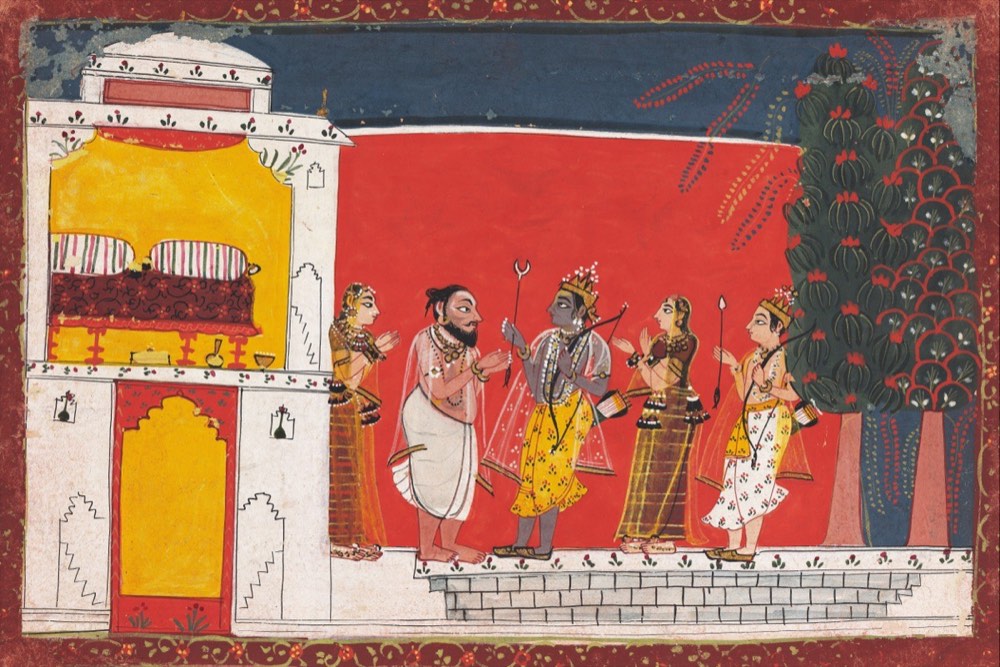
Anasūyā (अनसूया), whose name literally means “one who is free from envy and malice,” stands as one of the most exalted feminine figures in Hindu sacred literature. As the wife of Sage Atri — one of the seven great sages (Saptarṣi) and a mind-born son of Lord Brahmā — she embodies the highest ideal of pativratā dharma (the sacred vow of wifely devotion). Her story, woven through the Purāṇas, the Rāmāyaṇa, and the Mahābhārata, reveals a woman whose spiritual power was so immense that she could humble even the Trimūrti themselves: Brahmā, Viṣṇu, and Śiva.
Far from representing passive submission, Anasūyā’s pativratā dharma is depicted in the scriptures as a wellspring of extraordinary tapas (spiritual austerity) that grants cosmic power. Through her unwavering devotion, moral purity, and mastery over the senses, she attained a spiritual status that rivalled and even surpassed that of the greatest sages. She is celebrated as the mother of Dattātreya — the combined incarnation of the Trimūrti — and as the wise counsellor who guided Sītā at the threshold of her long exile.
Lineage and Marriage to Sage Atri
Anasūyā was the daughter of the sage Kardama Prajāpati and Devahūti, according to the Bhāgavata Purāṇa (3.24.22). Kardama was himself a Prajāpati (progenitor) who had received divine blessings from Lord Viṣṇu, and Devahūti was the daughter of Svāyambhuva Manu, the first Manu. This makes Anasūyā a woman of impeccable spiritual lineage — born into a family where devotion and austerity were the very fabric of daily life.
She was given in marriage to Maharṣi Atri, one of the Saptarṣi (seven primordial sages) who emerged from the mind of Brahmā at the dawn of creation. Atri is credited with composing a significant portion of the Ṛgveda, particularly the fifth maṇḍala, and his hymns include some of the most profound invocations to Agni, Indra, and the Viśvedevāḥ. Together, Atri and Anasūyā established their hermitage at Chitrakūṭa (modern-day Chitrakoot, on the border of Madhya Pradesh and Uttar Pradesh), where they practised severe austerities and became renowned across the three worlds for their spiritual attainments.
The Mārkaṇḍeya Purāṇa (chapters 15-18) recounts that Anasūyā’s tapas was so powerful that she once caused the Gaṅgā to flow near their hermitage to relieve a terrible drought, and that she transformed a barren wilderness into a verdant forest through the sheer force of her penance. These feats established her reputation not merely as a devoted wife but as a tapasvinī (female ascetic) of the highest order.
The Great Test of the Trimūrti
The most celebrated episode in Anasūyā’s legend is the divine test conducted by the Trimūrti themselves. This narrative, found in the Bhāgavata Purāṇa, the Mārkaṇḍeya Purāṇa, and various regional retellings, reveals the extraordinary depth of her spiritual power.
The Origin of the Test
According to the Mārkaṇḍeya Purāṇa, the fame of Anasūyā’s virtue spread through all the celestial realms, causing unease among the consorts of the Trimūrti — Sarasvatī, Lakṣmī, and Pārvatī. The celestial sage Nārada, ever the catalyst of divine play, confirmed that Anasūyā’s pativratā dharma surpassed that of any other woman in the universe. The three goddesses, stung by this declaration, urged their husbands to test Anasūyā’s virtue personally.
Brahmā, Viṣṇu, and Śiva disguised themselves as wandering sannyāsins (renunciants) and arrived at Anasūyā’s hermitage when Sage Atri was away, performing rituals at the river. They asked for bhikṣā (alms), which a pativratā was duty-bound to provide. However, they attached an extraordinary condition: they demanded that Anasūyā serve them food in a state of complete undress — nirvāṇa bhikṣā — a request designed to create an impossible dilemma between her dharmic duty of hospitality (atithi dharma) and her pativratā vow of modesty.
Anasūyā’s Triumph
Anasūyā, through her yogic insight, immediately recognized the true identity of her visitors. Rather than refusing them or compromising her virtue, she devised a solution of stunning spiritual brilliance. She meditated upon her husband, invoked the power accumulated through years of unwavering devotion, and sprinkled sacred water (mantrajala) upon the three disguised gods. Instantly, the mighty Trimūrti — creators and destroyers of universes — were transformed into helpless, crying infants.
Now, with three babies before her, Anasūyā could fulfil their request without any violation of dharma. She disrobed, cradled the three divine infants, and breastfed them with maternal affection, thus providing nirvāṇa bhikṣā in the only way that preserved both her hospitality and her chastity. The act demonstrated that true spiritual power does not reside in physical might or cosmic authority but in the accumulated merit of dharmic living.
The Goddesses Seek Mercy
When the Trimūrti did not return, the three goddesses became alarmed. They rushed to Anasūyā’s hermitage and discovered their omnipotent husbands reduced to babbling infants, utterly dependent on a mortal woman’s care. Humbled and chastened, Sarasvatī, Lakṣmī, and Pārvatī begged Anasūyā to restore their husbands to their original forms. Anasūyā, true to her name — free from all spite and malice — graciously agreed.
The Trimūrti, pleased by her extraordinary display of virtue, granted her a boon. Anasūyā requested that each of the three gods be born as her son. Thus were born her three illustrious children.
Mother of Three Divine Sons
Anasūyā’s motherhood is itself a testament to the cosmic significance of her tapas:
Dattātreya — the combined incarnation of Brahmā, Viṣṇu, and Śiva. He is venerated as the Ādi-Guru (first teacher) in many Hindu and particularly Nāth and Mahānubhāva traditions. He is iconographically depicted with three heads and six arms (or as a single sage accompanied by four dogs and a cow), symbolizing the unity of the Trimūrti. Dattātreya is the patron deity of the Dattātreya sampradāya and is especially revered in Maharashtra, Karnataka, Andhra Pradesh, and Gujarat. The Dattātreya Upaniṣad and the Avadhūta Gītā are attributed to his teachings.
Durvāsā — an incarnation of Śiva’s wrathful aspect, known throughout Hindu literature for his fearsome temper and the curses he bestowed upon those who offended him. His curse upon Śakuntalā (in the Mahābhārata and Abhijñānaśākuntalam of Kālidāsa) and upon Indra (leading to the Samudra Manthana or churning of the ocean) are pivotal episodes in Hindu mythology. Despite his irascibility, Durvāsā is revered as a great sage whose blessings brought immense spiritual merit.
Soma (also called Chandraātri) — an incarnation of Brahmā, identified with the moon deity. Some Purāṇic traditions identify him as Chandra, the lunar deity who illuminates the night sky. The Bhāgavata Purāṇa (4.1.15) confirms this lineage, stating that Soma was born from Anasūyā bearing the aṁśa (portion) of Brahmā.
Anasūyā in the Rāmāyaṇa: Guide to Sītā
One of the most tender and spiritually significant episodes involving Anasūyā occurs in the Vālmīki Rāmāyaṇa (Araṇya Kāṇḍa, Sargas 1-4). When Rāma, Sītā, and Lakṣmaṇa arrive at the hermitage of Sage Atri during the early days of their fourteen-year exile, they are warmly received by the elderly sage couple.
While Atri converses with Rāma about dharma and the duties of a king in exile, Anasūyā takes Sītā aside for a private and deeply meaningful exchange. The aged pativratā — by this time, a woman of immense experience and spiritual attainment — performs several acts of grace:
She gifts Sītā divine ornaments and garments. According to the Rāmāyaṇa (Araṇya Kāṇḍa, 4.17-19), Anasūyā presents Sītā with celestial garlands, unguents, and garments that would never fade, never soil, and would preserve her beauty through the hardships of forest life. These were gifts born of her own tapas — material manifestations of spiritual power.
She teaches Sītā the secrets of strīdharma. In a celebrated passage (Araṇya Kāṇḍa, 4.20-28), Anasūyā expounds upon the Strīdharma Rahasya — the inner mysteries of a woman’s sacred duty. She teaches that a devoted wife who serves her husband with love, loyalty, and moral integrity accumulates spiritual merit (puṇya) that equals the merit of the greatest austerities. She declares that a husband is the supreme deity (parama daivatam) for a wife, and that through faithful service, a woman can attain the highest spiritual realms.
She strengthens Sītā’s resolve. This teaching, coming at the very beginning of Sītā’s exile — before the terrors of Rāvaṇa’s abduction, the Agni Parīkṣā, and the years of suffering — serves as spiritual armour. Anasūyā’s counsel fortifies Sītā for the trials ahead, making this encounter a pivotal moment in the Rāmāyaṇa narrative.
Sītā, in turn, narrates the story of her own svayaṁvara — the breaking of Śiva’s bow by Rāma — which delights the elderly sage-woman. This exchange between two great pativratās — one at the end of her life’s journey, the other at its harrowing beginning — is among the most poignant passages in Indian literature.
Anasūyā’s Tapas and Spiritual Powers
The scriptures attribute several extraordinary feats to Anasūyā’s accumulated tapas:
Bringing the Gaṅgā to Chitrakūṭa. During a devastating drought that lasted ten years, Anasūyā performed severe austerities and caused a branch of the sacred Gaṅgā river, known as the Mandākinī, to flow through the parched forests of Chitrakūṭa. This act saved countless lives — both human and animal — and earned her the reverence of the entire sage community. The Mandākinī River that flows through Chitrakoot today is traditionally associated with this miracle.
Transforming the landscape. Through her penances, she is said to have turned ten yojanas (approximately 80 miles) of barren wilderness around the hermitage into a lush, fruit-bearing forest, restoring the natural order disrupted by the drought.
Serving as moral authority. The Mahābhārata (Vana Parva, chapters 230-232) references Anasūyā as a moral exemplar when discussing the dharma of women. Sage Mārkaṇḍeya narrates her story to the Pāṇḍavas as an illustration of the power that accrues from virtuous conduct.
Anasūyā Among the Great Pativratās
Hindu tradition honours five women as the Pañca Satī (Five Ideal Women) or Pañca Kanyā (Five Virgins), whose names are recited as a morning prayer: Ahalyā, Draupadī, Sītā, Tārā, Mandodarī. While Anasūyā is not always listed in this specific grouping, she occupies a position that many scholars and devotional traditions consider equal to or exceeding these figures in the specific domain of pativratā dharma.
Compared with Sāvitrī, who retrieved her husband Satyavān from the clutches of Yama (the god of death) through her devotion and sharp intellect, Anasūyā’s power is more sustained and cosmic in scope. Where Sāvitrī triumphed in a single supreme crisis, Anasūyā’s lifelong tapas accumulated a reservoir of spiritual power vast enough to subdue the Trimūrti themselves.
Compared with Sītā, whose pativratā dharma was tested through abduction, captivity, and the Agni Parīkṣā (fire ordeal), Anasūyā serves as the elder exemplar and spiritual guide. Their meeting at Chitrakūṭa represents a passing of the torch — the seasoned pativratā arming the young one for the trials ahead.
Compared with Draupadī, whose fiery spirit and demand for justice define her character, Anasūyā represents a different facet of feminine power: the quiet, accumulated strength of unwavering devotion that bends even cosmic forces to its will.
Compared with Ahalyā, who was cursed for a transgression (whether willing or coerced, depending on the version) and redeemed by Rāma’s touch, Anasūyā stands as the unblemished ideal — one who was never tested by personal failure but who transmuted the test itself into a demonstration of supreme virtue.
Temples and Sacred Sites
Several temples and sacred sites across India honour Anasūyā:
Sati Anasūyā Āśram, Chitrakūṭ — Located approximately 16 kilometres from Chitrakoot town in Madhya Pradesh, at the confluence of the Mandākinī, Gaṅgā, and Yamunā rivers (according to local tradition). This ashram, nestled in dense forests, marks the traditional site of Atri and Anasūyā’s hermitage. It houses images of the sage couple and remains a major pilgrimage destination, particularly during the month of Kārtika and on Dattātreya Jayantī (the birthday of Dattātreya, celebrated on the full moon of Mārgaśīrṣa, typically in December).
Atri-Anasūyā Temple, Chitrakoot — A temple within the main Chitrakoot pilgrimage circuit, where devotees honour both the sage and his wife before proceeding to visit the Rāmghāṭ on the Mandākinī.
Dattātreya temples across Maharashtra and Karnataka — Since Anasūyā is the mother of Dattātreya, she is venerated in all major Dattātreya shrines, including the famous temples at Ganagapur (Karnataka), Narasimha Wadi (Maharashtra), and Girnar (Gujarat). In these temples, images of Anasūyā and Atri frequently flank the central icon of Dattātreya.
Legacy and Significance for Womanhood
Anasūyā’s story carries profound significance for the understanding of womanhood in Hindu tradition:
Spiritual power through devotion. Her narrative demonstrates that the path of pativratā dharma is not one of diminishment but of immense spiritual empowerment. The woman who dedicates herself fully to dharmic living accumulates a power that the scriptures describe as capable of commanding even the gods.
Intelligence and resourcefulness. When confronted with the impossible demand of the Trimūrti, Anasūyā did not merely endure — she innovated. Her solution of transforming the gods into infants demonstrated that true virtue is not rigid rule-following but creative, intelligent engagement with dharmic principles.
The teacher role. As Sītā’s guide, Anasūyā demonstrates that older women in Hindu tradition hold the vital role of transmitting spiritual knowledge and strengthening the younger generation. Her teaching of the Strīdharma Rahasya places her in the lineage of great ācāryas (teachers).
Freedom from envy. Her very name — An-asūyā, “without envy” — encapsulates a spiritual ideal. In a narrative where even the three supreme goddesses succumbed to jealousy, Anasūyā remained serene, free from comparison and competition. This quality, the scriptures suggest, is the very foundation upon which all other virtues are built.
The Mārkaṇḍeya Purāṇa declares that merely reciting the name of Anasūyā with devotion purifies the mind of all traces of jealousy and malice. In a world often driven by comparison and envy, the ancient ideal she represents — a life grounded in devotion, purified of resentment, and radiant with accumulated spiritual merit — continues to offer a luminous model of inner strength and moral grandeur.