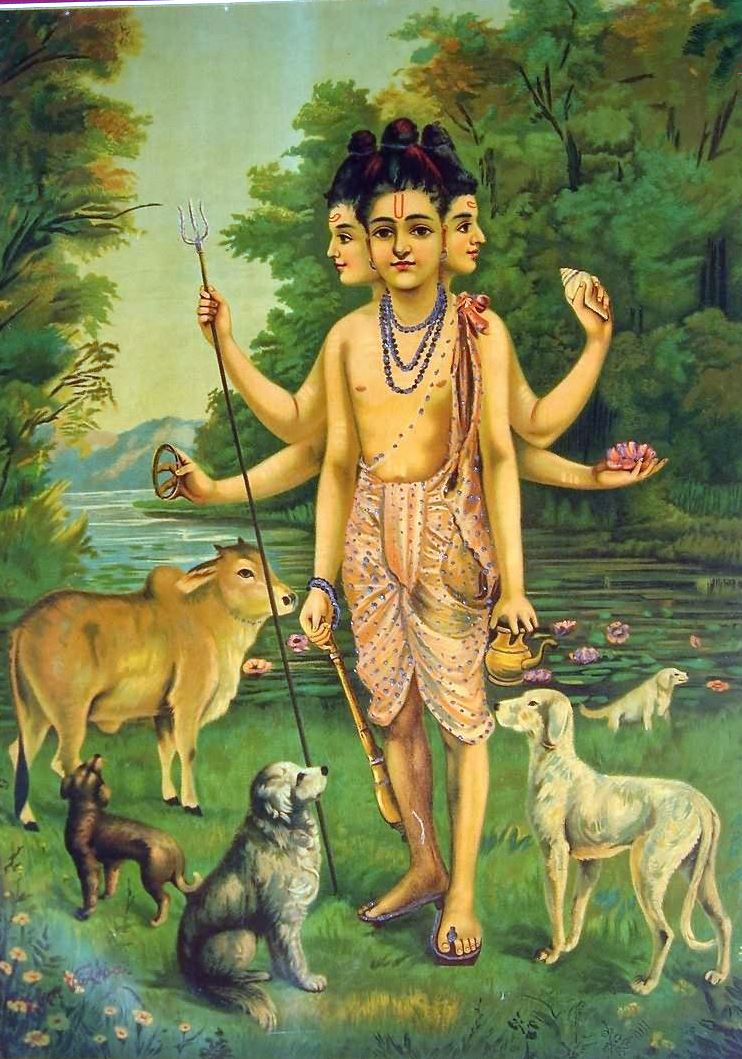
Lord Dattātreya (दत्तात्रेय, “Given to Atri”), also known as Dattā, Avadhūta, or Digambara, is one of the most extraordinary and enigmatic figures in Hindu tradition. Uniquely, he is revered as the combined incarnation of the three supreme deities of the Trimūrti — Brahmā the Creator, Viṣṇu the Preserver, and Śiva the Destroyer — unified in a single divine form. Dattātreya is celebrated as the Ādi-Guru (the first teacher), the patron deity of yoga, and the supreme example of the Avadhūta — one who has transcended all worldly attachments and social conventions to abide in pure consciousness.
Birth: The Grace of the Trimūrti
The story of Dattātreya’s birth is narrated across several Purāṇas, including the Mārkaṇḍeya Purāṇa and the Brahmāṇḍa Purāṇa, with variations in different textual traditions.
The sage Atri was one of the seven great Ṛṣis (Saptarṣis) born from the mind of Brahmā. His wife, Anasūyā (literally “free from envy”), was renowned across the three worlds as the ideal of wifely devotion (pativratā dharma). Her spiritual power was said to be so immense that it disturbed even the celestial order.
According to the most popular version of the narrative, the three goddesses — Sarasvatī, Lakṣmī, and Pārvatī — grew curious about Anasūyā’s legendary virtue and requested their husbands to test her. Brahmā, Viṣṇu, and Śiva disguised themselves as wandering Brāhmaṇa mendicants and arrived at Atri’s hermitage seeking food. They imposed a condition: Anasūyā must serve them food while unclothed.
Anasūyā, through her spiritual power, sprinkled sacred water upon the three gods, transforming them into infants. She then nursed them as her own children, fulfilling their condition without compromising her modesty. When the three goddesses arrived to retrieve their husbands, they were humbled by Anasūyā’s power and devotion. The three deities were so pleased that they granted a boon: they would be born as her son in a combined form. This child was Dattātreya — embodying Brahmā as the moon (associated with the creative mind), Viṣṇu as the preserver (his central nature), and Śiva as the ascetic and destroyer of ignorance.
The Twenty-Four Gurus: Wisdom from Nature
One of the most celebrated teachings attributed to Dattātreya is the doctrine of the Twenty-Four Gurus, narrated in the Bhāgavata Purāṇa (Canto 11, Chapters 7-9). In this profound discourse, the avadhūta Dattātreya explains to King Yadu how he gained spiritual wisdom by observing twenty-four elements of nature, each teaching a specific lesson:
- Earth (Pṛthvī) — patience and forgiveness even when burdened
- Air (Vāyu) — detachment while moving through the world
- Sky (Ākāśa) — remaining unaffected and all-pervading
- Water (Jala) — purity, sweetness, and the ability to cleanse
- Fire (Agni) — consuming all impurities, remaining brilliant
- Moon (Candra) — the self is unchanging though the body waxes and wanes
- Sun (Sūrya) — drawing up and giving back, never hoarding
- Pigeon (Kapota) — the danger of excessive attachment
- Python (Ajagara) — contentment with whatever food comes naturally
- Ocean (Samudra) — depth, stability, and unperturbed stillness
- Moth (Pataṅga) — the danger of being lured by sensory attraction
- Honeybee (Madhukara) — gathering wisdom from many sources in small measure
- Elephant (Gaja) — the trap of lustful desire
- Honey Thief (Madhu-hā) — the folly of hoarding
- Deer (Mṛga) — the danger of being captivated by sound (music)
- Fish (Mīna) — destruction through the sense of taste
- Piṅgalā the Courtesan — disillusionment leading to renunciation
- Osprey (Kurara) — the misery caused by possessiveness
- Child (Bālaka) — the bliss of innocence and freedom from anxiety
- Young Girl (Kumārī) — working alone in solitude to avoid conflict
- Arrow Maker (Iṣukāra) — single-pointed concentration
- Snake (Sarpa) — living alone without building a permanent dwelling
- Spider (Ūrṇanābhi) — the Lord creates and reabsorbs the world from himself
- Wasp (Bhṛṅgī) — one becomes what one constantly meditates upon
This teaching stands as one of the most powerful instructions in all of Hindu scripture on the art of learning from direct observation of the natural world — a hallmark of the Avadhūta approach to wisdom.
The Avadhūta Gītā
The Avadhūta Gītā (“Song of the Free One”) is a seminal Advaita Vedānta text attributed to Dattātreya. Composed in approximately 289 verses across eight chapters, it is one of the most uncompromising declarations of non-dual (advaita) truth in Hindu literature.
The central message is radical: the Ātman (Self) is identical with Brahman (the Absolute Reality), and all distinctions — between sacred and profane, pure and impure, self and other — are ultimately illusory. Key verses include:
“I am verily that Brahman, the One without a second, which is like the sky, subtle, without beginning and without end, in which all this — from the unmanifest to the manifest — appears like an illusion.” (Avadhūta Gītā 1.1)
“How shall I salute the Self, which is indestructible, which is all Bliss, which in Itself and by Itself pervades everything, and which is inseparable from Itself?” (Avadhūta Gītā 1.5)
The text rejects all external forms of religion — rituals, pilgrimage, mantra recitation, and even meditation — as unnecessary for one who has realized the Self. This radical non-dualism deeply influenced later Advaita and Nāth traditions.
The Dattātreya Upaniṣad
The Dattātreya Upaniṣad, belonging to the Atharva Veda, is a shorter but significant text that establishes Dattātreya as the supreme reality beyond the Trimūrti. It describes his nature as the Avadhūta who transcends all social and religious categories, who wanders naked and free, who has realized the identity of Ātman and Brahman.
The text also provides the Dattātreya Mantra and describes the six-armed iconographic form, connecting Dattātreya’s worship with both Vedāntic philosophy and Tāntric practice.
Iconography: The Three-Headed Lord
The traditional iconography of Dattātreya is rich with symbolic meaning:
- Three heads: Representing Brahmā, Viṣṇu, and Śiva — the unified Trimūrti
- Six arms: Carrying the attributes of all three gods — Brahmā’s kamaṇḍalu (water pot) and japamālā (rosary), Viṣṇu’s śaṅkha (conch) and sudarśana cakra (discus), and Śiva’s triśūla (trident) and ḍamaru (drum)
- Four dogs: Symbolizing the four Vedas (Ṛg, Yajur, Sāma, and Atharva) who faithfully follow the Lord
- A cow standing behind: Representing Mother Earth (Bhūdevī) and dharma; also symbolizing Kāmadhenu, the wish-fulfilling cow
- An audumbar tree (Ficus glomerata): The sacred tree under which Dattātreya is often depicted, representing the wish-fulfilling nature of the divine
In some traditions, particularly in Maharashtra, Dattātreya is depicted with a single head, bearing the serene and gentle appearance of a wandering sannyāsin. This form emphasizes his role as the supreme renunciant rather than the cosmic deity.
Connection to the Nāth Sampradāya
Dattātreya occupies a pivotal position in the Nāth Sampradāya, one of the most influential spiritual lineages in India. The Nāth tradition regards Dattātreya as one of the original Nava-Nāths (Nine Lords) — the divine progenitors of their lineage.
The connection is significant because the Nāth tradition synthesizes elements of:
- Shaivism (particularly the Pāśupata and Kāpālika traditions)
- Yoga (especially Haṭha Yoga and Kuṇḍalinī practices)
- Advaita Vedānta (non-dual philosophy)
- Tantric practices (including mantra, yantra, and subtle body practices)
Through the Nāth connection, Dattātreya is linked to the legendary Gorakhnāth (Gorakṣanātha), the founder of the Haṭha Yoga tradition, and Matsyendranāth, the primordial yogi. The Nāth tradition sees Dattātreya as the lord who transmitted the secret teachings of yoga, alchemy, and spiritual liberation to the Nāth Siddhas.
Scriptural Sources
Dattātreya appears across a wide range of Hindu scriptures:
- Bhāgavata Purāṇa (11.7-9): The teaching of the Twenty-Four Gurus to King Yadu
- Mārkaṇḍeya Purāṇa: The story of his birth to Atri and Anasūyā
- Avadhūta Gītā: The quintessential text of Advaita philosophy attributed to Dattātreya
- Dattātreya Upaniṣad: Establishes his Vedāntic and meditative significance
- Jñāneśvarī by Sant Jñāneśvar: References Dattātreya as part of the Nāth Guru lineage
- Gurucaritra (15th century): The most important devotional text in the Datta Sampradāya, narrating the lives of Dattātreya’s incarnations Śrīpād Śrīvallabha and Narasiṃha Sarasvatī
Worship Traditions
Maharashtra
Maharashtra is the heartland of Dattātreya worship. The Datta Sampradāya (Dattātreya tradition) is deeply woven into Maharashtrian spiritual life. Key pilgrimage centres include:
- Girnar (Gujarat): The mountain where Dattātreya is said to have performed tapas; the Dattātreya temple atop Girnar is one of the most ancient shrines
- Gaṇagāpur (Karnataka): The seat of Narasiṃha Sarasvatī, revered as an incarnation of Dattātreya; the Gurucaritra revolves around this sacred place
- Audumbar (Maharashtra): Named after the sacred fig tree associated with Dattātreya
- Nṛsiṃhavāḍī (Maharashtra): Another important centre connected to Narasiṃha Sarasvatī
The Thursday worship of Dattātreya (Guruvār Pūjā) is widespread in Maharashtra, where devotees light oil lamps, chant the Datta Stuti, and recite chapters from the Gurucaritra.
Karnataka
In Karnataka, the Datta tradition thrives through the legacy of Śrīpād Śrīvallabha and Narasiṃha Sarasvatī, who are worshipped as incarnations of Dattātreya. The Gaṇagāpur temple on the banks of the Bhīmā river draws lakhs of pilgrims annually. Karnataka also houses important Datta Maṭhas (monasteries) that carry forward the tradition of Vedāntic study and practice.
Datta Jayantī
The birth of Lord Dattātreya is celebrated on the full moon day (Pūrṇimā) of the month of Mārgaśīrṣa (November-December). Devotees observe fasting, perform special pūjā to the Trimūrti form, chant the Dattātreya Stotram and the Avadhūta Gītā, and circumambulate the sacred audumbar tree.
Philosophical Significance
Dattātreya’s significance extends far beyond mythology into the realm of living philosophy:
The Ideal of the Avadhūta
The Avadhūta represents the highest state of spiritual realization — one who has “shaken off” (avadhūta literally means “one who has shaken off”) all worldly conditioning. Unlike the conventional renunciant bound by monastic rules, the Avadhūta is completely free, sometimes appearing mad, sometimes wise, sometimes silent, sometimes dancing — utterly unconcerned with social opinion.
The Universal Guru
By learning from twenty-four gurus drawn from nature, Dattātreya teaches that wisdom is not the monopoly of any scripture, sect, or institution. The entire creation is a teacher for one who has eyes to see. This universalism has made Dattātreya beloved across sectarian boundaries.
Unity of the Trimūrti
Dattātreya’s very form embodies the Hindu philosophical insight that creation, preservation, and dissolution are not separate divine functions but aspects of one unified reality. In worshipping Dattātreya, the devotee transcends the sectarian divisions between Śaivism, Vaiṣṇavism, and the Brahmā tradition.
For devotees across Maharashtra, Karnataka, Gujarat, and beyond, Lord Dattātreya remains the living embodiment of the guru principle — the eternal teacher who appears in every age to guide sincere seekers from darkness to the light of Self-knowledge, reminding them that the divine teacher is present in every element of creation, waiting to be recognized by a humble and attentive heart.