Introduction
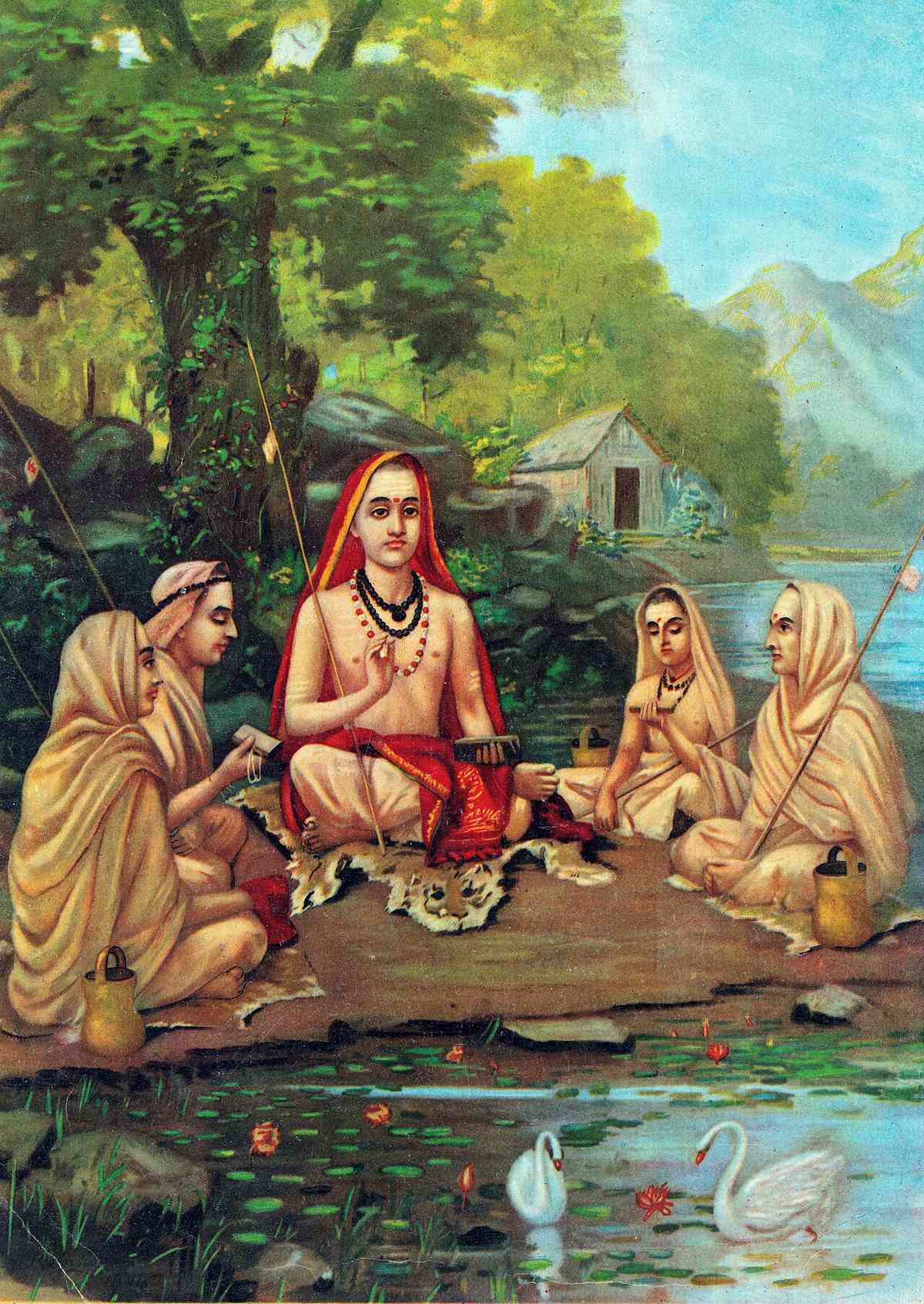
Ādi Śaṅkarācārya (IAST: Ādi Śaṅkara; c. 788–820 CE by traditional dating) is widely regarded as one of the most influential philosophers and spiritual teachers in the history of Indian thought. In a life spanning barely thirty-two years, he composed rigorous commentaries on the foundational texts of Vedānta, traversed the Indian subcontinent engaging rival scholars in public debate, founded four cardinal monastic seats (maṭhas) that endure to this day, and composed devotional hymns that continue to resonate across Hindu worship traditions. The Stanford Encyclopedia of Philosophy describes him as “one of the most widely known and influential Indian philosophers from the classical period and the most authoritative philosopher of Advaita Vedānta” (SEP, “Śaṅkara”).
His central teaching — that the individual self (ātman) and the ultimate reality (Brahman) are identical, and that the perceived multiplicity of the world is a superimposition (adhyāsa) born of ignorance (avidyā) — became the defining statement of the Advaita (non-dual) school of Vedānta and has shaped Hindu intellectual life for over twelve centuries.
Early Life and Renunciation
According to the traditional hagiographies known as Śaṅkara-vijaya texts — the most prominent being the Mādhavīya Śaṅkara Digvijaya attributed to Mādhava-Vidyāraṇya — Śaṅkara was born in Kālaḍi (modern Kalady), a small village on the banks of the Periyār River in Kerala, into a pious Nambūdiri Brahmin family (Britannica, “Shankara”). His father Śivaguru and mother Āryāmbā are said to have received the child as a divine blessing after years of prayer at the Vṛṣādri (Vṛṣācala) Śiva temple.
Hagiographic accounts describe the boy as a prodigy who mastered the Vedas by the age of eight. From an early age, Śaṅkara felt a powerful calling toward renunciation (saṁnyāsa). When his mother was reluctant to grant permission, tradition records that a crocodile seized the boy while he bathed in the river; he implored his mother to let him take saṁnyāsa so that he might die as a renunciate, and she consented. Upon her agreement, the crocodile released him — an event regarded as providential in the hagiographies (Sringeri Sharada Peetham, “Sri Adi Shankaracharya”).
Śaṅkara then travelled north to find his guru. He became the disciple of Govindabhagavatpāda, who was himself a student of Gauḍapāda — the author of the Gauḍapāda-kārikās on the Māṇḍūkya Upaniṣad, a seminal early Advaita text. Under Govinda’s guidance, Śaṅkara is said to have attained full realisation of non-dual Brahman (SEP, “Śaṅkara”).
Philosophy: Advaita Vedānta
Śaṅkara’s philosophical contribution lies not in inventing Advaita Vedānta but in systematizing it with unprecedented clarity and rigour. Advaita (literally “non-secondness”) holds that Brahman — pure, non-intentional consciousness, infinite and without attributes (nirguṇa) — is the sole ultimate reality. The empirical world of name and form (nāma-rūpa) is neither wholly real nor wholly unreal; it is mithyā — an appearance sustained by māyā (cosmic ignorance).
Central to Śaṅkara’s method is the doctrine of adhyāsa (superimposition), set out in the preamble to his Brahmasūtra-bhāṣya. Just as one may mistake a rope for a snake in dim light, beings superimpose the attributes of the phenomenal self upon the attributeless Brahman. Liberation (mokṣa) consists in the direct recognition (aparokṣa-anubhūti) that ātman is Brahman — a recognition achieved through śravaṇa (listening to scripture), manana (rational reflection), and nididhyāsana (sustained contemplation) (IEP, “Advaita Vedānta”).
Śaṅkara distinguished three orders of reality: pāramārthika (the absolute level, where Brahman alone exists), vyāvahārika (the empirical level of everyday experience), and prātibhāsika (the illusory level, such as dreams or mirages). This three-tiered framework allowed him to honour the scriptures that speak of a personal God (Īśvara) at the empirical level while maintaining non-duality at the absolute level.
Major Works
Śaṅkara’s literary output is remarkable for both volume and depth. Scholars generally accept the following as authentically his (SEP, “Śaṅkara”; shankaracharya.org):
Commentaries (Bhāṣyas):
- Brahmasūtra-bhāṣya — His magnum opus; a detailed commentary on Bādarāyaṇa’s Brahma Sūtras, establishing the Advaita interpretation of Vedānta against rival schools.
- Upaniṣad-bhāṣyas — Commentaries on the ten principal Upaniṣads: Īśā, Kena, Kaṭha, Praśna, Muṇḍaka, Māṇḍūkya, Aitareya, Taittirīya, Chāndogya, and Bṛhadāraṇyaka.
- Bhagavadgītā-bhāṣya — A commentary reading the Gītā as teaching jñāna (knowledge) as the direct means to liberation.
Philosophical Treatises (Prakaraṇa Granthas):
- Upadeśa-sāhasrī (“A Thousand Teachings”) — The only independent philosophical prose-and-verse work universally accepted as Śaṅkara’s.
- Vivekacūḍāmaṇi (“Crest-Jewel of Discrimination”) — A popular verse treatise on the path to self-knowledge. (Scholars note that its direct attribution to Śaṅkara is debated, yet the work is deeply interwoven with the Advaita teaching tradition.)
- Ātmabodha (“Self-Knowledge”) and Tattvabodha (“Knowledge of Reality”) — Short primers on Advaita doctrine.
- Aparokṣānubhūti (“Direct Realisation”) and Dṛg-Dṛśya-Viveka (“Discrimination Between the Seer and the Seen”).
Devotional Hymns (Stotras):
- Bhaja Govindam (“Worship Govinda”) — A celebrated hymn urging seekers to turn from worldly attachment to devotion and self-knowledge.
- Saundaryalaharī (“Wave of Beauty”) — A hundred-verse poem in praise of the Goddess, rich in tantric symbolism, divided into the Ānandalaharī (verses 1–41) and Saundaryalaharī proper (verses 42–100).
- Nirvāṇa-ṣaṭkam (also called Ātma-ṣaṭkam) — Six verses declaring the Self’s identity with pure consciousness.
- Numerous other hymns including Dakṣiṇāmūrti Stotra, Śivānandalaharī, and Kanakadhārā Stava.
The Digvijaya: Travels and Debates
After completing his studies, Śaṅkara embarked on a digvijaya — a “conquest of all quarters” — travelling the length and breadth of India to propagate Advaita Vedānta and engage proponents of rival philosophical systems (Sringeri, “Shankara Digvijaya — Part 3”).
The most celebrated episode is his debate with Maṇḍana Miśra, a distinguished householder-scholar of the Pūrva Mīmāṁsā school at Māhiṣmatīpura (identified with modern Mahishi in Bihar or Madhya Pradesh). Maṇḍana held that ritual action (karma) prescribed by the Vedas is the sole means to liberation, while Śaṅkara argued for the supremacy of jñāna (knowledge). According to the Mādhavīya Digvijaya, Maṇḍana’s wife Ubhaya Bhāratī — herself an erudite scholar — served as the arbiter. A garland of flowers was placed around each debater’s neck; the one whose garland withered first would accept defeat. After prolonged deliberation extending over many days, Maṇḍana’s garland faded. Ubhaya Bhāratī acknowledged Śaṅkara’s victory but challenged him further on topics of kāma-śāstra (the science of desire), a domain unfamiliar to the young renunciate. Tradition states that Śaṅkara requested a recess, gained the requisite knowledge through yogic means, and returned to satisfy the challenge. Maṇḍana Miśra subsequently took saṁnyāsa and became Śaṅkara’s disciple under the name Sureśvarācārya (esamskriti.com; Wikipedia, “Maṇḍana Miśra”).
Beyond this landmark debate, the digvijaya literature describes Śaṅkara engaging Buddhist, Jain, Śaiva, Vaiṣṇava, and Śākta scholars, as well as proponents of the Sāṁkhya, Yoga, and Nyāya-Vaiśeṣika systems.
Establishment of the Four Maṭhas
To institutionalize the teaching of Vedānta and ensure the continuity of the monastic tradition, Śaṅkara founded four āmnāya pīṭhas (cardinal seats of learning) at the four compass points of the subcontinent (Sringeri Sharada Peetham; Britannica):
| Maṭha | Location | Direction | Veda | First Head |
|---|---|---|---|---|
| Śṛṅgerī Śāradā Pīṭham | Śṛṅgerī, Karnataka | South | Yajur Veda | Sureśvarācārya |
| Dvārakā Śāradā Pīṭham | Dvārakā, Gujarat | West | Sāma Veda | Padmapādācārya |
| Govardhan Pīṭham | Purī, Odisha | East | Ṛg Veda | Hastāmalakācārya |
| Jyotir Maṭha | Jyotirmaṭh (Joshimath), Uttarakhand | North | Atharva Veda | Toṭakācārya |
Each maṭha was entrusted with the study and propagation of one of the four Vedas and headed by one of Śaṅkara’s four principal disciples. The unbroken succession of Śaṅkarācāryas (pontiffs) at these seats continues to this day, making them among the oldest continuously functioning religious institutions in the world.
The Daśanāmī Saṁnyāsa Tradition
Śaṅkara reorganised Hindu monasticism by establishing the Daśanāmī Sampradāya — the “Order of Ten Names.” Renunciates in this tradition adopt one of ten surname-suffixes: Giri, Parvata, Sāgara, Tīrtha, Āśrama, Bhāratī, Purī, Sarasvatī, Vana, and Araṇya. Each name is affiliated with one of the four maṭhas, thereby linking every Advaita saṁnyāsī to the institutional network Śaṅkara created (Wikipedia, “Adi Shankara”). This organisational framework gave Hindu renunciates a shared identity and structure that persists across the subcontinent.
The Ṣaṇmata: Six-Fold Worship
While Śaṅkara’s philosophical position is resolutely non-dual, he recognised the practical necessity of devotion (bhakti) at the empirical level. He is credited with formulating the Ṣaṇmata (six-fold system of worship) within the Smārta tradition, unifying six major deity-streams under a single philosophical canopy: Śiva, Viṣṇu, Śakti, Gaṇeśa, Sūrya, and Skanda (Kārttikeya) (VedaDhara, “Shanmatha”). Devotees could choose any iṣṭa-devatā (chosen deity) while understanding that all forms ultimately resolve into the one attributeless Brahman. This inclusive framework helped heal sectarian divisions and brought a measure of theological cohesion to the diverse landscape of Hindu worship.
Legacy and Influence
Ādi Śaṅkarācārya’s impact on Indian intellectual and religious history is difficult to overstate:
- Philosophical: He established Advaita Vedānta as the pre-eminent school of Hindu philosophy, a position it has held in learned circles for over a millennium. His commentarial method — grounding every argument in śruti (revealed scripture), yukti (reason), and anubhava (experience) — became the gold standard for Vedāntic discourse.
- Institutional: The four maṭhas he founded became engines of Sanskrit learning, scriptural preservation, and social welfare. They continue to ordain monks, run schools, and guide millions of devotees.
- Devotional: His stotras bridged the gap between abstract philosophy and heartfelt worship, demonstrating that jñāna and bhakti are not opposed but complementary.
- Cultural: By travelling across India and engaging diverse traditions, Śaṅkara forged a pan-Indian philosophical and cultural network. Nineteenth- and twentieth-century neo-Vedāntin thinkers — Svāmī Vivekānanda, Sarvepalli Radhakrishnan, and others — drew deeply on his thought when articulating a unified vision of Hinduism to both Indian and Western audiences.
His traditional mahāsamādhi (departure from the body) is placed at Kedārnāth in the Himalayas, around the year 820 CE. Whether one accepts the traditional dates or the earlier chronology favoured by some modern scholars (c. 700–750 CE), the brevity and brilliance of his life remain extraordinary — a testament to the power of disciplined intellect united with spiritual realisation.