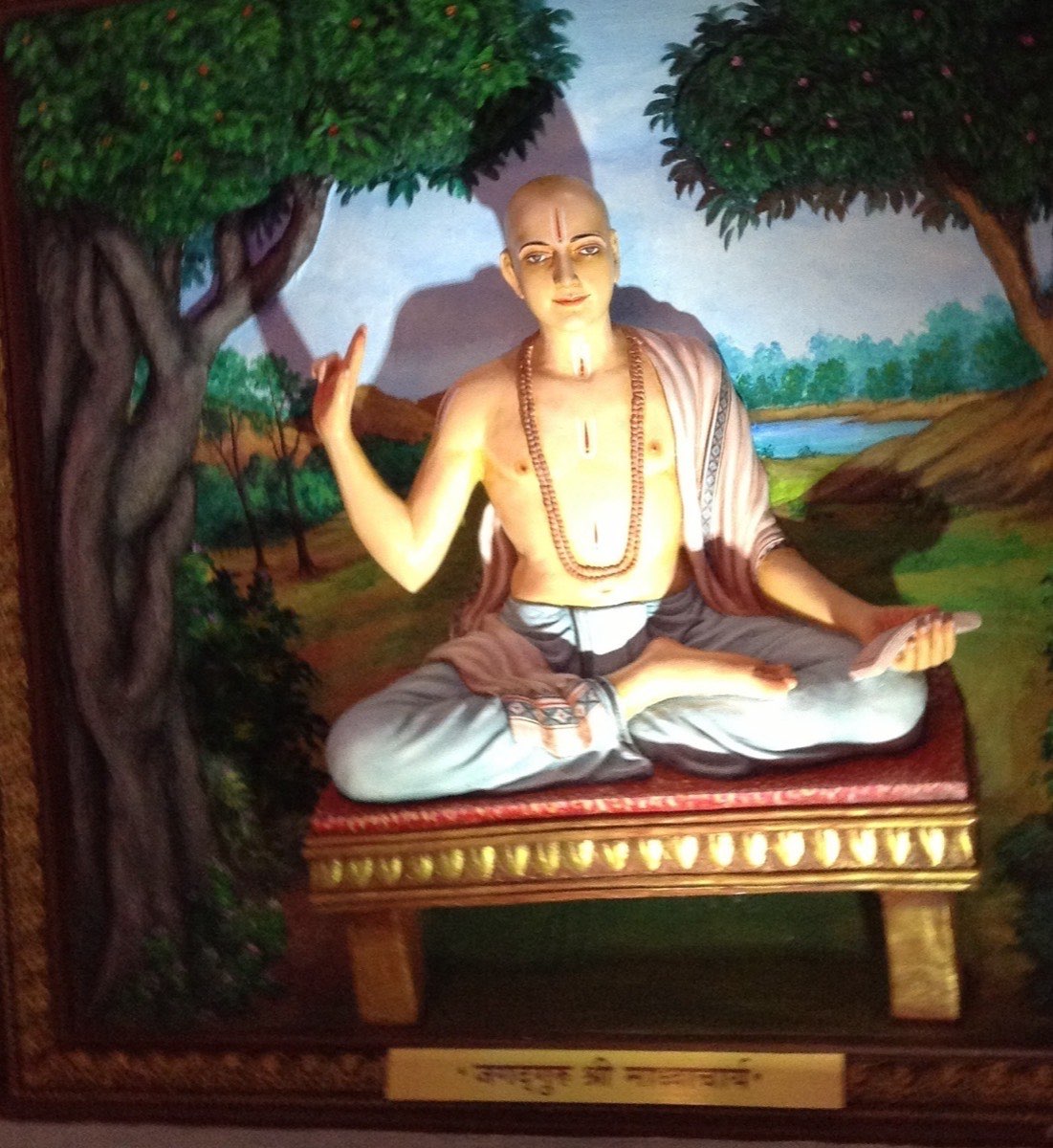
Introduction
Madhvācārya (Sanskrit: मध्वाचार्य; c. 1238–1317 CE), also known by his monastic names Pūrṇa Prajña (“full wisdom”) and Ānanda Tīrtha (“ford of bliss”), was one of the most influential philosopher-theologians in the history of Hinduism. He is the founder of the Dvaita (“dualism”) school of Vedānta — the third of the three great Vedāntic traditions, alongside Śaṅkarācārya’s Advaita (“non-dualism”) and Rāmānujācārya’s Viśiṣṭādvaita (“qualified non-dualism”). Together, these three systems constitute the principal philosophical frameworks through which Hindus have interpreted the relationship between the individual soul (ātman), the material world (jagat), and the supreme reality (Brahman) for the past millennium.
Madhvācārya’s central thesis — that God (Viṣṇu/Nārāyaṇa) and the individual soul are eternally, irreducibly distinct, and that liberation (mokṣa) is achieved only through the grace of God, never by the soul’s own effort alone — represented a bold and systematic rejection of the Advaitic claim that the individual self and Brahman are ultimately identical. His philosophy, also called Tattvavāda (“the doctrine of reality”), insisted on the full reality of God, souls, and the material world, and on the eternal dependence of the latter two upon the former (Britannica, “Madhva”).
An extraordinary polymath, Madhvācārya authored thirty-seven works in Sanskrit, including commentaries on the Brahma Sūtras, the principal Upaniṣads, the Bhagavad Gītā, and the Mahābhārata. He founded the Śrī Kṛṣṇa Maṭha at Uḍupī and the eight maṭhas (Aṣṭa Maṭhas) that continue to administer the temple to this day. His philosophical and institutional legacy endures as a living force in Indian religious life, particularly in Karnataka and among the broader Mādhva Vaiṣṇava community.
Early Life
Madhvācārya was born as Vāsudeva in the village of Pājaka (near Uḍupī) on the western coast of Karnataka, in a Tulu-speaking Śivallī Brāhmaṇa family. His father was Madhyageha Bhaṭṭa (also called Nādillāya), and his mother was Vedavatī. Traditional hagiographies — particularly the Madhvavijaya composed by his disciple Nārāyaṇa Paṇḍitācārya — describe numerous miraculous events surrounding his birth and childhood, portraying him as an incarnation of Vāyu (the wind god), who had previously incarnated as Hanumān and Bhīma (Wikipedia, “Madhvacharya”).
From childhood, Vāsudeva displayed extraordinary intellectual abilities. He is said to have mastered the Vedas at a remarkably young age and to have shown an early predisposition toward philosophical argument and devotion to Viṣṇu. The hagiographies describe him as physically powerful and athletic — a characteristic consistent with his identification as an incarnation of Vāyu, the god of strength and life-breath.
Initiation and Early Monastic Life
At the age of approximately eleven or twelve, the young Vāsudeva took sannyāsa (monastic renunciation) under the guidance of Acyutaprekṣa (also known as Acyutaprajña), a scholar of the Advaita tradition who headed a monastery in the Ekadaṇḍī order associated with the Brahma Sampradāya. Upon initiation, he received the monastic name Pūrṇa Prajña, later changed to Ānanda Tīrtha.
The relationship between Madhvācārya and his guru Acyutaprekṣa is one of the most striking in Indian philosophical history. The disciple almost immediately began challenging his teacher’s Advaitic interpretations. Where Acyutaprekṣa taught that Brahman and the individual soul are ultimately identical (tat tvam asi — “thou art that”), Madhvācārya argued that the scriptures teach an eternal distinction between God and the soul, and that the Advaitic reading rests on a misinterpretation of key Vedāntic texts. According to the Madhvavijaya, the force of Madhvācārya’s arguments eventually persuaded Acyutaprekṣa himself to accept the Dvaita position — though this claim is hagiographic and not independently confirmed (Internet Encyclopedia of Philosophy, “Madhva”).
The Dvaita Philosophy
Core Principles
Madhvācārya’s philosophical system rests on five fundamental distinctions (pañca-bheda) that are eternal and irreducible:
- Jīva and Īśvara (individual soul and God): The soul is eternally dependent on God and never identical with Him.
- Jīva and Jīva (one soul and another): Each individual soul is unique and distinct from every other soul.
- Jīva and Jaḍa (soul and matter): Conscious souls and inert matter are fundamentally different in nature.
- Īśvara and Jaḍa (God and matter): God is the independent controller of matter, which is entirely dependent on Him.
- Jaḍa and Jaḍa (one material entity and another): Individual material objects are distinct from one another.
This framework of pañca-bheda stands in sharp contrast to Advaita Vedānta, which holds that all distinctions are ultimately illusory (māyā) and that only Brahman is real. For Madhvācārya, these distinctions are not illusions to be transcended but realities grounded in the very nature of existence. He called his system Tattvavāda (“realism” or “the doctrine of reality”) precisely because it affirmed the full reality of God, souls, and the world (New World Encyclopedia, “Madhva”).
The Nature of God
For Madhvācārya, the supreme reality is a personal God — specifically, Viṣṇu (or Nārāyaṇa) — who possesses infinite auspicious qualities (ananta-kalyāṇa-guṇa) and is entirely independent (svatantra). All other entities — souls and matter — are dependent (paratantra) on God for their existence, nature, and activity.
God is the efficient and material cause of the universe, the inner controller (antaryāmin) of all beings, and the sole granter of liberation. Madhvācārya insisted that God’s nature is revealed in scripture (the Vedas, the Bhagavad Gītā, the Brahma Sūtras, and the Purāṇas, especially the Bhāgavata Purāṇa) and cannot be fully grasped by unaided human reason.
The Hierarchy of Souls
One of the most distinctive — and controversial — doctrines of Dvaita Vedānta is the teaching of svarūpa-bheda (intrinsic difference among souls) and the related doctrine of taratamya (hierarchical gradation). Madhvācārya taught that souls differ not merely in their accumulated karma but in their intrinsic spiritual capacity. Some souls are inherently suited for liberation (mukti-yogya), others are destined for eternal transmigration (nitya-saṁsārin), and a third class is destined for eternal damnation (tamo-yogya).
This doctrine of the inherent gradation of souls is unique to Dvaita Vedānta and has no parallel in Advaita or Viśiṣṭādvaita. It has been the subject of intense philosophical debate and criticism, but Madhvācārya grounded it in his reading of scriptural passages, particularly those from the Bhagavad Gītā (16.19–20) that describe certain beings as born into demonic (āsurī) natures (Internet Encyclopedia of Philosophy, “Madhva”).
Liberation (Mokṣa)
Liberation in Dvaita Vedānta is not the merging of the individual soul into Brahman (as in Advaita) but the soul’s attainment of its highest natural bliss in the eternal presence of God. The liberated soul retains its individual identity forever; it does not become God but enjoys God’s presence in a state of supreme happiness (ānanda), free from the bondage of karma and rebirth.
Liberation is achieved through bhakti (devotion), jñāna (knowledge), and vairāgya (detachment), but ultimately depends on the grace (prasāda) of God. No amount of self-effort alone can secure mokṣa; God must choose to liberate the soul. This emphasis on divine grace places Madhvācārya’s soteriology squarely within the broader Vaiṣṇava tradition and anticipates the later devotional theology of the Haridāsa movement in Karnataka.
Travels and Debates
Madhvācārya is traditionally credited with undertaking extensive travels across the Indian subcontinent. The hagiographies describe two major tours:
First Tour (Northern India): Madhvācārya is said to have travelled to Badarīnāth in the Himalayas, where he met the legendary sage Vyāsa (the compiler of the Vedas and author of the Mahābhārata) in his hermitage at Badarikāśrama. There, Vyāsa is said to have approved Madhvācārya’s commentary on the Brahma Sūtras and blessed his mission. While this encounter is obviously hagiographic, it served to establish Madhvācārya’s authority as a direct recipient of the Vyāsa lineage (Wikipedia, “Madhvacharya”).
Second Tour: Madhvācārya undertook a second journey, again visiting northern India and engaging in philosophical debates with scholars of competing schools — Advaita, Buddhist, and Jaina. The hagiographies portray him as invariably victorious in these debates, establishing the supremacy of Dvaita Vedānta through logical rigour and scriptural command.
Literary Works
Madhvācārya’s literary output is remarkable both in quantity and range. He is credited with thirty-seven works (sarva-mūla-grantha) in Sanskrit, which form the canonical textual foundation of the Dvaita school. The most important include:
Commentaries on the Prasthānatrayī
- Brahma Sūtra Bhāṣya: His commentary on Bādarāyaṇa’s Brahma Sūtras, interpreting the aphorisms through a dualistic lens and systematically refuting the Advaitic readings of Śaṅkara.
- Anuvyākhyāna: A supplementary philosophical poem on the Brahma Sūtras, considered by many Mādhva scholars to be his greatest work. It is composed in verse and is noted for its poetic beauty as well as its philosophical depth. Tradition holds that Madhvācārya dictated all four chapters simultaneously to four different disciples.
- Gītā Bhāṣya: His commentary on the Bhagavad Gītā.
- Gītā Tātparya Nirṇaya: A further exposition of the Gītā’s meaning, supplementing the Bhāṣya.
- Upaniṣad Bhāṣyas: Commentaries on ten principal Upaniṣads (Īśa, Kena, Kaṭha, Praśna, Muṇḍaka, Māṇḍūkya, Aitareya, Taittirīya, Bṛhadāraṇyaka, Chāndogya).
Other Major Works
- Mahābhārata Tātparya Nirṇaya: A comprehensive treatise extracting the philosophical and theological essence of the Mahābhārata, treating it as a Vaiṣṇava scripture.
- Bhāgavata Tātparya Nirṇaya: A similar treatment of the Bhāgavata Purāṇa.
- Viṣṇu Tattva Vinirṇaya: A work establishing the supremacy of Viṣṇu through scriptural and logical argumentation.
- Pramāṇa Lakṣaṇa: A treatise on epistemology, establishing the valid means of knowledge (pramāṇas) — perception, inference, and scripture.
- Tattva Saṅkhyāna and Tattva Viveka: Short philosophical works summarising the categories of reality in Dvaita metaphysics.
- Dvādaśa Stotra: Twelve devotional hymns to Viṣṇu that are still recited daily in Mādhva households and maṭhas (Britannica, “Madhva”).
The Uḍupī Kṛṣṇa Temple and the Aṣṭa Maṭhas
One of Madhvācārya’s most enduring institutional achievements is the establishment of the Śrī Kṛṣṇa Maṭha at Uḍupī and the eight surrounding monasteries (Aṣṭa Maṭhas) that administer it.
The Discovery of the Kṛṣṇa Idol
According to tradition, Madhvācārya discovered the idol of Bāla Kṛṣṇa (the child Kṛṣṇa holding a butter churn) inside a lump of gopīcandana (sacred clay) that had arrived in a ship from Dvārakā. The hagiographies relate that the ship was in distress off the coast of Uḍupī, and Madhvācārya, by waving his upper garment, guided it safely to shore. In gratitude, the captain offered him the lumps of gopīcandana as cargo. Madhvācārya, perceiving the presence of a divine image within one of the clay masses, broke it open and revealed the exquisite mūrti of Kṛṣṇa. He consecrated the idol in 1285 CE and personally worshipped it for twenty years (Wikipedia, “Madhvacharya”; Factum IAS).
The Eight Maṭhas
Madhvācārya appointed eight of his closest disciples as the heads of eight monasteries surrounding the Kṛṣṇa temple:
- Palimāru Maṭha — founded by Hṛṣīkeśa Tīrtha
- Adamāru Maṭha — founded by Narasiṁha Tīrtha
- Kṛṣṇapura Maṭha — founded by Janārdana Tīrtha
- Puṭṭige Maṭha — founded by Upendra Tīrtha
- Śirūru Maṭha — founded by Vāmana Tīrtha
- Sode Maṭha — founded by Viṣṇu Tīrtha
- Kaniyūru Maṭha — founded by Rāma Tīrtha
- Pejāvara Maṭha — founded by Adhokṣaja Tīrtha
These eight maṭhas were assigned the duty of administering the temple and performing the daily worship of Lord Kṛṣṇa in rotation — originally every two months, later modified by Śrī Vadirāja Tīrtha in the 16th century to a two-year cycle known as the Paryāya system. This system continues to function to the present day, making the Uḍupī Kṛṣṇa temple one of the most continuously and systematically administered religious institutions in India (Wikipedia, “Ashta Mathas of Udupi”).
Madhvācārya’s Critique of Advaita
A central dimension of Madhvācārya’s philosophical project was his systematic critique of Śaṅkara’s Advaita Vedānta. His objections were both logical and scriptural:
The Problem of Māyā
Advaita teaches that the world of multiplicity is an appearance (vivarta) projected by māyā (cosmic illusion) upon the one, undifferentiated Brahman. Madhvācārya argued that this doctrine is self-refuting: if māyā is real, then there are at least two realities (Brahman and māyā), contradicting non-dualism; if māyā is unreal, it cannot produce the appearance of the world. He pressed this dilemma relentlessly in his Brahma Sūtra Bhāṣya and Anuvyākhyāna (Internet Encyclopedia of Philosophy, “Madhva”).
Scriptural Interpretation
Madhvācārya accused Śaṅkara of misinterpreting key Upaniṣadic texts. The famous mahāvākya “tat tvam asi” (“thou art that,” Chāndogya Upaniṣad 6.8.7), which Advaita reads as an identity statement between the individual self and Brahman, was reinterpreted by Madhvācārya as “atat tvam asi” — “thou art not that” — arguing that the negative particle a had been dropped by Advaitic exegesis. While this particular interpretation has been criticised by scholars of other schools, it illustrates Madhvācārya’s willingness to challenge received readings at the most fundamental textual level.
The Reality of the World
Against the Advaitic teaching that the world is ultimately unreal (mithyā), Madhvācārya insisted that the world is fully real (satya) — created, sustained, and ultimately dependent on God, but not illusory. He argued that the everyday experience of a real, differentiated world is a valid source of knowledge (pramāṇa) and should not be dismissed as ignorance (avidyā).
Legacy and Influence
The Mādhva Vaiṣṇava Tradition
Madhvācārya’s philosophical and institutional legacy gave rise to a vibrant religious community — the Mādhva Vaiṣṇavas — centred in Karnataka but with adherents across India. The Aṣṭa Maṭhas of Uḍupī remain the institutional heart of this tradition, and the Paryāya festival, marking the transfer of temple administration between maṭhas, is one of the most important religious events in coastal Karnataka.
The Haridāsa Movement
Madhvācārya’s emphasis on devotion to a personal God (Viṣṇu/Kṛṣṇa), the reality of the world, and the possibility of divine grace laid the philosophical groundwork for the Haridāsa movement — the great Kannada devotional literary tradition that flourished from the 15th to the 17th centuries. Luminaries such as Purandaradāsa (the “father of Carnatic music”), Kanakadāsa, Vijaya Dāsa, and Jaganātha Dāsa were all Mādhva Vaiṣṇavas, and their compositions — the dāsakūṭa (devotional songs) and suḷādi (philosophical poems) — are integral to both Karnataka’s cultural heritage and the Carnatic musical tradition.
Influence on Later Vaiṣṇavism
Madhvācārya’s theology also influenced the development of the Gauḍīya Vaiṣṇava tradition of Bengal. Caitanya Mahāprabhu (1486–1534), the founder of Gauḍīya Vaiṣṇavism, traced his spiritual lineage through the Brahma Sampradāya — the same disciplic succession to which Madhvācārya belonged. While Caitanya’s acintya-bhedābheda (“inconceivable simultaneous difference and non-difference”) theology differs from strict Dvaita, the structural and devotional continuities are significant (New World Encyclopedia, “Madhva”).
The Three Ācāryas
In the landscape of Vedāntic philosophy, Madhvācārya is honoured as one of the three great ācāryas — the three founding teachers of the three principal schools of Vedānta. Together with Śaṅkarācārya (Advaita, c. 8th century) and Rāmānujācārya (Viśiṣṭādvaita, 1017–1137 CE), he defined the terms of the most important philosophical debate in Hindu intellectual history: the nature of the relationship between God, the soul, and the world. While they disagreed profoundly on the answers, their shared framework of commentary on the Prasthānatrayī (Brahma Sūtras, Upaniṣads, and Bhagavad Gītā) established the enduring structure of Vedāntic discourse.
Conclusion
Madhvācārya’s life and work represent one of the supreme achievements of Indian philosophical and religious thought. In an intellectual landscape dominated by the monistic vision of Śaṅkara, he dared to insist on the irreducible reality of difference — between God and the soul, between one soul and another, between the divine and the material. His Dvaita Vedānta offered a philosophically rigorous defence of theistic devotion, arguing that love for a personal God is not a lower rung on the ladder to impersonal realisation but the highest truth of existence.
His institutional genius — the founding of the Uḍupī Kṛṣṇa temple and the Aṣṭa Maṭhas with their Paryāya system — ensured that his philosophical vision would be carried forward not merely in texts but in living practice. And his literary output — thirty-seven works of extraordinary range and depth — provided the Dvaita school with a scriptural and philosophical foundation that has sustained it for over seven centuries.
As his Dvādaśa Stotra proclaims: vandé vandyaṁ sadānandaṁ vāsudevaṁ nirañjanam — “I worship the ever-blissful Vāsudeva, worthy of worship, free from all impurity.” In those words lives the essence of Madhvācārya’s vision: a universe in which the supreme God is real, the individual soul is real, and the loving relationship between them is the most real thing of all.