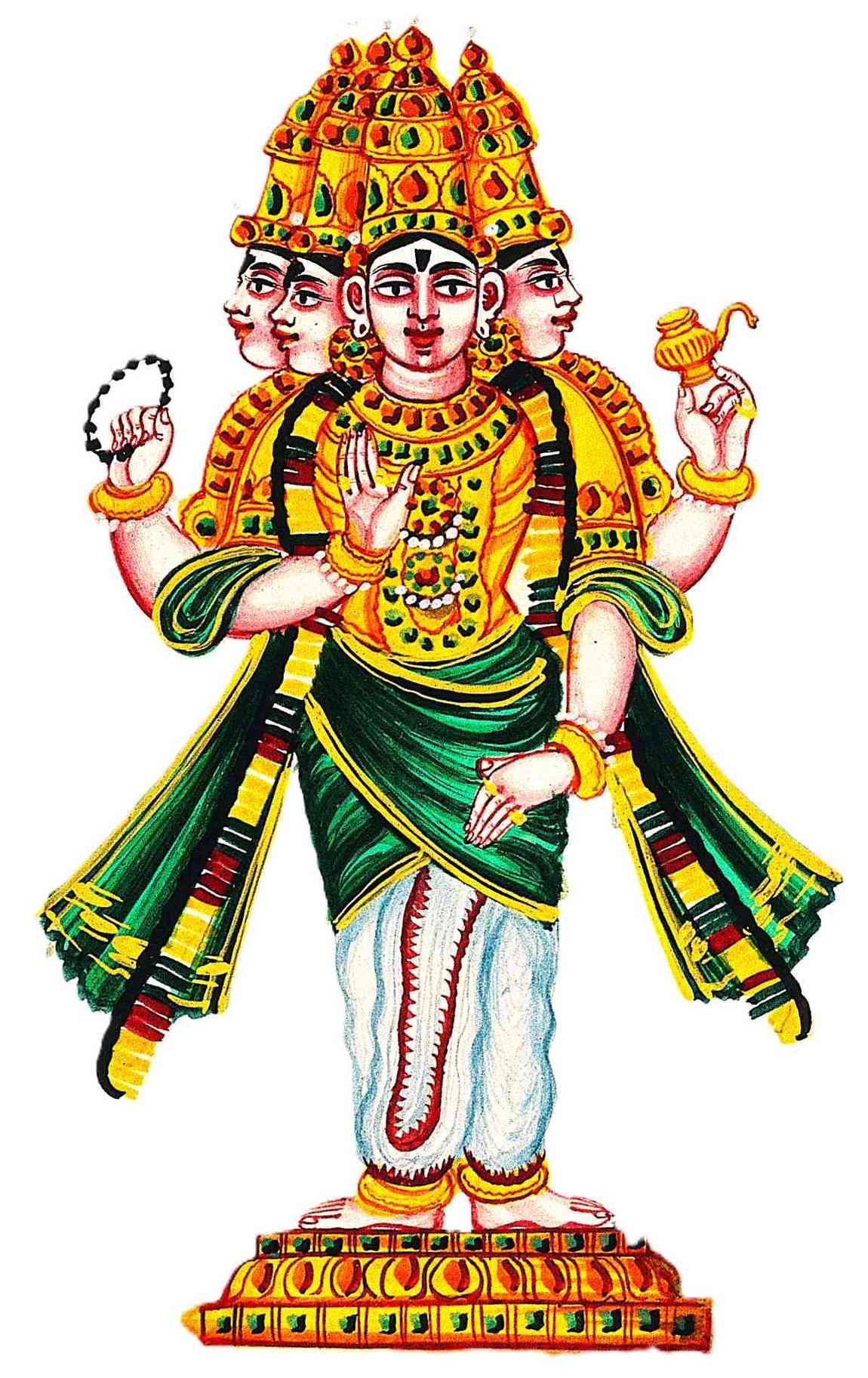
Lord Brahmā (ब्रह्मा), revered as the creator of the universe, is one of the three principal deities of Hinduism forming the Trimūrti alongside Viṣṇu (the preserver) and Śiva (the destroyer). While Viṣṇu and Śiva command vast devotional followings, Brahmā occupies a unique and contemplative position in Hindu theology — honoured in scripture as the progenitor of all living beings, yet rarely worshipped in temples today.
Role in the Trimūrti
The concept of the Trimūrti, meaning “three forms,” emerged prominently in the Purāṇas during the first millennium CE. In this cosmic framework, Brahmā is responsible for sṛṣṭi (creation), Viṣṇu for sthiti (preservation), and Śiva for saṃhāra (dissolution). Together they represent the cyclical nature of existence: the universe is born, sustained, and ultimately dissolved, only to be created anew.
The Viṣṇu Purāṇa describes Brahmā as emerging from a lotus that grew from the navel of Viṣṇu as he rested upon the cosmic serpent Śeṣa in the primordial ocean. In this account, Brahmā is a “secondary creator” — he fashions the forms and beings of the universe, but the primordial reality from which he arises is Viṣṇu himself. Śaiva texts, conversely, present Brahmā and Viṣṇu as emerging from Śiva.
Chaturmukha: The Four Heads
Brahmā is famously depicted with four heads (Chaturmukha), each facing a cardinal direction. According to the Purāṇas, he originally possessed five heads. The story of how he lost the fifth head is among the most significant legends associated with him.
The Legend of the Fifth Head
After creating the universe, Brahmā fashioned a beautiful woman named Śatarūpā from his own being. Overwhelmed by her beauty, he could not avert his gaze. As Śatarūpā moved to escape his stare, Brahmā grew additional heads — one for each direction she turned — until a fifth head appeared atop the others to watch her when she leaped skyward.
Lord Śiva, witnessing this impropriety, severed the fifth head to remind Brahmā that a creator must not develop attachment to his own creation. In another version found in the Śiva Purāṇa, the fifth head was cut off because Brahmā falsely claimed to have found the top of an infinite pillar of light (the Jyotirliṅga) — a lie born of arrogance.
The four remaining heads are said to represent the four Vedas (Ṛg, Yajur, Sāma, and Atharva), the four yugas (cosmic ages), the four varṇas (social orders), and the four directions of the compass.
Iconography and Symbols
Brahmā’s iconographic representation is rich with spiritual symbolism.
Sacred Objects
He is typically depicted with four arms, each holding a significant object:
-
The Vedas (sacred texts): Symbolize divine knowledge and the revealed wisdom that Brahmā transmitted to the sages at the dawn of creation.
-
Akṣamālā (prayer beads / rosary): Represent time, meditation, and the cyclical nature of cosmic existence.
-
Kamaṇḍalu (water pot): Signifies the primordial waters from which creation emerged, as well as purity and the sustaining power of life.
-
Padma (lotus): Represents truth, purity, and the creative potential of the universe, often depicted as his seat as well.
Haṃsa Vāhana
Brahmā’s vāhana (divine mount) is the haṃsa — a swan or goose. The haṃsa holds special significance in Hindu philosophy: it is said to possess the ability to separate milk from water when the two are mixed, symbolizing viveka (discernment) — the capacity to distinguish truth from illusion, the eternal from the transient.
Appearance
Brahmā is often portrayed with a reddish or golden complexion, wearing white or red garments, and bearing a long white beard that signifies the ancient wisdom of creation. He is sometimes shown seated upon a lotus throne.
Consort: Goddess Sarasvatī
Brahmā’s consort is Sarasvatī, the goddess of knowledge, music, arts, and learning. The relationship between Brahmā and Sarasvatī reflects the inseparability of creative power and wisdom: creation without knowledge would be formless chaos, and knowledge without manifestation would remain unrealized potential.
Sarasvatī is also associated with the haṃsa, and she is said to have emerged from Brahmā’s creative essence. Together, they represent the principle that the universe was brought into being through both will (icchā) and knowledge (jñāna).
Creation Mythology
The Golden Egg (Hiraṇyagarbha)
One of the most ancient creation narratives, found in the Ṛg Veda and elaborated in the Purāṇas, describes how the universe began as a vast expanse of water upon which rested a golden egg (Hiraṇyagarbha). Brahmā slept within this cosmic egg for a thousand divine ages before awakening. Upon emerging, he split the egg into two halves — one becoming the heavens and the other the earth — and then proceeded to create all living beings, the elements, time, and the natural laws.
The Brahmā Purāṇa Account
The Brahmā Purāṇa, one of the eighteen Mahāpurāṇas comprising approximately 10,000 verses, glorifies Brahmā as the architect of the cosmos. It describes how Brahmā created the Prajāpatis (progenitors of humanity), the Mānasaputras (mind-born sons such as the Sanatkumāras and Marīci), the elements, celestial bodies, and the moral order.
The Viṣṇu Purāṇa presents a complementary account in which Brahmā creates from his own nature: from his mind came the gods, from his body the demons, from his speech the Vedas, and from various parts of his being the animals, plants, and all forms of life.
Why Brahmā Is Rarely Worshipped
Despite his exalted role as creator, Brahmā has very few temples dedicated to him in India. Several mythological explanations account for this unusual absence.
The Curse of Savitrī
According to a prominent legend associated with the Pushkar temple, Brahmā once performed a great yajña (fire sacrifice) that required the presence of his wife. When his consort Savitrī was delayed, Brahmā married a local woman named Gāyatrī to complete the ritual in time. Upon arriving and discovering this, Savitrī cursed Brahmā, declaring that he would receive no worship anywhere on earth. After the intervention of the other devas, she softened the curse, permitting his worship only at Pushkar in Rajasthan.
Śiva’s Decree
As described above, after Brahmā’s transgression regarding Śatarūpā (or his falsehood about the Jyotirliṅga), Śiva decreed that Brahmā would not receive regular worship from humanity — a consequence of either improper desire or dishonesty.
The Pushkar Temple
The Brahmā Temple at Pushkar, located in Rajasthan, is widely regarded as the most prominent temple dedicated to Brahmā in the world. Built in the 14th century CE, the temple features a distinctive red spire and a marble structure adorned with images of the haṃsa.
Every year on Kārtik Pūrṇimā — the full moon of the Hindu month of Kārtik (October-November) — thousands of pilgrims gather at Pushkar to bathe in the sacred Pushkar Lake and offer prayers to Brahmā during the annual Pushkar Fair.
Brahmā and Brahman: A Vital Distinction
It is essential to distinguish Brahmā (ब्रह्मा), the personal creator deity, from Brahman (ब्रह्मन्), the ultimate metaphysical reality described in the Upaniṣads.
-
Brahmā is a masculine deity with form, attributes, and a specific role in cosmic creation. He is born, acts, and exists within the framework of time and space.
-
Brahman is the genderless, formless, infinite, and eternal absolute reality — the ground of all existence from which the entire universe, including the gods themselves, arises. In Advaita Vedānta, Brahman is identical with Ātman (the true self), and the realisation of this identity is the goal of spiritual life.
The Upaniṣads describe Brahman as “satyam jñānam anantam” — truth, knowledge, and infinity. Brahmā, Viṣṇu, and Śiva are understood in many Hindu philosophical systems as manifestations or aspects of this one Brahman.
Names and Epithets
Brahmā is known by many sacred names reflecting his nature and deeds:
- Prajāpati — “Lord of creatures”
- Pitāmaha — “Grandfather” (of all beings)
- Hiraṇyagarbha — “The golden embryo”
- Lokeśa — “Lord of the worlds”
- Svayambhū — “The self-existent one”
- Vāgīśa — “Lord of speech”
- Kamalāsana — “He who sits on the lotus”
- Chaturānana — “The four-faced one”
For seekers of wisdom, Brahmā represents the profound truth that creation itself is an act of divine knowledge. Though his temples are few, his presence pervades every corner of the cosmos he brought into being — in every syllable of the Vedas, every cycle of time, and every stirring of life.