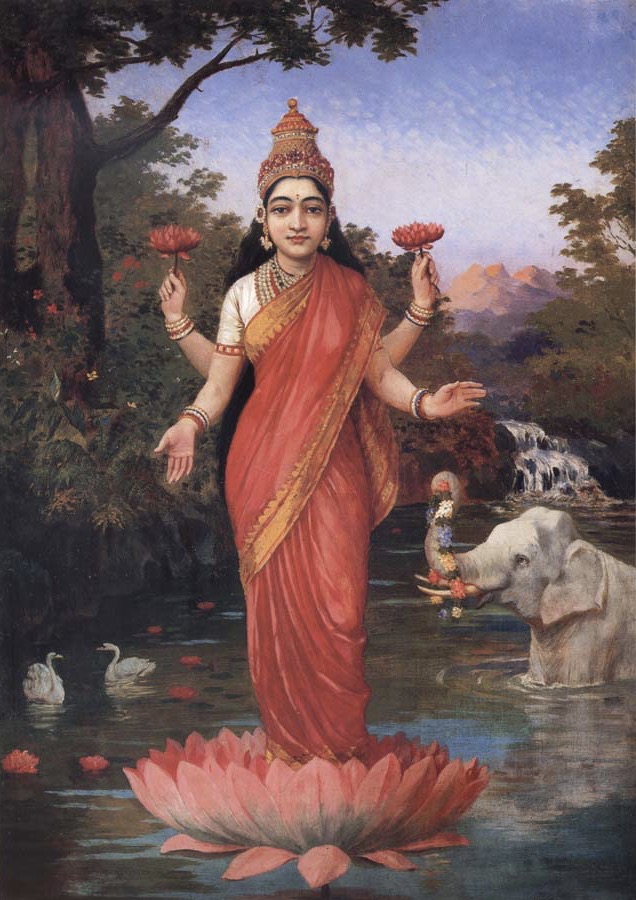
Goddess Lakṣmī (लक्ष्मी), also known as Śrī (श्री, “radiance, prosperity”), Padmā (पद्मा, “she of the lotus”), and Mahālakṣmī (महालक्ष्मी, “the great Lakṣmī”), is one of the principal deities of Hinduism. She is the goddess of wealth, fortune, beauty, fertility, and prosperity — both material and spiritual. As the eternal consort of Lord Viṣṇu, she embodies the creative energy that sustains the universe and accompanies him in every incarnation.
Vedic Origins and the Śrī Sūkta
The earliest literary reference to Lakṣmī appears in the Śrī Sūkta, a devotional hymn appended to the Ṛg Veda (found in the Bāṣkala śākhā). Scholars date these Rigvedic khilāni to the pre-Buddhist era. The hymn addresses Śrī as “glorious, ornamented, royal, lustrous as gold, and radiant as fire, moon, and the sun,” and entreats her to bestow “fame, bounty and abundance in the form of gold, cattle, horses, and food” (Śrī Sūkta, verses 1—15). Notably, the Śrī Sūkta already employs the motifs of the lotus (padma) and elephant (gaja) that remain inseparable from Lakṣmī’s iconography to this day.
In the Śatapatha Brāhmaṇa (composed c. 800—300 BCE), Śrī emerges from Prajāpati after his intense meditation on the creation of life, marking an important step in her transition from an abstract concept of auspiciousness to a fully personified deity.
The Samudra Manthan: Birth from the Ocean
The most celebrated origin story of Lakṣmī comes from the Samudra Manthana (Churning of the Ocean), narrated in the Viṣṇu Purāṇa (Book I, Chapter IX), the Bhāgavata Purāṇa (Canto 8, Chapters 5—12), and the Rāmāyaṇa. When the Devas (gods) and Asuras (demons) churned the Kṣīrasāgara (Ocean of Milk) using Mount Mandara as the churning rod and the serpent Vāsuki as the rope, fourteen precious treasures (ratnas) emerged. Among these divine gifts, Lakṣmī arose from the ocean waves, seated upon a fully bloomed lotus flower, radiating golden brilliance.
All the gods and demons desired her, but Lakṣmī chose Lord Viṣṇu as her eternal consort, placing a garland around his neck. According to the Viṣṇu Purāṇa, she declared that she would dwell wherever Viṣṇu resides, for he alone embodies the qualities worthy of her devotion.
Sacred Iconography
Lakṣmī’s visual representation is rich with symbolic meaning, deeply rooted in Hindu philosophical concepts.
The Lotus (Padma)
Lakṣmī is almost always depicted standing or seated upon a lotus (padmāsana), holding lotuses in her hands. The lotus blooms in muddy water yet remains untouched by impurity, symbolising spiritual purity, self-knowledge, and liberation (mokṣa) regardless of one’s circumstances.
Four Arms
Her four arms represent the four puruṣārthas — the four goals of human life according to Hindu philosophy: dharma (righteous conduct), artha (material prosperity), kāma (emotional fulfilment and love), and mokṣa (spiritual liberation). One hand typically bestows gold coins in a flowing stream (varada mudrā), signifying her ceaseless generosity.
Elephants (Gaja Lakṣmī)
In the classic Gaja Lakṣmī representation, two elephants flank the goddess, showering her with water from their trunks or from golden pots. The elephants symbolise royal authority, fertilising rains, and the bounty of the earth. Ancient Hindu tradition associated elephants with rain-bearing clouds, reinforcing Lakṣmī’s connection to agricultural prosperity and the sustenance of life.
Golden Complexion
Her radiant golden colour represents fulfilment, abundance, and the warmth of the sun that nourishes all life.
Consort of Viṣṇu: Incarnations Across Avatars
Whenever Viṣṇu incarnates on earth, Lakṣmī accompanies him as his consort. The Padma Purāṇa, Viṣṇu Purāṇa, and Bhāgavata Purāṇa all affirm this. Her most celebrated incarnations include:
- Sītā — consort of Lord Rāma (the Tretā Yuga avatar), embodying devotion, virtue, and patience as described in the Rāmāyaṇa
- Rukmiṇī — the first and supreme queen of Lord Kṛṣṇa (the Dvāpara Yuga avatar), described as an incarnation of Lakṣmī in the Bhāgavata Purāṇa (Canto 10)
- Padmāvatī — according to the Kalki Purāṇa, the consort who will accompany the future Kalki avatar in the Satya Yuga
- Dharaṇī (Earth) — consort of the Varāha (boar) avatar of Viṣṇu
This eternal bond reflects the understanding that the divine masculine (Preserver) and divine feminine (Sustainer through abundance) are inseparable aspects of cosmic order.
Aṣṭa Lakṣmī: The Eight Forms of Prosperity
Hindu tradition recognises eight manifestations of Lakṣmī, collectively known as Aṣṭa Lakṣmī, each presiding over a distinct form of wealth. Popularised through the Aṣṭalakṣmī Stotra, this concept teaches that true prosperity encompasses far more than material riches:
- Ādi Lakṣmī (the Primordial) — bestows spiritual wealth and liberation (mokṣa)
- Dhana Lakṣmī (Wealth) — grants material and monetary abundance
- Dhānya Lakṣmī (Grain) — provides agricultural wealth and sustenance
- Gaja Lakṣmī (Elephants) — confers royal power and animal wealth
- Santāna Lakṣmī (Progeny) — blesses with children and family continuity
- Vīra Lakṣmī (Courage) — bestows valour and the strength to overcome adversity
- Vidyā Lakṣmī (Knowledge) — grants mastery of arts, sciences, and learning
- Vijaya Lakṣmī (Victory) — ensures success and triumph in all endeavours
Together, these eight forms represent a holistic vision of fulfilment — enriched not only by wealth but by knowledge, courage, family, and spiritual realisation.
Lakṣmī Pūjā and Diwali
The most prominent festival honouring Lakṣmī is Dīpāvalī (Diwali). On the third night, known as Lakṣmī Pūjā, devotees across India and the diaspora perform elaborate rituals to invite the goddess into their homes.
Tradition holds that Lakṣmī roams the earth on this night, entering homes that are clean, well-lit, and welcoming. Key elements of the worship include:
- Thorough cleaning and decoration of homes with raṅgolī patterns and oil lamps (dīyas)
- Worship of Lakṣmī alongside Gaṇeśa (the remover of obstacles), who is invoked first
- Offerings of incense, lamps, flowers, sweets, and fresh fruits
- Recitation of the Śrī Sūkta and Lakṣmī-specific mantras
- Opening of new account books by merchants and businesspeople, seeking blessings for the coming financial year
Beyond Diwali, Fridays are traditionally dedicated to Lakṣmī worship, and many Hindu households begin each day with prayers seeking her blessings.
Significance in Daily Life and Commerce
Lakṣmī’s influence extends deeply into everyday Hindu life. Indian merchants have historically invoked her before commencing new ventures, and her image is found in shops, offices, and commercial establishments across South Asia.
However, Hindu scriptures caution that Lakṣmī is chañchalā (fickle) — she does not remain with those who hoard wealth selfishly or acquire it through adharmic (unrighteous) means. The Viṣṇu Purāṇa teaches that true prosperity requires ethical conduct, generosity, and devotion. Wealth must flow outward through charity (dāna) and righteous action, just as Lakṣmī’s hands ceaselessly pour gold coins for the benefit of all beings.
Names and Epithets
Lakṣmī is celebrated by numerous names: Śrī (auspiciousness), Padmā / Kamalā (she of the lotus), Haripriyā (beloved of Viṣṇu), Lokamātā (mother of the world), Kṣīrasāgarakanyakā (daughter of the Ocean of Milk), Indirā (beauty), and Ramā (she who delights).
For devotees, Goddess Lakṣmī represents the divine assurance that prosperity in all its dimensions — material, intellectual, familial, and spiritual — is accessible to those who live with dharma, devotion, and generosity. Her worship is a reminder that true wealth lies not merely in accumulation but in the grace of sharing it with the world.