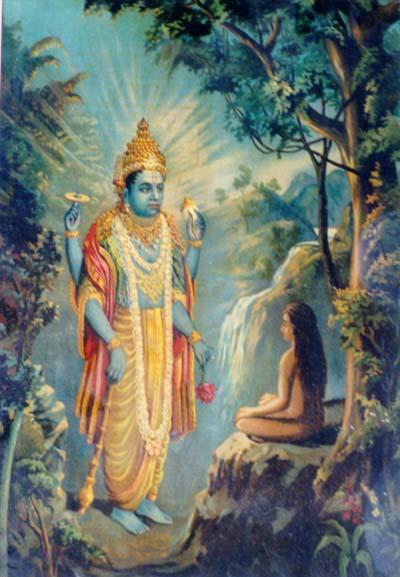
Dhruva (ध्रुव, “The Immovable One”) is one of the most inspiring figures in Hindu mythology — a five-year-old prince who, stung by rejection and injustice, embarked upon a spiritual quest so extraordinary that it won him an eternal, unshakeable place in the cosmos. His story, narrated in the Bhāgavata Purāṇa (Canto 4, Chapters 8-12) and the Viṣṇu Purāṇa (Book 1, Chapters 11-12), transforms a tale of childhood grief into one of the most powerful allegories of devotion, determination, and divine grace in all of Hindu scripture.
The very name “Dhruva” has come to mean “fixed,” “immovable,” and “steadfast” in Sanskrit — a meaning that applies equally to his character, his devotion, and his final celestial station as the Pole Star (Dhruva Tārā), the one star in the night sky that never moves.
Lineage and Early Life
Dhruva was the son of King Uttānapāda, who was himself the son of Svāyambhuva Manu, the first Manu and progenitor of humanity. Uttānapāda had two queens: Sunīti (also called Sunṛtā), Dhruva’s mother, and Suruci, the favoured queen.
Sunīti, though virtuous and gentle, had fallen out of the king’s favour. Suruci, beautiful and ambitious, held sway over Uttānapāda’s heart and court. She had a son named Uttama. The stage was set for a childhood rejection that would reshape the cosmos.
The Rejection: A Child’s Grief
The pivotal incident that launched Dhruva’s spiritual journey is narrated in Bhāgavata Purāṇa 4.8. One day, the young Dhruva — barely five years old — saw his half-brother Uttama sitting on their father’s lap. With the innocent desire of any child for a father’s affection, Dhruva approached King Uttānapāda to climb onto his lap as well.
Before the king could respond, Queen Suruci intervened with cruel words that would echo through eternity:
“My dear child, you do not deserve to sit on the throne or on the lap of the king. You were not born from my womb. If you desire such a position, you should worship the Supreme Lord Nārāyaṇa and pray to be born from my womb in your next life.” (Bhāgavata Purāṇa 4.8.11-12)
King Uttānapāda, weak-willed and dominated by Suruci, remained silent — neither defending his firstborn son nor consoling him. The Bhāgavata describes Dhruva trembling with grief and anger, his lips quivering, his small chest heaving with sobs that shook his entire body.
The child ran to his mother Sunīti, who could offer only tears and the bitter truth: she had no power to change the king’s heart. Yet Sunīti, in her gentle wisdom, echoed Suruci’s words in a transformed spirit: “My dear son, if you truly desire the highest seat, then there is one who can give it to you — the Supreme Lord Viṣṇu. Go and worship Him.”
Thus, what began as a stepmother’s cruelty became, through a mother’s faith, the catalyst for one of the greatest spiritual journeys in Hindu scripture.
Meeting Sage Nārada
Dhruva left the palace with small, determined steps, walking toward the forest with a resolve that astonished even the celestial beings. The Bhāgavata Purāṇa describes the devas watching in wonder as a five-year-old child marched alone toward the wilderness to find God.
The great sage Nārada Muni, moved by the child’s extraordinary determination, appeared before Dhruva on the path. Nārada initially attempted to dissuade him:
“My dear boy, you are only a small child of five years. Why are you so affected by such words of insult? A person in the transcendental position should not be affected by honor or dishonor.” (Bhāgavata Purāṇa 4.8.22-23)
Nārada tested the boy’s resolve, pointing out the impossibility of a child surviving alone in the wilderness, the dangers of wild animals, and the extreme austerity required to see the Lord. Great sages had meditated for thousands of years without achieving Viṣṇu’s darśana (divine vision). How could a little boy hope to succeed?
But Dhruva was unmoved. His determination had hardened from childhood grief into spiritual adamant. Seeing the boy’s unshakeable resolve, Nārada was deeply moved. He recognized the hand of the divine and decided to guide the child.
Nārada instructed Dhruva in the practice of meditation and gave him the sacred twelve-syllable mantra:
Oṁ Namo Bhagavate Vāsudevāya (ॐ नमो भगवते वासुदेवाय)
He directed Dhruva to the sacred forest of Madhuvana, on the banks of the Yamunā river, and instructed him in the method of meditating upon the four-armed form of Lord Viṣṇu — holding the conch, disc, mace, and lotus.
The Extraordinary Tapas
What followed is one of the most remarkable penances described in Hindu literature. Dhruva, a child of five, undertook austerities that would have broken the will of the most seasoned ascetics.
The Bhāgavata Purāṇa (4.8.57-80) describes the progression of his tapas in Madhuvana:
First Month
Dhruva ate only fruits and berries, once every three days, while maintaining constant meditation on Viṣṇu.
Second Month
He reduced his food to dry grass and leaves, eating once every six days.
Third Month
He drank only water, once every nine days, while standing on one leg in meditation.
Fourth Month
He breathed only once every twelve days, inhaling air as his sole sustenance.
Fifth Month
Dhruva stood perfectly still on one leg, his mind completely merged in the form of Viṣṇu. He controlled even his breath entirely.
Sixth Month
By this time, Dhruva’s meditation had become so intense and one-pointed that his concentration shook the three worlds. Standing on one leg, he pressed down with his single toe, and the earth itself began to tilt under the spiritual weight of his tapas. The devas grew alarmed as their celestial abodes trembled.
The Bhāgavata Purāṇa (4.8.78) records: “When the boy Dhruva, controlling his breathing, stood on one toe, the entire earth trembled and the celestial beings in all the planetary systems felt disturbed.”
Viṣṇu’s Darśana
Pleased beyond measure by the extraordinary devotion of this child, Lord Viṣṇu decided to reveal Himself. The Bhāgavata Purāṇa (4.9) describes this transcendent moment.
First, the Lord withdrew the divine form from within Dhruva’s meditation, causing the boy to open his eyes in distress. And there, standing before him in blazing splendour, was Lord Viṣṇu Himself — the four-armed, lotus-eyed form, exactly as Nārada had described, adorned with the Śrīvatsa mark, wearing the Kaustubha jewel, resplendent upon Garuḍa.
Dhruva fell prostrate, overwhelmed with divine ecstasy. He wished to offer prayers but found that, being a child, he could not find the words. The Lord, understanding his devotee’s heart, touched Dhruva’s cheek with His divine conch shell. At that touch, the floodgates of spiritual wisdom opened, and Dhruva composed one of the most beautiful hymns in the Bhāgavata Purāṇa — the Dhruva Stuti (4.9.6-17):
“My dear Lord, You are all-powerful. After entering within me, You have enlivened all my sleeping senses — my speech, mind, sight, hearing, touch, and sense of smell. I offer my respectful obeisances unto You.” (4.9.6)
“My Lord, the transcendental body of Viṣṇu is full of bliss, knowledge, and eternity. He has no material body, yet He appears in many forms. Unto Him I offer my respectful obeisances.” (4.9.14)
The Transformation: From Revenge to Regret
One of the most profound moments in the narrative occurs when Dhruva, having received the Lord’s darśana and been offered any boon he desired, realizes the transformation that has occurred within his own heart.
He had originally set out driven by a child’s wounded pride and a burning desire to achieve a position greater than his stepmother’s son. But through the process of tapas and the Lord’s grace, his motivations had been completely purified. The Bhāgavata Purāṇa (4.9.35) records his famous confession:
“My dear Lord, I came searching for broken pieces of glass, thinking them to be diamonds, but now I have found the most valuable jewel. I was searching for a higher material position, but I have received the greatest treasure — Your darśana.”
This moment encapsulates a central teaching of the Bhakti tradition: one may begin the spiritual journey with selfish or mixed motives, but the process of sincere devotion itself purifies the heart. The seeker who comes to God for material gain may find that, having tasted divine love, all worldly desires fall away like dry leaves.
The Boon: Dhruva Loka
Lord Viṣṇu, pleased with Dhruva’s devotion, bestowed upon him the highest reward. Dhruva would first return to his father’s kingdom, rule righteously for 36,000 years, and then ascend to Dhruva Loka — the Pole Star — an eternal, unshakeable abode that stands above even the seven great sages (the stars of the Saptarṣi constellation, known as the Big Dipper).
The Viṣṇu Purāṇa (1.12) elaborates: “The sphere of Dhruva is above those of the Sun, Moon, Mars, Mercury, Jupiter, Venus, and Saturn; above the seven Ṛṣis; and above all the celestial bodies. It is the pivot around which the entire cosmic wheel revolves.”
This celestial station is not merely an honour but a cosmological truth that Hindu astronomers have recognized for millennia. The Pole Star (Polaris), known in Sanskrit as Dhruva Tārā, is the one star that remains fixed while all other stars appear to revolve around it — the perfect symbol of unwavering devotion.
Return and Reign
Dhruva returned to his father’s kingdom, where Uttānapāda, now deeply repentant, received his son with tears of joy and remorse. Dhruva forgave both his father and his stepmother Suruci. He reconciled with his half-brother Uttama and, in time, was crowned king.
The Bhāgavata Purāṇa describes Dhruva’s reign as an era of dharma and prosperity. He married Bhrami, the daughter of Śiśumāra, and had two sons. He ruled the earth for thousands of years with wisdom and justice.
However, tragedy struck when Uttama, his half-brother, was killed by a Yakṣa during a hunting expedition in the Himālayas. Overcome by grief and anger, Dhruva launched a devastating war against the Yakṣas, slaying them in great numbers. It was only through the intervention of Svāyambhuva Manu, his grandfather, that Dhruva ceased his campaign of vengeance. Manu taught him that indiscriminate violence, even in the name of grief, is contrary to dharma. Kubera, the lord of the Yakṣas, appeared before Dhruva and blessed him, and peace was restored.
This episode demonstrates that even great devotees must continue to grow and learn — that the spiritual journey does not end with a single divine vision but continues throughout life.
Ascent to the Eternal Abode
At the end of his earthly life, the Bhāgavata Purāṇa (4.12) describes the glorious scene of Dhruva’s ascension. A celestial vimāna (chariot) descended from the heavens, accompanied by two divine attendants of Viṣṇu — the Sunanda and Nanda. Dhruva, having completed his duties as king and devotee, prepared to ascend.
In a moment of compassion, Dhruva hesitated, thinking of his mother Sunīti. The celestial attendants assured him: “Your mother has already gone before you, travelling on the path of the devoted.”
Dhruva then placed his foot upon the head of Death itself, ascended the celestial chariot, and rose through the heavens — past the planets, past the constellations, past even the abode of the Saptarṣis — to the supreme, immovable station that bears his name for all eternity.
Symbolism and Philosophical Significance
Unwavering Devotion
The very name “Dhruva” means “fixed” or “immovable.” His story teaches that genuine devotion, once established, becomes as immovable as the Pole Star itself. No hardship, no rejection, no trial can shake a heart that is anchored in the divine.
The Child’s Heart
Dhruva was only five years old when he began his tapas. His story affirms that spiritual realization is not the monopoly of aged scholars or experienced ascetics. The pure, determined heart of a child can achieve what decades of intellectual study cannot. As the Bhāgavata Purāṇa teaches, it is sincerity of intent, not sophistication of method, that moves the Lord.
Transformation of Motive
Dhruva began his quest seeking material glory and ended it seeking only the Lord. This arc — from self-interested prayer to selfless devotion — is the essential journey of the spiritual life as understood in Hindu philosophy. The Lord does not reject those who come with mixed motives; rather, the process of seeking Him purifies the seeker.
The Cosmic Anchor
In Hindu cosmology, the Pole Star serves as the fixed point around which the entire visible cosmos revolves. By placing His devotee at this cosmic centre, Viṣṇu demonstrated that steadfast devotion is the axis around which all of creation turns. The devotee who is “fixed” in the Lord becomes the immovable centre of the universe.
For devotees across India, Dhruva’s story continues to inspire — particularly children and young seekers — with the certainty that age, status, and circumstances are no barrier to the divine, and that a heart burning with sincere longing will never be turned away by the Lord who dwells within all beings.