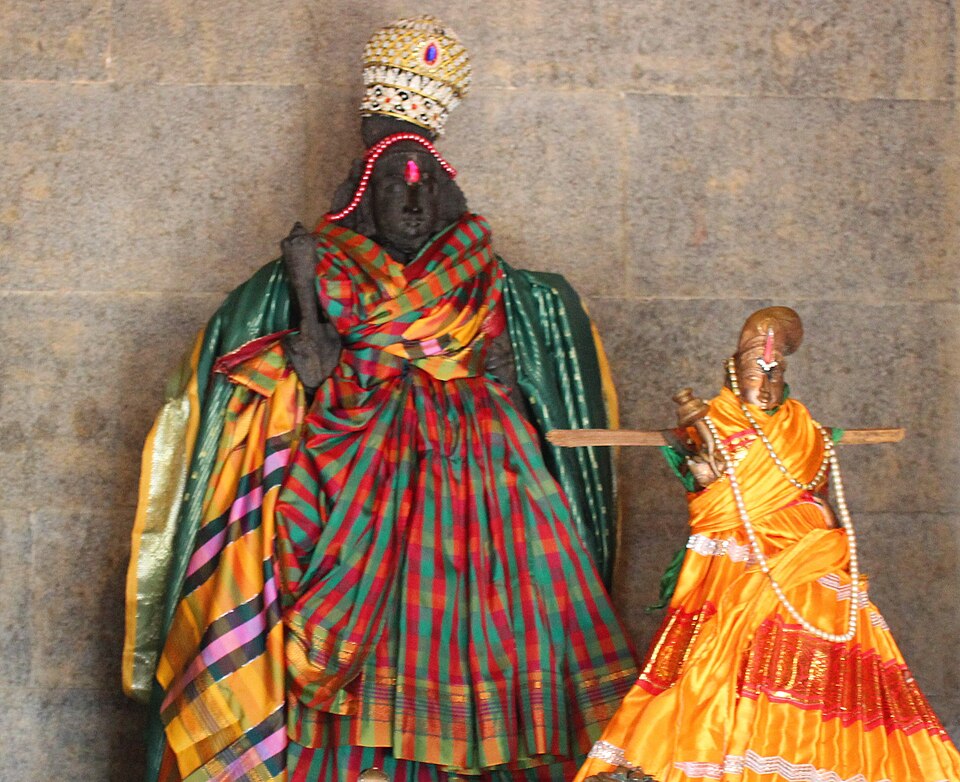
Āṇṭāḷ (ஆண்டாள்), also known as Kōtai (கோதை) and Gōdā Devī in the Sanskrit tradition, holds a position without parallel in Hindu devotional history. Among the twelve Āḻvārs — the Tamil Vaiṣṇava poet-saints whose ecstatic hymns form the Nālāyira Divya Prabandham (the 4000 sacred verses of Śrī Vaiṣṇavism) — Āṇṭāḷ is the only woman. More than a poet, she is worshipped as an incarnation of Bhūmi Devī (the Earth Goddess), a form of Śrī Lakṣmī herself, who descended to earth to demonstrate the highest reaches of bridal mysticism (madhura bhakti) and was ultimately absorbed into the divine image of Lord Raṅganātha at Śrīraṅgam.
Her two compositions — the thirty-verse Tiruppāvai (திருப்பாவை) and the 143-verse Nācciyār Tirumoḻi (நாச்சியார் திருமொழி) — rank among the finest devotional poetry in any language. The Tiruppāvai is recited every day during the Tamil month of Mārgaḻi (December-January) in millions of Vaiṣṇava homes and temples, and Āṇṭāḷ’s life story is celebrated with elaborate festivals across Tamil Nadu and wherever the Śrī Vaiṣṇava tradition is practised.
The Finding of Kōtai: A Child Among the Tulasī
According to the Guruparamparā (the lineage narratives of the Śrī Vaiṣṇava ācāryas) and the hagiographic text Āṟāyirappaṭi Guruparamparāprabhāvam, Āṇṭāḷ was discovered as an infant beneath a tulasī (holy basil) plant in the temple garden at Śrīvilliputtūr (modern Srivilliputhur in Tamil Nadu) by Periyāḻvār (Viṣṇucitta), himself one of the twelve Āḻvārs. Periyāḻvār, a Brahmin devoted to the worship of Vaṭapatraśāyī (Viṣṇu reclining on a banyan leaf), found the child while tending the temple flower garden and adopted her as his daughter.
He named her Kōtai (கோதை), meaning “garland of flowers” — a name that proved prophetic, for her life would be defined by garlands, both literal and metaphorical. The name Āṇṭāḷ (ஆண்டாள்) means “she who rules” or “she who immersed herself” (from the Tamil root āḷ, meaning to rule or to immerse), signifying her complete sovereignty over the divine beloved through the power of love.
The child grew up in the sacred atmosphere of Śrīvilliputtūr, surrounded by the fragrance of tulasī, the sound of Vedic chanting, and the daily rhythms of temple worship. From her earliest years, she showed extraordinary devotion to Lord Kṛṣṇa and Viṣṇu, absorbing the devotional poetry of the earlier Āḻvārs and developing her own intensely personal relationship with the divine.
The Secret of the Garland
The most famous episode from Āṇṭāḷ’s childhood reveals both her audacity and her divine nature. Periyāḻvār would weave fresh flower garlands each day to offer to the deity Vaṭapatraśāyī. Āṇṭāḷ, overcome by love for the Lord, began secretly wearing these garlands herself before her father offered them — adorning herself before a mirror, imagining herself as the bride of Viṣṇu, and then carefully placing them back for the temple offering.
When Periyāḻvār discovered what his daughter had been doing — finding strands of her hair among the flowers — he was horrified. How could a garland worn by a human be offered to God? He removed the garland and prepared a fresh one. But that night, the Lord appeared to Periyāḻvār in a dream and said: “I prefer the garland that Kōtai has worn. Her love makes these flowers more fragrant than any that have not touched her. Offer me only the garlands she has adorned.”
This episode — the Sūḍikkuḍutta Nācciyār (She Who Gave Her Worn Garland) — is the foundational moment of Āṇṭāḷ’s theology. It establishes that the devotee’s love is not a contamination but a consecration. The human body, animated by devotion, does not defile the divine offering — it elevates it. This radical insight overturns conventional ritual purity and places prema (love) above all formal worship.
The Tiruppāvai: Thirty Verses That Transformed a Tradition
The Tiruppāvai (திருப்பாவை — “The Sacred Vow”) is Āṇṭāḷ’s masterpiece and one of the most beloved devotional texts in the entire Hindu tradition. Composed in the voice of a gopī (cowherd girl) of Vraja, the poem describes the observance of the Pāvai Nōṉbu — a month-long vow performed during Mārgaḻi (December-January) by young girls seeking divine blessings.
The thirty verses trace a spiritual journey:
Verses 1-5: The call to observance — Āṇṭāḷ invokes the vow, describing the austerities (rising before dawn, avoiding milk and ghee, not adorning oneself) and declaring the purpose: to worship Nārāyaṇa and attain his grace.
Verses 6-15: The waking of the sleeping friends — In the pre-dawn darkness, Āṇṭāḷ goes from house to house, awakening her companions for the journey to the temple. Each verse describes a different girl being roused, with vivid domestic imagery: one sleeps behind a bolted door, another lies dreaming of her wedding, a third pretends not to hear. These verses are masterpieces of Tamil lyric poetry, blending the intimate and the cosmic.
Verses 16-20: The journey to Kṛṣṇa — The group makes its way to Nanda’s house (the home of Kṛṣṇa’s foster-father), encountering Nandagopa, Yaśodā, Kṛṣṇa’s brother Balarāma, and Kṛṣṇa’s wife Nappinnai (identified with Nīḷā Devī/Nappiṉṉai in the southern tradition).
Verses 21-29: The encounter with Kṛṣṇa — The girls address Kṛṣṇa directly, praising his divine deeds, his beauty, and his accessibility to devotees. The theology here is deeply Śrī Vaiṣṇava: God is not distant or indifferent but actively desires the love of his devotees.
Verse 30: The fruit of the vow — The concluding verse declares that those who recite these thirty verses will attain the grace of Tirumāl (Viṣṇu) and will be purified of all sins.
The Tiruppāvai’s significance in Śrī Vaiṣṇavism cannot be overstated. Rāmānuja (1017-1137 CE), the greatest ācārya of the tradition, called Āṇṭāḷ “one who has given us the ideal of surrender” and prescribed the daily recitation of the Tiruppāvai. Even today, in thousands of Vaiṣṇava temples across South India and the diaspora, the Tiruppāvai is recited every morning during the month of Mārgaḻi. In many temples, the entire month is dedicated to elaborately re-enacting Āṇṭāḷ’s journey.
The Nācciyār Tirumoḻi: The Cry of Divine Longing
While the Tiruppāvai is structured, measured, and communal, the Nācciyār Tirumoḻi (நாச்சியார் திருமொழி — “The Sacred Words of the Goddess”) is its passionate, intensely personal counterpart. This collection of 143 verses across 14 sections (tirumōḻi) is an unrestrained outpouring of love for Viṣṇu, expressed in the voice of a woman consumed by longing for her divine beloved.
The poems cover an extraordinary emotional range:
- Longing and separation (viraha) — Āṇṭāḷ describes the physical anguish of separation from Kṛṣṇa: “My bangles slip from my wasting arms; my eyes refuse to close in sleep; the cool breeze of the night burns me like fire”
- The dream wedding — In the famous Vāraṇam Āyiram section (Nācciyār Tirumoḻi 1), Āṇṭāḷ describes a dream in which she marries Viṣṇu in a grand ceremony attended by gods and sages, with a thousand elephants in procession. This dream-vision is one of the most celebrated passages in Tamil literature
- Addressing the natural world — Āṇṭāḷ sends messages to Kṛṣṇa through clouds, cuckoos, and the ocean, a convention (dūta-kāvya) she employs with extraordinary emotional intensity
- Bold declarations of love — Unlike the restrained devotional language of many male bhakti poets, Āṇṭāḷ is shockingly direct: “If he does not come to me, I will burn Kāmadeva’s (Manmatha’s) bow” (Nācciyār Tirumoḻi 1.1-10). She threatens the love-god, rebukes Kṛṣṇa for his indifference, and declares that she will accept no earthly husband
The Nācciyār Tirumoḻi’s theological contribution lies in its demonstration that madhura bhakti (the devotion of a lover to the beloved) is the highest form of spiritual relationship. Āṇṭāḷ does not approach God as a servant, a child, or a philosopher — she approaches as a bride, demanding the intimacy of union. This stance, later elaborated by Rāmānuja and the Śrī Vaiṣṇava tradition, profoundly influenced the development of bhakti theology across India.
The Marriage to Raṅganātha
The culmination of Āṇṭāḷ’s story is her divine marriage to Lord Raṅganātha (the reclining form of Viṣṇu enshrined at the great temple of Śrīraṅgam). According to tradition, as Āṇṭāḷ reached the age of marriage, she refused every human suitor, declaring that she would marry only Viṣṇu himself. Periyāḻvār, initially distressed, received a divine command: bring Kōtai to Śrīraṅgam.
The journey to Śrīraṅgam was a grand procession. Upon reaching the temple, Āṇṭāḷ — adorned in bridal attire — entered the sanctum sanctorum and approached the reclining image of Raṅganātha. Before the assembled devotees, she merged into the divine image, becoming one with God.
Different traditions describe this event in different ways — some say she physically merged into the image, others that she departed her mortal body in a state of divine ecstasy. All agree on the essential truth: Āṇṭāḷ’s devotion was so complete that the boundary between the human and the divine dissolved entirely. She became Raṅganāyakī — the consort of Raṅganātha — and is worshipped as such to this day.
At the Śrīraṅgam Raṅganāthaswāmy Temple, one of the largest functioning Hindu temples in the world, Āṇṭāḷ has her own shrine where she is worshipped as the divine consort. Her festival, called Āṭi Pūram (in the Tamil month of Āṭi, July-August), celebrates her earthly appearance and is observed with great splendour.
The Twelve Āḻvārs and Āṇṭāḷ’s Unique Position
The twelve Āḻvārs are the foundational saints of the Śrī Vaiṣṇava tradition, whose combined 4,000 verses (Nālāyira Divya Prabandham) are regarded as the “Tamil Veda” — equal in authority to the Sanskrit Vedas within the tradition. The Āḻvārs lived between approximately the 6th and 9th centuries CE and hailed from various castes and backgrounds, demonstrating the universality of divine grace.
Among these twelve, Āṇṭāḷ’s uniqueness is threefold:
- She is the only woman — in a tradition dominated by male voices, her feminine perspective introduces the dimension of bridal mysticism that becomes central to Śrī Vaiṣṇava theology
- She is the only Āḻvār who did not merely praise God but demanded union — the other Āḻvārs worship Viṣṇu as devotees; Āṇṭāḷ claims him as her husband
- She is worshipped as a form of the Goddess — unlike the other Āḻvārs who are venerated as saints, Āṇṭāḷ is venerated as Bhūmi Devī herself, the Earth Goddess who is the consort of Viṣṇu
Her father Periyāḻvār composed the famous Tiruppallaṇḍu (“Auspicious Benediction”), which opens the entire Nālāyira Divya Prabandham — making Āṇṭāḷ literally the daughter of the poet whose work begins the Tamil Vaiṣṇava canon.
Mārgaḻi Observances in Tamil Nadu
The month of Mārgaḻi (mid-December to mid-January) is the most sacred period in the Śrī Vaiṣṇava calendar, largely because of Āṇṭāḷ’s Tiruppāvai. During this month:
- Devotees rise at 4 AM (the pre-dawn hour called brahma muhūrta) to recite the Tiruppāvai
- Temples perform special Tiruppāvai Utsavams (festivals), with one verse sung each day for thirty days
- Young girls re-enact Āṇṭāḷ’s vow, going in groups from house to house singing the Tiruppāvai verses
- Kolam (elaborate floor designs made with rice flour) are drawn at the entrances of homes to welcome the month
- Special bhajan groups gather to sing Āṇṭāḷ’s compositions and discuss their theological meaning
- In Śrīvilliputtūr, the Āṇṭāḷ Temple hosts month-long celebrations that draw thousands of devotees
The cultural impact of Mārgaḻi and the Tiruppāvai extends beyond temple worship. The month is considered the most auspicious for music and dance, and the Mārgaḻi Season in Chennai features hundreds of Carnatic music and Bharatanatyam performances — many of them interpreting Āṇṭāḷ’s verses.
Śrīvilliputtūr: Āṇṭāḷ’s Sacred City
The Āṇṭāḷ Temple at Śrīvilliputtūr (the Vaṭapatraśāyī Temple) is one of the 108 Divya Desams (sacred sites celebrated by the Āḻvārs) and is considered the most sacred place associated with Āṇṭāḷ. The temple’s towering rāja gōpuram (main gateway tower), standing at approximately 192 feet, is the official emblem of the Government of Tamil Nadu — a testament to Āṇṭāḷ’s centrality in Tamil cultural identity.
Key features of the temple include:
- The inner shrine housing the images of Āṇṭāḷ and Raṅganātha
- The Nūl Tirumadal — a garden believed to be where Periyāḻvār found baby Kōtai under the tulasī plant
- Wall paintings depicting scenes from Āṇṭāḷ’s life and compositions
- Annual celebrations including the grand Āṭi Pūram festival
Enduring Significance
Āṇṭāḷ’s legacy extends far beyond the boundaries of Śrī Vaiṣṇavism:
- As a feminist icon: In an era when women’s spiritual voices were rarely heard, Āṇṭāḷ composed poetry of extraordinary boldness, claimed divine marriage on her own terms, and achieved recognition equal to (and in some contexts exceeding) her male contemporaries
- As a theological innovator: Her insistence on bridal mysticism as the highest form of devotion influenced subsequent bhakti movements across India, including the poetry of Mīrābāī, Akkamahādēvī, and the Brajbhasha poets
- As a literary artist: The Tiruppāvai and Nācciyār Tirumoḻi are masterworks of Tamil poetry, celebrated for their rhythmic beauty, vivid imagery, and emotional depth
- As a living presence: Āṇṭāḷ is not merely remembered — she is actively worshipped. In every Śrī Vaiṣṇava temple, her image receives daily offerings. Her verses are recited at weddings, festivals, and daily worship. She remains one of the most beloved figures in the Tamil devotional world
Āṇṭāḷ demonstrates that in the bhakti tradition, gender is no barrier to the highest spiritual attainment. As Rāmānuja declared: “Āṇṭāḷ is not a mere devotee — she is the very embodiment of śaraṇāgati (surrender), the ideal that all Śrī Vaiṣṇavas aspire to.” In her life and her poetry, the boundary between the human lover and the divine beloved dissolves — and in that dissolution, the ultimate truth of Vaiṣṇava theology is revealed: that God and the soul are not separate, that love is the bridge, and that surrender is the destination.