Introduction
Lord Śiva (IAST: Śiva; Sanskrit: शिव, “The Auspicious One”), also revered as Mahādeva (“The Great God”), Śaṅkara (“The Beneficent”), and Paśupati (“Lord of All Beings”), is one of the principal deities of Hinduism and the Supreme Being within the Śaiva tradition. In the Trimūrti framework, Śiva is understood as the destroyer and transformer of the universe alongside Brahmā (the creator) and Viṣṇu (the preserver), yet within Śaivism — one of the largest denominations of Hinduism — he is worshipped as the ultimate reality itself: creator, preserver, destroyer, concealer, and revealer of grace (Britannica, “Shiva”).
Śiva’s character is uniquely paradoxical. He is the great ascetic (Mahāyogī) seated in motionless meditation atop Mount Kailāsa, and simultaneously the wild dancer (Naṭarāja) whose cosmic tāṇḍava brings the universe into being and dissolves it at the end of each cycle. He is the terrifying Rudra of the Vedas and the gentle husband of Pārvatī. He is the naked mendicant smeared in cremation-ground ash and the lord of magnificent temples adorned with gold. These contradictions are not accidental — they express the Hindu theological insight that the Absolute transcends all dualities and contains all opposites within itself.
Vedic Origins: Rudra to Śiva
The roots of Śiva worship extend to the earliest strata of Indian religious literature. In the Ṛg Veda (c. 1500–1200 BCE), the deity Rudra appears as a fierce, storm-associated god invoked with both fear and reverence. Ṛg Veda 1.114 addresses Rudra as both a terrifying archer whose arrows bring disease and a benevolent healer who possesses “the most healing of medicines” (jalāṣabheṣajam). The hymn pleads: “Be gracious to us, O Rudra; bring us joy” (Ṛg Veda 1.114.1–2).
Rudra is already called “Śiva” (auspicious) as an epithet in the Ṛg Veda (Ṛg Veda 10.92.9), though the term became a proper name only in later texts. The crucial transition from the Vedic Rudra to the supreme Śiva occurs in the Yajurveda, particularly in the celebrated Śrī Rudram (also known as the Śatarudrīya), found in the Taittirīya Saṃhitā (Kṛṣṇa Yajurveda, Book 4, Chapters 5 and 7). This text — the oldest known Śaiva liturgy still in continuous ritual use — consists of the Namakam (eleven anuvākas of salutations) and the Chamakam (eleven anuvākas of petitions). The Namakam describes Rudra in an astonishing range of forms: lord of thieves, lord of forests, the blue-necked one, the dweller in cremation grounds, the healer, the fierce one, and the auspicious one. Crucially, the eighth anuvāka of the Namakam contains the sacred Pañcākṣarī mantra — Namaḥ Śivāya — which remains the most widely chanted mantra in Śaivism to this day (Wikipedia, “Shri Rudram”).
The Śvetāśvatara Upaniṣad: Philosophical Foundation
The decisive philosophical elevation of Rudra-Śiva to the status of Supreme Being occurs in the Śvetāśvatara Upaniṣad (c. 400–200 BCE), one of the principal Upaniṣads and the earliest systematic exposition of Śaiva theology. This text identifies Rudra with the universal Brahman, the one God who creates, sustains, and dissolves the cosmos:
“Eko hi Rudro na dvitīyāya tasthuḥ” — “There is one Rudra only; they do not allow a second.” (Śvetāśvatara Upaniṣad 3.2)
The Upaniṣad further declares that this one God is the inner self (antaryāmin) of all beings, the cosmic Puruṣa who controls māyā (the creative power of nature), and the bestower of liberation (mokṣa). The text seamlessly weaves together the language of Sāṅkhya (Puruṣa and Prakṛti), Yoga (meditation and discipline), and Vedānta (Brahman as ultimate reality), presenting Śiva as the synthesis of all philosophical streams. Scholars regard the Śvetāśvatara Upaniṣad as foundational not only for Śaivism but also for the Yoga and Vedānta schools of Hindu philosophy (Wikipedia, “Shvetashvatara Upanishad”; Wisdom Library, “Rudra-Śiva in Upaniṣadic Literature”).
Iconography and Symbolism
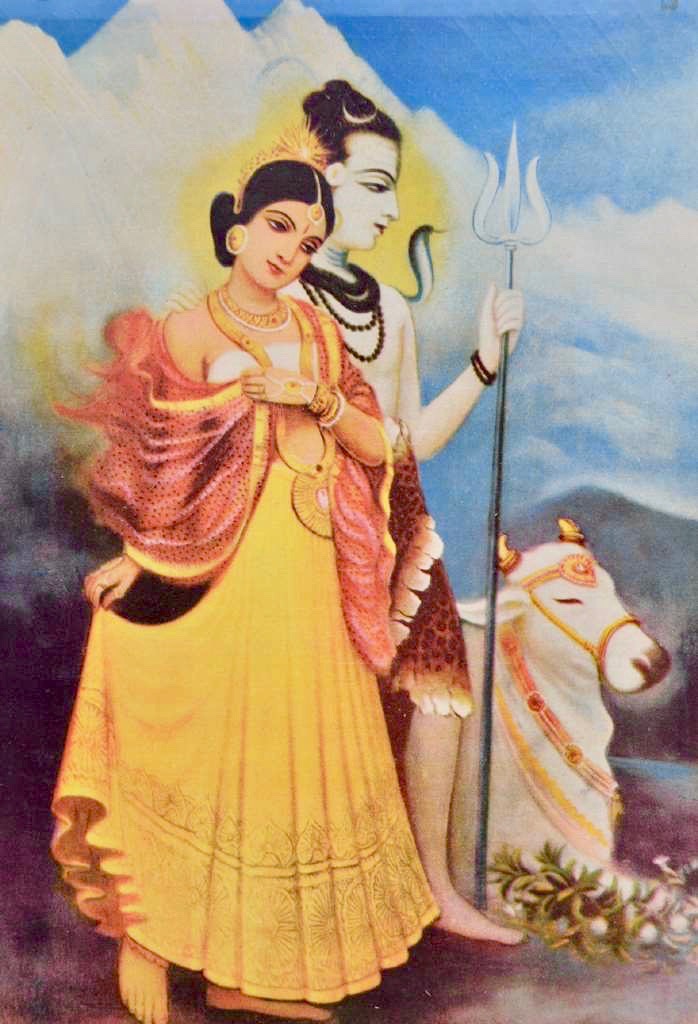
Śiva’s visual representations are among the most symbolically dense in all of Hindu art. Each element of his iconography carries layers of philosophical meaning:
The Third Eye (Tṛtīya Netra)
Śiva’s third eye, located on his forehead, represents the eye of wisdom and higher consciousness. When opened, it can destroy with its fire — as in the myth where it reduced Kāmadeva (the god of desire) to ashes when he attempted to disturb Śiva’s meditation. The third eye symbolises the destruction of ignorance and the awakening of transcendent knowledge (jñāna).
Matted Locks (Jaṭā) and the Gaṅgā
Śiva’s matted hair (jaṭā-mukuṭa) represents his rejection of vanity and worldly attachment — the mark of the supreme ascetic. Within these locks, the river Gaṅgā flows: according to the Purāṇas, when the celestial Gaṅgā descended from heaven at the request of King Bhagīratha, her force would have shattered the earth; Śiva caught her in his locks, channelling her power into a gentle stream. The crescent moon (candrakalā) nestled in the matted hair represents the cyclical nature of time and Śiva’s mastery over it.
The Trident (Triśūla)
The three-pronged trident symbolises Śiva’s dominion over the three guṇas (sattva, rajas, tamas), the three worlds (heaven, earth, underworld), and the three functions of creation, preservation, and dissolution. It also represents the trikāla — past, present, and future — under the lord’s sovereign control.
The Ḍamaru (Small Drum)
The hourglass-shaped drum held in one of Śiva’s hands represents the primordial sound (nāda) from which creation emerges. According to tradition, the Sanskrit alphabet itself was born from the fourteen sounds (Māheśvara Sūtras) produced by Śiva’s Ḍamaru at the conclusion of his cosmic dance. The drum thus links Śiva to language, grammar, music, and the rhythmic pulse of the universe.
The Serpent (Nāga)
The cobra coiled around Śiva’s neck (often identified as Vāsuki) represents the kunḍalinī energy dormant in every being, as well as Śiva’s mastery over fear, death, and the cycle of time. That a deadly serpent rests peacefully on the Lord’s body indicates his supreme equanimity.
The Blue Throat (Nīlakaṇṭha)
One of Śiva’s most beloved epithets is Nīlakaṇṭha, “the blue-throated one.” During the samudra manthana (churning of the cosmic ocean), a deadly poison (hālāhala) emerged that threatened to destroy all creation. Śiva drank the poison to save the universe, and Pārvatī pressed his throat to prevent it from descending further, leaving a permanent blue stain. This myth enshrines Śiva as the compassionate protector who absorbs the world’s suffering into himself (Śiva Purāṇa, Rudra Saṃhitā).
Nandī (The Bull Mount)
Śiva’s vāhana (mount) is the bull Nandī, who represents dharma (righteousness), devotion, and steadfast waiting. In temples, Nandī sits facing the Śivaliṅga, embodying the ideal devotee: patient, surrendered, and perpetually fixed upon the Lord.
Principal Forms and Manifestations
Śiva is worshipped in a remarkable variety of forms, each emphasising a different aspect of his nature:
Naṭarāja: Lord of the Cosmic Dance
The Naṭarāja (“King of Dance”) form is perhaps the most iconic image of Śiva and one of the most recognised symbols of Indian civilisation. Śiva dances the Ānanda Tāṇḍava — the dance of cosmic bliss — within a circle of flames (prabhāmaṇḍala) representing the cycle of saṃsāra. His upper-right hand holds the Ḍamaru (creation); his upper-left hand holds fire (destruction); his lower-right hand is raised in abhaya mudrā (the gesture of fearlessness); his lower-left hand points to his raised foot (signifying liberation). His right foot crushes the dwarf Apasmāra, who represents spiritual ignorance. The entire composition — exquisitely realised in Chola-era bronze sculptures (c. 10th–12th centuries CE) — expresses in a single image the five divine acts (pañcakṛtya): creation, preservation, destruction, concealment, and grace (Britannica, “Nataraja”).
Ardhanārīśvara: The Half-Male, Half-Female Form
In this form, Śiva’s right half is male and the left half is the goddess Pārvatī, expressing the inseparability of the masculine (Puruṣa) and feminine (Śakti) principles. The Ardhanārīśvara declares that the divine is neither exclusively male nor female but the unity of both — a profound theological statement about the nature of ultimate reality.
Dakṣiṇāmūrti: The South-Facing Teacher
Śiva as Dakṣiṇāmūrti is the primordial guru who teaches through silence. Seated beneath a banyan tree, he instructs aged sages in the highest truths of jñāna (knowledge), yoga, and saṅgīta (music). This form is particularly revered in the Advaita Vedānta tradition; Ādi Śaṅkarācārya composed the celebrated Dakṣiṇāmūrti Stotram in its honour.
Liṅga: The Aniconic Form
The Śivaliṅga is the most widely worshipped form of Śiva across India. Far from a mere phallic symbol (a colonial-era misreading), the liṅga represents the formless Absolute — the nirguṇa Brahman from which all forms arise. The Liṅga Purāṇa narrates the myth of the jyotirliṅga (pillar of infinite light) that appeared between Brahmā and Viṣṇu to demonstrate Śiva’s supremacy: neither could find its beginning or end. This myth underpins the twelve Jyotirliṅga pilgrimage sites scattered across India, from Somanātha in Gujarat to Rāmeśvaram in Tamil Nadu (Śiva Purāṇa, Vidyeśvara Saṃhitā).
Śaivism: Traditions and Philosophy
Śaivism encompasses a vast range of philosophical schools and devotional traditions:
-
Śaiva Siddhānta: The dominant Śaiva tradition of South India and Sri Lanka, presenting a dualistic theology in which individual souls attain liberation through Śiva’s grace while retaining their distinct identity. The Tamil Nāyaṇmār poet-saints (7th–8th centuries CE), particularly Appar, Sundarar, Sambandar, and Māṇikkavācakar, are the foundational voices of this tradition.
-
Kāśmīra Śaivism (Pratyabhijñā): A non-dual tradition that regards the entire universe as the self-expression of Śiva-consciousness. The great philosopher Abhinavagupta (c. 950–1016 CE) is its towering figure.
-
Vīraśaivism (Liṅgāyatism): Founded by Basavaṇṇa in 12th-century Karnataka, this egalitarian movement rejected caste hierarchy and temple ritualism, insisting that every devotee carry a personal liṅga (iṣṭaliṅga) as a direct connection to Śiva.
-
Pāśupata: One of the earliest Śaiva ascetic orders, attributed to Lakulīśa (c. 2nd century CE), emphasising radical renunciation and ecstatic practices.
All these traditions share the conviction that Śiva is the ultimate reality and that devotion, knowledge, or yogic practice — or their combination — leads to liberation (Wikipedia, “Shaivism”).
Major Temples and the Twelve Jyotirliṅgas
The twelve Jyotirliṅga temples are the most sacred Śaiva pilgrimage sites in India, each believed to enshrine a self-manifested liṅga of infinite light:
- Somanātha — Verāval, Gujarat
- Mallikārjuna — Śrīśailam, Andhra Pradesh
- Mahākāleśvara — Ujjain, Madhya Pradesh
- Omkareshwar — Khandwa, Madhya Pradesh
- Kedārnātha — Uttarakhand Himalayas
- Bhīmaśaṅkara — Maharashtra
- Viśveśvara (Kāśī Viśvanātha) — Vārāṇasī, Uttar Pradesh
- Tryambakaṃ — Nāsik, Maharashtra
- Vaidyanātha — Jharkhand
- Nāgeśvara — Gujarat
- Rāmeśvaram — Tamil Nadu
- Ghṛṣṇeśvara — Aurangabad, Maharashtra
Beyond the Jyotirliṅgas, the Chidambaram Naṭarāja Temple (Tamil Nadu), the Paśupatinātha Temple (Kathmandu, Nepal), and the Amarnātha ice-liṅga cave (Kashmir) hold immense significance for devotees worldwide.
Festivals and Worship
Mahāśivarātri
The “Great Night of Śiva,” observed on the fourteenth day of the dark half of the month of Phālguna (February–March), is the most important Śaiva festival. Devotees observe an all-night vigil (jāgaraṇa), fast, chant the Mahāmṛtyuñjaya and Pañcākṣarī mantras, and perform abhiṣeka (ritual bathing) of the Śivaliṅga with milk, honey, water, and bilva leaves. The festival commemorates multiple mythological events: the cosmic dance of Naṭarāja, the marriage of Śiva and Pārvatī, and the night when Śiva drank the hālāhala poison.
Worship Practices
Daily Śiva worship typically involves offering bilva (wood-apple) leaves, water, and vibhūti (sacred ash) to the Śivaliṅga while chanting Om Namaḥ Śivāya. The Rudrābhiṣeka — a ritual bathing of the liṅga accompanied by the chanting of the entire Śrī Rudram — is considered among the most powerful Vedic rituals. Mondays (Somavāra) are considered especially sacred to Śiva, and the Śrāvaṇa month (July–August) is dedicated to his worship across North India.
Family and Divine Relationships
Śiva’s family (Śiva-parivāra) occupies a central place in Hindu devotion:
- Pārvatī (also Umā, Gaurī): Śiva’s consort, the daughter of the mountain king Himavān, and the embodiment of śakti (divine feminine power). Their love story — Pārvatī’s severe tapas to win Śiva’s heart, the burning of Kāmadeva, their marriage on Mount Kailāsa — is one of the great narratives of Hindu mythology (Śiva Purāṇa, Pārvatī Khaṇḍa).
- Gaṇeśa: Their elephant-headed son, the remover of obstacles and lord of beginnings, born from Pārvatī’s creative power.
- Kārttikeya (Skanda, Murugan): Their second son, the god of war and commander of the divine armies, especially revered in South India and among the Tamil people.
Philosophical Significance
Śiva embodies some of the deepest philosophical insights of the Hindu tradition:
-
Transcendence of Dualities: As the one who is simultaneously ascetic and householder, destroyer and creator, terrible and beautiful, Śiva teaches that the Absolute cannot be confined to any single category. The coincidentia oppositorum — the coincidence of opposites — is central to Śaiva theology.
-
Consciousness as Ultimate Reality: In Kāśmīra Śaivism, Śiva is identified with pure consciousness (cit) — the luminous awareness that is the substratum of all experience. The universe is understood as the free creative play (svātantrya) of this consciousness.
-
Liberation through Grace: While personal effort (tapas, yoga, jñāna) is valued, Śaiva traditions ultimately emphasise that liberation depends on Śiva’s grace (anugraha). The fifth divine act — anugraha or grace — is considered the highest function of the Lord.
-
The Sanctity of the Ordinary: By dwelling in cremation grounds, wearing ash, and consorting with ghosts and outcasts, Śiva sacralises what society considers impure. His message is that the divine pervades all things without exception — there is nowhere that Śiva is not.
Contemporary Relevance
Śiva remains one of the most actively worshipped deities in the world today. The annual Mahāśivarātri festival draws millions of devotees to temples across India and Nepal. The Kumbha Melā — the largest religious gathering on earth — is intimately connected to Śaiva traditions. In popular culture, Śiva has inspired contemporary literature (Amish Tripathi’s Shiva Trilogy), scientific metaphor (Fritjof Capra’s The Tao of Physics famously uses the Naṭarāja image), and public art — a two-metre bronze Naṭarāja stands at CERN, the European Organisation for Nuclear Research, symbolising the cosmic dance of subatomic particles.
Conclusion
From the terrifying Rudra of the Ṛg Veda to the serene Mahāyogī of Kailāsa, from the ecstatic Naṭarāja of Chidambaram to the formless Jyotirliṅga that neither Brahmā nor Viṣṇu could fathom — Śiva defies every boundary that theology, philosophy, or human imagination might impose. He is the still centre and the whirling circumference, the silence of deep meditation and the thunder of the cosmic drum. For the billions who chant Om Namaḥ Śivāya, he is not merely a deity among deities but the very ground of being — the auspicious one in whom all things arise, endure, and ultimately dissolve, only to be born again in the endless dance of creation.