Introduction
Goddess Gaṅgā (Sanskrit: गङ्गा, IAST: Gaṅgā), also revered as Gaṅgā Mātā (Mother Gaṅgā), Jāhnavī, Bhāgīrathī, and Devabhūti, is one of the most sacred and beloved deities in Hinduism. She is the personification of the river Ganges — the holiest river in the Hindu tradition — and embodies the divine power of purification, forgiveness, and spiritual liberation (mokṣa). No other geographical feature on Earth commands such intense religious devotion: for over two millennia, Hindus have believed that her waters wash away lifetimes of sin, that dying on her banks guarantees passage to heaven, and that even invoking her name cleanses the soul.
Gaṅgā occupies a unique position in the Hindu pantheon, bridging the celestial and terrestrial realms. She originates in heaven as the daughter of Brahmā or Himavat (depending on the textual tradition), descends through the matted locks of Lord Śiva, and flows across the Indian subcontinent for over 2,500 kilometres before merging with the Bay of Bengal. This threefold existence — heavenly (Mandākinī), earthly (Bhāgīrathī), and netherworld (Bhogavatī) — has led to her epithet Tripathagā, “she who flows in three paths” (Rāmāyaṇa, Bālakāṇḍa 43.2).
Her mythology intersects with nearly every major deity and epic narrative: she is the consort of Viṣṇu in Vaiṣṇava traditions and of Śiva in Śaiva texts; the sister of Pārvatī; the mother of Bhīṣma, the grand patriarch of the Mahābhārata; and the spiritual mother of all Hindus who perform rituals at her banks. As the Skanda Purāṇa (4.1) declares: “There are many sacred rivers in heaven, on earth, and in the nether regions, but none equals the Gaṅgā” (Wikipedia, “Ganga (goddess)”).
Vedic Origins
The earliest textual references to Gaṅgā appear in the Ṛg Veda, though they are modest compared to the elaborate mythology of later texts. In the celebrated Nadīstuti Sūkta (“Hymn to the Rivers,” Ṛg Veda 10.75), the sage Sindhukṣit praises the great rivers of the subcontinent, listing them from east to west. Gaṅgā is mentioned at Ṛg Veda 10.75.5 alongside Yamunā, Sarasvatī, and Śutudrī, placing her among the revered waters of the Vedic world. A second reference appears at Ṛg Veda 6.45.31, though scholars debate whether this refers to the river or is used as a common noun meaning “swift-moving water.”
The relatively limited Vedic presence reflects the geography of early Vedic civilization, which was centred on the Sarasvatī and Sindhu (Indus) river basins in the northwest. As Vedic culture migrated eastward into the Gaṅgā-Yamunā Doāb during the late Vedic period (c. 1000–600 BCE), the river’s religious importance grew dramatically. The Atharvaveda (6.155.5) and several principal Upaniṣads — including the Bṛhadāraṇyaka Upaniṣad and the Muṇḍaka Upaniṣad — mention Gaṅgā with increasing reverence.
In the broader Vedic worldview, rivers were venerated as life-giving mothers (mātaraḥ, Ṛg Veda 7.18.10). The cosmic myth of Indra slaying the serpent-demon Vṛtra to release the imprisoned waters (Ṛg Veda 1.32) established a theological framework in which rivers are divine gifts — freed from demonic obstruction by the gods for the benefit of humanity. This template of celestial waters being released to flow earthward directly prefigures the Purāṇic narrative of Gaṅgā’s descent.
Purāṇic Origins: Daughter of Heaven
The Purāṇas offer multiple, sometimes divergent, accounts of Gaṅgā’s birth. In the Rāmāyaṇa (Bālakāṇḍa 35–44), she is the elder daughter of Himavat (the personification of the Himālayas) and Menā (also called Menakā), making her the sister of Pārvatī. The Devīs, or gods, requested Himavat to send Gaṅgā to heaven to purify the celestial realm, and thus she came to reside in Brahmā’s water-pot (kamaṇḍalu) in Brahmaloka.
The Bhāgavata Purāṇa (5.17) offers a Vaiṣṇava origin: when Viṣṇu, in his Vāmana (Dwarf) avatāra, measured the three worlds with his cosmic strides, his left foot pierced the shell of the universe (Brahmāṇḍa). Through this opening, the waters of the primordial ocean entered the universe and washed over his foot, becoming the Gaṅgā — literally, “she who issued from Viṣṇu’s foot” (Viṣṇupadī).
In the Brahmavaivarta Purāṇa, Gaṅgā is presented as one of the three consorts of Viṣṇu alongside Lakṣmī and Sarasvatī. After a quarrel among the three goddesses, Gaṅgā was cursed to descend to earth as a river, a narrative that provides an alternative theological explanation for her terrestrial existence.
These varying origin stories are not contradictory in the Hindu tradition but represent different theological lenses — Śaiva, Vaiṣṇava, and Śākta — through which the same divine reality is perceived.
Bhagīratha’s Penance and Gaṅgā’s Descent
The most celebrated narrative associated with Gaṅgā is the story of her descent to earth (Gaṅgāvataraṇa), as narrated in the Rāmāyaṇa (Bālakāṇḍa 38–44), the Mahābhārata (Vanaparvan 104–109), and the Viṣṇu Purāṇa (4.4). This story of cosmic devotion and divine grace remains one of the most beloved episodes in all of Hindu literature.
The Curse of Sage Kapila
King Sagara of the Ikṣvāku dynasty performed an Aśvamedha Yajña (horse sacrifice) to establish his sovereignty. The sacrificial horse was stolen by Indra, who hid it in the subterranean hermitage of Sage Kapila. Sagara’s sixty thousand sons tracked the horse to Kapila’s āśrama and, in their arrogance, disturbed the great sage’s meditation. Enraged, Kapila opened his eyes and reduced them all to ashes with his fiery gaze. He declared that their souls would remain in torment until the waters of the celestial Gaṅgā washed over their remains.
Generations of Effort
For generations, the descendants of Sagara attempted to bring Gaṅgā to earth, but none succeeded. King Aṃśumān and his son Dilīpa both performed austerities without result. It fell to Dilīpa’s son, Bhagīratha, to accomplish the seemingly impossible task.
Bhagīratha renounced his kingdom and undertook extraordinarily severe tapas (austerities) at Gokārṇa for a thousand years, standing on one foot with arms raised, subsisting only on air. Pleased by his devotion, Brahmā appeared and granted his wish — Gaṅgā would descend to earth. However, Brahmā warned that the force of her fall from heaven would shatter the earth itself. He counselled Bhagīratha to propitiate Lord Śiva, the only being capable of absorbing such cosmic force.
Śiva Catches Gaṅgā
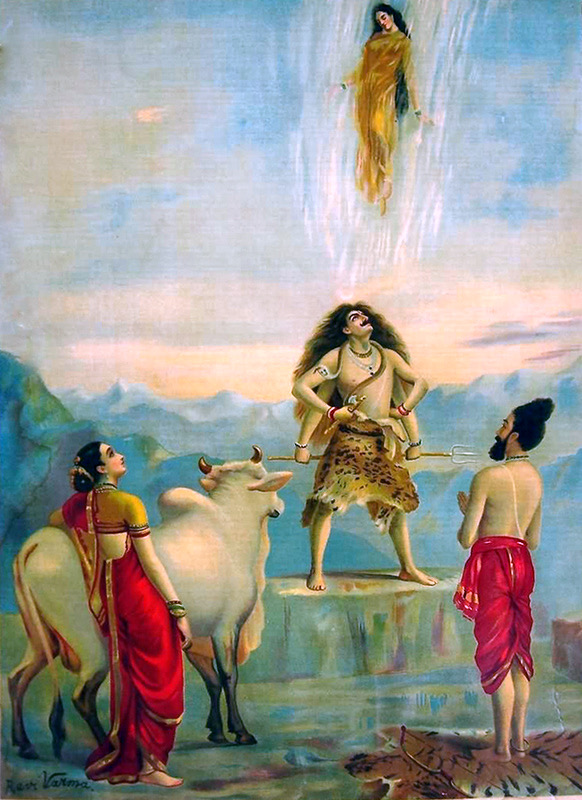
Bhagīratha performed another prolonged penance to please Śiva, who agreed to receive Gaṅgā upon his head. When the mighty river goddess descended from Brahmaloka with the force of a cosmic torrent, proud of her unstoppable power, Śiva calmly caught her in his matted locks (jaṭā). So vast was his hair that Gaṅgā wandered through its coils for what some texts describe as a thousand years, unable to find her way out. Humbled, she emerged as a gentle, life-giving stream. This act earned Śiva the epithet Gaṅgādhara (“Bearer of Gaṅgā”), and his iconic depiction with the river flowing from his hair is one of the most recognizable images in Hindu art.
Bhagīratha then led the purified river to the ashes of Sagara’s sons. Upon contact with her sacred waters, all sixty thousand souls attained mokṣa. The southern branch of the Ganges near its source is still called Bhāgīrathī in honour of the king whose devotion brought her to earth, and the word bhāgīratha prayatna (Bhagīratha’s effort) has entered Indian languages as an idiom for a supremely persistent endeavour.
Mother of Bhīṣma: Gaṅgā in the Mahābhārata
Beyond her descent narrative, Gaṅgā plays a pivotal role in the Mahābhārata as the mother of Bhīṣma, the grand patriarch and most formidable warrior of the Kuru dynasty.
The eight Vasus — celestial attendants of Indra — were cursed by Sage Vasiṣṭha to be born as mortals after they stole his divine cow, Nandinī. They appealed to Gaṅgā for help, and she agreed to become their mother on earth, promising to release each of them from mortal existence immediately after birth by immersing them in her own waters.
Gaṅgā appeared on the banks of the Ganges in her most beautiful form and married King Śantanu of Hastināpura, extracting from him a vow that he would never question her actions. Each time she bore a son, she drowned the child in the river — liberating the Vasu within. Śantanu watched in agonized silence as seven sons were drowned. When she was about to immerse the eighth child, Śantanu could no longer restrain himself and cried out in protest.
Gaṅgā revealed her divine identity and explained the curse. The eighth son — Prabhāsa, the Vasu most culpable in the theft — was destined to live a full mortal life. This child was Devavrata, who would become the legendary Bhīṣma. Gaṅgā took the boy to heaven, educated him under the tutelage of divine sages, and returned him to Śantanu as a fully accomplished prince (Mahābhārata, Ādiparvan 91–100).
Iconography
Gaṅgā’s iconographic representation has been remarkably consistent across two millennia of Hindu art, from Gupta-period sculpture (4th–6th century CE) to modern temple imagery.
She is typically depicted as a beautiful, fair-complexioned woman adorned in white garments symbolizing purity. Her most distinctive feature is her vāhana (divine mount): the makara, a mythical aquatic creature combining features of a crocodile, fish, and sometimes an elephant. The makara represents the life-giving power of water and the primordial vitality of the river, and appears prominently in temple doorway sculptures (dvārapāla panels) where Gaṅgā and Yamunā serve as guardian figures at temple entrances — a tradition dating to the Gupta period.
In her hands, Gaṅgā typically holds a water pot (kamaṇḍalu or kalaśa), symbolizing the abundance and purifying power of her waters, and a lotus (padma), signifying purity and spiritual awakening. Some depictions show her with a pūrṇa-kumbha (full vessel) — an ancient Indian symbol of auspiciousness and fertility.
The most iconic representation of Gaṅgā, however, is in relation to Śiva: she flows from his matted locks in the form known as Gaṅgādhara-mūrti, where Śiva stands calmly while the goddess emerges from his jaṭā. The magnificent 7th-century rock relief at Mahābalipuram (Tamil Nadu), variously called “Descent of the Ganges” or “Arjuna’s Penance,” is one of the largest open-air rock reliefs in the world and depicts the celestial descent of Gaṅgā with over one hundred carved figures of gods, humans, and animals converging on a central cleft representing the river (Wikipedia, “Descent of the Ganges (Mahabalipuram)”).
Major Temples and Worship Sites
Gaṅgā is worshipped at virtually every point along the 2,525-kilometre course of the river Ganges, but certain sites hold special significance:
- Gaṅgotrī (Uttarakhand): The origin temple at 3,100 metres elevation, near the glacier source of the Bhāgīrathī. The temple, built by Gorkha general Amar Singh Thapa in the early 18th century, houses a natural rock śilā worshipped as the place where Śiva received Gaṅgā.
- Haridwār (Uttarakhand): Literally “Gateway of God,” where Gaṅgā emerges from the Himālayas onto the plains. The Har-kī-Pauḍī ghāṭ, built by King Vikramāditya, is the site of the world-famous Gaṅgā Ārtī — a nightly ceremony of fire and light that draws thousands of devotees.
- Prayāgarāj (Uttar Pradesh): The Trivēṇī Saṅgam, or confluence of Gaṅgā, Yamunā, and the invisible Sarasvatī. The Kumbh Melā held here every twelve years is the largest religious gathering on earth, with over 100 million pilgrims in recent celebrations.
- Vārāṇasī (Uttar Pradesh): The most sacred city in Hinduism, where Gaṅgā flows in a northward arc — an auspicious direction. The Daśāśvamedha Ghāṭ hosts a spectacular nightly Gaṅgā Ārtī, and it is believed that dying in Vārāṇasī on the banks of the Gaṅgā guarantees liberation from the cycle of rebirth.
- Gaṅgāsāgar (West Bengal): The island at the confluence of the Gaṅgā and the Bay of Bengal, where the Gaṅgāsāgar Melā — the second-largest Hindu fair after Kumbh Melā — draws millions of pilgrims on Makara Saṅkrānti. The Kapil Muni Temple here commemorates the sage whose gaze reduced Sagara’s sons to ashes.
Festivals
Gaṅgā Daśaharā
The principal festival honouring Gaṅgā’s descent to earth, celebrated on the Daśamī (10th day) of the Śukla Pakṣa (waxing moon) in the Hindu month of Jyeṣṭha (May–June). The name Daśaharā derives from daśa (ten) and hara (to destroy): bathing in the Gaṅgā during these ten days is believed to destroy ten categories of sin — three related to the body, four to speech, and three to the mind. Haridwār, Prayāgarāj, and Vārāṇasī are the primary celebration centres.
Gaṅgā Saptamī
Observed on the Saptamī (7th day) of Śukla Pakṣa in the month of Vaiśākha (April–May). This festival marks the day Gaṅgā first descended upon Mount Meru in the celestial realm. Devotees take ritual baths and offer prayers, lamps, and flowers to the river.
Gaṅgā Ārtī
While not a calendar festival, the nightly Gaṅgā Ārtī ceremonies at Haridwār and Vārāṇasī have become among the most iconic worship rituals in Hinduism. Performed at dusk by Brahmin priests wielding multi-tiered brass lamps, accompanied by conch shells, bells, and devotional songs, the ceremony offers fire and light to the river goddess while thousands of small oil lamps (dīyas) are set floating on the current.
Cultural Significance Across India
Gaṅgā’s influence extends far beyond geography. In Hindi-speaking northern India, she is invoked in the oath formula “Gaṅgā kī kasam” (“I swear by the Gaṅgā”) — considered one of the most sacred and binding oaths. Water from the Gaṅgā (Gaṅgājala) is kept in virtually every Hindu household for use in rituals, for purification, and for placing drops in the mouth of the dying to ensure a peaceful passage.
The river’s symbolism pervades Hindu philosophy: the Bhagavad Gītā (10.31) identifies Gaṅgā as the supreme among all flowing things when Kṛṣṇa declares, “Among rivers, I am the Gaṅgā” (srotasām asmi jāhnavī). The Viṣṇu Purāṇa (2.2.35) states that one who chants “Gaṅgā, Gaṅgā” even from hundreds of leagues away is freed from sin and reaches the highest abode.
In South India, though the physical Gaṅgā does not flow, her spiritual presence is ubiquitous. Temple tanks are ritually consecrated as Gaṅgā tīrthas, and the puṣkarāvartana ceremony invokes the Gaṅgā into any body of water for ritual purposes. The Cauvery in Tamil Nadu is often called the “Gaṅgā of the South” (Dakṣiṇa Gaṅgā), and the Godāvarī river in Maharashtra-Telangana also bears this epithet.
Environmental Concerns and Modern Relevance
The sacred status of the Gaṅgā stands in stark tension with the ecological crisis that threatens her waters. The Ganges river basin is the largest in India, encompassing 27% of the country’s landmass and supporting approximately 47% of its population — an estimated 500 million people. Decades of industrial effluents, untreated sewage, agricultural runoff, and ritual refuse have made stretches of the river among the most polluted waterways in the world.
The Indian government launched the Namāmi Gaṅge Programme in June 2014 as a flagship conservation mission with a budget exceeding Rs. 40,000 crore, focused on pollution abatement through sewage treatment plants, biodiversity conservation, riverfront development, and afforestation. Over 300 projects have been completed under this programme, and the initiative was recognised as a World Restoration Flagship under the UN Decade on Ecosystem Restoration (Wikipedia, “Namami Gange Programme”).
For Hindu communities, the pollution of the Gaṅgā is not merely an environmental issue but a spiritual crisis. The river regarded as the purest substance in the cosmos — capable of purifying all that touches her — now carries toxins that threaten the very life she sustains. This paradox has galvanised a unique environmental movement that blends scientific conservation with deep religious conviction, drawing together scientists, policy-makers, and sādhus (ascetics) in common cause.
Theological Significance
The theology of Gaṅgā rests on the profound Hindu insight that the sacred (tīrtha) is not merely a metaphor but a living, tangible reality. In the Śaiva Siddhānta and Smārta traditions, Gaṅgā represents the divine grace (anugraha) that flows perpetually from the Absolute into the world of forms. She is mokṣa-dāyinī (“bestower of liberation”), pāpa-nāśinī (“destroyer of sin”), and sarva-deva-svarūpiṇī (“embodiment of all deities”).
The Padma Purāṇa (Uttarakhaṇḍa) enumerates the seven modes of Gaṅgā worship: (1) calling her name, (2) having darśana (sight) of her, (3) touching her waters, (4) worshipping her with rituals, (5) bathing in her, (6) standing in her waters, and (7) carrying clay from her riverbed. Each successive mode yields greater spiritual merit, but even the first — simply uttering the name “Gaṅgā” — is said to purify the devotee.
In the vast tapestry of Hindu devotion, Gaṅgā remains the supreme tīrtha — the meeting point of heaven and earth, of purity and grace, of the divine and the human. She flows not only across the plains of India but through the very heart of Hindu civilization, carrying within her waters the prayers, ashes, and aspirations of a billion souls.