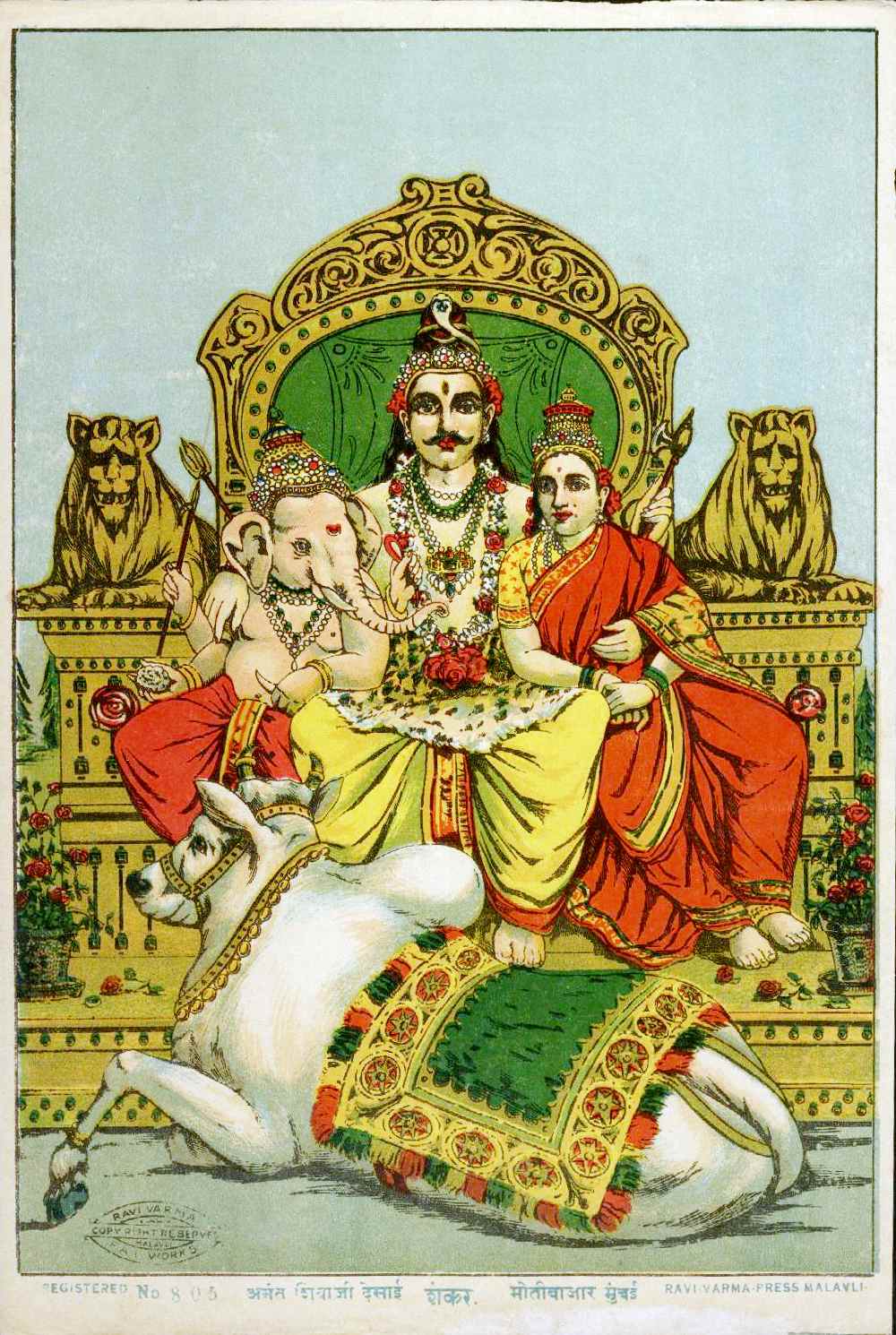
Goddess Pārvatī (पार्वती), also known as Umā (उमा), Gaurī (गौरी), and Śakti (शक्ति), is one of the most beloved and revered deities in Hinduism. As the consort of Lord Śiva, the mother of Gaṇeśa and Kārttikeya, and the supreme embodiment of divine feminine energy, she occupies a central place in Hindu theology, philosophy, and devotional practice. Her name literally means “daughter of the mountain,” derived from Parvata (mountain), referring to her father Himavān, the lord of the Himālayas.
Origins and Birth
Daughter of the Himālayas
According to the Śiva Purāṇa, Pārvatī was born as the daughter of Himavān (also called Himavat or Parvatarāja), the king of the Himālayas, and his wife Menā (also known as Menavati). Her birth was not an ordinary event but a cosmic necessity. After the self-immolation of Satī — Śiva’s first wife, who had given up her life following her father Dakṣa’s humiliation of Śiva — the great god had withdrawn into deep ascetic meditation, renouncing all worldly bonds.
The gods grew anxious, for without Śiva’s participation in creation, the cosmic order was endangered. Moreover, the demon Tārakāsura had obtained a boon that only a son of Śiva could slay him. Thus, the divine plan required Śiva to marry again, and Pārvatī was born as the reincarnation of Satī to fulfil this cosmic purpose (Śiva Purāṇa, Rudra Saṁhitā, Pārvatī Khaṇḍa).
Connection to Uma Haimavatī
Pārvatī’s divine identity stretches back to the Vedic period. In the Kena Upaniṣad (3.12), a goddess named Umā Haimavatī appears as the one who reveals the knowledge of Brahman to the Vedic gods Agni, Vāyu, and Indra. Scholars identify this Umā Haimavatī with Pārvatī, establishing her as a mediator of supreme spiritual knowledge even in the earliest Upaniṣadic literature.
The Legendary Tapas
Penance to Win Śiva’s Love
The story of Pārvatī’s tapas (austerities) is one of the most inspiring narratives in Hindu mythology. After Kāmadeva (the god of love) was burnt to ashes by Śiva’s third eye for attempting to distract him from meditation, Pārvatī resolved to win Śiva’s heart not through desire but through the power of devotion and self-discipline.
As described in the Śiva Purāṇa (Rudra Saṁhitā, Chapter 22), Pārvatī undertook severe penances at Śṛṅgī Tīrtha, a place that came to be known as Gaurī Śikhara:
- In summer, she lit fires all around herself and sat in the centre, continuously performing japa (mantra repetition)
- In the rainy season, she performed tapas sitting on bare rock drenched by rain
- In winter, she sat immersed in water, continuing her devotion day and night without food
Initially she consumed food, then only leaves, and finally she gave up even leaves — fasting completely. Because she discarded all sustenance (parṇa, meaning leaves), the gods named her Aparṇā (“one who took no leaves”). Standing on one leg, she chanted the sacred Pañcākṣara mantra (Namaḥ Śivāya) ceaselessly.
Her mother Menā, witnessing these extreme austerities, cried out “U mā!” (“Oh, don’t!”), pleading with her to stop. This exclamation became another of the goddess’s celebrated names: Umā.
Śiva’s Test and Their Union
Impressed by the intensity of her devotion, Śiva disguised himself as a brahmacārī (wandering ascetic) and visited Pārvatī to test her resolve. He spoke disparagingly of himself — calling Śiva an unkempt, ash-smeared ascetic unworthy of a princess. Pārvatī defended Śiva with unwavering faith and declared she would marry no one else. Moved by her steadfastness, Śiva revealed his true form and accepted her as his consort. Their divine wedding on Mount Kailāsa is celebrated as one of the most sacred events in Hindu mythology.
Divine Motherhood
Pārvatī is revered as the mother of two of Hinduism’s most important deities:
- Gaṇeśa — the elephant-headed god of wisdom, beginnings, and the remover of obstacles. In the Śiva Purāṇa, Pārvatī created Gaṇeśa from the turmeric paste (or sandalwood) of her own body to serve as her guardian.
- Kārttikeya (also known as Skanda or Murugan) — the god of war and commander of the celestial armies, born to defeat the demon Tārakāsura.
As a mother, Pārvatī embodies unconditional love, fierce protectiveness, and nurturing grace. Her motherhood is not merely biological but cosmic — she is the mother of the entire universe in Śākta philosophy.
The Many Forms of Pārvatī
One of the most remarkable aspects of Pārvatī is the breadth of her manifestations, ranging from gentle and nurturing to fierce and terrifying.
Benevolent Forms
- Umā — the gracious, luminous one; embodiment of beauty and spiritual knowledge
- Gaurī — “the fair one,” worshipped for marital happiness and fertility
- Annapūrṇā — the goddess of food and nourishment, depicted holding a golden ladle and a bowl of rice, worshipped especially in Kāśī (Vārāṇasī)
- Lalitā — the playful one, the supreme goddess in Śrī Vidyā tradition
- Kāmākṣī — the goddess of love and desire, enshrined at Kanchipuram
Fierce Manifestations
- Durgā — the invincible warrior goddess who slays Mahiṣāsura
- Kālī — the fierce dark goddess who destroys evil and ego; in the Devī Bhāgavata Purāṇa, Kālī manifests from Pārvatī’s wrath during battle against the demons Śumbha and Niśumbha
- The Daśa Mahāvidyās — the ten wisdom goddesses, fierce tantric forms of the supreme feminine
The Devī Bhāgavata Purāṇa and the Devī Māhātmya describe how the gentle Pārvatī transforms into these terrifying forms whenever dharma is threatened, illustrating that the same divine mother who nurtures creation does not hesitate to destroy evil.
Ardhanārīśvara: The Sacred Union
Perhaps the most philosophically profound concept associated with Pārvatī is Ardhanārīśvara (अर्धनारीश्वर) — the composite form in which Śiva and Pārvatī share a single body, the right half being male (Śiva) and the left half female (Pārvatī).
The term derives from three Sanskrit words: ardha (half), nārī (woman), and īśvara (lord) — “the Lord whose half is woman.” This form represents:
- The inseparability of masculine (Puruṣa) and feminine (Prakṛti) principles in the universe
- The unity of consciousness (Śiva) and creative energy (Śakti)
- The philosophical teaching that the divine transcends gender, encompassing and surpassing both
According to the Kālikā Purāṇa, Pārvatī wished to remain eternally united with Śiva in his very body, and the divine couple merged as Ardhanārīśvara. This icon served historically as a synthesis of the two principal Hindu traditions — Śaivism and Śāktism — teaching that Śiva without Śakti is incomplete, and Śakti without Śiva has no form.
Scriptural Sources
Pārvatī’s stories and theology are elaborated across a vast body of Hindu sacred literature:
- Śiva Purāṇa — the most detailed source for her birth, tapas, marriage, and family life (especially the Rudra Saṁhitā and Pārvatī Khaṇḍa)
- Devī Bhāgavata Purāṇa — celebrates the supreme goddess in all her forms, including Pārvatī as the eternal Śakti
- Kena Upaniṣad — the earliest Upaniṣadic reference to Umā Haimavatī as the revealer of Brahman
- Kumārasambhava by Kālidāsa — the great 5th-century Sanskrit poem narrating the love story of Śiva and Pārvatī
- Skanda Purāṇa and Liṅga Purāṇa — further accounts of her mythology and worship
Significance for Devotees
Goddess Pārvatī teaches that true devotion, sustained through patience and unwavering faith, can move even the most immovable forces. Her tapas demonstrates that spiritual power is not achieved through shortcuts but through disciplined practice and sincere love. As the ideal wife, devoted mother, and supreme Śakti, she embodies the completeness of feminine divinity — gentle yet fierce, nurturing yet powerful, domestic yet cosmic.
For millions of devotees, Pārvatī represents the accessible face of the divine mother: approachable in prayer, present in the home, and powerful enough to transform the entire universe.