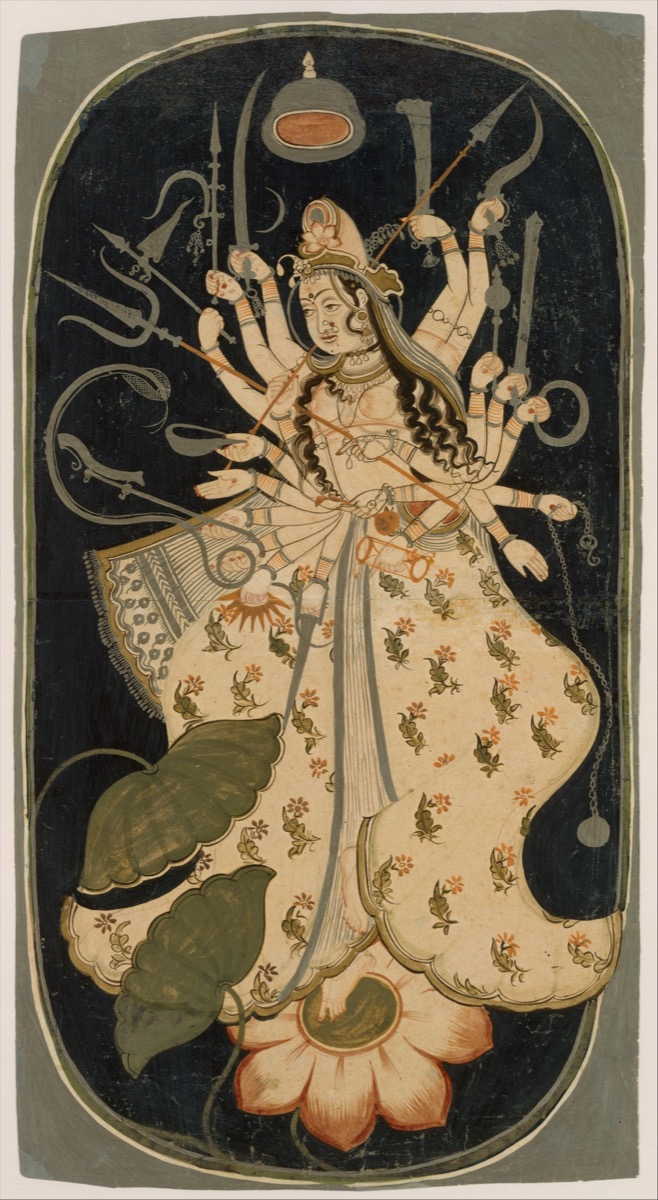
Ādi Parāśakti (आदि पराशक्ति), also known as Mahādevī (महादेवी, “the Great Goddess”), Ādi Śakti (आद्या शक्ति, “the Primordial Power”), and Parā Prakṛti (परा प्रकृति, “the Supreme Nature”), is the ultimate, transcendent reality in the Śākta tradition of Hinduism. She is not merely a goddess among many — she is the Supreme Being (Para Brahman) in feminine form, the infinite cosmic energy from whom the entire universe is born, sustained, and dissolved. Every deity, every force of nature, every living being is understood as a manifestation of her limitless power.
In Śākta theology, while Brahmā creates, Viṣṇu preserves, and Śiva dissolves, they do so only because Ādi Parāśakti empowers them. Without her Śakti, even the Trimūrti remain inert. As the celebrated verse declares: “Śivaḥ śaktyā yukto yadi bhavati śaktaḥ prabhavitum, na ced evaṃ devo na khalu kuśalaḥ spanditum api” — “Śiva, united with Śakti, becomes capable of creation; without her, he cannot even stir” (Saundaryalaharī 1).
Scriptural Foundations
The Devī Sūktam (Ṛgveda 10.125)
The earliest textual witness to the concept of a supreme feminine divinity is the Devī Sūktam (also called Vāk Sūktam), found in the Ṛgveda (10.125). Here, the goddess Vāk (Speech) declares herself to be the supreme reality pervading all existence:
“Ahaṃ rudrebhir vasubhiś carāmi, aham ādityair uta viśvadevaiḥ” (“I move with the Rudras, the Vasus, the Ādityas, and all the gods”)
She further proclaims: “Ahaṃ suve pitaram asya mūrdhan, mama yonir apsv antaḥ samudre” — “I give birth to the father [of creation] at the head of this [world]; my womb is in the waters, within the ocean.” This hymn establishes the Devī not as a consort or subsidiary deity but as the self-existent source of all cosmic functions — creation, preservation, and dissolution.
The Devī Māhātmya (Durgā Saptashatī)
Embedded within the Mārkaṇḍeya Purāṇa (chapters 81-93), the Devī Māhātmya (c. 5th-6th century CE) is the foundational text for Devī worship. It narrates how the Mahādevī manifests from the combined tejas (radiant energy) of all the gods to slay the buffalo-demon Mahiṣāsura. The text declares:
“Yā devī sarvabhūteṣu śaktirūpeṇa saṃsthitā, namastasyai namastasyai namastasyai namo namaḥ” (“Salutations to that Devī who abides in all beings as Śakti [power]”)
This verse, repeated in multiple forms (as consciousness, as sleep, as hunger, as memory, as compassion, as patience), reveals the Devī as the immanent presence within every aspect of existence.
The Devī Bhāgavata Purāṇa
The most systematic exposition of Ādi Parāśakti theology appears in the Devī Bhāgavata Purāṇa (c. 9th-14th century CE), one of the eighteen Mahāpurāṇas according to the Śākta tradition. In its seventh skandha, the text describes Manidvīpa — the jewelled island at the summit of all realms, the eternal abode of the Supreme Goddess. Here, Ādi Parāśakti sits upon the Siṃhāsana (throne) supported by Brahmā, Viṣṇu, Rudra, Maheśvara, and Sadāśiva as its five legs, symbolizing her sovereignty over all cosmic functions.
The Devī Bhāgavata (1.5.47-54) explicitly states that the Supreme Goddess is nirguṇa (beyond attributes) and saguṇa (possessing attributes) simultaneously — the formless Brahman who freely assumes forms out of compassion for her devotees. She is called Bhuvaneśvarī (sovereign of the worlds), the very ground of being from which Māyā, Prakṛti, and the manifest cosmos emerge.
The Three Great Manifestations: Mahāsarasvatī, Mahālakṣmī, Mahākālī
According to the Devī Māhātmya and later Śākta texts, Ādi Parāśakti manifests as three supreme forms to carry out the cosmic functions:
Mahākālī (महाकाली) — the power of dissolution and transformation. She is the tāmasic śakti, associated with Śiva, who destroys ignorance, ego, and the bonds of saṃsāra. She appears as the fierce dark goddess who annihilates demons and liberates souls.
Mahālakṣmī (महालक्ष्मी) — the power of sustenance and prosperity. She is the sāttvic śakti, associated with Viṣṇu, who maintains cosmic order, bestows wealth (both material and spiritual), and nourishes all life. In the Devī Māhātmya, it is Mahālakṣmī who is identified with the supreme form of the Goddess.
Mahāsarasvatī (महासरस्वती) — the power of creation and knowledge. She is the rājasic śakti, associated with Brahmā, who brings forth the universe through divine wisdom, speech, and creative energy. She embodies Vidyā (knowledge) and all the arts and sciences.
This triadic theology does not reduce these goddesses to mere consorts. Rather, Durgā, Lakṣmī, Sarasvatī, Kālī, Pārvatī, and all other goddesses are understood as different faces of the one Ādi Parāśakti, just as sunlight refracts into different colours through a prism.
Lalitā Tripurasundarī and Śrī Vidyā
In the esoteric Śrī Vidyā tradition — one of the most refined and philosophically sophisticated streams of Śākta Tantra — Ādi Parāśakti is worshipped as Lalitā Tripurasundarī (ललिता त्रिपुरसुन्दरी, “the Beautiful One of the Three Cities”). She is the supreme deity of the Śrī Vidyā system, representing the union of Śiva and Śakti, consciousness and bliss.
The name “Tripurasundarī” carries multiple layers of meaning:
- Tri-pura — she who is beautiful in the three worlds (physical, subtle, causal)
- Tri-pura — she who transcends the three states (waking, dreaming, deep sleep)
- Tri-pura — she who is the essence of the three aspects of time (past, present, future)
The Lalitā Sahasranāma (from the Brahmāṇḍa Purāṇa) enumerates her one thousand names, each revealing a different aspect of her infinite nature. Names such as Parā (the Supreme), Mahārājñī (the Great Queen), Cit-śakti (the Power of Consciousness), and Kāmakalā (the Art of Desire) describe a goddess who is simultaneously transcendent and intimately present.
Central to Śrī Vidyā is the Śrī Yantra (also called Śrī Cakra) — a geometric diagram of nine interlocking triangles that represents the goddess’s cosmic body. The five downward-pointing triangles symbolize Śakti, the four upward-pointing ones symbolize Śiva, and their interpenetration creates the 43 subsidiary triangles that constitute the entire manifest universe. At the bindu (central point) dwells Lalitā herself — pure, undifferentiated consciousness-bliss (cid-ānanda).
The Pañcadaśī mantra (the fifteen-syllable mantra) and the Ṣoḍaśī mantra (the sixteen-syllable mantra) are the primary mantras of Śrī Vidyā, transmitted through guru-disciple lineages. The great Ādi Śaṅkarācārya himself is traditionally credited with composing the Saundaryalaharī (“The Ocean of Beauty”), a hundred-verse hymn to Lalitā Tripurasundarī that is simultaneously a devotional masterpiece and a manual of Śrī Vidyā practice.
The Daśa Mahāvidyā: Ten Great Wisdom Goddesses
A distinctive feature of Śākta theology is the concept of the Daśa Mahāvidyā — ten great cosmic forms of the Supreme Goddess, each representing a different aspect of transcendent wisdom. These are:
- Kālī — Time, transformation, and the dissolution of ego
- Tārā — Compassion, guidance, and the power of the spoken word
- Ṣoḍaśī (Tripurasundarī) — Beauty, auspiciousness, and sovereign grace
- Bhuvaneśvarī — Space, cosmic sovereignty, and the manifest world
- Bhairavī — Fierce tapas, spiritual fire, and the destruction of obstacles
- Chinnamastā — Self-sacrifice, the reversal of creation, kuṇḍalinī energy
- Dhūmāvatī — The void, renunciation, and the power of dissolution
- Bagalāmukhī — The power to stun enemies and silence falsehood
- Mātaṅgī — Speech, music, and dominion over impurity
- Kamalā — Prosperity, beauty, and the fullness of manifest blessing
Each Mahāvidyā is not a separate goddess but a lens through which the one Ādi Parāśakti is perceived. The Mahābhāgavata Purāṇa and the Śāktapramoda describe how these ten forms arose when Satī, consumed by rage at Dakṣa’s insult to Śiva, manifested herself in ten directions, filling the cosmos with her terrible and beautiful forms.
The Śakti Pīṭhas: Sacred Seats of the Goddess
According to the Purāṇic narrative, when Satī immolated herself in the fire of Dakṣa’s yajña and the grief-stricken Śiva carried her body across the cosmos, Viṣṇu’s Sudarśana Cakra dismembered the divine body, and the pieces fell at various locations across the Indian subcontinent. These sites became the Śakti Pīṭhas — sacred seats where the Goddess’s living presence is eternally manifest.
The number of Śakti Pīṭhas varies across traditions — 4 Ādi Pīṭhas, 18 Mahā Pīṭhas, 51 Pīṭhas, or 108 Pīṭhas are enumerated in different texts. The four Ādi Pīṭhas are:
- Kāmākhyā (Assam) — where the goddess’s yoni (womb) fell, the supreme centre of Śākta Tantra
- Tārā Pīṭha (West Bengal) — where her third eye fell, sacred to Tārā
- Kālīghāṭ (Kolkata) — where her right toes fell, the origin of the name “Calcutta”
- Vimalā (Puri, Odisha) — where her navel fell, within the Jagannātha temple complex
Each Pīṭha is a living tīrtha where the Goddess’s energy is believed to be especially concentrated. Pilgrimage to the Śakti Pīṭhas is considered among the highest forms of Devī worship, and the Pīṭha Nirṇaya texts provide elaborate descriptions of the rituals, mantras, and spiritual benefits associated with each site.
Iconography and Symbolism
Ādi Parāśakti’s iconography varies considerably depending on the tradition and the specific form being depicted:
As Mahādevī / Ādi Śakti: She is shown with multiple arms (often eight, ten, sixteen, or eighteen), each bearing a divine weapon or symbol — trident (triśūla), discus (cakra), conch (śaṅkha), bow and arrows, sword, shield, lotus, and rosary. She stands or sits upon a lotus (symbolizing purity and transcendence) and radiates a golden or saffron aura. Her multiple arms represent her omnipotent control over all cosmic functions.
As Lalitā Tripurasundarī: She is depicted as a beautiful, red-complexioned goddess seated on a throne (siṃhāsana) placed upon the body of Sadāśiva (the eternal Śiva), which itself rests on the Śrī Yantra. She holds a noose (pāśa, binding attachment), a goad (aṅkuśa, spurring spiritual progress), sugarcane bow (representing the mind), and five flower-arrows (representing the five subtle elements). Her red colour symbolizes compassion, passion for her devotees, and the creative power of desire.
As Durgā: She rides a lion or tiger, wielding weapons gifted by each god, her face serene even in battle — the image of controlled, purposeful divine power defeating the forces of chaos.
The Śrī Yantra itself is considered the most abstract yet complete iconographic representation of Ādi Parāśakti — geometry as theology, revealing the mathematical precision underlying the goddess’s creative activity.
Philosophical Significance
Śakti as Para Brahman
The philosophical core of Śākta thought identifies Śakti with Para Brahman — the absolute, ultimate reality. This is not a sectarian claim but a metaphysical position articulated by texts such as the Devī Gītā (embedded within the Devī Bhāgavata Purāṇa, 7.31-40), which mirrors the Bhagavad Gītā in structure but places the Devī as the speaker of supreme truth.
In the Devī Gītā, the Goddess declares: “I alone existed in the beginning; there was nothing else. That which is called ‘I’ is known as Ātman” (7.32.6). She further states that she is both the nirguṇa (attributeless) and saguṇa (attribute-possessing) Brahman, thereby reconciling the apparent opposition between the transcendent Absolute and the personal God.
The Śiva-Śakti Relationship
Unlike dualistic theologies, Śākta philosophy does not posit Śiva and Śakti as genuinely separate. They are described as inseparable, like fire and its power to burn, like a word and its meaning. The Yoginīhṛdaya (a key Śrī Vidyā text) explains that Śiva is prakāśa (the light of consciousness) and Śakti is vimarśa (the self-reflective awareness of that consciousness). Without vimarśa, prakāśa would be inert — a mirror reflecting nothing. This non-dual understanding (sometimes called Śākta Advaita) sees the entire cosmos as the creative self-expression of the Goddess.
Māyā and Mahāmāyā
In Śākta thought, Māyā is not merely illusion but the creative, mysterious power of the Goddess. The Devī Māhātmya calls her Mahāmāyā — the “Great Māyā” who simultaneously veils and reveals reality. She is both the cause of bondage (through ignorance) and the means of liberation (through knowledge). The aspirant who recognizes Māyā as the Goddess herself transforms bondage into devotion and ignorance into wisdom.
Temples and Living Worship
Ādi Parāśakti is worshipped across India in countless forms:
- Kāñcīpuram (Tamil Nadu) houses the Kāmākṣī Amman Temple, one of the most important Śrī Vidyā centres, where the Goddess is worshipped as Kāmākṣī with the Śrī Yantra
- Vārāṇasī (Uttar Pradesh) has temples to the Goddess as Viśālākṣī and Annapūrṇā
- Kolhāpur (Maharashtra) is home to the Mahālakṣmī Temple, one of the Śakti Pīṭhas
- Kāmākhyā (Assam) remains the supreme centre of Tāntric Śākta worship
- Madurai (Tamil Nadu) venerates her as Mīnākṣī, the fish-eyed goddess
The Navarātri festival — nine nights of worship divided into three triads honouring Durgā, Lakṣmī, and Sarasvatī — is perhaps the most widespread celebration of the Supreme Goddess across all Hindu communities. In Bengal, Durgā Pūjā is the grandest festival of the year; in South India, Navarātri culminates in Vijaya Daśamī (Dasara), celebrating the triumph of the Goddess over evil.
Ādi Parāśakti in Daily Life
The concept of Ādi Parāśakti is not confined to temples and scriptural exegesis. For millions of Hindus, the recognition that the Divine is feminine — that the Supreme Being is Mother — profoundly shapes devotional life. The relationship between the devotee and the Goddess is one of the child to the mother: intimate, trusting, and emotionally direct.
The great Śākta saint Rāmaprasāda Sena (Rāmprasād, 1718-1775) of Bengal composed hundreds of devotional songs addressed to the Goddess as Mother, mixing lament, humour, philosophical insight, and ecstatic love. Similarly, the Tamil tradition honours the Goddess through the deeply devotional poetry of the Abhirāmi Antādi by Abhirāmi Bhaṭṭar.
For the Śākta devotee, every woman embodies an aspect of the Goddess, every act of creation mirrors her cosmic play (līlā), and the universe itself is her body. This vision — of the sacred feminine as the ground of all reality — represents one of Hinduism’s most profound and enduring theological contributions to world spiritual thought.
Conclusion
Ādi Parāśakti is not one goddess among many but the ground of all divinity, the power behind every power, the consciousness within all consciousness. From the ancient Vedic hymn of Vāk to the sophisticated theology of the Devī Bhāgavata Purāṇa, from the geometric perfection of the Śrī Yantra to the passionate devotion of Bengal’s Śākta poets, the tradition of the Supreme Goddess offers a vision of the Divine that is simultaneously transcendent and immanent, terrifying and compassionate, philosophically rigorous and devotionally accessible. To know Ādi Parāśakti is to recognise that the entire cosmos pulses with her living presence — that Śakti is not a quality the Divine possesses but the very nature of reality itself.