Introduction
Goddess Durgā (IAST: Durgā; Sanskrit: दुर्गा), also known as Devī, Mahādevī, Mahiṣāsuramardinī, and Caṇḍikā, is one of the most powerful and widely revered deities in Hinduism. She is the supreme embodiment of Śakti — the divine feminine energy that creates, sustains, and dissolves the universe — and stands at the centre of the Śākta theological tradition, one of the major denominations of Hinduism alongside Vaiṣṇavism and Śaivism.
The name Durgā derives from the Sanskrit root dur (difficult) and gam (to pass or go through), meaning “she who is difficult to approach,” “the invincible one,” or “the impregnable fortress.” The Nirukta of Yāska and the Aṣṭādhyāyī of Pāṇini (4.1.99, 6.3.63) attest to the word’s antiquity, and references to Durgā and its cognates appear in the Ṛg Veda (hymns 4.28, 5.34, 8.27, 10.127) and the Atharva Veda (10.1, 12.4), making her worship among the most ancient strands of Hindu practice (Wikipedia, “Durga”).
Durgā’s most celebrated mythology is enshrined in the Devī Māhātmya (also called the Durgā Saptaśatī or Caṇḍī Pāṭha) — a text of 700 Sanskrit verses embedded in the Mārkaṇḍeya Purāṇa (chapters 81–93), composed around the 5th–6th century CE. This text, which is to Śākta Hinduism what the Bhagavad Gītā is to Vaiṣṇavism, narrates three great cosmic battles in which the Goddess vanquishes demonic forces, establishing her as the supreme power of the universe (Sacred Texts, “Devi Mahatmya”).
Etymology and Theological Identity
The Devī Māhātmya and the later Devī Bhāgavata Purāṇa present Durgā not merely as a warrior goddess but as the Brahman itself — the ultimate reality underlying all existence. The Devī Upaniṣad, a Śākta text dated to approximately the 9th century, explicitly identifies the Devī with Brahman and Ātman: she is the ground of creation, preservation, and dissolution, the source of māyā (cosmic illusion) and prakṛti (primordial nature), and the liberating power that grants mokṣa (Wikipedia, “Shaktism”).
The Śākta philosophical formulation holds: “Brahman is static Śakti; Śakti is dynamic Brahman” — the Absolute and its Power are not two separate realities but one inseparable truth viewed from two perspectives. Within Tantra, this principle reaches its fullest expression: the feminine principle as Śakti is raised to the level of the Absolute itself.
Durgā thus occupies multiple theological registers simultaneously: she is the saguṇa (with qualities) form of the Goddess — fierce, beautiful, armed, and mounted upon her lion — and she is also the nirguṇa (without qualities) Brahman that transcends all form. This dual identity is the foundation of all Durgā worship.
The Three Great Episodes of the Devī Māhātmya
The Devī Māhātmya unfolds in three episodes (caritras), each narrating a cosmic crisis in which the Goddess intervenes to restore dharma.
First Episode: The Slaying of Madhu and Kaiṭabha (Chapter 1)
In the primordial waters before creation, two demons — Madhu and Kaiṭabha — emerged from the earwax of the sleeping Viṣṇu and threatened Brahmā. Brahmā prayed to Yoganidrā — the cosmic sleep residing in Viṣṇu’s eyes — beseeching her to awaken Viṣṇu so he might slay the demons. The Goddess withdrew her influence, Viṣṇu awoke, and after a battle lasting five thousand years, he slew Madhu and Kaiṭabha.
The philosophical significance of this episode centres on tamas (inertia, ignorance). The demons represent the primordial forces of darkness and delusion; the Goddess in her form as Yoganidrā represents the power to dispel the cosmic sleep of ignorance. She does not fight directly in this episode — she acts by withdrawing, demonstrating that even the removal of obstruction is a form of divine grace (Cultural Samvaad, “Durga Saptashati”).
Second Episode: The Slaying of Mahiṣāsura (Chapters 2–4)
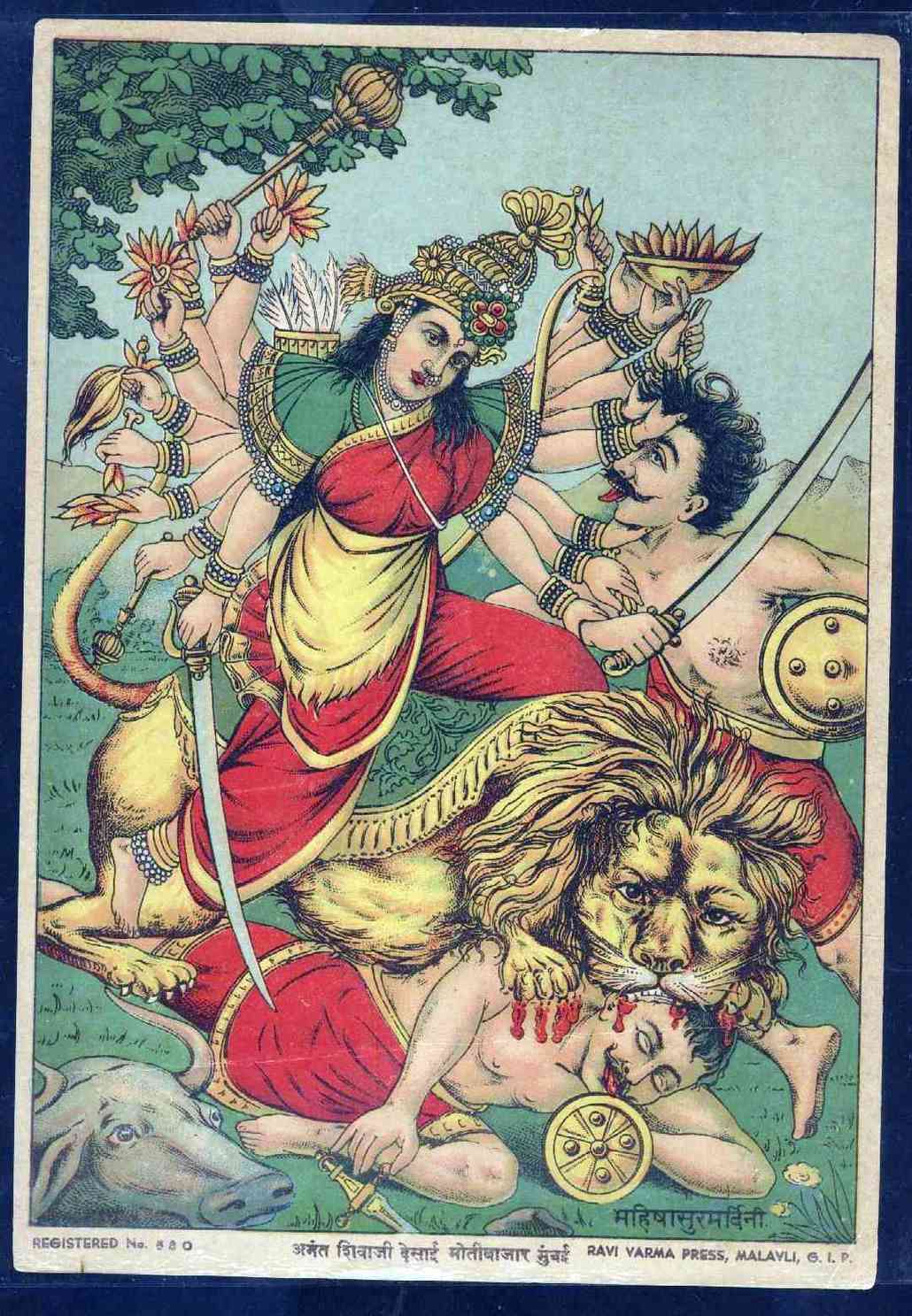
This is the most celebrated episode and the source of Durgā’s foremost epithet: Mahiṣāsuramardinī — “Slayer of the Buffalo Demon.”
The demon king Mahiṣāsura, having obtained a boon from Brahmā that no man or god could kill him, conquered the three worlds and expelled the gods from heaven. The humiliated gods combined their collective tejas (divine radiance) to generate a supreme feminine being. Each deity contributed a weapon and attribute: Śiva gave his trident (triśūla); Viṣṇu his discus (cakra); Indra his thunderbolt (vajra); Varuṇa his conch and noose; Agni his spear; Yama his staff of death; Brahmā his rosary and water-pot; Viśvakarmā his axe and armour; Himālaya his lion as her mount. Thus Durgā emerged — ten-armed, resplendent, armoured with the combined might of the cosmos.
The battle raged for nine nights. Mahiṣāsura shape-shifted between buffalo, lion, elephant, and human forms, but the Goddess matched each transformation. On the tenth day — celebrated as Vijayā Daśamī (the “Tenth Day of Victory”) — Durgā placed her foot upon the demon’s neck, pierced him with her trident, and severed his head with her sword as he emerged from the buffalo’s decapitated body. The heavens rejoiced, flowers rained from the sky, and the gods sang her praises in the famous Devī Stuti (Devī Māhātmya, chapters 2–4; Britannica, “Durga”).
Third Episode: The Destruction of Śumbha and Niśumbha (Chapters 5–11)
The demon brothers Śumbha and Niśumbha, having conquered the gods and seized their domains, learned of the Goddess’s beauty and sent an emissary demanding her hand in marriage. The Goddess, appearing in the form of the beautiful Ambikā (also called Kauśikī), set a condition: she would wed only one who could defeat her in battle. Enraged by her refusal, the demons sent their generals — Dhūmralocana, Caṇḍa, Muṇḍa, and Raktabīja — against her.
From Ambikā’s furrowed brow emerged Kālī, terrible and dark, who devoured Caṇḍa and Muṇḍa (earning the name Cāmuṇḍā). The battle with Raktabīja — a demon whose every drop of spilled blood spawned a new demon — was overcome when Kālī drank his blood before it could touch the ground. Finally, Durgā confronted Śumbha in single combat; when he accused her of relying on the help of other goddesses, she absorbed all the Mātṛkās (Mother Goddesses) back into herself and declared: “I alone exist in this world; who else is there besides me?” (Devī Māhātmya 10.5) — one of the most powerful theological statements in Hindu scripture. She then slew Śumbha, restoring cosmic order.
Iconography and Symbolism
Durgā’s iconography is rich with theological meaning:
The Ten Arms
Each arm carries a weapon bestowed by a different god, signifying that Durgā is the unified power (samāhāra śakti) of the entire divine pantheon. No single deity could defeat Mahiṣāsura alone; it required the collective energy of all gods, channelled through the feminine principle. This is a radical theological statement: the feminine is not subordinate to the masculine but is the very power through which the masculine gods act.
The Lion (Siṁha) or Tiger (Vyāghra)
Durgā’s mount (vāhana) is a lion (in most North Indian traditions) or a tiger (in some South Indian and Bengali traditions). The lion represents fearlessness, sovereignty, and dharmic authority. That the Goddess rides the king of beasts signifies her mastery over all animal instincts and her supremacy over the natural world.
The Third Eye
Like Śiva, Durgā possesses a third eye on her forehead — the eye of wisdom (jñāna cakṣu) that sees beyond illusion, perceives the true nature of reality, and can reduce adharma to ash with its fire.
Complexion and Adornment
Durgā is depicted with a radiant golden or reddish complexion, sometimes deep blue. Gold and red signify the dynamic, creative energy (rajas) of the cosmos; blue represents the infinite, unmanifest consciousness. She wears a red sāṛī, gold ornaments, and a crown — simultaneously a queen, a warrior, and a mother.
Mahiṣāsuramardinī Pose
The most iconic image depicts Durgā with her foot on the buffalo demon, her trident piercing his body, while maintaining a serene, composed expression — the visual paradox of supreme power exercised without agitation, wrath expressed without losing inner tranquility.
The Navarātri Festival
Navarātri (Sanskrit: नवरात्रि, “Nine Nights”) is the principal festival dedicated to Durgā and one of the most widely celebrated festivals in Hinduism. It occurs twice yearly:
- Śārad Navarātri (September–October): The primary celebration, coinciding with the autumnal equinox
- Vasanta Navarātri (March–April): The spring celebration, also called Caitra Navarātri
The Nine Forms of Durgā (Navadurgā)
Each night of Navarātri is dedicated to one of the nine forms of the Goddess:
- Śailaputrī — Daughter of the Himālaya, embodying nature and the earth
- Brahmacāriṇī — The ascetic form, representing tapas and spiritual discipline
- Candraghaṇṭā — The warrior adorned with a half-moon, symbolizing readiness for battle
- Kūṣmāṇḍā — The creator who brought light to the void, the cosmic egg
- Skandamātā — Mother of Skanda (Kārttikeya), embodying maternal love
- Kātyāyanī — The wrathful warrior born in the hermitage of Sage Kātyāyana
- Kālarātrī — The dark, terrifying form who destroys ignorance and evil
- Mahāgaurī — The luminously fair form, representing purity and redemption
- Siddhidātrī — Bestower of all siddhis (supernatural perfections)
Worship During Navarātri
Devotees observe fasts, perform daily pūjā, and recite the entire Devī Māhātmya (700 verses) over the nine nights — a practice called Saptaśatī Pāṭha or Caṇḍī Pāṭha. In Gujarat and western India, communities celebrate with Garbā and Daṇḍiyā Rās — devotional circle dances performed around an earthen lamp or an image of the Goddess. The tenth day, Vijayā Daśamī (also called Dussehra), commemorates Durgā’s victory over Mahiṣāsura and Rāma’s victory over Rāvaṇa, linking the Śākta and Rāma traditions in a shared celebration of the triumph of dharma.
Durgā Pūjā: Bengal’s Supreme Festival
While Navarātri is celebrated across India, Durgā Pūjā in Bengal (and across the Bengali diaspora) is a phenomenon of extraordinary cultural, artistic, and spiritual magnitude. In 2021, UNESCO inscribed Durga Puja in Kolkata on its Representative List of the Intangible Cultural Heritage of Humanity, recognizing it as the world’s largest open-air public art installation and a model of inclusive community celebration (UNESCO, “Durga Puja in Kolkata”).
The Tradition
The festival centres on the creation, worship, and immersion of large clay images of Durgā and her divine family — Lakṣmī, Sarasvatī, Kārttikeya, and Gaṇeśa — crafted by artisans from Kumārtulī (Potters’ Quarter) in North Kolkata. Using unfired clay drawn from the Gaṅgā (Hooghly) riverbed, these sculptors create elaborate images that are installed in thousands of paṇḍāls (temporary pavilions) across the city. The eyes of the Goddess are painted on the morning of Mahālayā — the moment that symbolically invokes the Goddess’s descent to earth.
The Five Days
The principal celebrations span five days:
- Ṣaṣṭhī (sixth day): The Goddess is unveiled; prāṇa pratiṣṭhā (installation of life-breath) ceremony
- Saptamī (seventh day): Formal worship begins; the nabapatrikā (nine plants representing nine forms of the Goddess) is bathed and installed
- Aṣṭamī (eighth day): The climactic day of worship; Kumārī Pūjā (worship of a young girl as the living Goddess) is performed; sandhi pūjā at the junction of Aṣṭamī and Navamī marks the moment of Mahiṣāsura’s slaying
- Navamī (ninth day): Final worship and homa (fire offering)
- Daśamī (tenth day): Vijayā Daśamī — the tearful farewell; women apply sindūra (vermilion) to the Goddess and to each other; the images are carried in grand processions to the river for visarjana (immersion), symbolizing Durgā’s return to her husband Śiva’s abode in Kailāsa
Cultural and Economic Impact
A 2019 study estimated that Durgā Pūjā generates approximately USD 4.53 billion in economic activity, representing about 2.58% of West Bengal’s GDP. The festival involves hundreds of thousands of artisans, musicians (dhākī drummers), priests, light designers, and pandal architects, making it one of the world’s largest collaborative creative events.
Major Temples and Pilgrimage Sites
- Vaishno Devi, Jammu: One of the most visited Hindu shrines in the world, receiving over 8 million pilgrims annually. The Goddess is worshipped here in three piṇḍī (natural rock formations) representing Mahālakṣmī, Mahākālī, and Mahāsarasvatī.
- Vindhyavāsinī Temple, Mirzapur (Uttar Pradesh): An ancient Śākta pīṭha where Durgā is worshipped as Vindhyavāsinī — “She Who Dwells in the Vindhya Mountains.” The site is mentioned in the Devī Māhātmya itself.
- Dakṣiṇeśwar Kālī Temple, Kolkata: While primarily dedicated to Kālī, this temple complex — where Śrī Rāmakṛṣṇa Paramahaṁsa served as priest — includes shrines to Durgā and is a major centre of Śākta worship.
- Chamunḍeśvarī Temple, Mysore (Karnataka): Situated atop Chamundi Hill, dedicated to Cāmuṇḍeśvarī (the form of Durgā who slew Caṇḍa and Muṇḍa), and the presiding deity of the Mysore royal family.
- Kamākhyā Temple, Guwahati (Assam): The foremost Tantric Śākta pīṭha, where the Goddess is worshipped without an anthropomorphic image — in the form of a natural yoni-shaped cleft in the rock.
Sacred Literature
Durgā is celebrated across a vast body of Hindu sacred literature:
- Devī Māhātmya / Durgā Saptaśatī (Mārkaṇḍeya Purāṇa, chapters 81–93): The foundational 700-verse text, recited daily by Śākta practitioners and in its entirety during Navarātri
- Devī Bhāgavata Purāṇa: A major Purāṇa entirely devoted to the Goddess, presenting her as the supreme Brahman
- Devī Upaniṣad: A philosophical text identifying the Devī with Brahman, Ātman, and all forms of knowledge
- Lalitā Sahasranāma (Brahmāṇḍa Purāṇa): The “Thousand Names of the Beautiful Goddess,” recited as a litany
- Soundarya Laharī: Attributed to Ādi Śaṅkarācārya, a 100-verse poem praising the beauty and power of the Goddess
- Ṛg Veda (10.125 — the Devī Sūkta): “I am the sovereign queen… I am the first among those worthy of worship” — the Vedic hymn where Vāk (the Goddess of Speech) declares her cosmic supremacy
- Mahābhārata (Bhīṣma Parva 6.23 — Durgā Stotram): Arjuna’s hymn to Durgā before the Kurukṣetra war
Names and Epithets
Durgā is known by innumerable names, each reflecting an aspect of her limitless nature. Among the most significant:
- Mahiṣāsuramardinī — Slayer of the Buffalo Demon
- Caṇḍikā / Caṇḍī — The Fierce One, the wrathful destroyer of evil
- Kātyāyanī — Born in the hermitage of Sage Kātyāyana
- Śakti — Divine energy, the active power of the cosmos
- Ambikā — The Mother
- Bhavānī — The Giver of Existence
- Jagaddhātrī — Sustainer of the World (especially revered in Bengal)
- Vindhyavāsinī — She Who Dwells in the Vindhyas
- Aparājitā — The Unconquered One
- Ṣoḍaśī — The Ever-Sixteen (eternally youthful)
- Annapūrṇā — The Provider of Food (her benevolent, nourishing form)
Conclusion
Goddess Durgā stands as one of the most theologically profound and devotionally powerful figures in Hinduism. She is the Śakti that animates the entire universe, the Mother who protects her children, the Warrior who annihilates adharma, and the Brahman that transcends all dualities. Her mythology teaches that when the forces of darkness grow so powerful that no single god can overcome them, it is the divine feminine — the unified, primordial energy of the cosmos — that rises to restore the balance. Her worship, from the intimate recitation of the Saptaśatī to the thundering dhāk drums of a Kolkata paṇḍāl, is an affirmation that strength and compassion, ferocity and grace, destruction and creation are not opposites but aspects of a single, inexhaustible divine Mother.
As the Devī Māhātmya declares: “Yā Devī sarvabhūteṣu Śakti-rūpeṇa saṁsthitā, namastasyai namastasyai namastasyai namo namaḥ” — “To the Goddess who abides in all beings as Power — salutations to her, salutations to her, salutations to her, again and again” (Devī Māhātmya 5.18).