Introduction
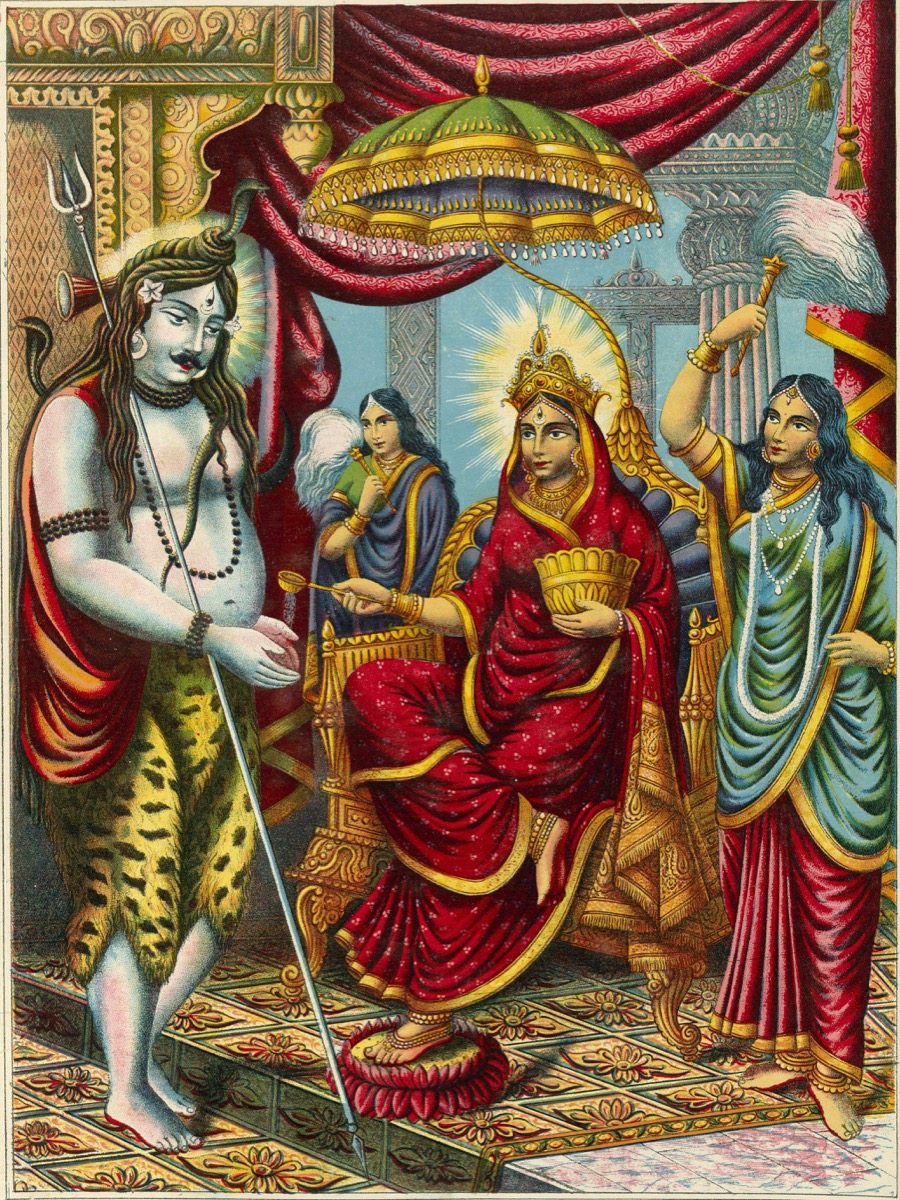
Goddess Annapūrṇā (अन्नपूर्णा, literally “she who is full of food” or “she who fills with food”) is the Hindu deity of nourishment, abundance, and the sustaining power of food. A form of Pārvatī, the consort of Lord Śiva, she is depicted as a radiant goddess holding a golden ladle and a vessel overflowing with rice porridge or pāyasam (sweet rice pudding), generously feeding all who come to her. Her principal temple stands in Kāśī (Varanasi), the most sacred city of Hinduism, where she is worshipped as the presiding deity who nourishes both the city and the cosmos.
The theology of Annapūrṇā draws from one of the most profound philosophical statements in the Upaniṣads: the declaration in the Taittirīya Upaniṣad (3.2) that anna (food) is Brahman — annaṃ brahmeti vyajānāt (“he realized that food is Brahman”). In this vision, food is not merely a material substance but the very manifestation of the divine creative force that sustains all life. Annapūrṇā personifies this truth: she is the goddess who transforms the abstract philosophical concept of anna-Brahman into a tangible, maternal, nourishing presence. To worship Annapūrṇā is to recognize that every meal is sacred, every act of feeding is an act of worship, and the sustenance of life is the sustenance of divinity itself.
The Myth of Śiva Begging for Food
The Cosmic Dissolution of Food
The central myth of Annapūrṇā is found in the Śiva Purāṇa and various regional māhātmya (glorification) texts of Kāśī. The story begins with a philosophical debate between Śiva and Pārvatī. Lord Śiva, the supreme ascetic, declared that the entire material world — including food — is māyā (illusion), and that the truly enlightened soul needs nothing material for sustenance.
Pārvatī, who as Prakṛti (Nature) is the source of all material manifestation, was deeply displeased. She asked: “If food is illusion, then what sustains the universe? What feeds your devotees? What nourishes the sages during their austerities?” To teach Śiva a profound lesson, Pārvatī vanished from the cosmos.
With her disappearance, all food vanished from the three worlds. The earth became barren, rivers dried up, trees ceased to bear fruit, and fire lost its power to cook. The devas, ṛṣis, and all living beings faced starvation. Nature itself ground to a halt, for Pārvatī — as Śakti — was the animating force behind all material existence.
The Lord Begs from His Own Consort
Śiva, seeing the suffering of the cosmos, realized the profound truth: the material world is not merely illusion but the divine body of the Goddess herself. Humbly taking up a begging bowl (bhikṣā pātra), the great lord of the universe went to Kāśī, where Pārvatī had manifested as Annapūrṇā and established a kitchen (annakṣetra) to feed the starving world.
The scene of Śiva standing at Annapūrṇā’s door with his begging bowl is one of the most iconic images in Hindu art. The supreme ascetic, the destroyer of the universe, the lord of Mount Kailāsa — reduced to a humble mendicant, begging food from his own wife. Annapūrṇā, seated upon a throne with her golden ladle, smiled and filled his bowl. In this act, the cosmos was restored: food flowed again, nature revived, and the balance between spirit (puruṣa) and matter (prakṛti) was reestablished.
The theological lesson is clear: jñāna (knowledge) without anna (nourishment, sustenance, the material foundation of life) is incomplete. Śiva, the supreme consciousness, cannot function without Śakti, the supreme energy. The Śiva Purāṇa states: śivaḥ śaktyā yukto yadi bhavati śaktaḥ prabhavitum — “Śiva is powerful only when united with Śakti.” Annapūrṇā’s myth dramatizes this Śaiva-Śākta synthesis in the most intimate and domestic of settings — the kitchen and the meal (Śiva Purāṇa; Wikipedia, “Annapurna (goddess)”).
Vedic and Upaniṣadic Foundations
Anna as Brahman in the Taittirīya Upaniṣad
The philosophical foundation of Annapūrṇā worship lies in the Taittirīya Upaniṣad, one of the oldest and most revered Upaniṣads, belonging to the Black Yajurveda. In the third chapter (Bhṛgu Vallī), the sage Bhṛgu, guided by his father Varuṇa, undertakes a systematic inquiry into the nature of Brahman (ultimate reality). He examines each layer of existence — anna (food/matter), prāṇa (breath/life-force), manas (mind), vijñāna (intellect), and ānanda (bliss).
The inquiry begins with the foundational statement: annaṃ brahmeti vyajānāt — “He realized that anna is Brahman” (Taittirīya Upaniṣad 3.2). The text elaborates:
Annād bhūtāni jāyante, annena jātāni jīvanti, annaṃ prayanty abhisaṃviśanti. “From food all beings are born, by food the born ones live, and into food they return upon departing.”
This is not a reduction of the divine to mere physical food but an elevation of food to the status of the divine. Anna encompasses all material sustenance — the earth, rain, seasons, agriculture, and the entire cycle of cosmic nourishment. The Taittirīya Upaniṣad concludes its discussion of anna with the ecstatic realization: ahaṃ annam, ahaṃ annam, ahaṃ annam — “I am food, I am food, I am food!” and ahaṃ annādaḥ, ahaṃ annādaḥ — “I am the eater of food, I am the eater of food!” In this ultimate vision, the distinction between the nourisher and the nourished dissolves into a unified field of divine sustenance (Taittirīya Upaniṣad; Wisdom Library).
The Pañca-Kośa Doctrine
The Taittirīya Upaniṣad also presents the pañca-kośa (five sheaths) model of the human person, where the outermost sheath is the annamaya kośa — the “sheath made of food.” This physical body, constituted entirely of food, is the first temple in which the divine resides. Annapūrṇā, as the goddess of anna, is thus the deity of the annamaya kośa — the protectress of the most fundamental layer of human existence.
The Annapūrṇā Temple at Kāśī (Varanasi)
The Annapūrṇā Devī Mandir in Varanasi is one of the most important Śākta shrines in the holy city. Located near the Viśvanātha (Kāśī Viśveśvara) Temple, it stands as a testament to the intimate relationship between Śiva (Viśvanātha, the Lord of the Universe) and his consort in her nourishing form.
The temple houses a striking mūrti of Annapūrṇā holding her iconic golden ladle (akṣaya pātra) and a bowl of rice, with Śiva standing before her as a mendicant. The temple is particularly revered for its annakṣetra (charitable feeding) tradition, where free meals are distributed daily to pilgrims and the poor — a direct continuation of the mythological narrative.
On the festival of Annapūrṇā Jayantī (celebrated on the full moon of the month of Mārgaśīrṣa, November-December), the temple conducts elaborate pūjā and abhiṣeka ceremonies, and special food offerings are prepared and distributed on a grand scale. Devotees observe that Kāśī itself is understood as Annapūrṇā’s eternal kitchen — no one in the city of Śiva, it is said, ever truly goes hungry, for the Goddess ensures that her sacred city is always fed (Wikipedia, “Annapurna Devi Temple”).
Ādi Śaṅkarācārya’s Annapūrṇā Stotram
One of the most celebrated hymns to Annapūrṇā was composed by Ādi Śaṅkarācārya (8th century CE), the great Advaita Vedānta philosopher who paradoxically combined the highest non-dual metaphysics with fervent devotional poetry. The Annapūrṇā Stotram consists of eleven verses, each ending with the refrain: Annapūrṇe sadāpūrṇe, Śaṅkara prāṇavallabhe — “O Annapūrṇā, ever complete, beloved of Śaṅkara (Śiva).”
The first verse sets the devotional tone:
Nityānandakarī varābhayakarī soundaryaratnākarī Nirdhūtākhila ghora pāvanakarī pratyakṣa māheśvarī Prāleyācala vaṃśa pāvanakarī Kāśīpurādhīśvarī Bhikṣāṃ dehi Kṛpāvalambanakarī Mātā-Annapūrṇeśvarī
“O Mother Annapūrṇeśvarī, giver of eternal bliss, bestower of boons and fearlessness, ocean of beauty, purifier of all terrible sins, the directly manifest Maheśvarī, sanctifier of the Himalayan lineage, sovereign of the city of Kāśī — give me food (bhikṣā), O refuge of compassion!”
The stotram is remarkable for its combination of philosophical depth and practical devotion. Śaṅkarācārya, who taught that the world is ultimately mithyā (apparent reality), here humbly begs the Goddess for food — mirroring Śiva’s own act of begging. The philosophical implication is that even the highest jñānī (knower of Brahman) must honour the material foundation of existence (Wisdom Library, “Annapurna Stotra”).
Iconography and Symbolism
The Golden Ladle and the Overflowing Vessel
Annapūrṇā’s iconography is centred on the acts of cooking and feeding. In the classic depiction:
- She is seated on a throne or lotus, beautifully adorned, in a domestic setting
- Her primary hand holds a golden ladle (akṣayapātra darvi), representing the inexhaustible nature of divine nourishment
- Her other hand holds a vessel of food — typically rice, pāyasam, or khīra (rice pudding) — overflowing to signify abundance without limit
- Śiva stands before her as a mendicant (bhikṣuka), holding out his begging bowl — the supreme lord humbled before the supreme mother
- She may also hold a book (representing wisdom-nourishment) and a lotus (representing spiritual beauty)
The 1895 Chore Bagan Art Studio lithograph from Kolkata — one of the most widely reproduced Annapūrṇā images — shows her in an ornate pillared hall, enthroned with attendants holding fly-whisks, as Śiva receives rice from her hands. This image captures the domestic intimacy that is central to Annapūrṇā’s appeal.
The Kitchen as Sacred Space
Annapūrṇā’s mythology and iconography elevate the kitchen (pākaśālā) from a mundane domestic space to a sacred site. In traditional Hindu homes, the kitchen is treated as a temple: shoes are removed, ritual purity is observed, and the first portion of cooked food is offered to the deity (naivedya) before any person eats. This practice is a direct expression of Annapūrṇā theology — the recognition that cooking is a sacred act and the meal is a form of yajña (sacred offering).
Festivals and Worship
Annapūrṇā Jayantī
The principal festival of Annapūrṇā is her Jayantī (birthday), celebrated on the full moon (pūrṇimā) of the month of Mārgaśīrṣa (November-December). On this day, devotees prepare elaborate feasts, perform special pūjā with offerings of rice and sweets, and distribute food to the hungry. In Varanasi, the festival draws large crowds to the Annapūrṇā Devī Mandir.
Annaprāśana: The First Rice-Feeding Saṃskāra
The connection between Annapūrṇā and the Annaprāśana saṃskāra (the ceremony of feeding a child solid food for the first time, typically at six months) is deeply significant. This saṃskāra, one of the sixteen prescribed in the Gṛhya Sūtras, is performed with prayers to Annapūrṇā, asking the Goddess to bless the child with lifelong nourishment. The first morsel is offered with the Vedic mantra: annapate annasya no dehy anamīvasya śuṣmiṇaḥ — “O Lord of food, grant us food that is free from disease and full of vitality” (Ṛg Veda 11.83; Wikipedia, “Annaprashana”).
Annakūṭa and Charitable Feeding
The Annakūṭa (“mountain of food”) festival, particularly celebrated in Vaiṣṇava traditions on the day after Dīpāvalī as Govardhan Pūjā, involves preparing a mountain-like heap of food offerings to the deity. While primarily associated with Kṛṣṇa’s lifting of Govardhan hill, the theology of Annakūṭa is deeply connected to Annapūrṇā’s principle of divine abundance. Across India, temples maintain annakṣetras (free kitchens) — from the Jagannāth temple’s Ānanda Bāzāra in Purī to the vast laṅgars of Sikh gurdwārās — all of which reflect the Annapūrṇā ideal that no one should go hungry in the presence of the divine.
Annapūrṇā in Regional Traditions
Bengal and Eastern India
In Bengal, Annapūrṇā holds special significance. The Annakūṭa festival in Bengali Vaiṣṇava tradition is celebrated with great elaboration, and Annapūrṇā pūjā is a domestic observance in many Bengali households. The Kalighat painting tradition of Kolkata frequently depicts the Annapūrṇā-Śiva narrative, emphasizing the playful, intimate relationship between the divine couple. In Assam, the goddess is invoked during the Bhogālī Bihu harvest festival as the source of agricultural abundance.
South India
In Tamil Nadu and Karnataka, Annapūrṇā is worshipped as Annapūraṇēśvarī in temples that maintain extensive charitable feeding programs. The famous annasattram (free feeding hall) tradition of South Indian temples is explicitly dedicated to her. The Annapūrṇā temple at Horanadu in Karnataka is a major pilgrimage centre where thousands of devotees receive free meals daily.
The Universal Kitchen
Annapūrṇā’s theology has a distinctly universal dimension. The principle that feeding the hungry is the highest form of worship transcends sectarian and even religious boundaries. Svāmī Vivekānanda, deeply influenced by the Annapūrṇā ideal, famously declared: “So long as millions live in hunger and ignorance, I hold every person a traitor who, having been educated at their expense, pays not the least heed to them.” The modern anna dāna (food charity) movement in India, including programmes like the Akṣaya Pātra Foundation that feeds millions of schoolchildren daily, draws its spiritual inspiration from the Annapūrṇā tradition.
Conclusion
Goddess Annapūrṇā transforms one of the most ordinary acts of human life — eating — into a theological statement of the highest order. In her mythology, the supreme God himself is humbled before the power of nourishment; in her Upaniṣadic foundations, food is elevated to the status of Brahman; in her worship, the kitchen becomes a temple and every meal a sacred offering. As Ādi Śaṅkarācārya’s stotram pleads: Bhikṣāṃ dehi — “Give me food, O Mother” — the devotee acknowledges that even the highest spiritual attainment depends upon the grace of the Goddess who fills the world with sustenance. Annapūrṇā reminds us that in a world where hunger persists, the most divine act may be the simplest: to feed another being.