Introduction
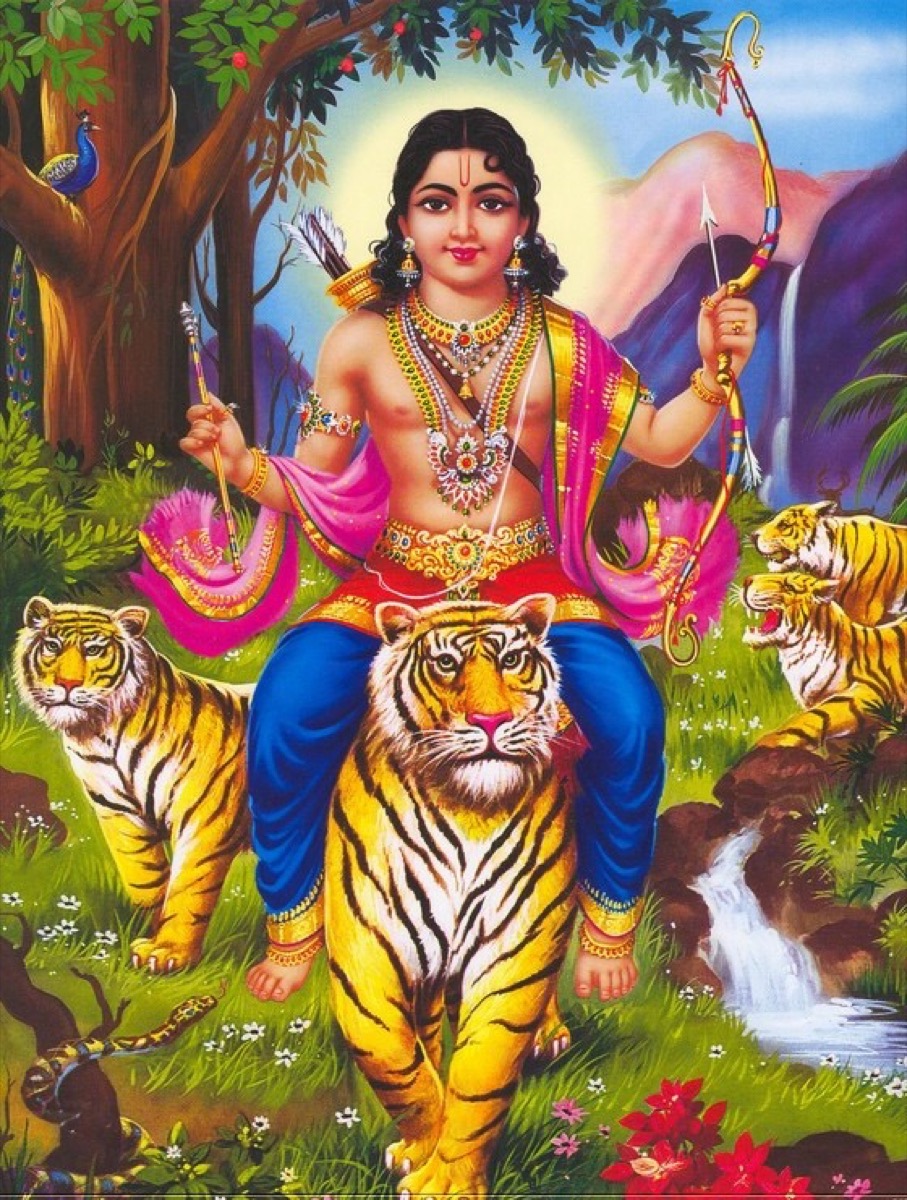
Lord Ayyappa (അയ്യപ്പൻ), also known as Dharmaśāstā (धर्मशास्ता, “the Lord who governs Dharma”), Maṇikanṭha (“the one with a jewel around his neck”), and Hariharaputra (“the son of Hari and Hara”), is one of the most widely venerated deities of South India, particularly in Kerala, Tamil Nadu, Karnataka, and Andhra Pradesh. His hilltop shrine at Sabarimala, nestled in the Western Ghats at an elevation of 468 metres, attracts an estimated 40-50 million pilgrims annually during the Maṇḍala-Makaravilakku season, making it one of the largest annual pilgrimages on earth.
What sets Ayyappa apart from most Hindu deities is his unique theological identity as the son of two male divine principles — Śiva (Hara) and Viṣṇu in his female form Mohinī (Hari). This Hari-Hara synthesis embodies the transcendence of sectarian divisions between Śaivism and Vaiṣṇavism. Furthermore, Ayyappa is worshipped as a naiṣṭhika brahmacārī (eternal celibate), and his cult emphasizes rigorous asceticism, equality of all devotees regardless of caste or religion, and the warrior ideal of dharmic protection. The greeting among Ayyappa devotees — “Swāmiyē Śaraṇam Ayyappā!” (“Lord Ayyappa, I take refuge in you!”) — echoes through the forests and hills of Kerala every pilgrim season.
Mythological Origins
The Birth from Hari-Hara
The primary narrative of Ayyappa’s birth is found in the Bhūtanātha Purāṇa and various regional sthala purāṇas (temple legends) of Kerala. When the asura (demon) Mahiṣī — the sister of Mahiṣāsura — obtained a boon from Brahmā that she could only be killed by a being born from the union of Śiva and Viṣṇu, she considered herself invincible, for how could two male gods produce offspring?
The answer came through Viṣṇu’s Mohinī avatāra. During the churning of the cosmic ocean (samudra manthana), Viṣṇu assumed the enchanting female form of Mohinī to distribute the divine nectar (amṛta) exclusively to the devas. Śiva, captivated by Mohinī’s beauty, united with her, and from this divine union was born Ayyappa (also known as Śāstā or Maṇikanṭha). The child was found on the banks of the Pambā river with a golden bell (maṇi) around his neck — hence the name Maṇikanṭha (Bhūtanātha Purāṇa; Wikipedia, “Ayyappan”).
The Story of King Rājasekhara
The best-known narrative of Ayyappa’s earthly life connects him to the Pandalam royal dynasty of Kerala. King Rājasekhara of Pandalam, who was childless, found the divine infant Maṇikanṭha on the banks of the Pambā river during a hunting expedition. The king adopted the boy and raised him as the crown prince.
As Maṇikanṭha grew, he displayed superhuman abilities — mastering the martial arts, taming wild elephants, and demonstrating profound spiritual wisdom. The queen, who had later borne a biological son, plotted against Maṇikanṭha. She feigned illness and had the royal physician prescribe tigress’s milk as the only cure, hoping to send the prince to certain death in the forest.
Maṇikanṭha set out for the forest and was gone for many days. In the wilderness, he encountered and vanquished the demoness Mahiṣī, fulfilling the purpose of his divine birth. He returned to Pandalam riding a tigress, accompanied by a retinue of tigers — revealing his divine nature to all. The king, recognizing his son as God incarnate, asked what boon Maṇikanṭha desired. The prince requested that a temple be built for him at the spot where an arrow he shot from Pandalam would land. The arrow landed at Sabarimala, atop the Sabari hill in the dense forests of the Western Ghats. There, the king built the sacred temple, and Maṇikanṭha, now revealed as Lord Ayyappa, installed himself in the form of the yogapīṭha (yogic posture) mūrti that devotees worship today (Britannica, “Ayyappan”).
The Sabarimala Temple and Pilgrimage
The Sacred Geography
The Sabarimala temple is situated in the Periyar Tiger Reserve in the Pathanamthitta district of Kerala. The temple is accessible only by foot — a trek of approximately 4.5 kilometres through dense forest from the base camp at Pambā. The isolation and the physical rigour of the journey are integral to the spiritual experience. The trek through the forest is understood as a metaphor for the soul’s journey from the worldly plain to the divine summit.
The temple is open for worship only during specific periods: the annual Maṇḍala Pūjā season (mid-November to late December, corresponding to the 41-day vrata), the Makaravilakku festival in January, Viṣu (April), and the first five days of each Malayalam month. This limited accessibility enhances the sacredness of the pilgrimage and distinguishes Sabarimala from temples that are open year-round (Wikipedia, “Sabarimala”).
The Maṇḍala Vrata: 41 Days of Austerity
The Sabarimala pilgrimage is not a casual journey. Before setting out, a devotee must undertake the Maṇḍala Vrata — a 41-day period of strict austerity (tapas). During this period, the pilgrim must:
- Wear black or dark blue clothing (symbolizing renunciation)
- Observe strict celibacy (brahmacarya)
- Eat only vegetarian food, typically one or two simple meals daily
- Sleep on the floor and avoid all luxury
- Refrain from alcohol, tobacco, and intoxicants
- Practice daily prayer and meditation, ideally visiting a local temple twice daily
- Address every person as “Swāmī” — recognizing the divine in all beings
The vrata is initiated by a guru swāmī (an experienced pilgrim who serves as spiritual guide) who ties an irumuḍi (a sacred bundle carried on the head) containing two compartments: the front holds offerings of ghee-filled coconut (nei abhiṣeka) for the deity, while the rear holds provisions for the journey. The irumuḍi must never touch the ground once tied, symbolizing the pilgrim’s elevated spiritual state (Wikipedia, “Mandala Puja”).
The Eighteen Sacred Steps (Padiṉeṭṭām Paḍi)
The final approach to the Sabarimala sanctum requires ascending the Padiṉeṭṭām Paḍi — eighteen sacred gold-plated steps that lead to the temple. Only those who have observed the Maṇḍala Vrata and carry the irumuḍi on their head are permitted to climb these steps. Each step is said to represent a specific spiritual quality or stage of inner evolution:
According to tradition, the first five steps represent the five senses (pañcendriya), the next eight represent the eight emotional states (aṣṭa rāga), the following three represent the three guṇas (sattva, rajas, tamas), and the final two represent vidyā (knowledge) and avidyā (ignorance). Ascending all eighteen steps signifies the transcendence of worldly attachments and the attainment of the divine vision of Ayyappa in his yogic form.
Makaravilakku and the Celestial Light
The Makaravilakku festival, celebrated on Makara Saṅkrānti (January 14-15), is the climactic event of the Sabarimala season. The festival is named after a mysterious light (vilakku, meaning “lamp”) that appears on the distant Ponnambalamedu hill, visible from the temple. Devotees regard this light as a divine manifestation (jyoti darśana), and its appearance is greeted with thunderous chants of “Swāmiyē Śaraṇam Ayyappā!”
The highlight of the festival is the Tīrtha Āṭṭa Mahotsava — the ceremonial display of the sacred ornaments (tiruvabharanam) of Ayyappa. These jewels, traditionally kept at the Pandalam palace, are carried in a grand procession through the forest to Sabarimala, accompanied by elephants, musicians, and thousands of devotees. The ornaments are placed on the deity precisely when the Makaravilakku light appears, creating a moment of extraordinary spiritual intensity (Wikipedia, “Makaravilakku”).
Iconography and Worship
The Yogapīṭha Form
Unlike most Hindu deities who are depicted standing or in dynamic postures, the central mūrti of Ayyappa at Sabarimala is in yogapīṭha (yogic seated posture) with a yogapaṭṭa (meditation band) around his knees, hands in cin mudrā (the gesture of consciousness). This posture emphasizes Ayyappa’s identity as a brahmacārī (celibate ascetic) and yogi. In other temples, Ayyappa may be depicted riding a tiger, holding a bow, or in a warrior stance reflecting his role as a protector of dharma.
The Significance of the Bell (Maṇi)
The golden bell (maṇi) around Ayyappa’s neck is his defining attribute. It connects him to his infancy on the banks of the Pambā and serves as a symbol of the primordial sound (nāda) — the praṇava (Oṁ) from which all creation emerges. The ringing of bells is a central feature of Ayyappa worship, filling the hill forests with sacred sound.
Social and Theological Significance
Transcendence of Caste and Religious Boundaries
The Ayyappa tradition is notable for its egalitarianism. The pilgrimage strips away all social distinctions: every devotee, whether Brahmin or Dalit, Hindu or Muslim, dresses identically in dark clothing, observes the same vrata, and is addressed as “Swāmī.” The Vāvar Mosque at Erumely, where Ayyappa pilgrims stop to pay respects before entering the forest trail, embodies the tradition’s syncretic spirit. Vāvar is venerated as a Muslim warrior-saint who was Ayyappa’s close companion, and no Sabarimala pilgrimage is considered complete without honouring him.
The Hari-Hara Synthesis
Theologically, Ayyappa represents the resolution of the Śaiva-Vaiṣṇava divide that has shaped much of Hindu sectarian history. As the son of Śiva and Viṣṇu (Mohinī), he embodies the unity of the two great streams of Hindu devotion. The famous verse states: Hariharasutaṃ devaṃ, Dharmaśāstāram āśraye — “I take refuge in the god who is the son of Hari and Hara, the Lord of Dharma.” This synthetic theology makes Ayyappa a powerful symbol of Hindu unity, particularly in South India where Śaiva-Vaiṣṇava tensions were historically pronounced.
Pan-South Indian Devotion
While Kerala remains the epicentre of Ayyappa worship, the cult has spread across all of South India and into parts of the north. Tamil Nadu has over 1,000 Ayyappa temples, particularly in the southern districts. In Karnataka, the deity is worshipped as Maṇikanṭheśvara, and the ancient temple at Kukke Subrahmaṇya maintains a Śāstā shrine. In Andhra Pradesh and Telangana, the Maṇḍala season sees massive processions of irumuḍi-bearing pilgrims heading south to Sabarimala. The diaspora has carried Ayyappa worship to Malaysia, Singapore, Sri Lanka, and the West, with dedicated temples and annual Maṇḍala Vrata observances.
The Ayyappa Tradition in Literature and Arts
The Harivarasanam — a devotional lullaby sung to Lord Ayyappa at the close of each day’s worship in Sabarimala — is one of the most beloved hymns in Kerala. Composed by Kumbakkuḍi Kulaśekhara Paṭṭar, its gentle melody and profound lyrics (Harivarasanaṃ viśvamohanam, Haridhādhīśvaram ārādhyapadhmanābham…) are broadcast every night as the temple doors close, and the deity is symbolically put to sleep. The song encapsulates the intimate, personal relationship between the devotee and Ayyappa.
The Śabarimalai tradition has also inspired a rich body of devotional music in Malayalam, Tamil, and Telugu. The Tamil film industry has produced numerous devotional films centred on Ayyappa, and ayyappan pāttu (Ayyappa songs) constitute a distinct genre of South Indian devotional music.
Conclusion
Lord Ayyappa stands as a remarkable figure in the Hindu pantheon — a deity who bridges the divine and the ascetic, the Śaiva and the Vaiṣṇava, the tribal and the classical, the Hindu and the syncretic. The Sabarimala pilgrimage, with its demanding vrata, its forest trek, and its eighteen sacred steps, offers devotees not merely a journey to a hilltop shrine but a transformative spiritual discipline. In the words of the ancient invocation: Lokāḥ samastāḥ sukhino bhavantu — “May all beings everywhere be happy” — the Ayyappa tradition calls its followers to transcend division and embrace the universal dharma of compassion, self-discipline, and devotion.