Introduction
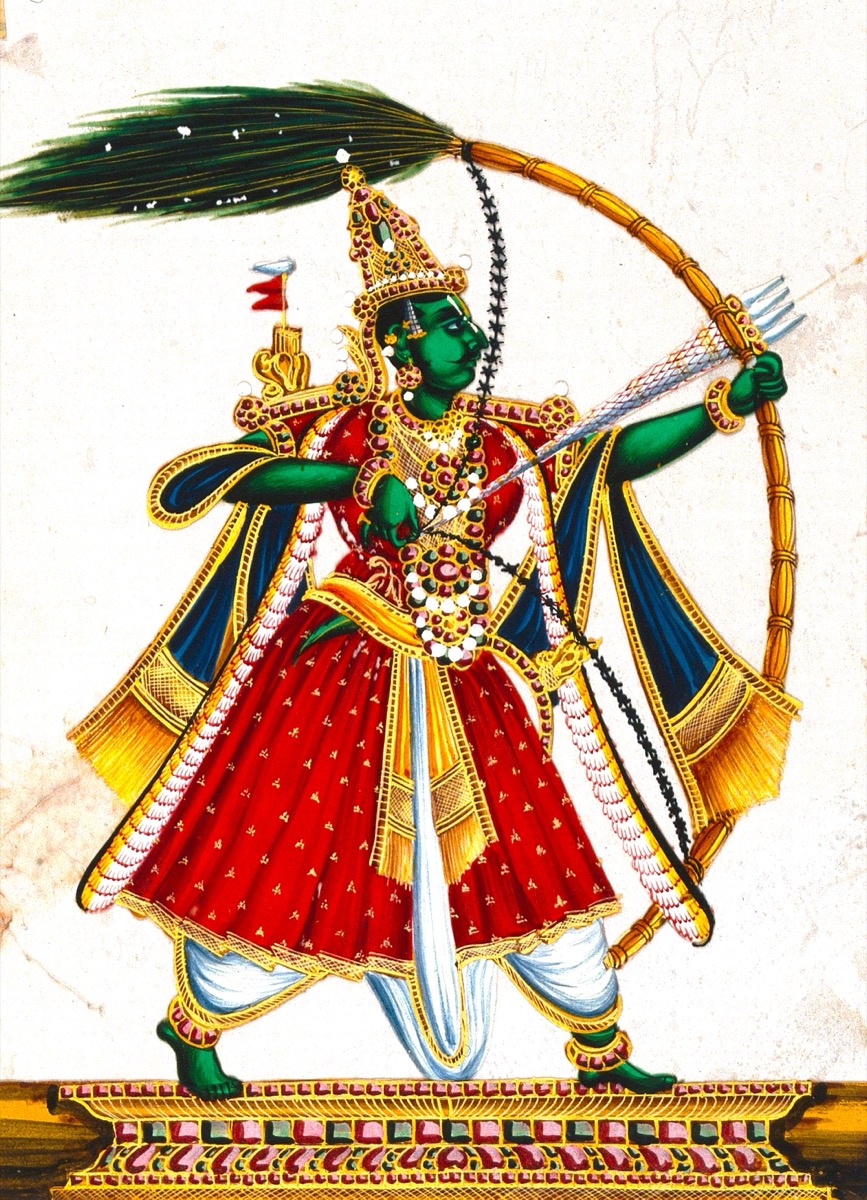
Kāmadeva (कामदेव, “the god of desire”), also known as Manmatha (“the churner of hearts”), Madana (“the intoxicating one”), Anaṅga (“the bodiless one”), and Puṣpadhanuṣ (“the one whose bow is made of flowers”), is the Hindu god of love, desire, and attraction. Armed with a bow of sugarcane strung with a line of humming bees, and five arrows tipped with five different flowers, he rides upon a parrot (śuka) and is accompanied by his consort Rati (Pleasure) and companion Vasanta (Spring). His banner bears the emblem of the makara (a mythical sea-creature), and the gentle breeze of the spring season is his army.
Kāmadeva is not merely a god of romantic love or physical desire. In Vedic philosophy, Kāma is a primordial cosmic force — the creative desire that set the universe in motion. The Nāsadīya Sūkta (Ṛg Veda 10.129.4) declares: kāmas tad agre samavartatādhi manaso retaḥ prathamaṃ yad āsīt — “In the beginning, desire arose, which was the first seed of mind.” The Atharva Veda devotes an entire hymn (AV 9.2) to Kāma as a cosmic principle superior even to the gods. Thus Kāmadeva personifies not just human love but the fundamental attractive force that holds the cosmos together — a concept that resonates with the Greek notion of Eros as a primordial cosmogonic principle (Britannica, “Kama”).
Vedic Origins: Kāma as Cosmic Principle
The Nāsadīya Sūkta (Ṛg Veda 10.129)
The most philosophically significant reference to Kāma in the Vedas occurs in the famous Nāsadīya Sūkta (the Hymn of Creation). This hymn describes the state before creation, when there was neither being (sat) nor non-being (asat), neither death nor immortality, neither light nor darkness. From this primordial void, the first stirring arose:
kāmas tad agre samavartatādhi manaso retaḥ prathamaṃ yad āsīt sato bandhum asati nir avindan hṛdi pratīṣyā kavayo manīṣā
“Desire (kāma) arose in the beginning, which was the first seed of mind. The wise, searching in their hearts with wisdom, found the bond (bandhu) of being in non-being.”
Here, Kāma is not a personal deity but a cosmogonic force — the original creative impulse that bridges the gap between non-existence and existence. This philosophical Kāma is the ancestor of the mythological Kāmadeva, just as the Vedic cosmogonic principle of Ṛta (cosmic order) evolved into the personal deity Varuṇa (Ṛg Veda 10.129; Sacred Texts).
The Atharva Veda Hymns to Kāma
The Atharva Veda (9.2) contains a remarkable hymn that elevates Kāma to supreme divine status:
Kāmo jajñe prathamaḥ, taṃ na devā āpnuvan na pitaraḥ na manuṣyāḥ. “Kāma was born first; neither the gods nor the ancestors nor humans could reach him.”
Kāma, tatas tvam asi mahān, tasmāt tvam asi sarvataḥ. “O Kāma, you are great beyond all, you pervade everything.”
This hymn presents Kāma as prior to the gods themselves — a primordial principle that predates the organized Vedic pantheon. The Atharva Veda also contains numerous love charms and spells invoking Kāma for the attraction of a beloved, the healing of heartbreak, and the restoration of passion in marriage. These practical applications show that even in the earliest Vedic period, the cosmic principle of Kāma was understood to manifest in the everyday experiences of human love and desire (Atharva Veda; Sacred Texts).
The Mythology of Kāmadeva
Birth and Attributes
In Purāṇic mythology, Kāmadeva is variously described as the mind-born son of Brahmā (one of the first beings to emerge from the Creator’s thought), or as an emanation of Viṣṇu (particularly in Vaiṣṇava traditions where he is identified with Pradyumna, the son of Kṛṣṇa). The Bhāgavata Purāṇa (10.55) narrates that Kāmadeva, after being burned by Śiva, was reborn as Pradyumna, the son of Kṛṣṇa and Rukmiṇī, thus linking the god of love directly to the supreme Vaiṣṇava deity.
His attributes are among the most poetic in Hindu mythology:
- Bow: Made of sugarcane (ikṣu dhanur), representing the sweetness of desire
- Bowstring: A line of humming bees (madhukarī), representing the intoxicating buzzing of attraction
- Five arrows: Each tipped with a different flower — lotus (aravinda, arousing infatuation), aśoka (dispelling sorrow), mango blossom (cūta, causing pining), jasmine (mallikā, creating enchantment), and blue lotus (nīlotpala, inducing exhaustion from love) — representing the five stages of falling in love
- Mount: A parrot (śuka), the bird of eloquent speech and amorous messages
- Banner: Bearing the makara (a composite sea-creature), hence Kāmadeva’s epithet Makaradhvaja (“he whose banner bears the makara”)
- Companions: His wife Rati (Pleasure/Delight) and his friend Vasanta (Spring personified)
The Burning by Śiva’s Third Eye
The most famous myth of Kāmadeva is his burning by Śiva’s third eye — a story that carries profound philosophical significance. The narrative, found extensively in the Śiva Purāṇa (Rudra Saṃhitā) and immortalized in Kālidāsa’s Kumārasambhava, unfolds as follows:
After the death of Śiva’s first consort Satī, the grief-stricken Lord withdrew into deep meditation on Mount Kailāsa, renouncing all worldly engagement. Meanwhile, the demon Tārakāsura obtained a boon from Brahmā that he could only be killed by a son of Śiva. Since Śiva was lost in samādhi (meditative absorption) and showed no inclination toward marriage or procreation, the gods faced a crisis: without Śiva’s son, Tārakāsura would destroy the universe.
The gods devised a plan. Satī had been reborn as Pārvatī, the daughter of the mountain king Himavān, and was already performing intense austerities to win Śiva as her husband. The gods sent Kāmadeva to Kailāsa to awaken desire in Śiva’s heart and draw his attention toward Pārvatī.
Kāmadeva arrived in the spring season, accompanied by Vasanta and Rati. As Pārvatī approached Śiva to offer flowers, Kāmadeva drew his sugarcane bow, fitted a mango-blossom arrow, and shot it at Śiva. For a fleeting moment, Śiva’s concentration wavered — his eyes opened and fell upon the beautiful Pārvatī. But then, realizing that his meditation had been deliberately disrupted, Śiva was consumed with rage. From his third eye (tṛtīya netra) blazed a column of fire that reduced Kāmadeva to ashes in an instant.
Rati, witnessing her husband’s destruction, was devastated. She pleaded with the gods, who interceded with Śiva. The great lord, his anger subsiding, granted a boon: Kāmadeva would henceforth exist as Anaṅga — the Bodiless One — invisible yet omnipresent. He would no longer have a physical form, but his power would pervade the cosmos more effectively than ever. Love, Śiva declared, does not need a body to operate; it works through the mind, the heart, and the very atmosphere of spring (Śiva Purāṇa; Britannica, “Kama”).
The Kumārasambhava of Kālidāsa
The greatest literary treatment of the Kāmadeva myth is Kālidāsa’s Kumārasambhava (“The Birth of Kumāra [Kārtikeya]”), composed around the 4th-5th century CE and considered one of the masterpieces of Sanskrit mahākāvya (court epic). The third canto of this poem depicts Kāmadeva’s mission to Kailāsa in exquisite detail.
Kālidāsa’s description of spring’s arrival — manipulated by Kāmadeva to create the perfect atmosphere of desire — is among the most celebrated passages in world literature:
Priyeṣu nāgendraḥ parāmṛśan gajān Vanaspatīn puṣpa-bharāvanadbhiḥ
The poet describes how the mango trees burst into bloom, the kokila (cuckoo) began to sing, the southern breeze (malaya mārutaḥ) carried the fragrance of sandalwood, and all of nature conspired to awaken desire. Even the sages on Kailāsa found their meditations disturbed.
The moment of Kāma’s burning is described with characteristic Kālidāsian restraint and pathos. The fire of Śiva’s eye is compared to the cosmic fire of dissolution (pralayāgni), and Kāma’s body dissolves like camphor in flame. Rati’s lament, her desperate attempt to throw herself on the pyre of her husband’s ashes, and the consolation offered by Vasanta and a divine voice form one of the most poignant episodes in Sanskrit poetry (Wisdom Library, “Kumarasambhava”).
Kāmadeva’s Restoration and Rebirth
The Bodiless God
In many Purāṇic traditions, Śiva eventually restored Kāmadeva partially — allowing him to be visible to his wife Rati but invisible to the rest of the world. This “bodiless” (anaṅga) existence is theologically significant: it suggests that desire operates most powerfully when it is invisible, working through mood, atmosphere, memory, and imagination rather than through direct sensory confrontation.
Rebirth as Pradyumna
The Vaiṣṇava tradition offers a different resolution. According to the Bhāgavata Purāṇa (10.55), Kāmadeva was reborn as Pradyumna, the eldest son of Kṛṣṇa and Rukmiṇī. Stolen as an infant by the demon Śambara, Pradyumna was raised by Māyāvatī (who was Rati reborn) and eventually slew Śambara, returning to Kṛṣṇa’s court in Dvārakā. The identification of Kāma with Pradyumna links the god of love directly to the rāsalīlā tradition of Kṛṣṇa, in which divine love (prema) is the highest spiritual attainment.
Rati: The Goddess of Pleasure
Rati (रति, “Pleasure” or “Delight”) is Kāmadeva’s eternal consort and an important deity in her own right. She is the personification of sensual pleasure, beauty, and erotic delight. In art, she is depicted as an exquisitely beautiful woman, often shown applying perfume, holding a mirror, or standing beside Kāmadeva as he draws his bow.
Rati’s loyalty to Kāmadeva after his burning is celebrated in poetry and drama. Her grief, her austerities to win back her husband, and her eventual reunion with him (whether in his anaṅga form or as Pradyumna) parallel the devotional themes of Sītā’s faithfulness to Rāma and Pārvatī’s austerities for Śiva. Rati thus represents the persistence of love and pleasure even through destruction and loss — a theme that resonates with the Hindu understanding of desire as an eternal force that cannot be permanently destroyed.
Comparisons with Eros and Cupid
The parallels between Kāmadeva and the Greco-Roman gods of love — Eros (Greek) and Cupid (Roman) — are striking and have fascinated comparative mythologists since the colonial period:
| Attribute | Kāmadeva | Eros/Cupid |
|---|---|---|
| Weapon | Flower-tipped arrows, sugarcane bow | Lead and gold arrows, golden bow |
| Mount | Parrot | Wings (often depicted as winged) |
| Consort | Rati (Pleasure) | Psyche (Soul) |
| Companion | Vasanta (Spring) | Aphrodite/Venus (Beauty) |
| Destruction | Burned by Śiva, becomes Anaṅga | In some traditions, punished by Zeus |
| Cosmic role | Primordial creative desire (Ṛg Veda) | Primordial Eros (Hesiod’s Theogony) |
The most significant parallel lies in the cosmogonic role: both the Vedic Kāma and Hesiod’s primordial Eros are understood as forces that existed before the organized pantheon, driving the very process of cosmic creation. Whether these parallels reflect a shared Indo-European inheritance or independent philosophical insights remains a subject of scholarly debate (Wikipedia, “Kamadeva”; Britannica, “Kama”).
Spring Festival Associations
Vasanta Pañcamī and Holī
Kāmadeva is intimately associated with spring — the season of flowering, birdsong, and romantic awakening. The festival of Vasanta Pañcamī (the fifth day of the bright fortnight of Māgha, January-February) marks the arrival of spring and is associated with both Sarasvatī and Kāmadeva. In some regions, particularly in Odisha and parts of eastern India, Vasanta Pañcamī includes special worship of Kāmadeva and Rati.
The more dramatic association is with Holī, the spring festival of colours. According to one tradition, the burning of Holikā on the eve of Holī commemorates the burning of Kāmadeva by Śiva’s third eye. The bonfires represent the fire that consumed Kāma’s body, and the joyous colour-throwing on the following day celebrates his resurrection as Anaṅga — the invisible, all-pervading power of love that colours the entire world with desire. The Holī tradition of South India, called Kāmadahana (“the burning of Kāma”), explicitly re-enacts this myth, with effigies of Kāmadeva burned in bonfires while devotees sing and dance (Wikipedia, “Holika Dahan”).
Madana Trayodaśī and Madan Mahotsava
In some Vaiṣṇava traditions, Madana Trayodaśī (the thirteenth day of the bright fortnight of Caitra, March-April) is celebrated as the day of Kāmadeva’s revival. Temples dedicated to Kṛṣṇa celebrate the Madan Mahotsava (“the great festival of Madana”), where Kṛṣṇa and Rādhā are worshipped as the supreme manifestation of divine love, with Kāmadeva honoured as the facilitator of their eternal romance.
Kāmadeva in Art and Literature
Kāmadeva has been a favourite subject of Indian art and literature across millennia. In sculpture, he appears at Khajurāho, Koṇārka, and other temple complexes known for their erotic art, typically depicted as a handsome youth drawing his flower-bow while riding a parrot. In painting, the Rajput and Pahari miniature traditions frequently depict the Rāga Vasanta (Spring Melody) with Kāmadeva and Rati in a garden setting surrounded by flowering trees and singing birds.
In literature, beyond the Kumārasambhava, Kāmadeva features prominently in Bhartṛhari’s Śṛṅgāra Śataka (hundred verses on love), Jayadeva’s Gīta Govinda (where Kṛṣṇa is essentially Kāma incarnate), and Kālidāsa’s Ṛtusaṃhāra (The Garland of Seasons), where the poet celebrates each season’s erotic potential.
Conclusion
Kāmadeva occupies a unique position in the Hindu pantheon: he is simultaneously the most human of gods and the most cosmic of forces. As a god with a flower-bow and parrot-mount, he embodies the sweetness, beauty, and vulnerability of romantic love. As the Vedic Kāma, he is the primordial creative desire without which no universe could exist. His burning by Śiva teaches that desire must ultimately be transcended through spiritual discipline — yet his persistence as Anaṅga, the Bodiless One, reminds us that desire can never be fully destroyed, for it is woven into the very fabric of existence. In the words of the Ṛg Veda: kāmas tad agre samavartatādhi — “In the beginning, desire arose first.” Love, Kāmadeva tells us, is not a human invention but a cosmic truth — the first truth, the seed from which all else grows.