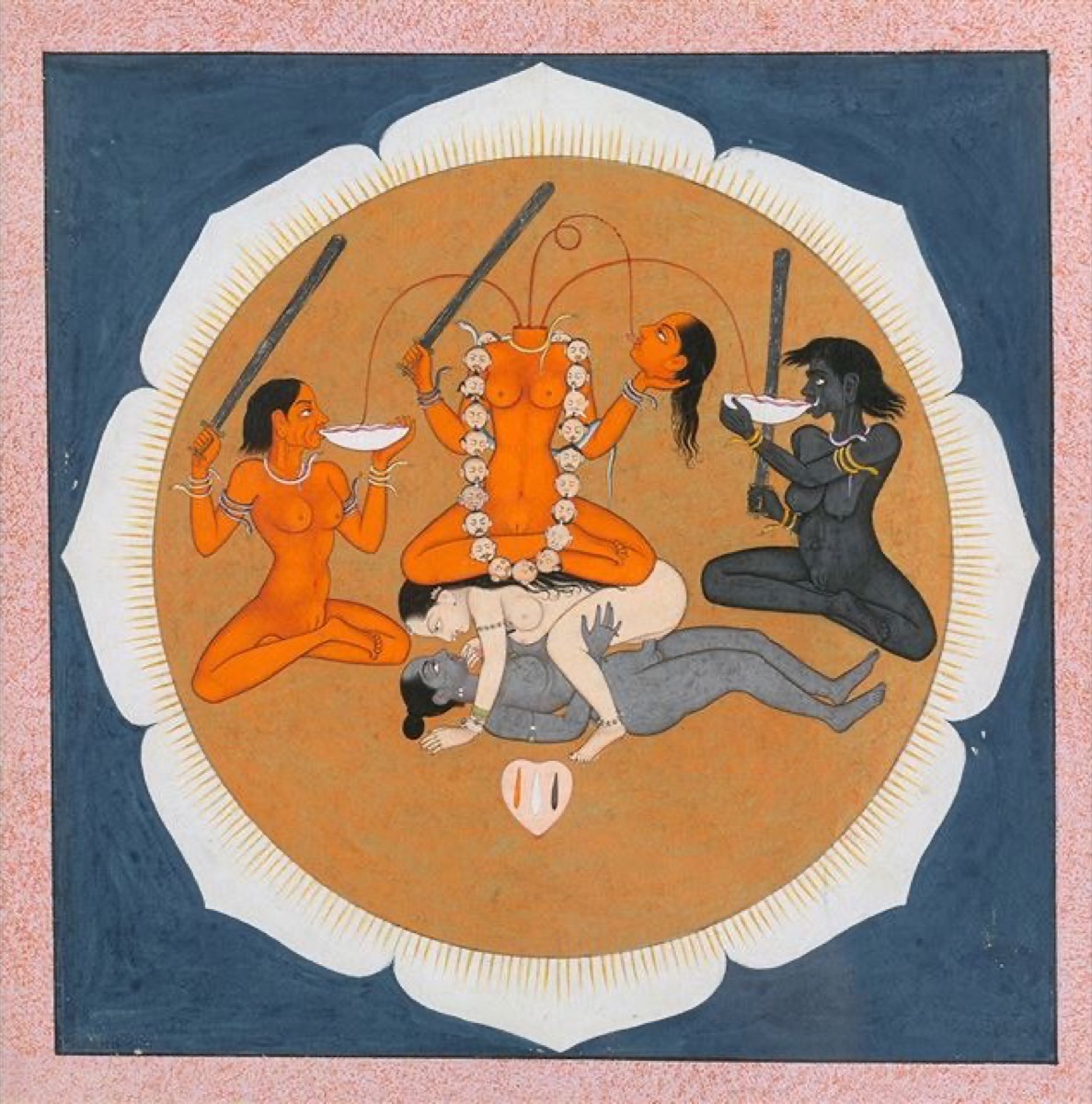
Goddess Chinnamastā (छिन्नमस्ता), also known as Chinnamastikā (छिन्नमस्तिका), Pracaṇḍacaṇḍikā (प्रचण्डचण्डिका, “the Furiously Fierce”), and Vajravairochanī (वज्रवैरोचनी), is one of the most extraordinary and enigmatic deities in the Hindu tantric pantheon. As a member of the Daśa Mahāvidyā — the ten great wisdom goddesses of Śākta tradition — she is variously enumerated as the fifth or sixth Mahāvidyā, depending on the textual lineage followed. Her most iconic representation, in which she holds her own severed head while three jets of blood stream from her neck to nourish herself and her two attendants, constitutes one of the most philosophically profound and visually arresting images in all of Indian religious art.
Chinnamastā’s iconography transcends mere shock value. She embodies the fundamental paradox at the heart of existence: that creation and destruction are simultaneous, that the sustainer of life must also be its consumer, and that liberation demands the radical annihilation of the ego-self. Her worship, rooted in the deepest currents of tantric sādhana, offers the practitioner a path to kuṇḍalinī awakening and the dissolution of dualistic consciousness.
Etymology and Names
The name Chinnamastā is a Sanskrit compound derived from chinna (छिन्न, “severed,” “cut off”) and mastā (मस्ता, “head”), literally meaning “She whose head is severed.” This name directly refers to her central iconographic feature — the goddess who has decapitated herself with her own fingernails or a sword and yet continues to live, standing triumphant with her severed head in hand.
She bears numerous epithets across tantric literature. The Śākta Pramoda and the Tantrasāra refer to her as Pracaṇḍacaṇḍikā (“the Furiously Fierce One”), emphasizing her terrifying aspect. Her mantra name Vajravairochanī (“She who shines like a thunderbolt”) connects her to the Buddhist tradition, where her counterpart is known as Chinnamuṇḍā (“the Severed-headed One”) or Trikāya-Vajrayoginī (“Triple-bodied Vajrayoginī”). Among her 108 names (Aṣṭottaraśatanāmāvalī) recorded in the Śākta Pramoda, she is invoked as Mahābhīmā (“the Great Terrible One”), Caṇḍamātā (“Mother of the Fierce”), Krodhinī (“the Wrathful”), and Kopāturā (“Afflicted with Rage”).
Position Among the Daśa Mahāvidyā
The Daśa Mahāvidyā (दश महाविद्या, “Ten Great Wisdoms”) represent ten aspects of the supreme Devī, each embodying a particular dimension of transcendent knowledge and cosmic power. The standard enumeration, as given in texts like the Mahābhāgavata Purāṇa and the Devī Bhāgavata Purāṇa, lists them as: Kālī, Tārā, Tripurasundarī, Bhuvaneśvarī, Bhairavī, Chinnamastā, Dhūmāvatī, Bagalāmukhī, Mātaṅgī, and Kamalā. In this ordering, Chinnamastā occupies the sixth position.
However, certain tantric lineages, particularly those following the Toḍala Tantra and related texts, place her as the fifth Mahāvidyā. This variation reflects the fluid nature of tantric classification systems, where different schools arranged the goddesses according to their own ritual priorities and philosophical emphases. Regardless of her numerical position, Chinnamastā is universally recognized as among the most powerful and esoteric of the ten, a deity whose worship demands exceptional courage and spiritual maturity.
Within the Mahāvidyā group, Chinnamastā represents the moment of cosmic dissolution at the peak of creation — the instant when the life force reaches its zenith and turns back upon itself. While Kālī governs time and dissolution broadly, Chinnamastā embodies the specific transformative instant when consciousness severs its identification with the body-mind complex.
Mythological Origins
The Bathing at the Mandākinī River
The most widely recounted origin narrative of Chinnamastā appears in the Prāṇatoṣiṇī Tantra (18th century), which draws upon older sources attributed to the Svātantra Tantra. According to this account, the goddess Pārvatī went to bathe in the Mandākinī river accompanied by her two female attendants, Jayā and Vijayā (also known by their tantric names Ḍākinī and Varṇinī). While bathing, Pārvatī became suffused with intense inner energy, and her complexion turned dark.
As time passed, her two companions grew desperately hungry and repeatedly entreated the goddess to provide them food. Pārvatī initially reassured them that she would feed them upon returning home. But when they continued to plead, overcome by hunger, the merciful goddess — embodying the supreme ideal of self-sacrifice — severed her own head with her fingernails. Her head fell onto the palm of her left hand.
Three streams of blood immediately gushed from her severed neck. The left stream flowed into the mouth of Ḍākinī, standing to her left. The right stream nourished Varṇinī, standing to her right. The central stream arced upward into the mouth of her own severed head, held aloft in her hand. Thus Pārvatī came to be known as Chinnamastā — the goddess who decapitated herself to feed her devotees.
The Variant Narrative
A second version, also recorded in the Prāṇatoṣiṇī Tantra and attributed to the Svātantra Tantra, presents a different context. In this telling, Śiva narrates how his consort Caṇḍikā (identified with Pārvatī) was engaged in passionate union with him. At the moment of his seminal emission, she became enraged, and her attendants Ḍākinī and Varṇinī arose from her body. In this version, the river is called the Puṣpabhadrā, and the day of Chinnamastā’s self-decapitation is designated Vīrarātri (“the Night of the Hero”). Upon seeing the pale, self-sacrificed Pārvatī, Śiva becomes infuriated and assumes the terrifying form of Krodha Bhairava.
Iconography and Visual Symbolism
The Self-Decapitated Form
Chinnamastā’s iconographic form is described in elaborate detail in the dhyāna ślokas (meditative verses) found in texts such as the Tantrasāra, the Śākta Pramoda, and the Mantra-mahodadhi. The standard depiction shows the goddess in the following manner:
She stands or sits in a pratyālīḍha posture (with the left leg forward, a battle stance), her body nude and red-complexioned — described as being red as the hibiscus flower or brilliant as a million suns. In her left hand she holds her own severed head by its hair, the face drinking from one of the three blood jets. In her right hand she brandishes a kartarī (curved knife or scimitar) — the instrument of her self-decapitation. Her breasts are adorned with lotuses, and a serpent encircles the jewel on her forehead. She has three eyes, signifying her perception of past, present, and future.
The Three Blood Streams
The three jets of blood (tri-dhārā) that spurt from Chinnamastā’s severed neck constitute the central symbolic element of her iconography. Each stream has precise tantric significance:
- The left stream feeds Ḍākinī, her left-side attendant, who is dark-complexioned and holds a skull-cup and knife
- The right stream feeds Varṇinī, her right-side attendant, who is light-complexioned and bears similar attributes
- The central stream feeds the goddess’s own severed head, which she holds in her left hand
These three streams are identified in tantric physiology with the three principal nāḍīs (energy channels) of the subtle body: Ḍākinī represents the Iḍā nāḍī (the lunar, left channel), Varṇinī represents the Piṅgalā nāḍī (the solar, right channel), and the central stream feeding Chinnamastā’s own head represents the Suṣumnā nāḍī (the central channel through which kuṇḍalinī rises). The act of self-decapitation thus symbolizes the opening of the Suṣumnā and the ascent of kuṇḍalinī energy through the crown of the head.
Standing Upon Kāma and Rati
In her most complete iconographic form, Chinnamastā stands upon the copulating couple of Kāma (the god of desire) and Rati (his consort, the goddess of passion), who are depicted lying upon a lotus. This element carries multiple layers of meaning:
First, it signifies the goddess’s triumph over kāma (desire) — she literally stands above and transcends sexual passion, the most fundamental of worldly attachments. Second, the copulating couple beneath her represents the creative energy of the universe (the union of puruṣa and prakṛti), upon which Chinnamastā stands as the force that simultaneously sustains and transcends this creative process. Third, the contrast between the couple engaged in the act of creation below and the goddess engaged in the act of self-destruction above conveys the tantric teaching that creation and destruction are inseparable aspects of the same reality.
Some tantric commentators interpret the coupling of Kāma and Rati as representing the union of prāṇa and apāna (the upward and downward vital breaths), the harmonization of which is essential for kuṇḍalinī awakening. Chinnamastā, standing upon this union, represents the moment when these forces are transcended and consciousness bursts through the sahasrāra (crown) chakra.
Philosophical and Tantric Symbolism
Self-Sacrifice and the Dissolution of Ego
At its deepest level, Chinnamastā’s self-decapitation represents the radical dissolution of the ego-self (ahaṅkāra). The head, seat of individual identity and rational consciousness, is severed voluntarily — not by an external force but by the goddess herself. This act symbolizes the spiritual practitioner’s willingness to surrender the limited self in pursuit of the unlimited divine consciousness.
The fact that the goddess continues to live — indeed, continues to nourish herself and others — after removing her head teaches that true selfhood persists beyond the ego. The decapitation does not result in death but in a higher form of existence. As tantric scholars note, Chinnamastā’s iconography conveys that reality is the coincidence of creation and destruction, the continuous cycle of self-giving and self-renewal that sustains the cosmos.
Kuṇḍalinī Awakening
Chinnamastā is explicitly identified in tantric texts as Kuṇḍalinī Śakti in her active, ascending form. The Prāṇatoṣiṇī Tantra and commentarial literature establish the following correspondences:
- The goddess’s body represents the Suṣumnā nāḍī, the central channel
- Ḍākinī and Varṇinī represent the Iḍā and Piṅgalā nāḍīs flanking it
- The severed head represents consciousness liberated from bodily identification
- The three blood streams represent the flow of prāṇa through the three channels
- The act of decapitation represents the piercing of the Brahmarandhra (the opening at the crown)
The goddess herself is described as a spiritually mature sixteen-year-old (ṣoḍaśī) who has conquered her ego and awakened her kuṇḍalinī, while her attendants are described as spiritually immature twelve-year-olds who are sustained on the goddess’s blood and have not yet attained liberation from the delusion of duality. This distinction underscores the teaching that the guru sustains and nourishes disciples from her own spiritual substance.
The Coincidence of Opposites
Perhaps no deity in the Hindu pantheon embodies the tantric principle of dvandvātīta (transcendence of dualities) as powerfully as Chinnamastā. In her single form, she simultaneously embodies:
- Life and death — she is both decapitated and alive
- Giver and receiver — she feeds others and feeds herself
- Creation and destruction — she stands upon the creative act while performing the destructive one
- Desire and renunciation — she is above Kāma yet described as “inclined towards lust” (kāmāsaktā)
- Terrible and compassionate — her act of self-mutilation is motivated by mercy toward her hungry attendants
This coincidentia oppositorum is the hallmark of the highest tantric realization, where all apparent contradictions dissolve in the non-dual awareness of Brahman.
Tantric Worship and Sādhana
Mantra
Chinnamastā’s mūla mantra (root mantra), as prescribed in the Tantrasāra and Śākta Pramoda, is:
Oṁ Śrīṁ Hrīṁ Klīṁ Aiṁ Vajravairochanīye Hūṁ Hūṁ Phaṭ Svāhā
The mantra invokes the goddess by her tantric name Vajravairochanī, connecting her to both the vajra (thunderbolt/diamond) symbolism shared with Buddhist tantra and the concept of supreme illumination (vairochanī, “she who illuminates”). The seed syllables (bīja) in the mantra — Śrīṁ, Hrīṁ, Klīṁ, Aiṁ — invoke abundance, māyā, desire, and wisdom respectively.
Yantra
The Chinnamastā Yantra features an inverted triangle (representing śakti and the yoni) at its center, surrounded by lotus petals and enclosed within a square bhūpura (earth enclosure). The inverted triangle echoes the triangular form of the goddess’s iconography — the three blood streams creating a downward-pointing triangular pattern. The yantra serves as the geometric representation of the goddess’s energy field and is the focal point for meditation and pūjā.
Modes of Worship
The Śākta Pramoda prescribes nine sections of practice (navāṅga sādhana) for Chinnamastā worship, including: dhyāna (meditative visualization), yantra pūjā (worship of the sacred diagram), mantra japa (repetition of the sacred syllable), recitation of the 108 names (aṣṭottaraśatanāmāvalī), and the sahasranāma (thousand-name hymn).
Chinnamastā’s worship is classified under vīrācāra (the heroic mode of tantric practice). The Prāṇatoṣiṇī Tantra states that those who worship her are of three types: yogis (those seeking spiritual union), world renouncers (saṁnyāsīs), and those who are heroic in nature (vīra). Her worship is not recommended for beginners or the faint-hearted — it demands a practitioner who has already developed significant mastery over fear, attachment, and the conventional limitations of consciousness.
The Chinnamastikā Temple at Rajrappa
The most important temple dedicated to Chinnamastā is the Chinnamastikā Temple at Rajrappa, located approximately 28 km from Ramgarh Cantonment along NH-20 in the Ramgarh district of Jharkhand. Situated on a hillock at the sacred confluence (saṅgama) of the Dāmodar and Bherā (Bhairavī) rivers near the Rajrappa falls, this site is recognized as one of the most significant Śaktipīṭhas in eastern India.
The origins of the temple are shrouded in antiquity. The site has been a place of worship among tribal communities since ancient times, with some local traditions tracing its sacred character to the era of Samudragupta (4th century CE). The natural rock formation that serves as the primary object of worship — a stone covered with an aṣṭadhātu (eight-metal alloy) kavaca (protective covering) — is believed to be a svayambhū (self-manifested) representation of the goddess.
The present temple structure was built by a tāntric Bengali sādhaka according to tantric architectural principles, featuring dome-shaped tops reminiscent of Kāmrūpa architectural traditions of Assam — a fitting connection, given that Assam’s Kāmākhyā tradition is a major center for Mahāvidyā worship. The Durgā Saptaśatī also references this sacred site. Major festivals include Chaitra Navarātri and Vīrarātri, when thousands of devotees — particularly tantric practitioners — converge upon the temple.
Connection to Buddhist Chinnamuṇḍā Vajrayoginī
One of the most remarkable aspects of Chinnamastā is her close parallel with the Buddhist deity Chinnamuṇḍā (“She with the Severed Head”), a form of Vajrayoginī in Vajrayāna Buddhism. The Buddhist form, also called Trikāya-Vajrayoginī (“Triple-bodied Vajrayoginī”), shares virtually identical iconography: a self-decapitated female figure holding her head, with three blood streams feeding herself and two attendants.
The question of which tradition originated the deity has been debated by scholars. Benoytosh Bhattacharyya, the pioneering scholar of Buddhist iconography, concluded that the Hindu Chinnamastā derived from the Buddhist Chinnamuṇḍā, who was worshipped by at least the 7th century CE. The earliest extant texts describing the deity date from the 9th and 10th centuries — a period when Hindu and Buddhist tantras were developing under mutual influence in the same regions of India, particularly in Bengal, Bihar, and Nepal.
However, scholars like S. Shankaranarayanan argue that Chinnamastā has Vedic antecedents, pointing to symbolic parallels with the self-sacrificing cosmic puruṣa in the Ṛg Veda’s Puruṣa Sūkta and the theme of sacrificial dismemberment in Vedic ritual. Elisabeth Anne Benard, in her definitive monograph Chinnamasta: The Aweful Buddhist and Hindu Tantric Goddess (1994), adopts a more nuanced position, arguing that the two traditions likely developed the deity in dialogue with each other, making questions of absolute priority impossible to resolve definitively.
In Buddhist practice, Chinnamuṇḍā is integrated into the Cakrasaṃvara Tantra cycle and is worshipped as a wisdom deity (prajñā) embodying the realization of śūnyatā (emptiness). The three bodies are interpreted through the Buddhist doctrine of trikāya (three bodies of the Buddha): dharmakāya, saṃbhogakāya, and nirmāṇakāya.
Representation in Art
Chinnamastā has been represented primarily in illustrated manuscripts of tantric texts from the 17th through 19th centuries, with major artistic traditions including:
- Pāhāṛī miniatures: The famous painting by Nainsukh of Guler (c. 1740), executed in gouache and gold on paper, is considered a masterpiece of the genre. It portrays the goddess in vivid red standing upon Kāma and Rati with delicate precision typical of the Guler-Kangra school.
- Rājasthānī miniatures: Paintings from the Bundi and Kota schools frequently depict Chinnamastā within sets illustrating all ten Mahāvidyās.
- Nepali paubha paintings: The Newar artistic tradition of Nepal has produced some of the most elaborate depictions, including an 18th-century painting showing Chinnamastā above Kāma and Rati upon a lotus.
- Tāntric scroll paintings: Bengali and Assamese traditions include Chinnamastā in paṭa paintings used for ritual purposes.
Festivals and Observances
Chinnamastā is primarily worshipped during Chaitra Navarātri (March-April), with particularly elaborate rituals on the day dedicated to the Mahāvidyās within the nine-night festival. Vīrarātri — the “Night of the Hero” — mentioned in the Prāṇatoṣiṇī Tantra as the anniversary of the goddess’s self-decapitation, is observed by dedicated tantric practitioners with night-long vigils, mantra recitation, and meditation upon her yantra.
At the Rajrappa temple, the annual mela (fair) draws hundreds of thousands of devotees from Jharkhand, West Bengal, Bihar, and beyond. Animal sacrifice (bali) has historically been a feature of worship at this and other Chinnamastā temples, reflecting the vāmācāra (left-hand) tantric traditions associated with the goddess, though contemporary practice increasingly offers symbolic substitutes.
Chinnamastā in Contemporary Practice
In modern Hindu practice, Chinnamastā remains one of the most revered yet least publicly worshipped Mahāvidyās, owing to the esoteric nature of her sādhana and the fearless disposition required of her practitioners. She is particularly invoked by those seeking to overcome deep-seated fears, dissolve stubborn ego attachments, and awaken the dormant kuṇḍalinī śakti. Tantric practitioners regard her as the goddess who grants the ability to confront the most terrifying truths of existence — including the reality of death itself — without flinching.
As modern scholars and spiritual seekers rediscover the Mahāvidyā tradition, Chinnamastā’s profound symbolism continues to reveal new dimensions of meaning. She stands as a testament to the extraordinary capacity of Hindu tantric theology to encode the deepest metaphysical truths within images of startling power and beauty — reminding practitioners across the centuries that liberation demands nothing less than the complete surrender of the illusory self to the infinite reality that sustains, transforms, and transcends all existence.