Introduction
Lord Hanumān (IAST: Hanumān; Sanskrit: हनुमान्), also known as Mārutī, Bajrāṅgabalī, and Āñjaneya, is one of the most revered and widely worshipped deities in Hinduism. He is celebrated across scripture, theology, and living devotional practice as the supreme exemplar of bhakti (devotion), sevā (selfless service), vīrya (heroic valour), and vinaya (humility). His central role in the Rāmāyaṇa as the foremost ally and servant of Śrī Rāma has made him an enduring archetype of the ideal devotee — one whose immeasurable strength is placed entirely in the service of the divine, without any trace of ego or self-interest.
Hanumān occupies a unique theological position in Hinduism. He is simultaneously a deity worthy of independent worship, an exemplary bhakta whose devotion is the model for all others, and a Cirañjīvī — one of the seven immortals destined to live until the end of the present cosmic age. His worship cuts across sectarian boundaries: Vaiṣṇavas revere him as Rāma’s supreme devotee, Śaivas honour him as an incarnation of Śiva, and across rural and urban India alike, his vermilion-smeared images guard village crossroads, wrestling grounds, and temple gateways. As Tulsīdās declared in the Hanumān Cālīsā: “Rāma dūta atulita bala dhāmā, Añjanī-putra Pavana-suta nāmā” — “Messenger of Rāma, abode of incomparable strength, son of Añjanā, named the son of the Wind” (Hanumān Cālīsā, verse 1).
Birth and Childhood
Divine Parentage
Hanumān was born to Añjanā, an apsarā (celestial nymph) who had been cursed to take birth on earth as a vānara (monkey-like being), and Kesarī, the king of the vānaras and, according to the Vālmīki Rāmāyaṇa, a descendant of Bṛhaspati, the preceptor of the gods. Multiple traditions describe the role of Vāyu, the wind god, in Hanumān’s conception. In the most widely accepted account, when King Daśaratha performed the Putreṣṭi Yajña (fire sacrifice for progeny), Vāyu carried a portion of the divine pāyasa (sacred offering) to Añjanā, resulting in Hanumān’s birth. This dual lineage — earthly father Kesarī and divine father Vāyu — explains the epithet Pavanaputra (“Son of the Wind”) and his extraordinary powers of flight, speed, and shapeshifting (Wikipedia, “Hanuman”).
In the Śaiva tradition, Hanumān is further regarded as an avatāra (incarnation) of Lord Śiva himself, born to assist Rāma — an incarnation of Viṣṇu — in his earthly mission. The Śiva Purāṇa and several regional traditions affirm this identification, which places Hanumān at the intersection of Vaiṣṇava and Śaiva theology.
Swallowing the Sun
The most celebrated episode of Hanumān’s childhood is narrated in the Vālmīki Rāmāyaṇa (Kiṣkindhā Kāṇḍa) and elaborated in later Purāṇas. As an infant, the preternaturally powerful Hanumān mistook the rising sun for a ripe fruit and leaped skyward to swallow it. This act alarmed Indra, the king of the gods, who struck the child with his vajra (thunderbolt), breaking his jaw. The name “Hanumān” is etymologically derived from the Sanskrit hanu (jaw) — “the one with the [broken] jaw.”
Enraged by the assault on his son, Vāyu withdrew all air from the universe, causing suffocation among all living beings. The crisis compelled Brahmā, Śiva, and the assembled gods to intervene. They revived the child and, as reparation, each deity bestowed a boon upon him: Indra granted that Hanumān’s body would be as strong as his vajra; Agni granted immunity from fire; Varuṇa granted immunity from water; Brahmā granted immunity from the brahmāstra; and Sūrya later became his guru, teaching him all the scriptures and sciences. These boons collectively account for Hanumān’s near-invincibility and his mastery of the aṣṭa siddhis (Swami Krishnananda, “The Life and Glory of Hanuman”).
The Curse and Its Lifting
A lesser-known but theologically important episode recounts that the child Hanumān, emboldened by his powers, began disturbing sages during their austerities. The ṛṣis cursed him to forget his divine abilities until someone reminded him of them at the right moment. This curse becomes narratively crucial in the Kiṣkindhā Kāṇḍa, when Jāmbavān reminds the despondent Hanumān of his forgotten powers before the leap to Laṅkā — a moment that transforms the entire course of the Rāmāyaṇa.
Role in the Rāmāyaṇa
First Meeting with Rāma
Hanumān first encounters Rāma and Lakṣmaṇa in the Kiṣkindhā Kāṇḍa of the Vālmīki Rāmāyaṇa. Disguised as a Brahmin mendicant on the orders of Sugrīva (the exiled vānara king), Hanumān approaches the two princes to assess whether they are friend or foe. Rāma is immediately struck by the refinement of Hanumān’s speech and remarks to Lakṣmaṇa: “No one can speak in this way without mastering the Ṛg Veda, the Yajur Veda, and the Sāma Veda… his speech is faultless in grammar and expression” (Vālmīki Rāmāyaṇa, Kiṣkindhā Kāṇḍa 3.28–32). This crucial passage establishes Hanumān not merely as a warrior but as a scholar, diplomat, and master of language — qualities that will prove essential in his mission to Laṅkā.
The Sundara Kāṇḍa: Hanumān’s Epic
The fifth book of the Vālmīki Rāmāyaṇa, the Sundara Kāṇḍa (“The Beautiful Book”), is unique in the entire epic: it is the only kāṇḍa in which the hero is not Rāma but Hanumān. Comprising 2,885 Sanskrit verses across 68 chapters, it narrates Hanumān’s solo mission to Laṅkā in extraordinary detail (Sundara Kanda, Wikipedia). Devotee-scholars who equate the Rāmāyaṇa with the Veda consider the Sundara Kāṇḍa its Upaniṣad — the essential, innermost portion. Many Hindus believe that reading the Sundara Kāṇḍa alone is equivalent to reading the entire Rāmāyaṇa.
The key episodes of the Sundara Kāṇḍa include:
-
The Leap to Laṅkā: Hanumān expands his body to an immense size and leaps across the ocean — a distance of one hundred yojanas (roughly 800 miles). Along the way, he overcomes the sea-serpent Surasā by shrinking to the size of a thumb and escaping through her mouth, and defeats the shadow-devouring demoness Siṁhikā. This leap is one of the most iconic moments in all of Hindu mythology.
-
Finding Sītā: After a painstaking search through the palaces, gardens, and inner chambers of Laṅkā, Hanumān finally discovers Sītā in the Aśoka grove (Aśoka Vāṭikā), emaciated and grief-stricken, surrounded by rākṣasī guards. He presents Rāma’s signet ring as proof of his identity and delivers Rāma’s message of hope.
-
Burning of Laṅkā: After allowing himself to be captured by Indrajit and brought before Rāvaṇa, Hanumān delivers a fearless speech urging the demon king to return Sītā. When Rāvaṇa orders his tail set ablaze, Hanumān escapes his bonds and leaps from rooftop to rooftop, setting all of Laṅkā ablaze — a devastating display of power and a symbolic foreshadowing of the war to come.
-
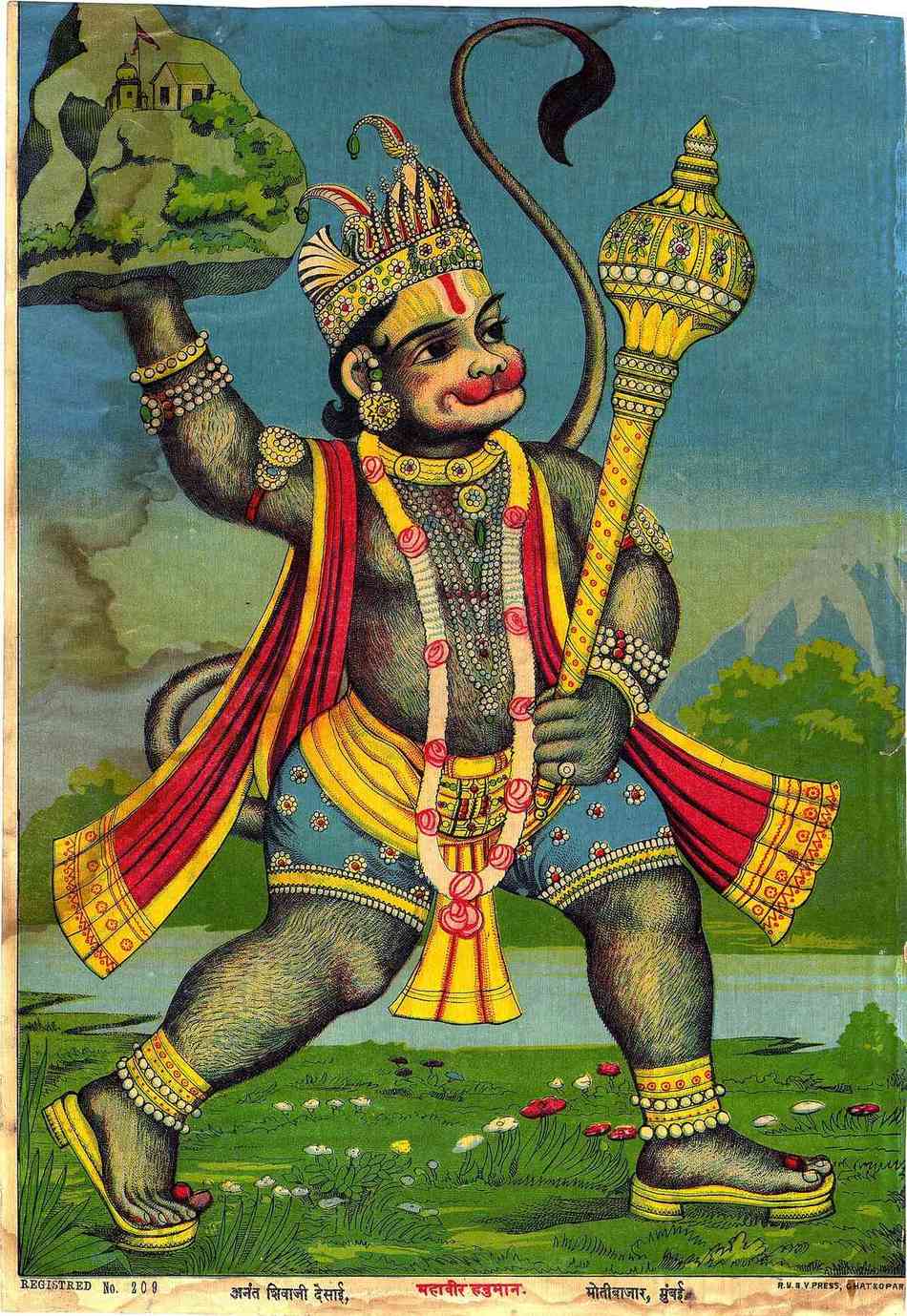
The Sañjīvanī Mountain: During the great war, when Lakṣmaṇa is struck unconscious by Indrajit’s śakti weapon, the physician Suṣeṇa prescribes four herbs from the Droṇagiri mountain in the Himalayas. Unable to identify the exact herbs, Hanumān uproots the entire mountain and flies it back to the battlefield before dawn — an image of superhuman devotion that has become one of the most iconic scenes in Indian art.
Hanumān in the Mahābhārata
Hanumān’s presence extends beyond the Rāmāyaṇa into the Mahābhārata, underscoring his status as a Cirañjīvī. In the Vana Parva (Book of the Forest), the Pāṇḍava prince Bhīma — himself a son of Vāyu and therefore Hanumān’s half-brother — encounters an aged monkey blocking a forest path during the Pāṇḍavas’ exile. Bhīma, proud of his immense physical strength, asks the monkey to move his tail aside. Despite his greatest efforts, Bhīma cannot budge the tail even an inch. The monkey then reveals himself as Hanumān and embraces Bhīma.
This episode carries profound theological significance. Hanumān teaches Bhīma that physical strength without humility and devotion is insufficient — a lesson Bhīma needed before the Kurukṣetra war. Hanumān also grants Bhīma a boon: “I shall sit upon the flagstaff of Arjuna’s chariot, and with my thunderous roar, I shall strike terror into the hearts of your enemies” (Mahābhārata, Vana Parva 149). True to his word, Hanumān’s image adorns Arjuna’s battle standard throughout the great war (Wisdom Library, “Bhima meets Hanuman”).
The Aṣṭa Siddhis and Nava Nidhis
Hanumān is said to possess the Aṣṭa Siddhis (eight supernatural perfections) and the Nava Nidhis (nine divine treasures), as celebrated in the Hanumān Cālīsā:
- Aṇimā — the power to reduce one’s body to the size of an atom
- Mahimā — the ability to expand infinitely
- Garimā — the power to become immeasurably heavy
- Laghimā — the ability to become weightless
- Prāpti — the capacity to obtain anything desired
- Prākāmya — the power to fulfil any wish
- Īśitva — supreme lordship over creation
- Vaśitva — the power to control all beings
Tulsīdās writes: “Aṣṭa siddhi nava nidhi ke dātā, asa bara dīnha Jānakī Mātā” — “Bestower of the eight perfections and nine treasures, such a boon Mother Jānakī (Sītā) has given” (Hanumān Cālīsā, verse 31). In this verse, it is Sītā herself who grants Hanumān the authority to distribute these powers to worthy devotees.
Philosophical and Theological Significance
The Ideal of Dāsya Bhakti
In Vaiṣṇava theology, Hanumān represents the supreme ideal of dāsya bhakti — devotion expressed as selfless service to God. Of the nine forms of bhakti enumerated in the Bhāgavata Purāṇa (7.5.23), dāsya (service) is the mode that Hanumān embodies with unparalleled perfection. When asked who he is, Hanumān’s response in the Rāmāyaṇa is the definitive theological statement: “When I identify with my body, I am your servant; when I identify with my individual soul, I am a part of you; when I identify with the Ātman, you and I are one” — a formulation that spans the spectrum from dualistic service to non-dual identity.
Jñāna and Vairāgya Incarnate
Tulsīdās, in the Rāmacaritamānasa, characterises Hanumān as the living embodiment of both jñāna (knowledge) and vairāgya (renunciation) — the two prerequisites for attaining Rāma. Unlike many devotees who must struggle to acquire these qualities, Hanumān possesses them inherently. He is a brahmacārī (celibate ascetic) of absolute purity, a scholar of all sciences, and yet completely devoid of ego — qualities that make him the ideal intermediary between God and the devotee (Ramcharitmanas, Wikipedia).
The Emblem of Strength and Humility
The famous image of Hanumān tearing open his chest to reveal Rāma and Sītā dwelling within his heart captures a central paradox of his theology: he is the mightiest of beings, yet his might exists solely as a vessel for love. This image, widely reproduced in temple art and popular devotion, teaches that true strength is not autonomous power but power surrendered to the divine.
The Hanumān Cālīsā
The Hanumān Cālīsā is a forty-verse devotional hymn composed by Gosvāmī Tulsīdās (c. 1532–1623 CE) in Avadhī, a dialect of Hindi. It is among the most widely recited prayers in all of Hinduism. According to tradition, Tulsīdās composed the Cālīsā while imprisoned; his fervent recitation summoned an army of monkeys that compelled the Mughal authorities to release him (Hanuman Chalisa, Wikipedia).
The Cālīsā praises Hanumān’s birth, his divine powers, his role as Rāma’s messenger and servant, his burning of Laṅkā, his carrying of the Sañjīvanī mountain, and his mastery of the eight siddhis. Its concluding verse promises: “Jo sata bāra pāṭha kara koī, chūṭahiṁ bandhi mahā sukha hoī” — “Whoever recites this a hundred times shall be freed from bondage and attain supreme bliss.”
Recitation of the Hanumān Cālīsā is believed to grant physical courage, protection from evil spirits, relief from planetary afflictions (especially those of Śani, Saturn), and spiritual upliftment. It is recited daily by millions of Hindus, particularly on Tuesdays and Saturdays.
Sacred Names and Epithets
Hanumān is known by a rich constellation of names, each illuminating a facet of his nature:
- Mārutī / Pavanaputra — Son of Vāyu (the Wind)
- Bajrāṅgabalī — “The Mighty One with a Thunderbolt Body,” recalling Indra’s vajra that made his limbs invincible
- Āñjaneya — Son of Añjanā
- Kesarīnandana — Son of Kesarī
- Rāmadūta — Messenger and emissary of Rāma
- Saṅkaṭamocana — Remover of afflictions and dangers
- Mahāvīra — The Great Hero
- Laṅkādahana — The Burner of Laṅkā
- Pañcamukha Hanumān — The Five-Faced Hanumān, a Tantric form
Iconography
Hanumān is typically depicted as a muscular vānara with a human-like body, a monkey face, and a long tail. His skin is usually shown in vermilion red or orange — colours associated with brahmacārya (celibacy) and tapas (austerity). Devotees anoint his images with sindūra (vermilion) and oil, a practice linked to the tradition that Sītā applied sindūr to her forehead for Rāma’s well-being; Hanumān, seeing this, smeared his entire body in vermilion to magnify the blessing for his Lord.
Common iconographic forms include:
- Dāsa Hanumān: Standing with hands folded in añjali mudrā (gesture of devotion), the classic devotee pose
- Vīra Hanumān: Striding forward with a gadā (mace) in one hand and the Sañjīvanī mountain in the other
- Pañcamukha Hanumān: A five-headed Tantric form with the faces of Hanumān, Narasiṁha, Garuḍa, Varāha, and Hayagrīva — representing mastery over the five directions
- Chest-opening Hanumān: Tearing open his chest to reveal Rāma and Sītā seated within his heart
Major Temples and Worship Traditions
Hanumān temples are among the most numerous in India, found in virtually every town and village. Some of the most important include:
- Hanumān Gaṛhī, Ayodhyā: A fortress-temple perched on a hillock in Rāma’s birthplace, administered by the Nirvaṇī Aṇī Akhāṛā of the Rāmānandī Sampradāya. It is considered the foremost Hanumān shrine in North India (Hindu Sanatan Vahini, “Famous Hanuman Temples”).
- Hanumān Temple, Connaught Place, Delhi: One of the oldest temples in Delhi, believed to date to the time of the Pāṇḍavas.
- Saṅkaṭamocana Temple, Vārāṇasī: Founded by Tulsīdās himself in the 16th century, this temple is the site of the annual Saṅkaṭamocana Saṅgīta Sammelan, a major Hindustani classical music festival.
- Jakhu Temple, Shimla: Perched at 8,000 feet with a 108-foot Hanumān statue, marking the spot where Hanumān is said to have rested while carrying the Sañjīvanī mountain.
- Karmaṅghāṭ Hanumān Temple, Hyderabad: One of the oldest temples in Telangana, dating to approximately the 12th century.
Worship Practices
Tuesdays and Saturdays are the principal days of Hanumān worship across India. Devotees visit temples to offer sindūra (vermilion), laḍḍūs (sweetmeats — Hanumān’s favourite prasāda), colā (sacred cloth), tela (oil), and tulasī leaves. Many devotees observe fasts (vrata) on these days and recite the Hanumān Cālīsā, the Sundara Kāṇḍa, or the Bājraṅg Bāṇa (a protective hymn attributed to Tulsīdās).
The association with Saturday (Śanivāra) relates to Hanumān’s legendary power over Śani (Saturn). According to tradition, Hanumān once subdued Śani and freed him from captivity by Rāvaṇa; in gratitude, Śani promised never to trouble those who worship Hanumān. This belief makes Hanumān worship especially important for those undergoing the astrological period of Śani Sāḍhesātī (Saturn’s seven-and-a-half-year transit).
Hanumān also holds a special place in akhāṛā (wrestling gymnasium) culture across North India. Wrestlers and martial artists venerate him as the patron deity of physical strength and brahmacārya. Many akhāṛās contain a Hanumān shrine, and training sessions begin with obeisance to him.
Festivals
- Hanumān Jayantī: Celebrated on the full moon (pūrṇimā) of the month of Caitra (March–April) in most traditions, and on the new moon (amāvasyā) of Mārgaśīrṣa (December) in some South Indian traditions. Temples hold special abhiṣeka (ceremonial bathing of the deity), recitations of the Sundara Kāṇḍa, and community feasts.
- Rāma Navamī: As Rāma’s foremost devotee, Hanumān is prominently worshipped during the celebration of Rāma’s birth.
- Dīpāvalī (Diwali): In many North Indian traditions, the night of Diwali is also associated with Hanumān worship.
Hanumān in Regional and Contemporary Culture
Hanumān’s influence pervades Indian culture beyond the strictly religious. The Rāmlīlā (dramatic re-enactment of the Rāmāyaṇa), performed in thousands of towns during Dussehra, always features Hanumān as a central character. In South India, the Yakṣagāna and Kathakali dance-drama traditions include elaborate Hanumān performances. In folk traditions across Rajasthan, Maharashtra, and Karnataka, Hanumān is invoked as a guardian against evil spirits and a granter of courage.
In modern India, Hanumān remains a powerfully living presence. His images are ubiquitous — on truck mudflaps, at highway intersections, in police stations, and in the homes of devotees across all social classes. The naming of India’s Mars orbiter mission’s secondary satellite imaging system and various national programmes after Hanumān reflects his enduring cultural resonance as a symbol of audacious achievement and selfless service.
Conclusion
Hanumān stands as one of the most theologically rich and devotionally beloved figures in all of Hinduism. He is at once the mightiest warrior and the humblest servant, the master of all siddhis and the one who desires nothing for himself, the immortal guardian who spans the cosmic ages and the intimate companion who dwells in the heart of every devotee who calls upon Rāma’s name. As Tulsīdās sang: “Rāma rasāyana tumhare pāsā, sadā raho Raghupati ke dāsā” — “The elixir of Rāma’s name is ever in your keeping; may you always remain the servant of Raghupati.” In those words lives the essence of Hanumān — strength perfected by love, power perfected by surrender.