Introduction
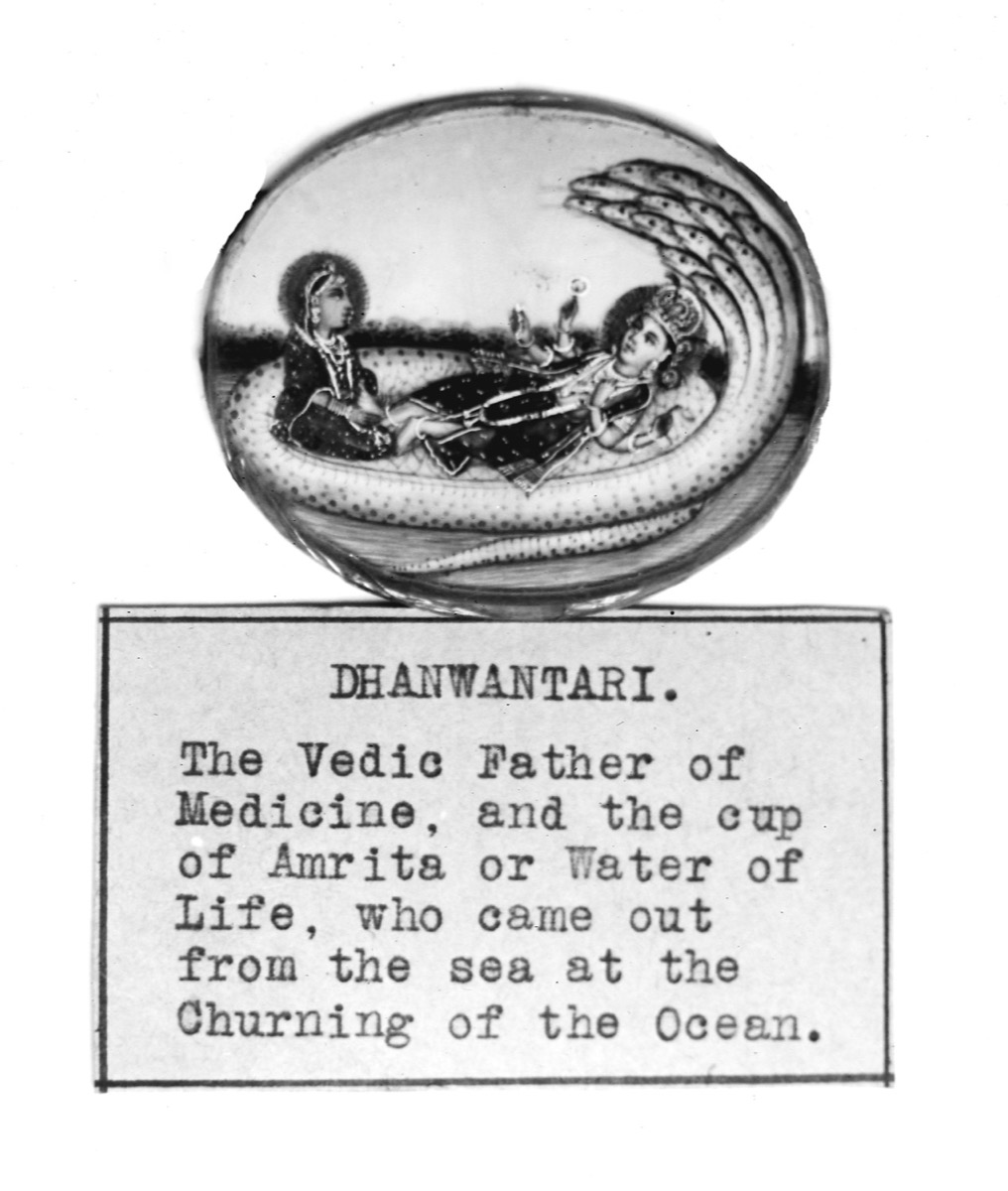
Dhanvantarī (Sanskrit: धन्वन्तरि, IAST: Dhanvantari) is one of the most revered deities in the Hindu pantheon, worshipped as the divine physician of the gods (devānāṁ vaidyaḥ) and the celestial progenitor of Āyurveda, the ancient Indian science of life and medicine. His very name has become synonymous with medical excellence in Indian civilization — to this day, an exceptionally skilled physician may be called a “Dhanvantarī” as the highest compliment.
Unlike many Hindu deities whose origins are tied to cosmic cycles of creation and dissolution, Dhanvantarī’s emergence is anchored to one of the most dramatic events in Hindu mythology: the Samudra Manthana, the great churning of the cosmic ocean of milk. Rising from the turbulent waters with a golden vessel of amṛta (the nectar of immortality) in his hands, Dhanvantarī embodies the principle that true healing is divine in origin — that the knowledge to cure disease, overcome suffering, and prolong life is a sacred gift from the Supreme Being to humanity.
As an avatāra (incarnation) of Lord Viṣṇu, Dhanvantarī occupies a unique position in Hindu theology. He is not merely a physician but a manifestation of the Supreme Lord’s compassion — the aspect of divinity that preserves life, alleviates suffering, and sustains the well-being of all creation. The Bhāgavata Purāṇa (8.8.34) explicitly identifies him as viṣṇor aṁśāṁśa-sambhavaḥ — “born from a partial portion of a partial portion of Lord Viṣṇu” — establishing his divine credentials beyond doubt.
The Samudra Manthana: Emergence from the Cosmic Ocean
The Great Churning
The story of Dhanvantarī’s appearance is inseparable from the Samudra Manthana (Sanskrit: समुद्रमन्थन), one of the most celebrated episodes in Hindu mythology, narrated in detail in the Bhāgavata Purāṇa (Canto 8, Chapters 5–12), the Viṣṇu Purāṇa (1.9), and the Mahābhārata (Ādi Parva, Chapters 15–17).
The narrative unfolds when the Devas (gods) and Asuras (demons), seeking the amṛta — the nectar that would grant them immortality — agreed to jointly churn the Kṣīrasāgara (the Ocean of Milk). They used Mount Mandara as the churning rod and Vāsuki, the serpent king, as the churning rope. Lord Viṣṇu himself, in his Kūrma (tortoise) avatāra, supported Mount Mandara on his back to prevent it from sinking into the ocean floor.
As the churning progressed, numerous divine treasures and beings emerged from the ocean: the wish-fulfilling cow Kāmadhenu, the celestial tree Pārijāta, the moon god Chandra, the goddess Lakṣmī, the lethal poison Hālāhala (consumed by Lord Śiva), the divine elephant Airāvata, the celestial horse Uccaiḥśravā, and many others.
The Appearance of Dhanvantarī
Near the culmination of the churning, a resplendent figure emerged from the depths of the milky ocean. The Bhāgavata Purāṇa (8.8.32–34) provides a vivid description: he was a youth of extraordinary beauty, with long and powerful arms, a conch-shaped neck, reddish and lustrous eyes, a broad chest, and a dark complexion (śyāma-varṇa). He was dressed in yellow garments (pītāmbara), adorned with gem-studded earrings, a radiant crown, and divine ornaments, with his curly hair anointed with oil. In his hands he carried a golden pot (kalaśa) filled with amṛta.
The Bhāgavata Purāṇa (8.8.34) declares:
sa vai bhagavataḥ sākṣād viṣṇor aṁśāṁśa-sambhavaḥ dhanvantarir iti khyāta āyur-veda-dṛg ijya-bhāk
“This person was Dhanvantarī, a plenary portion of a plenary portion of Lord Viṣṇu. He was very conversant with the science of medicine, and as one of the demigods he was permitted to take a share in sacrifices.”
Upon his appearance, the Asuras seized the pot of amṛta from his hands, leading to the subsequent episode in which Viṣṇu assumed the form of Mohinī (the enchantress) to retrieve the nectar and distribute it exclusively to the Devas.
Viṣṇu Avatāra Status
Position Among the Incarnations
Dhanvantarī holds a distinguished position among the avatāras of Viṣṇu. In the list of twenty-four avatāras enumerated in the Bhāgavata Purāṇa (Canto 1, Chapter 3), Dhanvantarī is recognized as the twelfth incarnation. While he is not included in the more commonly known list of ten principal avatāras (Daśāvatāra), his significance in Vaiṣṇava theology is profound.
The great Vaiṣṇava commentator Śrīla Madhvācārya emphasized that Dhanvantarī, who carried the nectar jug during the churning of the milk ocean, was a direct incarnation of the Supreme Personality of Godhead — not merely an empowered being but a genuine manifestation of Viṣṇu’s divine energy.
The Earthly Incarnation as King Divo-dāsa of Kāśī
According to the Bhāgavata Purāṇa (9.17.4) and several other Purāṇic texts, Dhanvantarī incarnated on earth as Divo-dāsa (also known as Dhanvantarī II), the king of Kāśī (modern-day Vārāṇasī). In this incarnation, he took birth in the royal lineage of Kāśī and reigned as a righteous and learned monarch. It was during this earthly incarnation that Dhanvantarī is said to have taught Āyurveda to human sages, making the divine science of healing accessible to mortals.
The Suśruta Saṁhitā narrates that the sage Suśruta, along with other disciples including Aupadhenava, Vaitaraṇa, Aurabhra, Pauṣkalāvata, Gopurarakṣita, Bhoja, and others, approached King Divo-dāsa of Kāśī to learn the science of medicine. Dhanvantarī (as Divo-dāsa) instructed them in the eight branches of Āyurveda (Aṣṭāṅga Āyurveda).
Iconography and Attributes
The Four-Armed Form
Dhanvantarī is most commonly depicted in a form bearing close resemblance to Lord Viṣṇu, reflecting his status as an avatāra. According to the Viṣṇudharmottara Purāṇa and the Agni Purāṇa, his standard iconographic representation shows him as a four-armed deity (caturbhuja) standing upon a lotus pedestal, radiating an aura of divine healing and compassion.
The Four Primary Attributes
The four hands of Dhanvantarī hold objects that are rich in symbolic meaning:
-
Śaṅkha (Conch Shell) — Held in the upper right hand, the conch represents the primordial cosmic sound (Oṁkāra) that invokes healing and cosmic harmony. Its sound dispels negative energies and summons divine protection.
-
Sudarśana Cakra (Discus) — Held in the upper left hand, the discus signifies the destruction of disease and protection against malevolent forces. It represents Viṣṇu’s power to sever the cycle of suffering.
-
Jalauka (Leech) — Held in the lower right hand, the leech is a uniquely medical attribute that distinguishes Dhanvantarī from other Viṣṇu forms. It symbolizes Raktamokṣaṇa (therapeutic bloodletting), one of the five principal detoxification procedures (Pañcakarma) in Āyurveda. The leech represents the practical, hands-on healing aspect of medicine.
-
Amṛta Kalaśa (Pot of Nectar) — Held in the lower left hand, the golden pot of amṛta is Dhanvantarī’s most iconic attribute. It symbolizes the elixir of immortality, the ultimate medicine that conquers death itself, and represents the complete knowledge of Āyurveda that grants longevity and well-being.
Alternative Depictions
In some regional traditions, Dhanvantarī is depicted holding medicinal herbs (auṣadhī) or a medical text in place of the leech or discus. Two-armed representations also exist, particularly in South Indian temple sculpture, where he holds only the amṛta kalaśa and herbs. His complexion is consistently shown as dark blue or bluish-black (śyāma), aligning with Viṣṇu’s characteristic appearance, and he is almost invariably clothed in yellow garments.
Dhanvantarī in the Āyurvedic Tradition
The Progenitor of Medical Science
Hindu tradition holds that Āyurveda was originally composed by Lord Brahmā himself in a vast work of 100,000 verses organized into 1,000 chapters. Recognizing that such an immense body of knowledge was beyond the capacity of ordinary mortals, Dhanvantarī is credited with reorganizing this knowledge into eight practical divisions (Aṣṭāṅga Āyurveda):
- Śalya Tantra — Surgery
- Śālākya Tantra — Treatment of diseases of the head, eyes, ears, nose, and throat
- Kāya Cikitsā — Internal medicine
- Bhūtavidyā — Psychiatry and treatment of spirit-related ailments
- Kaumāra-bhṛtya — Pediatrics and gynecology
- Agada Tantra — Toxicology
- Rasāyana Tantra — Rejuvenation therapy and geriatrics
- Vājīkaraṇa Tantra — Fertility and reproductive medicine
Connection to Suśruta and Surgical Tradition
Dhanvantarī is especially revered as the patron deity of surgery (Śalya Tantra). The Suśruta Saṁhitā, one of the foundational texts of Āyurveda and arguably the world’s oldest systematic treatise on surgery, opens with Dhanvantarī (in his incarnation as King Divo-dāsa of Kāśī) transmitting surgical knowledge to the sage Suśruta.
This text describes over 300 surgical procedures, classifies 125 surgical instruments, and covers topics ranging from rhinoplasty (reconstruction of the nose) to cataract surgery, making it a remarkably advanced medical document for its era (approximately 6th century BCE). The fact that this entire body of surgical knowledge is attributed to Dhanvantarī’s teachings underscores his status as the ultimate source of medical wisdom.
The Four Methods of Knowledge
Dhanvantarī taught his disciples using four methods of acquiring medical knowledge: Pratyakṣa (direct perception or clinical observation), Āgama (authoritative scripture), Anumāna (logical inference), and Upamāna (analogy). This empirical and rational approach to medicine — combining observation, textual authority, reasoning, and comparison — anticipates many principles of modern evidence-based medicine.
The Dhanvantari Nighaṇṭu
Overview and Historical Context
The Dhanvantari Nighaṇṭu (also known as Dravyāvalī Samuccaya) is one of the oldest and most important Āyurvedic materia medica texts, dated to approximately the 8th–10th century CE. While not authored by the mythological Dhanvantarī himself, the text bears his name as a mark of reverence, connecting its pharmacological knowledge to the divine physician’s lineage.
Structure and Content
The text is organized into seven Vargas (groups or categories):
- Gudūcyādi Varga — beginning with Gudūcī (Tinospora cordifolia)
- Śatapuṣpādi Varga — beginning with Śatapuṣpā (Anethum graveolens)
- Candanādi Varga — beginning with Candana (sandalwood)
- Karavīrādi Varga — beginning with Karavīra (Nerium oleander)
- Āmrādi Varga — beginning with Āmra (mango)
- Suvarṇādi Varga — beginning with Suvarṇa (gold)
- Miśrakādi Varga — miscellaneous substances
The text catalogues a total of approximately 527 drugs, systematically presenting each with its synonyms, pharmacological properties (Rasa, Guṇa, Vīrya, Vipāka), and therapeutic actions. Notably, the Dhanvantari Nighaṇṭu was among the first Āyurvedic texts to include non-plant substances — listing mineral preparations (kṣāra and lavaṇa), animal-origin drugs, alcoholic preparations, and various types of medicinal waters.
Contributions to Drug Safety
A distinguishing feature of the Dhanvantari Nighaṇṭu is its attention to drug safety and incompatibilities. Beyond simply listing synonyms as earlier lexicons did, this text discusses the unique properties, actions, incompatible combinations (viruddha), and safety profiles of individual drugs — making it an early contribution to what we would now call pharmacovigilance.
The Dhanteras Festival
Connection to Dhanvantarī Jayantī
Dhanteras (also called Dhanaterasa or Dhantrayodaśī) falls on the thirteenth day (trayodaśī) of the dark fortnight (Kṛṣṇa Pakṣa) in the Hindu month of Kārtika (October–November), two days before Dīpāvalī. This day is celebrated as Dhanvantarī Jayantī — the birthday of Lord Dhanvantarī — commemorating his emergence from the ocean of milk during the Samudra Manthana.
Worship and Rituals
On Dhanteras, devotees worship Dhanvantarī by:
- Lighting dīpas (oil lamps) and placing them near Tulasī plants or at the entrance of homes
- Offering prayers for good health and freedom from disease
- Chanting the Dhanvantarī mantra: Oṁ Dhanvantaraye Namaḥ (ॐ धन्वन्तरये नमः)
- Purchasing gold, silver, or new utensils, symbolizing the amṛta kalaśa
- Reciting the Dhanvantarī Gāyatrī: Oṁ Tatpuruṣāya Vidmahe Amṛtakalaśahastāya Dhīmahi Tanno Dhanvantariḥ Pracodayāt
National Āyurveda Day
In recognition of Dhanvantarī’s foundational role in Indian medicine, the Government of India, through the Ministry of AYUSH (Āyurveda, Yoga and Naturopathy, Unani, Siddha, and Homeopathy), declared Dhanteras as National Āyurveda Day. The first observance was on 28 October 2016, since which the day has been used to promote Āyurvedic research, education, and healthcare.
Temples Dedicated to Dhanvantarī
Major Temples in India
While temples dedicated solely to Dhanvantarī are relatively rare compared to those of other Viṣṇu forms, several notable shrines exist, particularly in South India where Āyurveda has been extensively practised and patronized:
-
Thottuva Dhanvantarī Temple, Kerala — One of the most famous Dhanvantarī temples in India, housing a nearly six-foot-tall idol of Lord Dhanvantarī facing east. This temple is a pilgrimage site for Āyurvedic practitioners and patients seeking divine blessings for healing.
-
Śrī Raṅganāthasvāmī Temple, Śrīraṅgam, Tamil Nadu — Within the vast courtyard of this celebrated Vaiṣṇava temple stands a Dhanvantarī shrine with daily worship. A 12th-century inscribed stone near the shrine records that Garuḍa Vāhana Bhaṭṭar, a renowned Āyurvedic physician, established the Dhanvantarī idol.
-
AVCRI Dhanvantarī Temple, Coimbatore, Tamil Nadu — The Arya Vaidya Chikitsalayam campus houses one of the rare temples in the world exclusively devoted to Lord Dhanvantarī, serving as a centre of both worship and Āyurvedic practice.
-
Dhanvantarī Temple, Āyurved Saṅkul, Ānand, Gujarat — A marble temple dedicated to Lord Dhanvantarī, associated with Āyurvedic education and research in western India.
Dhanvantarī in Other Temples
Beyond dedicated shrines, Dhanvantarī iconography appears in many Viṣṇu temples across India, often in panels depicting the Samudra Manthana. Notable sculptural representations include those at the Somanāthapura Keśava Temple (13th century, Karnataka), where beautifully carved Dhanvantarī panels adorn the temple walls.
Prayers and Mantras
The Dhanvantarī Dhyāna Śloka
The most widely recited prayer to Dhanvantarī is the following invocation, chanted at the beginning of Āyurvedic study and practice:
Namāmi Dhanvantarim Ādidevaṁ Surāsurair Vanditapādapadmam Loke Jarārugbhayamṛtyunāśanaṁ Dhātāramīśaṁ Vividhauṣadhīnām
“I bow to Lord Dhanvantarī, the primeval deity, whose lotus feet are worshipped by gods and demons alike, who destroys old age, disease, fear, and death in this world, and who is the Lord and bestower of all varieties of medicinal herbs.”
The Dhanvantarī Gāyatrī Mantra
Oṁ Tatpuruṣāya Vidmahe Amṛtakalaśahastāya Dhīmahi Tanno Dhanvantariḥ Pracodayāt
“We meditate upon the Supreme Being; we contemplate the one who holds the pot of amṛta in his hand. May Lord Dhanvantarī inspire and illuminate us.”
Modern Relevance
The Āyurveda Revival
In the contemporary world, Dhanvantarī’s legacy has gained renewed significance with the global revival of interest in Āyurvedic medicine. India’s establishment of the Ministry of AYUSH in 2014, the promotion of Āyurvedic research through institutions like the Central Council for Research in Āyurvedic Sciences (CCRAS), and the growing international interest in holistic and plant-based medicine have all reinvigorated the tradition that traces its origin to Dhanvantarī.
Symbol of Indian Medical Heritage
Dhanvantarī has become a national symbol of Indian medical heritage. His image appears on the logos of numerous Āyurvedic colleges, hospitals, and pharmaceutical companies across India. The Dhanvantarī Award, instituted by the Government of India, is one of the highest recognitions in the field of Āyurvedic medicine, honouring practitioners who have made exceptional contributions to the science.
Relevance in Integrative Medicine
As modern medicine increasingly recognizes the value of integrative approaches — combining the best of conventional and traditional systems — Dhanvantarī stands as a powerful symbol of holistic healing. His Āyurvedic legacy, with its emphasis on treating the whole person (body, mind, and spirit), maintaining balance among the three doṣas (Vāta, Pitta, Kapha), and preventing disease through lifestyle and diet, resonates deeply with contemporary wellness movements worldwide.
The figure of Dhanvantarī reminds us that in the Hindu worldview, medicine is sacred — the knowledge to heal is not a mere human invention but a divine revelation, and the act of healing is itself a form of worship. As long as humanity seeks freedom from disease and suffering, the worship and remembrance of Dhanvantarī, the divine physician who emerged from the cosmic ocean bearing the nectar of immortality, will endure.